Editor’s note: This article is adapted from a version published April 28, 2026 by the Minnesota Women’s Press.
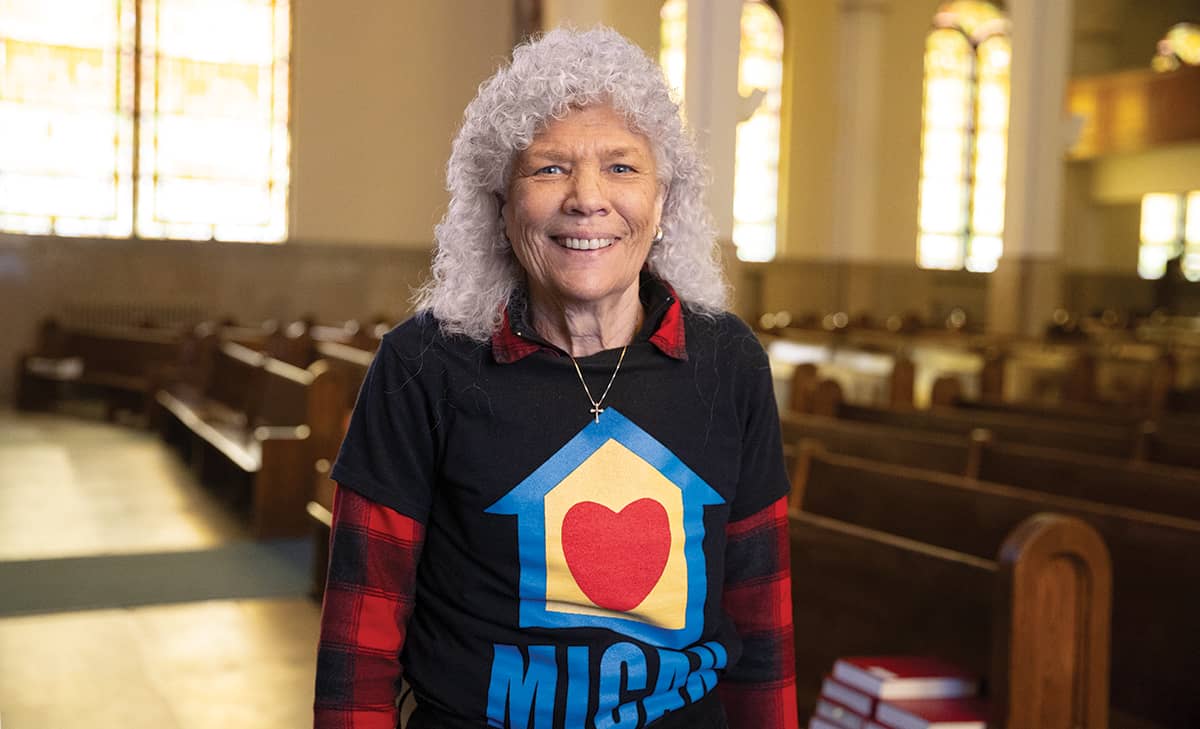
By Sue Watlov Phillips as told to Mingyu Ma, 04/28/2026
I have spent nearly six decades working with people impacted by housing instability and homelessness. Through my work with the National Coalition for the Homeless, the Homes for All Minnesota coalition, and my work as executive director at Metropolitan Interfaith Council on Affordable Housing (MICAH), one thing has become painfully clear to me. The biggest challenge facing Minnesota communities — and communities across the country — is not a lack of resources, but a lack of equity in how those resources are distributed and used. We have built a system that overwhelmingly benefits those who already have access while leaving those with the greatest need struggling to survive.
When I look at housing in America today, I see a system tilted toward homeowners. We provide substantial support through the mortgage interest deduction, property tax deductions, homestead credits, and capital gains benefits. We offer assistance for first-time homebuyers. Altogether, these supports amount to four or five times the funding we dedicate to people with limited incomes who are simply trying to secure stable housing. That imbalance shapes everything. It determines who gets ahead and who falls behind.
Housing is not just a market issue — it is a human right. But if we are going to treat it that way, we have to understand the broader systems that push people into housing insecurity.
Historical Context
I have seen that avalanche unfold in real time. When I began this work nearly 59 years ago, the landscape was very different. In the 1970s and 1980s, a series of decisions were made that had long-term consequences. We demolished large amounts of low-cost housing, particularly single-room occupancy units — SROs — that had provided a safety net for many people. In their place, we built office buildings and entertainment venues, many of which now sit underused or vacant.
Layer onto that the dismantling of anti-poverty programs from the 1960s and 1970s, along with weakened enforcement of civil rights protections, and you begin to see the full picture. Add in decades of disinvestment in affordable housing and public assistance programs that have not kept pace with the cost of living, and the outcome becomes almost inevitable.
Homelessness, as a result, has not only persisted — it has grown. In fact, we are currently experiencing the longest period of rising homelessness in our nation’s history. In the late 1970s, the issue was largely concentrated among single adults. Over time, it has expanded to include families, children, and young people.
I remember those early years vividly. I volunteered at Simpson Shelter (Simpson Housing) and listened to what people were telling us. Their needs were not complicated. They wanted a place to feel safe and stable again.
From there, we developed one of the first transitional housing programs in the country, Elim Transitional Housing. The model was simple but effective: we rented apartments, brought people together to live in shared spaces or provided rent subsidies, and helped them find jobs and access services. As they stabilized, they took over the rental of the unit or moved on to other permanent housing.
We helped expand that model across the country. We worked with local governments to develop programs like Rapid Rehousing, which moves people directly from shelters into permanent housing, with supports if needed.
We didn’t dictate solutions. Instead, we asked individuals about their dreams, their strengths, and the barriers they faced. Together, we created plans — “dream sheets” — that outlined the steps they wanted to take toward stability.
I led that work for 30 years, and I can tell you that it works because it is rooted in respect and partnership with people experiencing homelessness or housing instability. We had an 85 to 95 percent success rate in people remaining housed.
That kind of person-centered approach is something I worry we are losing. As systems become more computerized and data-driven, we risk losing the human connection that is essential to this work. You cannot reduce someone’s experience to a dataset. If you have met one person experiencing homelessness, then you have met one person experiencing homelessness. Their story is unique, and their path forward must be as well.
Another growing challenge is the increasing barriers people face when trying to access housing. Beginning in the late 1980s, landlords started relying more heavily on rental and credit checks, criminal background checks, and drug screenings. Today, with automated systems and artificial intelligence, even minor issues on a person’s record can prevent them from being considered. People are screened out before they have a chance to explain.
From my perspective, shaped by both my faith and my own lived experience — including experiencing homelessness as a teenager — we are all vulnerable. We have all made mistakes. That is why compassion and community matter so much.
Through my work, we talk about six key pillars that shape whether someone can achieve stability.
- People need access to a range of affordable housing options — places suitable for individuals, families, youth, and even intergenerational living.
- They need a livable income. Right now, none of our public assistance programs provide enough for people to afford housing.
- Access to health care must go beyond insurance; people need to be able to receive care when they need it.
- Education and job training opportunities are essential if people are going to move forward.
- Civil rights must be protected and enforced.
- We must confront the deep racial and ethnic disparities that continue to shape housing outcomes.
When these pillars are weak or missing, people are pushed closer to the edge. Most Americans are already standing near it. Around 60 percent of people in this country live paycheck to paycheck. That means it doesn’t take much — a medical bill, a job loss, a rent increase — to tip someone into homelessness.
During Operation Metro Surge, neighbors came together in extraordinary ways: delivering food, helping with rent, offering rides. It reminded me that solutions to homelessness are not just about policy; they are about relationships. Sometimes, something as simple as a smile or a kind word can begin to restore a person’s sense of belonging.
We need to ensure that people with lived experience are at the center of decision-making. At MICAH, the majority of our board and many of our staff come from communities directly impacted by housing instability. That perspective is essential if we are going to build systems that truly work.
I continue this work because I believe in the dignity of every person and in the responsibility we have to care for one another. My faith reminds me that my time here is limited, and that I am called to do as much good as I can.
There is a passage we often share, words spoken from God to Joshua: Be strong and of good courage. Be not frightened, neither be dismayed, for the Lord your God is with you wherever you go.
Those words have guided me throughout my life. Despite the challenges, I still believe that change is possible — if we are willing to act with courage, compassion, and a commitment to justice.