Given exactly one minute on a Zoom call to unmute yourself and say your thoughts on Rethinking I-94, what would you say? For well over half of the dozen or so members of the public who commented during MnDOT’s Rethinking I-94 Policy Advisory Committee (PAC) meeting last Tuesday, the key point was a demand to pause the project. The possible pause was first brought up by MnDOT officials, who noted that the team had received a letter from state lawmakers and “multiple” form letters from the public on pausing the project — apparently about 11,000 letters. State Senator Scott Dibble, a member of the PAC who represents a district bordering the Rethinking I-94 project area, later read out the letter from lawmakers. Senator Dibble said that the letter had been sent to MnDOT, and had been signed by all state senators whose districts touch I-94, as well as many other state senators and representatives.
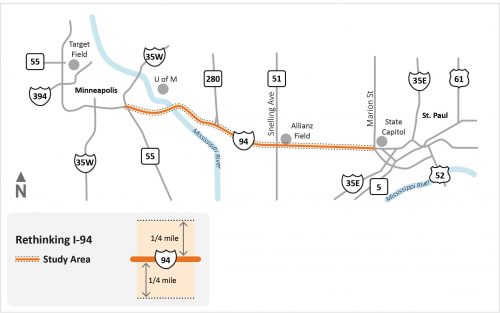
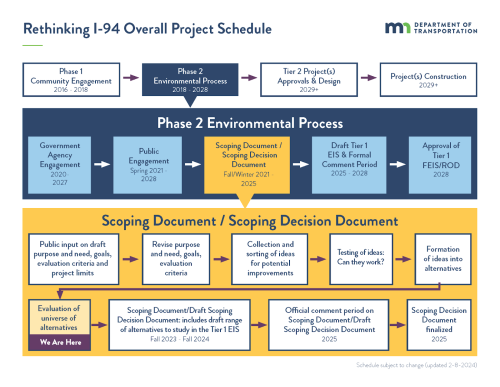
MnDOT started Rethinking I-94 a decade ago, and completed a draft of the first stage of federal environmental review last winter. In this stage, called the Scoping Decision Document (SDD), MnDOT explored alternatives ranging from expanding the freeway to filling in the trench and replacing it with a surface boulevard. Of twelve alternatives to rethink I-94, ten involved a freeway. Based primarily on recycling relatively reliable traffic forecasts into methodologically questionable other metrics, MnDOT narrowed down the alternatives to a question of whether I-94 will have three lanes or four, pending review of public comments.
The main reason given by supporters of the pause is changes in federal policy, which have caused MnDOT to delete references to environmental justice, climate change, and other key concepts from the project. Trump’s Federal Highway Administration (FHWA) has been cancelling projects that fund anything other than car-dominant infrastructure. Many are also worried about the impact Operation Metro surge may have had on public engagement, as it coincided with most of the Draft SDD comment period.
Mark Lindeberg, a MnDOT official, argued that state law would require MnDOT to still address most of the issues that pause supporters are worried about. Towards the end of the meeting, Senator Dibble countered that this is exactly the kind of thing that could get the project defunded. A representative of the FHWA was in attendance, but did not speak.
During the meeting, MnDOT commissioner Nancy Daubenberger implied that the SDD would be finalized soon, although without a specific timeline. MnDOT is currently in the process of responding to each of about 8,000 public comments on the Draft SDD.
The Meeting
The question of whether to pause the project took center stage at the end of a meeting that otherwise had very little new information from MnDOT. According to the registration confirmation sent to attendees, the main purpose of the meeting was to update PAC members on traffic modeling conducted as part of the SDD and traffic data observed during I-94 construction in summer 2025. As a secondary topic, MnDOT would share preliminary themes from public comments on the Draft SDD.
The PAC is composed of lawmakers and representatives from the many local, state, and federal agencies who have input on the project. This June 3 PAC meeting was hosted on Zoom by WSB Engineering, which was a major contributor to the Draft SDD as a consultant.
Traffic Modeling
Lindeberg read updates on traffic modeling from a script, sitting in front of a keyed-in Zoom background of a beach house. Between the end of the Draft SSD public comment period and now, consulting firm Michael Baker International turned in an independent review of traffic modeling done for the project. Their conclusion? MnDOT had done everything exactly right. Lindeberg emphasized that the model design was fit-for-purpose, the methods were thorough and that MnDOT does not set land use policy, and therefore can’t consider the land use impacts of the Rethinking I-94 project.
The bulk of Lindeberg’s time went to explaining at a summary level how traffic forecast modeling works. Compared to a February presentation that covered much of the same material, Lindeberg’s tone indicated that he might be attacking his script with some exasperation this time.
Lindeberg didn’t have a lot of new ground to cover because the underlying traffic model has been known to be industry standard all along. The key limitation of this type of modeling is the same as with all future predictions; if we could know the prediction were accurate, we wouldn’t need the model. In order to account for the prediction possibly being off, we need to assume some safety margin of uncertainty. Uncertainty as a concept is mostly absent from the Draft SDD. From Lindeberg’s presentation, it’s not clear whether Michael Baker addressed uncertainty either.
Later in the meeting, when responding to comments, Lindeberg described the alternatives as having a “clear difference” in modeled safety, which is simply not supported by the modeling as presented in the Draft SDD.
2025 Construction
In broad strokes, the 2025 construction data showed that closing part of I-94 from April to August made traffic worse, but a number of factors make generalizing difficult. The presenter avoided making any claim that the findings would be applicable to the future. During construction, delays increased across the road network, and the analysis found no evidence of people switching modes or traveling less.
Although nobody in the meeting said so explicitly, this appeared to be an attempt to test the reduced demand hypothesis, which claims that reducing capacity on freeways will reduce vehicle travel proportionally. Despite better experiences with temporary highway closures in other cities, a few months is a relatively short timespan to test that hypothesis. One key study on the inverse induced demand phenomenon found that demand caught up to roadway capacity within about five years. MnDOT’s own traffic modeling in the Draft SDD showed that reduced demand could be substantial for Rethinking I-94 alternatives with reduced capacity. As an added confounding factor, there were only a few weeks during which I-94 was the only major east-west road closed in the Twin Cities.
Public Comments
Themes from public comments in this meeting broadly reflected comments gathered at earlier stages of the project. Key themes included concerns about mobility of people and goods, air and noise pollution impacts, justice for people and neighborhoods along the route, questioning the traffic forecasting methods implemented by MnDOT, opposition to dropping certain alternatives from the project, requests to consider rail transit in the trench, demands to consider land use at all and demands to remove the freeway.
Lindeberg and MnDOT official Jack Corkle took shifts reading out the comments, and either dismissing them or explaining that concerns would be addressed in the next phase of the project.
Public Reaction
In addition to Senator Dibble, Minneapolis City Councilmember Robin Wonsley and State Senator Doron Clark shared statements in support of a pause. Representatives of Our Streets, the Sierra Club, and the Saint Anthony Park Community Council also supported the pause. PAC member Tony Carter, from the Metropolitan Council, asked for further information on the risks and benefits of a pause, and MnDOT Commissioner Nancy Daubenberger said that she “welcom[ed] further discussion” on a pause.
After “pause,” another repeated idea that stood out was “once in a lifetime opportunity;” an opportunity most commenters thought MnDOT was fumbling. A Rondo resident passionately expanded on this theme by inviting those of us present on the call to think about whose lifetimes this might refer to. They reminded us that Rethinking I-94 will be the last chance for anyone who was directly affected by I-94’s construction to see some justice.