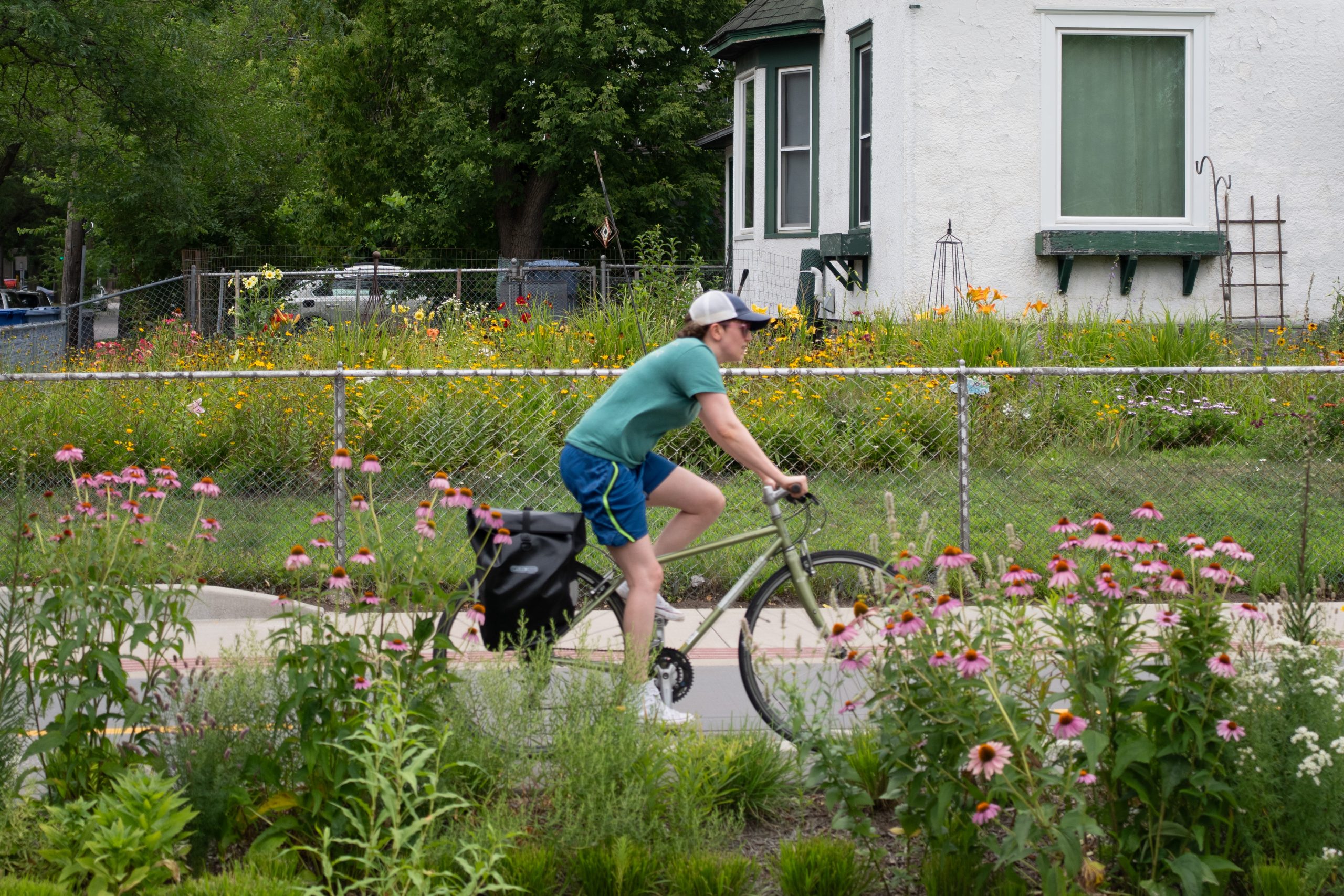
Minnesota’s largest city is recognized as one of the top cities in the U.S. for cycling. In the Copenhagenize Index, Minneapolis is ranked fourth in North America and first in the U.S., with a global ranking of 44. The top cities globally are Utrecht, Netherlands and Copenhagen, Denmark.
I met up with Alex Schieferdecker, Pedestrian and Bicycle Coordinator with the City of Minneapolis Public Works Department at Bryant Ave S and 38th St. This is one intersection on a new curb-level protected bikeway completed in 2023. Schieferdecker emphasized that Minneapolis is different from many cities because Public Works plans pedestrian and bikeway improvements concurrently with needed street and utility improvements.
In the case of Bryant, there was an entire street reconstruction needed to upgrade aging infrastructure. These improvements citywide are already seeing great return on investment. On Bryant, cycle counts have doubled from 350 per day with the previous “bicycle boulevard” to 700 with a curb-level bikeway, according to Public Works.

Schieferdecker said the city has been adjusting its designs in response to how people actually use the infrastructure. “Community feedback and support has led to more construction of curb-level or curb-protected bikeways. These bikeways meet the ‘All Ages and Abilities’ standard that is called for by the Transportation Action Plan, which itself was the product of extensive community engagement.”
For another project, S 2nd St, also in 2023, there was a mill and overlay needed, which allowed the City to upgrade a painted semi-buffer bikeway into a curb-protected bikeway. On S 2nd St, cycle counts increased by a third — 540 per day to 715 — measuring in September in years before and after the construction.
Minneapolis overall is less dependent on personal motor vehicles. While only 8.5% of U.S. households are car-free, 17.9% of Minneapolis households are car-free, according to the American Community Survey published by the U.S. Census Bureau. Statistics on how workers commute can be misleading because they do not include children, retired seniors, and adults that do not commute to a workplace outside their home. The City of Minneapolis has a long-range goal to build out an expansive “All Ages and Abilities” bikeways network that improves access to populations that most need transportation access without a car.

At the end of 2024, the City of Minneapolis had built or upgraded 30.8 miles of “low-stress bikeways” as part of its All Ages and Abilities bikeway network. The City has a goal to reach 80 miles of new or upgraded low-stress bikeways by 2030. Cycling in an American urban environment can be seen as high-risk and stressful, not ideal for youth and seniors. With protected bikeways and safer crossings, more cyclists and micromobility users like those with power mobility scooters can enjoy a safe and accessible network. The City publishes an online web map of existing bikeways by level of service.
In 2024, the City and partners like MnDOT and Hennepin County built 5.2 miles of new curb-protected dedicated bikeways, according to City of Minneapolis Public Works. In the 2025 construction season, that expanded further by 3.5 miles, and in 2026 there will be 2.6 miles of new curb-protected bikeways from a previous zero state and 1.25 miles where a previous bikeway is being upgraded to curb-protected.
Schieferdecker explained the synergy between community feedback, safer streets, and the expanding bikeways network. “Minneapolis Public Works will continue to work to make Minneapolis streets safer and more comfortable for all users, according to the Transportation Action Plan, Vision Zero Action Plan, and other adopted policy guidance with whatever money we have allocated to us,” said Schieferdecker.

By the end of the 2026 construction season, the City will have completed 46% of its 2030 goal for low-stress bikeway.
These projects improved from streets with either no bikeways or different levels of boulevard and painted buffers. An example in 2025 was University Ave SE and 4th St SE on the East Bank. Those state roads had painted buffer bikeways before and now have curb-level and curb-protected segments at different stretches.
I asked Schieferdecker about how bikeway designs have changed over the last decade of improvements. “The details of the city’s designs change in small ways that may not be noticed by the public, but are responsive to community feedback or observation of community use. For example, the City’s guidelines regarding tactile edges that separate curb-level bikeways from sidewalks have recently changed to maximize the amount of pedestrian space,” he said. ‘Tactile edges’ is the civil engineering term for the bumpy sections where one use meets another use, like a light rail track and the passenger platform or a curb-level bikeway and the sidewalk.
On the East Bank of Minneapolis, MnDOT is adding bikeways on University Ave between Central Ave and 1st Ave NE. This portion of University is a two-way avenue. These bikeways will likely be curb-level to align with the City of Minneapolis All Ages & Abilities bikeway plan, similar to the new bikeways on E Hennepin and 1st Ave NE that were implemented as part of Hennepin County improvements.
Intersections with multiple jurisdictions require collaboration between transportation departments. “City staff work closely with Hennepin County and MnDOT staff on projects that involve county and state roads within the city, and these agencies have been enthusiastic partners when it comes to building out our bikeway network,” said Schieferdecker.

Answering Common Questions About Cycling in Minneapolis
Yes, the goal of the All Ages and Abilities bikeway network is to create a higher class of protected bikeway that is safe and inviting for underrepresented cyclists like youth and seniors. Protected bikeways can include curb-protected bikeways where there is a narrow curb barrier between car traffic and a bikeway. Examples of curb-protected bikeways are Hennepin Ave near Minneapolis College, S 2nd St in Downtown East, and 10th Ave S adjacent to Powderhorn Park. There are also curb-level protected bikeways that have space for cyclists and pedestrians at sidewalk level. Examples of these curb-level bikeways include Hennepin Ave between Washington Ave and 12th St S and Hennepin Ave between Douglas Ave and W Lake St.
Can I get from my neighborhood to key destinations like schools, grocery stores, parks, and downtown without riding in traffic?
Connections between everyday destinations are often more important than one commute for cycling to be a viable transportation option. Schieferdecker from Public Works shared how connecting high-quality trails and greenways to upgraded bikeways improves cycle counts on all those corridors. In Minneapolis, narrowing to grocery stores, Lunds & Byerlys Downtown is one of the only full-service grocery stores that is directly on a protected bikeway, while others are on bicycle boulevards or near connections.
The current debate on Hennepin County’s upcoming reconstruction of Lyndale Ave S showcases where there could be a protected bikeway. The current Lyndale is designated as a bicycle boulevard, where cyclists are forced to share the road with cars going often over 30 mph. The neighborhoods surrounding the Aldi and Wedge Co-op full-service grocery stores have a high number of car-free households, with 16.0% of households in ZIP code 55408 having no access to a personal motor vehicle.
What happens at intersections where bikeways meet streets? Are there safe crossings, or do I have to merge with cars?
Intersections where cyclists or drivers cross the paths of each other are the places where the most crashes occur. The City’s All Ages and Abilities bikeway network seeks to improve these connections, but so far there have been no new construction of grade-separated infrastructure like the Midtown Greenway and Martin Sabo Bridge.