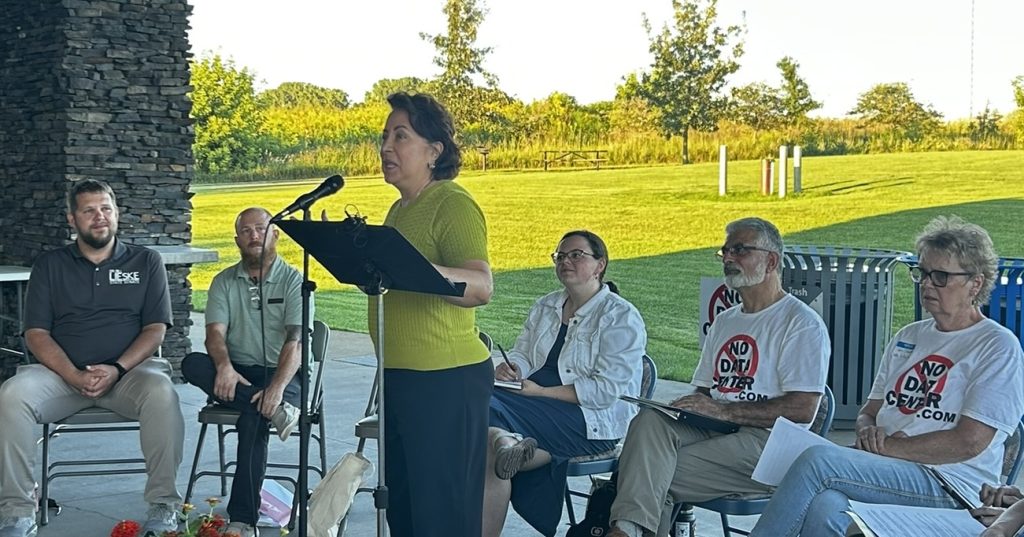
Coalition co-founder Cathy Johnson offers some concluding remarks at the forum about responsible data center development in Farmington, which is the subject of a lawsuit by neighbors against city leadership. (photo by Dylan Morrissette)
DEEP DIVE: The Farmington Push for Responsible Hyper-Scale Data Centers
At a recent public meeting hosted by the Minnesota Women’s Press, about 50 residents, legislators, and advocates invited by the Coalition for Responsible Data Center Development gathered to discuss the rapid growth of hyper-scale data centers. The conversation centered on a proposed facility in Farmington — a project that could use as much as 2.93 million gallons of water per day — and raised broader questions about transparency, economic trade-offs, and the future of responsible development in the state.
The Coalition’s grassroots organizing in living rooms and neighborhoods are focused on communities stepping into a policy gap left by limited regulation and corporate non-disclosure agreements (NDAs). The Farmington project became a focal point because of its scale and secrecy. Many details — ranging from water sourcing to electricity use — remain hidden under NDAs signed between developers and local officials. For residents who will live alongside these massive facilities, this lack of transparency is deeply troubling.
Advertisement
One of the biggest selling points for communities considering data centers is the promise of jobs. But several speakers emphasized that the economic benefits are limited, sharing details about the typical scenario in other cities. Construction phases employ a significant number of workers — which makes it attractive to labor lobbyists — but those jobs disappear after the buildings are completed. Long-term staffing levels remain relatively low. While a few of these roles pay well, many are highly specialized and may not directly employ the local workforce.
Patricia Torres Ray was one of the featured participants who spoke at a forum about hyper scale data centers. Others featured (l-r) Bill Lieske, Drew Roach, Sarah Mooradian, Mo Feshimi, Cathy Johnson (not pictured here Peter Wagenius) (photo by Olivia Worcester)
Former Minnesota senator Patricia Torres Ray, who now consults with Minnesota Interfaith Power and Light, pointed out that lobbyists for data centers are well-paid — based on her experience with lobbyists, perhaps about $350,000 per year. “Who is paying lobbyists for your interests? The Public Utilities Commission is also making these decisions on your behalf, with your representatives. I encourage you to look at what they do and how they approve these projects. I really want you to look into the cost of this and talk to your representatives about the cost. We talk about the use of water a lot, but it is also about building roads and the infrastructure to get to these facilities — every activity related to their business is subsidized by you, as taxpayers. Your water bill will go up. Your electrical bill will go up. You will be paying for the recycling of electronics and every product that they use, and so what you pay for garbage is going to go up, because disposing of these electronics is very, very expensive. This conversation you have with your city council members and your mayor is going to dictate how you implement changes in the land and water use.”
Neighbors Weigh In
Community members like IT professional Mo Feshimi, who lives near the proposed Farmington site, have been sounding alarms about the environmental impact. “We’re talking about millions of gallons of water every single day,” he said, noting that other states, such as Georgia, have already seen shortages linked to data center proliferation.
As someone who spent more than half of his career as a telecommunication and data network architect for large companies, Feshimi says he understands how data centers and cloud service providers are built. When he first heard about it, he assumed it would be one of the legacy data centers he knew about, which he was happy about. But when he went to the first hearing and found out it is a hyper scale data center — about 1,000 times bigger than the legacy data centers — that raised his concerns.
Advertisement
“That’s why I joined the coalition,” Feshimi says, “as I realized the significant impact of these data centers, not only to our water, not only to our environment, but also with a lot of the tax giveaways that the state is giving them to incentivize into coming to our state, at a time when we’re cutting services. I want to do everything I can to use my technical background to educate people on potential significant impacts if these data centers are not done properly.”
A forum participant asked how much of the water use is being discharged into the Mississippi River, and whether it can be used for irrigating crops.
Feshimi responded that, according to the contract signed between the developer and city of Farmington, the water peak daily flow requested will someday be 2.93 million gallons a day. “The entire city of Farmington, on an average day, uses less than that — 2.3 million gallons. The peak discharge daily flow would be 2.34 million gallons a day. So basically, almost all of it is getting discharged. Very little is planned to be conserved. A majority of the water usage happens in the hottest days of summer, when the city asks us to preserve water: Don’t water your grass, don’t take showers every day. But that’s when these data centers, the nine or 10 that are coming to Dakota County, will be pumping all the water, in the hottest of the summer days.”
Environment, AI, and the Bigger Picture
Environmental advocates added that Minnesota currently lacks strong regulations to adequately protect water resources. “We’re giving away our resources without even demanding sustainable practices in return,” said Sarah Mooradian, government relations and policy director for CURE, a rurally based Minnesota nonprofit that works at the intersection of environment, energy, and rural democracy.
Advertisement
Sarah Mooradian (photo Sarah Whiting)
In December 2024, she says, Amazon approached the Public Utilities Commission (PUC) to ask for an exemption to the Certificate of Need process needed to develop its emergency backup generation for a proposed data center in Becker. They would need up to 600 megawatts of emergency backup generation — “which is about the size of the Monticello nuclear plant; that’s how much energy we’re talking about.” CURE said the backup generation, which would be powered by diesel fuel, should not be exempt from the process. Since the PUC agreed, Amazon went to the legislature and asked them to put the exemption into law. CURE lobbied against an end run around the state agency. “CURE is most concerned about the lack of transparency, especially when it comes to energy and water use, combined with who is being kept out of the decision-making process.”
Peter Wagenius, legislative director of the North Star chapter of the Sierra Club, noted that even basic information — like projected electricity demand — remains shielded from the public. At the state capitol this year, he says, some legislators asked for someone from the data center companies to discuss the bill. “They refused to come up and talk about it. At one point, they claimed in a meeting that how much energy they were using, how much water they were using, had national security implications. Don’t ever fall for that — we need to have information that affects our electricity bills, our ability to use water, agriculture’s ability to use water to irrigate their crops. It is a nationwide phenomenon, and Minnesota, generally, is known for having more transparent government, for having open data laws, and they need to be updated to include this.”
Peter Wagenius, Sierra Club (photo by Olivia Worcester)
Wagenius offered background about Minnesota’s data center tax credit, which was originally passed in 2011, giving corporations “an uncapped giveaway that has already cost Minnesota taxpayers over $350 million. When it was originally passed in 2011, it was estimated to cost just $5 million annually, but the program has since then ballooned to over $110 million a year. And as these centers proliferate across the state, the cost to us taxpayers will skyrocket unless the legislature acts. And who are we subsidizing? Not Minnesotans struggling to afford their lives, but the wealthiest corporations in human history: Amazon, Google, Microsoft. They do not need our tax dollars. Whomever is at a table with data centers, are they being good negotiators on your behalf or not? Are they fully representing your interests or not? Since we’re giving them state money, no matter where in the state they want to locate, the state should require them to be good citizens and good neighbors.”
He also pointed out that as the land of 10,000 lakes, Minnesota has protections in place since the 1990s indicating that big skyscrapers in Minneapolis and Saint Paul, for example, are required to have a closed loop water system to cool its buildings. “Instead of having water flow through once for evaporative cooling, they reuse it many, many times before discharging it,” he says. “That not only prevents water depletion, it also makes it easier to deal with water pollution, because it’s a smaller amount of water they’re having to filter at the end of the process before they discharge it. If we’ve been requiring that skyscrapers for over 20 years at this point, why would we not require that of data centers who have an even greater pull on the water system?”
Another theme of the meeting was the growing demand for computing power, particularly as artificial intelligence expands. Coalition co-founder Cathy Johnson pointed out that AI applications range from the useful — such as medical research — to the frivolous, like generating celebrity faces on cats, and part of the process is to build awareness about what these searches cost us. [In a future story in this series, we will talk with a hydrologist about this.]
Not all voices were critical. A senior data center consultant acknowledged the challenges of water usage but emphasized the importance of large facilities like those operated by Amazon, Microsoft, and Google Cloud. These centers, he argued, provide essential cloud connectivity for local businesses, enabling economic growth across industries. Others responded that responsible development requires investment in closed-loop cooling systems and other technologies to reduce environmental strain.
Policy Efforts & Legislative Action
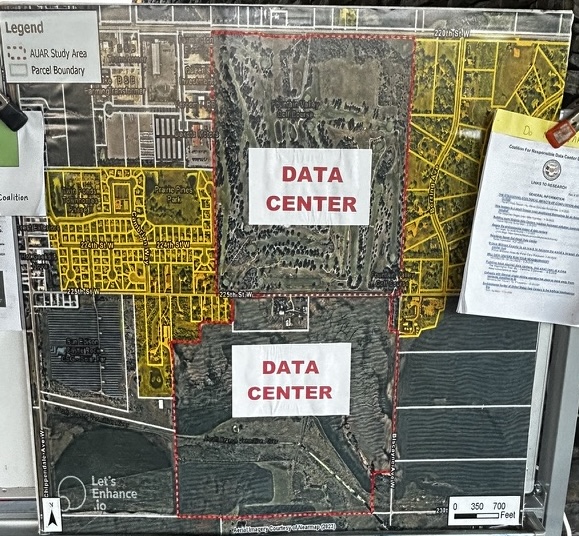
A map of the intended data center in Farmington, which abuts residential homes. (photo by Olivia Worcester)
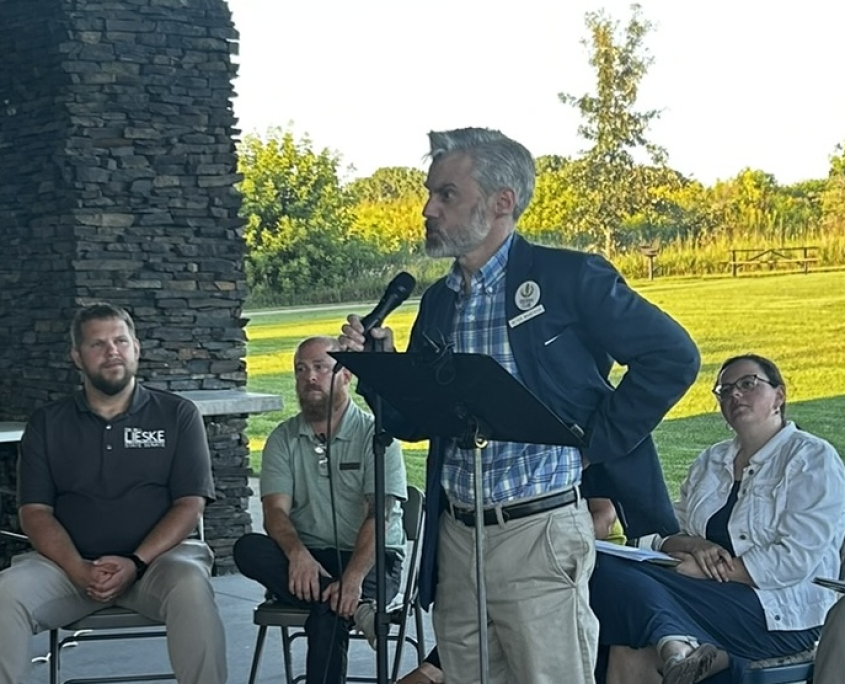
Minnesota senator Bill Lieske and House Representative Drew Roach, who represent Farmington, described hearing from constituents frustrated by the city council’s lack of transparency in handling the project, emphasizing the need for more local control over decisions with regional consequences.
One potential solution discussed was Senate File 608, a bill that would require regional planning and Department of Natural Resources (DNR) approval before such facilities can proceed. Advocates argued that without state-level oversight, individual cities and counties will remain vulnerable to pressure from large corporations promising tax revenue but delivering few long-term benefits.
Lieske said he originally presumed the data center would be similar to a center Meta was building in nearby Rosemount, where the company had listened to community concerns and explained how they would change what the water usage would be. “Are the plans perfect? No, but are they much better than what the original plan was? Yes. Fast forward to this data center, which will cover much more acreage than the Meta center. I started watching city council meetings on livestream to understand it. I saw that the local government wasn’t listening, and that was the number one concern I had. I saw people asking for help, and no one was listening. That’s what led me to Senate File 608; Drew is the co-author in the house. We authored that bill trying to find a way to finesse an okay way of handling data centers. It’s very important to understand that we don’t dislike data centers, because we all know we use them. The problem is where they go and how they affect people.”
Roach started going to planning commission and council meetings last year, saw the lack of transparency from the mayor and city council of Farmington. “I’m for the open market. I would never try to step on the property owners who want to sell their property to whoever they want to. But when it affects other people, it’s a matter of principle. It doesn’t affect my exact neighborhood, I’m not having to look at it in my backyard, but as Cathy said, some people have lived there for 50 years, and they should have a say as well.”
He said he was motivated and frustrated by the lack of transparency and honesty — which included a city employee trying to intimidate him into not showing up, indicating ‘who am I to show up against a proposal that’s going to bring so much benefit to the community? That the people complaining about this don’t even live in Farmington.’ Roach continued, “That was absurd. People I talked to most certainly live in Farmington.
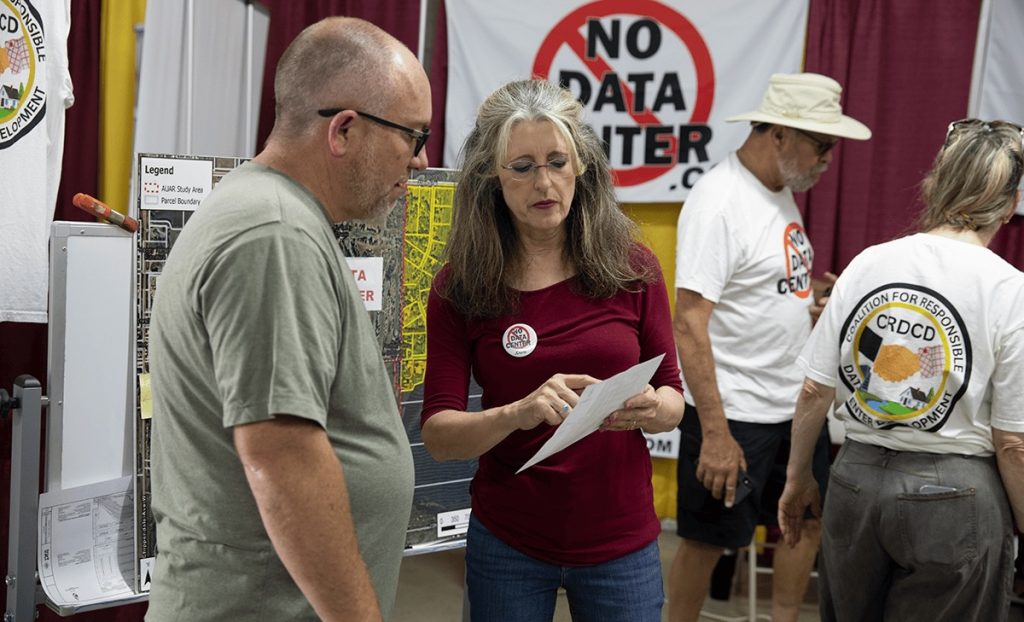
The Coalition for Responsible Data Center Development had a booth at the Dakota County Fair to help more neighbors become aware of what is coming to many Minnesota neighborhoods. (photo by Sarah Whiting)
Call to Action
The coalition opposing the Farmington project is not only raising awareness but also pursuing legal remedies. A lawsuit has been filed against the City of Farmington (the approving authority) for what coalition members call an inadequate environmental review, including the violation of an Orderly Annexation Agreement between Farmington and Castle Rock township. Legal costs are steep — the discovery phase alone is expected to require $150,000 by January — so fundraising has become a key part of the movement, which is largely being led by retired community members.
Cathy Johnson stresses the importance of participation at every level: “This fight isn’t just about Farmington. It’s about setting a precedent for how Minnesota regulates these massive facilities in the future.”
Attendees were urged to contact the governor’s office and legislative committee chairs overseeing environment, energy, and state government.
Speakers encouraged participants to stay skeptical but hopeful. One expressed that progress is being made, forcing corporations to pay more for municipal electricity use, and a demand for accountability and transparency.
Conclusion
The consensus at the forum is that the debate over the Farmington data center is about more than one facility. It is a test case for how Minnesota balances economic development with environmental stewardship and community well-being. With water, energy, and climate pressures mounting, the choices made will shape the state’s landscape for decades to come as more Minnesota communities are impacted — especially those in rural areas, where roughly 12 centers are currently being planned.
Wagenius urged people not to buy into competition — fear of losing short-term gains to another city. “The most effective thing you can do is to ask for standards that will apply to every community. This coalition has the most impressive grassroots operation of any; there is opposition bubbling up all around the state against data centers, in Hermantown and Bemidji. But you have the most impressive operation. And here’s why: Your strategy is in your name, Coalition for Responsible Data Centers. It’s not the Farmington NIMBY club.”
He pointed out that at the capitol, protecting one community against water pollution and depletion, and damage to the electric grid, but being okay putting them in another community “does not play. None of the state representatives and state senators are interested in hearing the argument that says these are terrible in our community if they’re unregulated, so you should put them in a different community. Cathy’s message is persuasive. ‘We support data centers. We know they’re part of the future, but it has to be done right, and it has to be done right everywhere.’”