Editor’s note: This article is adapted from a version published Dec. 3, 2025, by the Minnesota Women’s Press.
When the Minnesota legislature convened in June 2025 for a special session, one of the bills introduced was House File 16 (HF16), about regulations for hyperscale data centers. HF16 modified tax exemptions, adjusted environmental and energy regulatory requirements, and authorized a clean energy and capacity tariff.
Both Republican and Democratic legislators have expressed concerns about the tax incentives Minnesota gives to hyperscale developers, funded by corporations such as Meta and Amazon, as well as the nondisclosure agreements (NDAs) city leaders sign with developers.
At an August discussion in Farmington that Minnesota Women’s Press hosted with the Coalition for Responsible Data Center Development, Republican Senator Bill Lieske described the work he and other legislators did to address issues of data centers that are more than 800,000 square feet. The proposal in Farmington is 2.5 million square feet.
Lieske said that what especially concerned him was watching the city council interact with residents. “The number one concern I had was seeing all the people asking for help, and no one was listening.” That led him to co-draft a legislative bill — which did not pass — because “this is a people issue.”
As the 2026 legislative session prepares to open on February 17, Minnesota Women’s Press spoke with two legislators about what they would like to see in upcoming bills to protect residents. [We also reached out to a labor-friendly Democratic representative from Mankato and the Minnesota Department of Labor for comments; both declined to participate.]
Rep. Patty Acomb: Championing Smart Regulations
Representative Patty Acomb (DFL), the legislator for Minnetonka and other parts of Hennepin County, co-chairs the House Energy Committee. She shared concerns that Minnesota sales tax dollars — given away as incentives to data centers — are going towards powerful tech companies.
Acomb’s legislative work has focused on reliability and affordability for utility rate-payers, in order to ensure current residents will not pay the generation and transmission costs data centers bring.
“When utilities need to build out more transmission, or more generation, to bring power around the state, that cost can be rate-based,” she says. “So, that means all of the rate payers will pay that cost. [Last year] we wanted to make sure there would be assurances that residential rate payers are not going to be paying the generation and transmission costs for data centers.”
Acomb’s other priority is environmental protections, including ensuring that data centers are coordinating with the Department of Natural Resources instead of solely working with a local municipality’s water permit.
She believes there is a way to create regulations specific to data centers so they can move forward after a thorough environmental review that is industry-specific.
Like some of her colleagues, the lack of transparency troubles Acomb. She feels companies should be allowed a modicum of privacy when conducting business transactions, but in the case of extensive data center development, more transparency seems necessary — especially after land has been purchased.
Acomb says, “I have a harder time thinking that [developers] can’t tell the state and residents what kind of business is going [in].” She wants to see a process and timeline for “proper public engagement and meetings” so residents can understand what kind of company is going into their neighborhood.
She notes ongoing concerns that the existing system can seem redundant, including an environmental review and a mandatory Environmental Impact Statement (EIS) required for the mostly diesel-fueled backup generation that data centers need. She sees a win-win in sitting down together to create “a data center–specific environmental review that would take into account some of what they’re pointing out is redundant, and maybe customize it for data centers,” says Acomb.
Acomb shares hope with several colleagues that bipartisan work can be done about data centers. She says there is shared dismay among legislators and residents about the reliance on Alternative Urban Area Reviews, which is “not a very thorough environmental review.”
She adds: “Data centers are a bit of an unknown. While we have 11 or so potential hyperscalers coming to Minnesota, not all of them will likely get built, so it’s hard to know [what to be] concerned about.”
In sum, she says, “we all need to do better about fully understanding the implications and how we can put up some guardrails to protect ourselves and our communities.” She encourages residents to be involved in discussions.

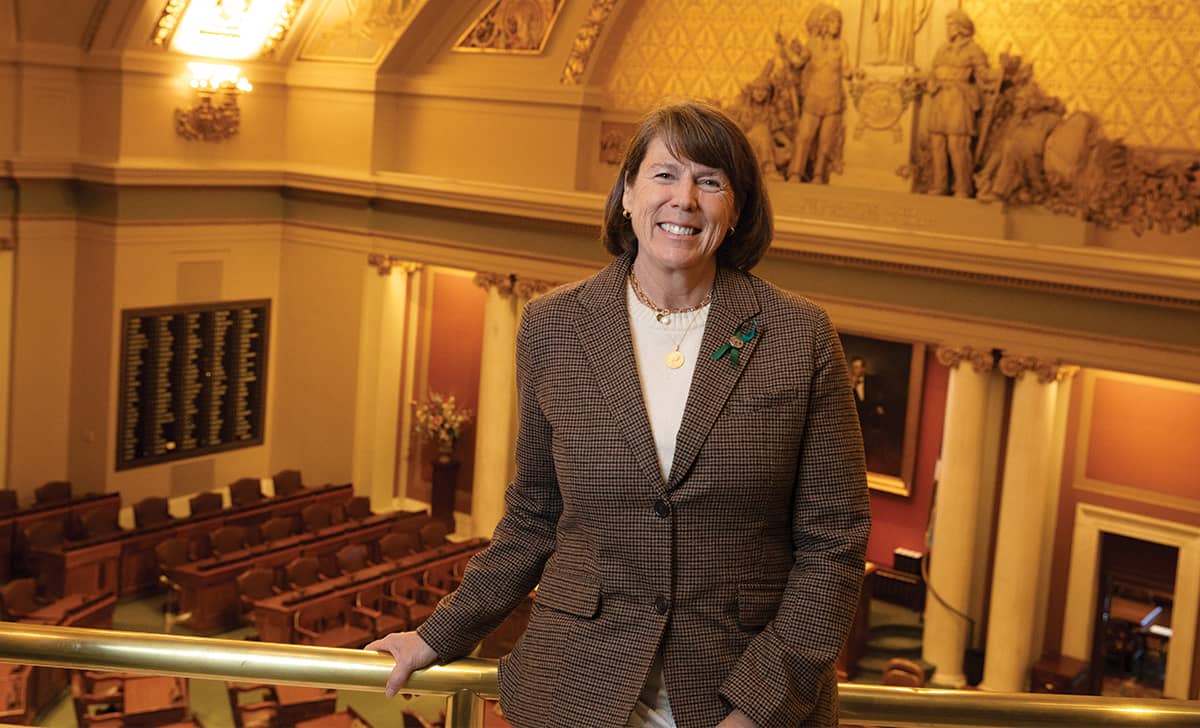
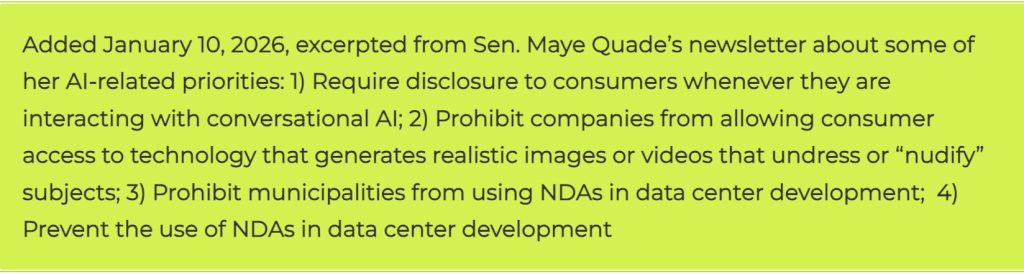
For Senator Erin Maye Quade (DFL) of Rosemount, HF16 did not cover her primary concern with hyper-scale data centers. “The first issue is the tax exemption these multibillion dollar international corporations are receiving from the state of Minnesota,” she told us.
Quade says the estimated amount of taxes a data center pays falls to about $230 million per biennium. With billionaires’ corporations behind this development, she says, she “can’t think of people who deserve [tax breaks] less and whose companies need it less. They need us more than we need them, and yet we’re giving them tax breaks.”
She is also concerned about the unchecked ability of A.I. to design and create bioweapons; “it scrapes our writing or emails to train A.I. models without our consent.” She notes that Cato Institute has published multiple white papers about concerns that “large language models can do a lot of processing in a really small amount of time.”
Quade is deeply worried that data centers are susceptible to threats from other countries. The Cato Institute has even recommended data centers be treated like military bases. “So, we’re building hyperscale data centers in [suburban] communities like mine? There’s a reason why they keep nuclear warheads in the middle of nowhere, because it’s dangerous to live near them if there are bombings, fires, or are targeted by foreign militaries.”
Quade clarifies that she is not opposed to companies like Land O’ Lakes utilizing smaller-scale data centers to conduct day-to-day operations, and she understands why NDAs are signed to protect preliminary information from being available to competing businesses. But she believes that in Hermantown, Farmington, and several other cities, residents are left in the dark much longer than they should be.
Despite these concerns, Quade is hopeful that more bipartisan legislation can be passed.
“There are very few policy spaces left that are bipartisan, but this is one that is,” Quade indicates. She is optimistic that the coalition of legislators who are “anti–tech billionaire tax breaks” continues to grow, but she’s not sure stronger legislation will be passed in 2026. “We have some work to do, but I can also say that it is a very strong grassroots movement that I’ve seen pop up. I’m deeply appreciative of community members who have come together.”
Quade urges people to persistently question the legality of developers’ actions. “I think there are real legal questions to be answered about when cities can enter into an NDA with a private corporation.”
Cathy Johnson, who is part of a resident lawsuit in Farmington, Johnson, said at a November Minnesota Women’s Press forum that the development in Rosemount — unlike in her city nearby — involved negotiations that were “far more efficient and representative of what the people want. Developer-led projects are going to be like this unless the state protects us.” She raised concerns that many local leaders are not trained to negotiate industrial projects.
She also noted that when city leaders believe they are competing to get money from developer deals, they are not incentivized to talk about long-term needs. “That’s why we need the state to step in for [statewide] regulations.”
Potential Data Center Sites to Date
Apple Valley
Becker
Cannon Falls
Chaska
Eagan
Faribault
Hampton
Harmony
Hermantown
Lakeville
Monticello
North Mankato
Nobles County
Pine Island
Rosemount