
Minneapolis has earned a reputation as a national leader on housing and land use reform. Rightly so: the city’s 2040 Comprehensive Plan, a multi-pronged effort to allow more housing, supported more housing development throughout the city, and improved housing affordability.
While Minneapolis has done many things right when it comes to land use, one important piece of low-hanging fruit remains: reducing minimum lot sizes. Today, Minneapolis requires most houses to sit on lots that are at least 5,000 square feet, but this unnecessary requirement makes homes more expensive. Lowering this requirement, so that houses can be built on smaller lots, is one simple, proven reform for increasing housing affordability — and in particular, creating lower-cost homeownership opportunities. As Minneapolis prepares to again rewrite its land use code for its 2050 Comprehensive Plan, minimum lot size reform should be a top priority in order to support affordable homeownership.
The many benefits of minimum lot size reform
I’d imagine that most policymakers would be extremely intrigued if you told them that there was a costless way to make homeownership more affordable. In fact, this perfectly describes minimum lot size reform.
Conceptually, reducing minimum lot sizes is a simple change. Unlike other reforms such as allowing triplexes throughout a city, or building denser apartment buildings near transit — worthy efforts too, to be sure — minimum lot size reform doesn’t necessitate any change in the type of housing being built in a neighborhood. Instead, it allows people to build single family homes, but using less land.
In Minneapolis, current laws dictate that a new single-family house must be built on a lot that’s at least 5,000 square feet. When someone buys a home, they are implicitly paying for the value of the actual house, plus the value of those 5,000 square feet of land. This means that when we institute minimum requirements for the lot size, we’re also instituting a minimum price for buying a house, because we’re mandating that people pay for more land.
In line with other cities, Minneapolis first introduced minimum lot sizes in their 1924 zoning code. The motivations for implementing this restriction were varied: larger-lot homes were thought to be cleaner and more sanitary, while small-lot homes were seen as low-quality and undesirable. Though I am not aware of any evidence that this policy was racially motivated in Minneapolis, other research shows that minimum lot sizes were more likely to be implemented in suburbs that saw more Black residents in moving during the Great Migration — by raising the cost of housing, minimum lot sizes could serve as an effective tool of exclusion.
Raising the cost of a house will prevent some people from being able to afford a home. Furthermore, even among people who can afford to buy a home on a 5,000 square foot lot, some of them would rather save some money by choosing a house on a smaller lot, instead of being required to pay for all 5,000 square feet. In other words, minimum lot sizes make a variety of people worse off by reducing housing affordability.
The solution is simply to allow homes to sit on smaller lots. This reform is an easy-to-implement, nondisruptive way to create more homeownership opportunities at scale. It’s also been previously implemented in other American cities, where evidence suggests that Minneapolis has much to gain from reforming minimum lot sizes.
Another strength of lot size reform is that it is primarily focused on building detached, single-family homes, which are very familiar to developers. Detached homes can utilize standard financing structures and building code rules. Therefore, it might be easier to see quick impacts from lot size reform than zoning reforms that allow small multifamily housing such as triplexes, as houses on small lots can avoid some of these technical barriers.

How should Minneapolis reduce minimum lot sizes? Based on other cities that have implemented these reforms, a reasonable choice would be to cut minimum lot sizes in half: whereas homes currently must sit on 5,000 square foot lots, we should instead allow them to be on lots as small as 2,500 square feet.
For minimum lot size reform to work best in Minneapolis, the city would also need to ease up on floor-area ratio rules for buildings on smaller lots, allowing more flexibility in the size footage of small-lot housing. This doesn’t necessarily mean that the resulting houses would be larger than currently existing houses in Minneapolis — they would just be larger relative to the smaller lots on which they’d sit.
Learning from other cities
Houston is the most famous success story of minimum lot size reform. The fast-growing Texan city was an early adopter of this approach, passing rules to streamline small-lot housing development in 1998, with further efforts to support this type of housing in successive years.
For the past two decades, Houston has seen thousands of new houses built each year on sub-5,000 square foot lots, with some homes on lots as small as 2,000 square feet. One study of the houses built on small, recently-divided lots in Houston found that these homes were about $200,000 cheaper than new homes on larger lots (in 2020, the average newly built small-lot home was worth about $340,000). This is a straightforward win for lowering the cost of housing.
More recently, Portland, Oregon and Nashville, Tennessee have passed similar reforms, with similarly impressive successes. In these cities, it’s become possible to build multiple detached homes on a single lot, and sell them to separate homebuyers. Thus, each home ends up with less than 5,000 square feet of land. The legal architecture for reform in these cities has been slightly different — essentially, developers are empowered to separately sell multiple houses on a single, standard-sized lot without doing a formal lot split. But the result is similar, as homeowners gain the option to buy houses on smaller plots of land. In both cases, these reforms have enabled homes that are more affordable by tens of thousands of dollars, just as we’d expect.
As of 2023, even Saint Paul has outdone Minneapolis. When the city rewrote its zoning code to allow more housing in residential neighborhoods, it also slashed minimum lot sizes. Like Minneapolis, Saint Paul had previously required homes to be on 5,000 square foot lots. Now, they can be built on lots as small as 1,000 or 1,500 square feet, depending on the district.
It may take some time (and some local economic recovery) before Saint Paul sees large-scale impacts from this change. But anecdotally, there’s already one example of the housing market responding to this reform: last fall, a developer received approval to turn three vacant lots into five smaller lots, which would have been impossible prior to minimum lot size reform.
In other words, there’s plenty of reason to think that reducing lot sizes in Minneapolis would be beneficial for housing affordability, much as it has been for other cities.
Learning from data on Minneapolis
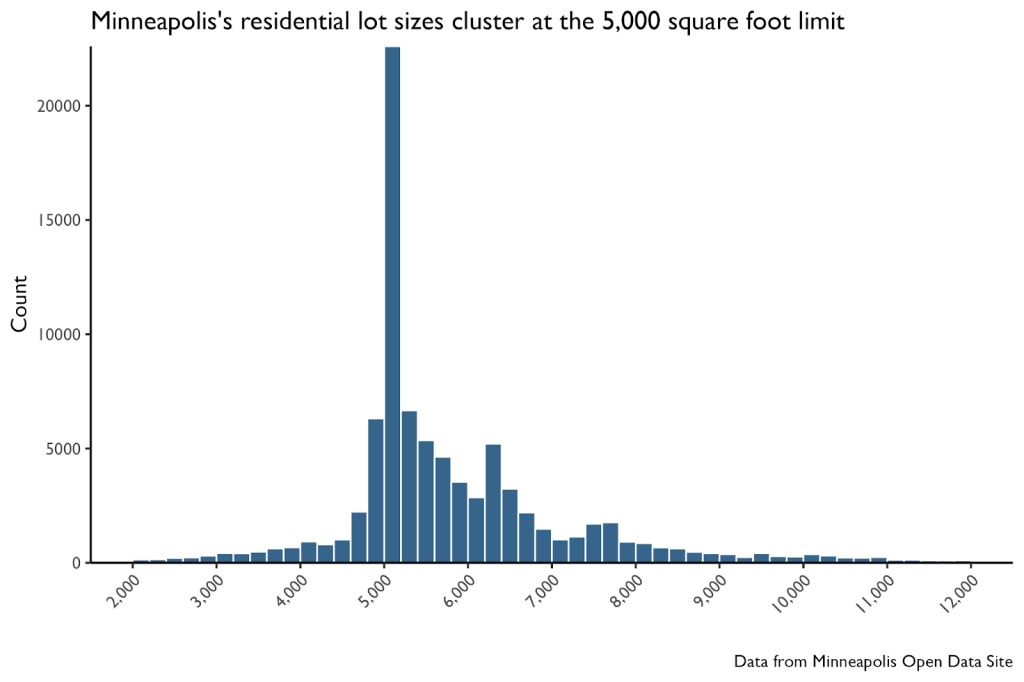
When we look at data on Minneapolis’s existing housing stock, it becomes even more clear that the city stands to benefit from this reform. As is visible in the chart below — which I created using the city’s data — a large number of single-family homes in Minneapolis have lot sizes just slightly higher than the 5,000 square foot minimum. This suggests that minimum lot size requirements are “binding” in Minneapolis, limiting housing supply and driving up costs.
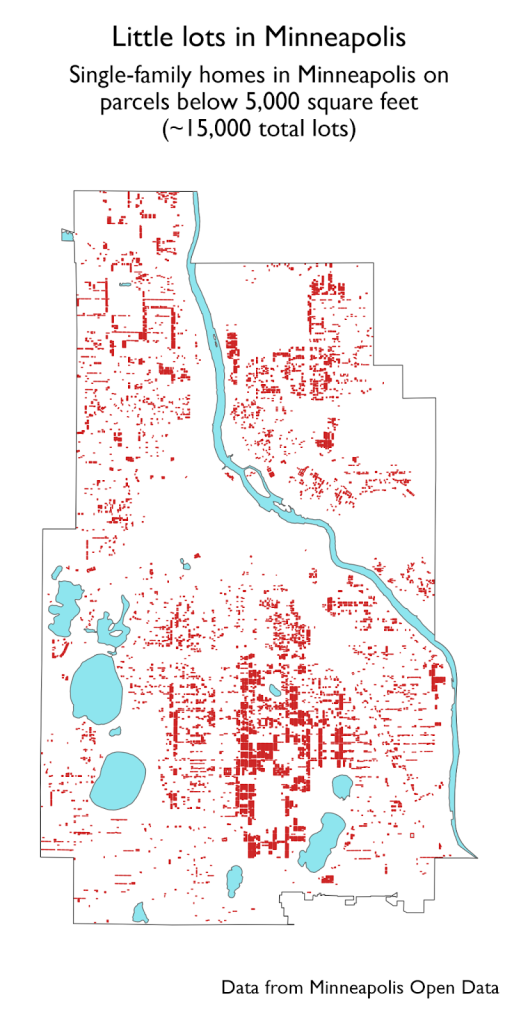
There are also about 15,000 residential lots in Minneapolis with lot sizes below 5,000 square feet, breaking the minimum lot size rules. If we examine the years that the houses on these lots were built, it becomes clear that Minneapolis’s sub-5,000 square foot lots mostly exist only because they were built prior to the adoption of Minneapolis’s first zoning code in 1924, which introduced the city’s first minimum lot size policies.
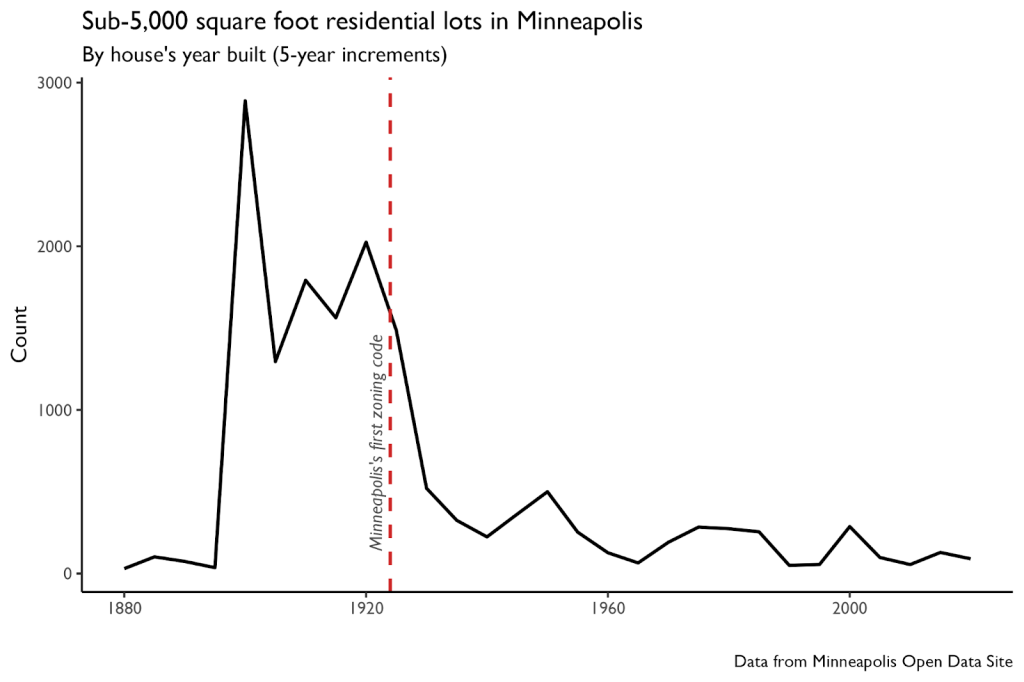
This evidence further suggests that there is suppressed demand for these smaller-lot homes in Minneapolis. We’d be seeing more of them built — if it became legal to do so.
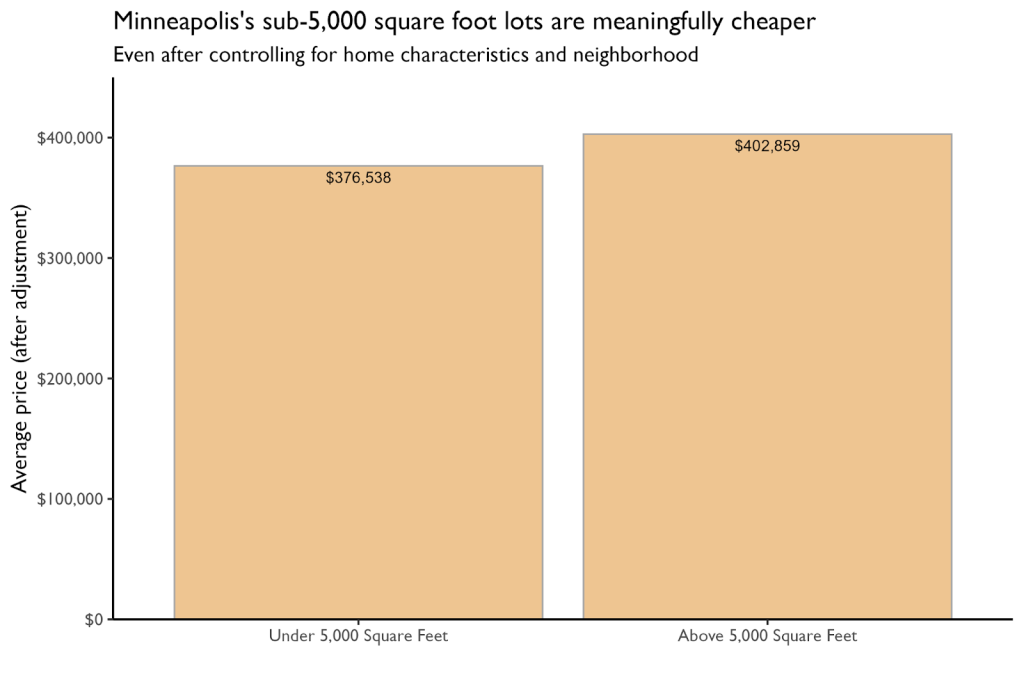
Finally, my analysis of Minneapolis’s existing small-lot homes confirms that these types of homes can improve affordability in Minneapolis. Compared to other homes in Minneapolis, these small-lot homes have lower assessed values — that is, they are generally cheaper. Even after controlling for characteristics including the number of bedrooms and bathrooms, square footage, and neighborhood, Minneapolis homes on sub-5,000 square foot lots have assessed values about $27,000 lower (see the Appendix for more detail on how I created this estimate).
Conclusion
I’ve discussed some of these themes and case studies in previous writing about the Twin Cities. But the potential gains from minimum lot size reform in Minneapolis are so large, and the necessary reforms so simple, that this deserves more explicit attention.
While local policymakers discussed implementing such a change while writing the Minneapolis 2040 Plan, they ultimately shied away from doing so. According to longtime Minneapolis Planning Commissioner Chris Meyer, the 2040 Plan included some small changes to curtail the most extreme minimum lot size requirements, but the 5,000 square foot minimum remained untouched. To be fair, at that point the city had enough on its plate; the 2040 Plan already included a great deal of substantial changes to zoning and land use policy.
Now, however, there’s no excuse for failing to act. Minneapolis needs to reduce minimum lot sizes so that homes can be built on smaller lots, expanding homeownership opportunities for its residents.
Appendix
The price comparison analysis is based on a regression analysis using a sample of about 80,000 residential lots in Minneapolis, with parcel data collected from Minneapolis’s Open Data Portal. The sample includes only residential lots with the following categories, according to city data:
To measure the price of properties, I used the “totalvalue” column, which measures a property’s assessed value including both the land value and building value. Though this is an imperfect measure of property value — the actual sales price would be more precise — assessed values are highly correlated with sales prices, and have served as a useful measure elsewhere in the literature on minimum lot sizes (Jake Wegmann, Emily Hamilton).
To create the chart comparing typical housing values for homes depending on their lot size, I used a hedonic-style regression. The regression includes controls for the number of bedrooms, year the building was built, number of bathrooms, above-ground and basement square footage, number of garage stalls, and a categorical control for neighborhood – defining neighborhoods using Minneapolis’s 13 Communities.
I then calculated the average residuals from this regression, which does not include any variable capturing lot size. The residuals from this regression tell us how much a house’s value deviates from its expected value, given its neighborhood and other house characteristics. By averaging these residuals separately for the groups of properties with lot sizes above and below 5,000 square feet, we can see how smaller-lot and larger-lot homes each deviate from their expected price. Then, we take this average residual and add it to the mean housing value for the entire sample. This gives us an adjusted price estimate for houses with different lot sizes that controls for other housing characteristics.