
If you’ve looked for rental housing in the Twin Cities in the last few years, you’ve likely run into the disorienting world of luxury “affordable” housing:
“It’s time to pay less! Amazing affordable 2 bed, 1 bath! Stop by!”
“…affordable living meets unparalleled historical charm…”
“Enjoy modern living… find luxurious features and amenities at an affordable price!”
Pools, gyms, lounges, rooftop bars, the whole works – at an affordable price! It is genuinely exciting to come across some of these listings during a housing search in Minneapolis, where competition is stiff and much of the affordable housing stock has seen better days. However it doesn’t take long to realize that you probably don’t qualify for any of these units. This is the result of income maximums… and minimums.
An income maximum is the highest annual household income allowed to qualify for a subsidized or affordable unit, typically set as a percentage of the Area Median Income (AMI). An income minimum, often called an income floor, requires a tenant to earn at least two to three times the monthly rent. Legally, the U.S. Department of Housing and Urban Development (HUD) defines affordable housing as housing for which a household pays no more than 30 percent of its gross annual income on rent and utilities. While the idea of affordable units sounds like a no-brainer, in practice affordable units are extremely difficult to qualify for.
For example, If you’re looking for a single bedroom in an income restricted development that costs $1,367 a month, you need to make at least $43,980 a year. However, you also need to make less than $55,620 per year. So you have to earn between 2.5 and 3.18 times the cost of rent per month. Considering that the annual cost of living for a single adult in Hennepin county (as determined by the Minnesota Department of Employment and Economic Development) is $42,285, the word “affordable” seems like a stretch.
If we examine the Hennepin County income data from the Census Bureau, we can see that 16.2% of the population earns less than $35,000 a year, which is less than 50% of AMI. Yet when we look at all publicly subsidized new developments in Hennepin county from 2021-2024, only 3.14% of units are set aside for the extremely low-income households (≤30% AMI) who need them most. Another 7.01% serve households at 31-50% AMI, and 7% at 51-60% AMI.
The most important finding, however, is that 64.08% of units in these new developments are reserved for market-rate rents with no income restrictions whatsoever. An additional 6.31% serve households earning up to 115% of AMI, households that could likely afford market rates in many parts of the county. What this reveals is that “affordable housing” developments, as they are actually built, are predominantly market-rate housing. The affordable component is a small slice, less than one-third of total units, and even within that slice, the deepest affordability levels (≤30% AMI) receive the smallest allocation. The income requirements for the limited affordable units that do exist are so narrow that a small raise at work or a modest jump in rent could push a household out of eligibility. This raises the question: if the affordable set-asides are this small and the targeting this narrow, are these developments meaningfully addressing the housing crisis for low-income residents, or are they primarily market-rate projects funded by our taxes? The data would suggest the latter. So how did we get here and how do these “affordable” developments keep cropping up?
Low Income Housing Tax Credits (LIHTC)
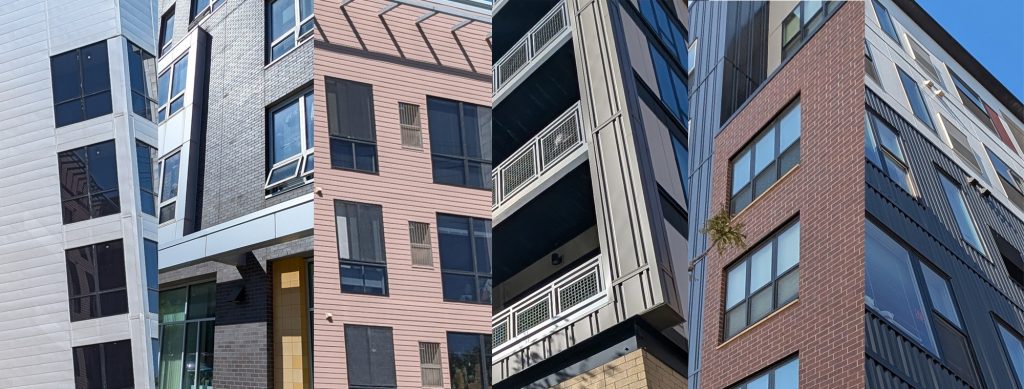
Typical features of a LIHTC-subsidized development. Author’s photo.
Created in 1986, the Low-Income Housing Tax Credit (LIHTC) program was an effort to shift affordable housing expenses away from the government and towards private entities. Rather than investing our tax dollars into dignified public housing developments, the federal government wanted to entice private developers to do the job by giving them tax breaks to construct affordable rental units (what could go wrong?). Today, LIHTCs are involved in around 90% of affordable housing projects.
In order to qualify for LIHTC in Minnesota as a housing developer, there are a number of things that you must agree to, including but not limited to:
- Minimum Set-Aside Election. Developers must set aside a certain percentage (20-40%) of units to be “affordable.” What is affordable is determined by the Multifamily Tax Subsidy Project (MTSP) income limits, a set of limits that is calculated and published by the Federal Dept of Housing and Urban Development.
- Maximum Rent. Owners of these developments cannot accept tenants into said units that make too much money.
- Compliance Period. The income requirements must be applied for a minimum of 15 years. After this the developers or owners can charge whatever they want.
As housing development (and everything else in our society) is often focused on the bottom line, developers seeking HTCs typically formulate a development that maximizes profitability. For example, they have no incentive to offer more than 20-40% affordable units, and they are unlikely to offer units any cheaper than dictated by requirements. This is how private business works: no corporation is building affordable units out of the goodness of their hearts, but because they believe that the combination of tax credits, rental income and the limited compliance period can ultimately make these developments a profitable investment. And apparently, the math checks out for many of these companies, as the state of Minnesota has provided $15,722,256 in tax credits to developers from 2022-2023 alone.
The LIHTC Formula
Typically, when developers receive these tax credits, they don’t actually have the ability to cash in on these credits and they don’t have the cash on hand to build the new development right away. Fortunately for them, there is a well-defined formula in place to enable them to proceed with development and enrich a handful of middlemen in the process. The first issue here is that developers don’t have huge tax liabilities, so they often can’t really utilize the tax credits. In other words, the tax credits often are greater than the amount that developers would owe in taxes. So what do they do with these tax credits? They sell them!
Enter the syndicator. Syndicators are usually banks that pool LIHTCs across a large geographic area and then sell ownership of these credits to corporate investors (usually other banks). The investor banks provide capital (up to 80% of all LIHTC equity nationally) to the syndicators, who then provide the capital to the developers. But the syndicators don’t just buy the credits at face value. For most years, developers cannot receive a full dollar of investment for each dollar of tax credit bought by syndicators. Since 2017, for example, syndicators have been able to buy these tax credits for about 91 or 92 cents per dollar of tax credit. In the last quarter of 2023, it fell below $0.90. So not only does the developer suck millions of dollars away from the public to build their properties, but they only get 9/10ths of that money to actually build the “affordable” units. The banks get the remaining 1/10th, because they have people’s money on hand.
However, the money that developers receive from their LIHTC credits is not enough to build the building. There are two more sources of money that are used to “fill the gap.” The first is public taxpayer money called “gap financing,” and the second is your typical, private construction loan from another bank. In Minneapolis, gap financing is provided by the Affordable Housing Trust Fund (AHTF). This is an annual pool of money that went from $8.8 million in 2017, when Frey took office, to $17 million in 2024. Mayor Frey made the AHTF a central piece of his agenda, and the City Council has repeatedly voted to increase it over the years as a measure to combat homelessness. This is mostly taxpayer money that is used in conjunction with LIHTCs. Note that this does not mean that the city owns any part of the constructed property.
To be fair, in 2025, AHTF funds (totaling $14 million) were used to help build 600 “affordable” units, along with 130 shelter beds. So $14 million went to building units that most people don’t qualify to live in (as well as 130 beds in homeless shelters). The AHTF’s “gap financing” comes in the form of long term loans with very, very low interest rates – typically something like a 30 year loan with .1% interest (although the City does not publish actual interest rates publicly). So does the taxpayer get this money back? Technically, yes, but the taxpayer is probably actually losing money through the AHTF loans because the interest rates do not keep up with inflation.
When the affordability period expires (commonly after 15 years, per the requirements above), all of the sudden the property is worth way more because it’s a decently new building and the owner can charge whatever they want. So the owners of the building refinance the mortgage and get a big chunk of money that they can use to pay off any remaining loans, including that AHTF loan from the city and private construction loans. After 15-30 years, though, inflation takes its toll, and because the interest is so low, the value of the AHTF loan at this point in time is much less than it was at the time that the gap financing was issued. So the taxpayers lose out on that one, but the banks and the developer have a huge payout.
In summary, this is the formula of LIHTC profiteering:
- Politicians declare homelessness a crisis.
- Tax credits are given to developers so that they can build a small number of “affordable” units (with 3% of units eligible for those making less than ~$39k).
- Developers sell tax credits to banks for less than they are worth.
- Banks pocket 10% of the tax credit money just because they had the money to front developers.
- Banks pay less taxes and give developers some cash to get the build done.
- Banks also provide standard loans with normal interest rates for construction.
- The City provides a deferred (very long term) loan with very low interest to “fill the gaps.”
- Homelessness is not addressed, because homeless people are explicitly excluded from affordable units due to income requirements.
- Affordability expires, the owners of the properties get a huge payout upon refinancing the building.
- Loans that don’t keep up with inflation are paid back to the City at a value less than when they were issued.
- Construction loans with normal interest are paid back to the bank and the bank profits.
- Banks and developers give money to politicians.
- Repeat.
The Expiration of Affordability is the Engine of LIHTC Development
Within market-based solutions for housing development, housing only happens if it’s profitable. The LIHTC system of “affordable” housing development is nothing more than an illusion. The only reason that developers take on these projects is because they will make money when the affordability expires. If there is no expiration for that affordability, the incentive for developers to build “affordable” units goes away entirely. The refinancing that occurs at the end of the affordability period is the windfall that makes it all possible. The ability of banks to profit off of this in the short term adds some extra incentive to keep the system going. This is why the idea of rent control is virulently opposed by local politicians, banks, and developers. If there is no windfall upon refinancing when the affordability expires, the whole system falls apart.
The Effects of LIHTC Development
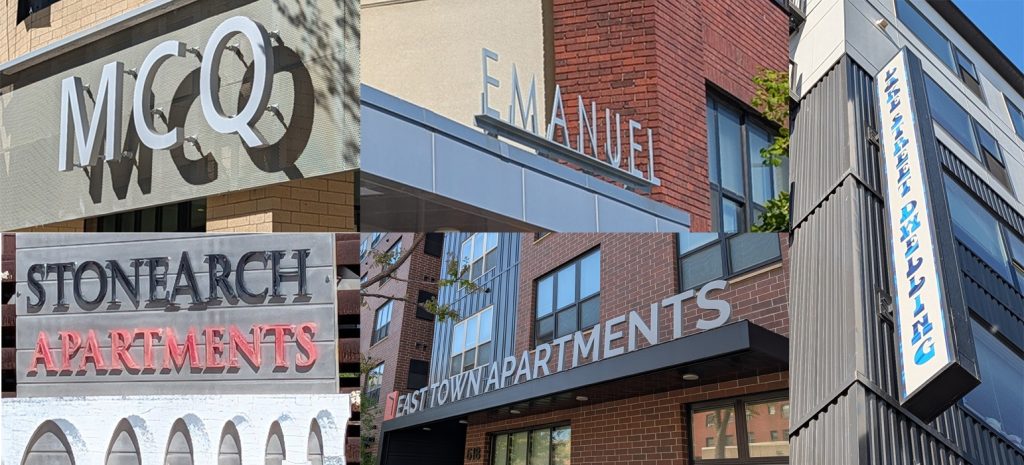
Catchy names signal the presence of “affordable” developments and give the neighborhood a “fresh look.” Author’s photo.
The real-world effects of LIHTC development are slow waves of displacement and gentrification. Short term “affordability” is eclipsed by long term unaffordability. In practice, these developments function as waypoints on the road to neighborhood transformation, not as anchors for existing communities.
LIHTC projects are celebrated as neighborhood investments. Local media runs stories about “new affordable housing coming to a working-class neighborhood.” Politicians cut ribbons on the new developments. Existing residents feel a flicker of hope that their neighborhood is finally being prioritized. But LIHTC development sends an immediate signal to real estate speculators that this neighborhood is safe for capital. The development itself becomes an anchor that reduces perceived risk for market-rate developers. The LIHTC property, while marketed as “affordable,” rarely serves the poorest residents. And their exclusion is not merely an oversight. It is functional. The super majority of units in LIHTC developments intentionally select for residents with higher incomes and more stable rental histories. These residents are, from a landlord’s perspective, “desirable.” Their presence signals to the market that further investment is warranted.
By the end of the affordability period, the neighborhood has transformed. The LIHTC property has been joined by market-rate developments. The original residents are gone. Where did they go? Further out. To suburbs with longer commutes and worse transit access. To housing stock that is older and less healthy. To communities that lack the political power to resist the next wave of “affordable” development.
“Solving” the Housing Crisis in Minneapolis
A brief search of the news related to housing costs in the Twin Cities is sure to bring a smile to your face. Articles praising the slow increase of rental costs in the Twin Cities compared to other cities will point out that renting here is great. And affordable!
On the other hand, a brief walk outside in many neighborhoods in Minneapolis will make your heart weep at the sight: encampments in freezing weather, desperation and despair and the faces of those who are excluded from dignified housing. How can the policy makers and citizens of the Twin Cities claim victory in the housing crisis when so many are forced to sleep outside?
LIHTC has been pitched to us as the solution to the housing crisis. Every election year, homelessness is the one of the main topics addressed by mayoral and city council hopefuls, yet no one has proposed any alternatives to the LIHTC system of “affordable” development. While it may have some short term benefits, all it takes is a walk around to see that many people are homeless. What if we just built dignified public housing and adopted a “housing-first” policy? No one has to make money on this. The taxpayers of this city are already donating their money to the coffers of banks and developers. Why not just take that money and donate it to dignified housing owned and managed by a public institution? This is what they have done in Finland, where they have reduced homelessness by 81% in 40ish years by providing public housing to the homeless without any conditions. We as Minnesotans are already very inspired by the Nordic countries of Northern Europe. Why not follow in their footsteps to address homelessness?