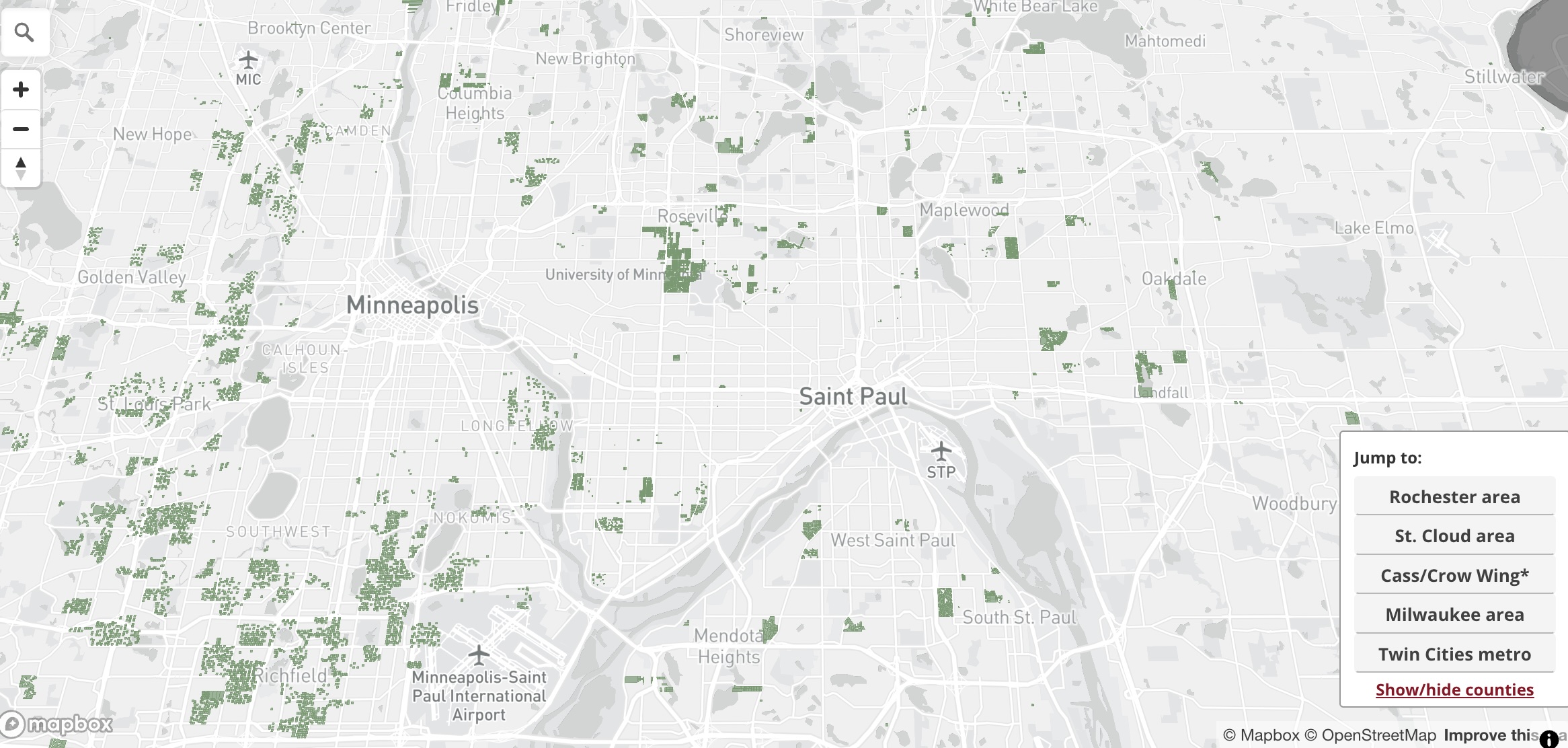
Often discussions around urban planning and housing focus on what’s to come and where we go from wherever we are now. But in the Twin Cities there’s also a long history to understand and to repair. One of the projects doing some of that work is Mapping Prejudice—a project out of the libraries at the University of Minnesota aimed at identifying and mapping racial covenants in housing deeds.
Racial covenants are legal, binding clauses placed in property records that banned people of specific races from buying, leasing, or living in a house or on a property. In Minnesota, including homes across Minneapolis and St. Paul, there are homes that long-ago banned BIPOC folks, Jewish people, and more from living in them. These covenants survived in perpetuity—so even if a house was sold, the racial covenant would continue, and if one tried to challenge the covenant, they could lose a claim to their own property. Racial covenants were first used in California property deeds as early as 1892 and they spread across the country from there.
While those covenants are no longer legal, Mapping Prejudice is working to understand and illuminate the systemic racism built into our housing and as they say, “to support the work of reparations.”
The Mapping Prejudice research project began in 2016 focused on Hennepin County, conducted and organized by a team of University of Minnesota-affiliated librarians, historians, geographers, digital humanists, activists, and more. The project began, in part, because Minnesota has some of the worst racial disparities in the nation—particularly in housing. Mapping Prejudice cites that 78% of white families in Minnesota own their own homes, while only 25% of Black families are homeowners.
The project is volunteer-focused. Deeds are uploaded to Zooniverse, participants go through a training, and then folks read through deeds answering specific questions using the exact language. That data is then sent back to the team who map the covenants.
In Hennepin County, 38341 housing deeds with racial covenants were found. Racial covenants were supported by many different groups at the time, including the National Association of Real Estate Boards, a group that formed in 1908. According to the MNHS, NAREB stated that “[racial covenants] kept the peace and protected investment.” In Minnesota most racial covenants targeted Black community members and Jewish community members—though a 1919 law passed by the Minnesota State Legislature banned “real estate restrictions based on religious faith or creed.”
The first racial covenant in Minneapolis was for a home sold in 1910. According to the Minnesota Historical Society (MNHS) the first racial covenant appeared “‘when Henry and Leonora Scott sold a property to Nels Anderson. The deed for that transaction stipulated that “premises shall not at any time be conveyed, mortgaged or leased to any person or persons of Chinese, Japanese, Moorish, Turkish, Negro, Mongolian or African blood or descent.’” According to the MNHS, before 1908 Minnesota was not especially segregated, though violence against Black homeowners began to erupt in the early 1900s in places like Prospect Park—as white mobs sought to force Black families out of their newly-purchased homes.
Scott, who had used that first racial covenant language, owned a real estate development company at the time and ensured that the same language was inserted into the deeds of thousands of new properties across Hennepin County and Ramsey County—the MNHS says that by 1930 most new housing developments had racial restrictions built into them.
Folks can learn more about the lived experience of racial covenants. In 2018, PBS produced a documentary Jim Crow of the North that also discusses the work of Mapping Prejudice.
In 2020 the Mapping Prejudice project expanded to include Ramsey County through a partnership with St. Catherine University’s “Welcoming the Dear Neighbor?” project—a project that formally began in 2017.
“Welcoming the Dear Neighbor” is a community engagement project, built on the “Dear Neighbor” motto of the Sisters of St. Joseph of Carondelet—St. Paul Province. The project asks three questions:
- “Did we welcome the dear neighbor in Ramsey County regardless of race in the past?”
- “How have we demonstrated care for our dear neighbor in Ramsey County regardless of race in the present?”
- “If we didn’t welcome the dear neighbor historically, what do we do about this in the present?”
Mapping Prejudice has since expanded to include more counties and communities—Dakota County, Stearns County, and Anoka County, all in Minnesota; Milwaukee County in Wisconsin; Contra Costa County in California; Washington, DC. Similar projects are also taking place in communities like St. Louis, MO; Washtenaw County (Ann Arbor), Michigan; Chicago, IL; Seattle, WA; and many more.
The Minnesota State Legislature banned racial covenants in Minnesota in 1953. In 1962, the state then banned any sort of housing discrimination on the basis of race, religion, and national origin. And in 1968 Congress passed the Fair Housing Act. These laws nullified past racial covenants.
To participate in the projects, folks can attend a community mapping session (training included) or map on their own at their own pace (after completing an online training).