Drive south along Highway 52 past Rosemount and you will notice a rapid shift in Minnesota’s peripheral landscape. Where fields once rolled unbroken into small-town borders, windowless, sprawling industrial complexes spanning hundreds of thousands of square feet are rising.
Tech giants and developers—backed by state tax exemptions passed over a decade ago—are betting big on Minnesota. To economic development agencies, hyperscale data centers sound like pure upside: pristine high-tech investments, bolstered commercial tax bases, and construction jobs. But for Minnesotans focused on climate mandates, grid reliability, municipal land use, and freshwater stewardship, these massive facilities pose fundamental challenges that our existing policy frameworks are only beginning to reckon with.
The Megawatt Squeeze
At the heart of the issue is an unprecedented thirst for electric power. For years, regional electricity demand across the Upper Midwest grew at an incremental, predictable trickle. Hyperscale data centers, spurred primarily by high-intensity AI training clusters and cloud infrastructure, have obliterated that baseline.
A single hyperscale facility can require 300 to 700 megawatts of power—equivalent to the electrical demand of hundreds of thousands of homes, or roughly the total output of the Monticello nuclear generating plant. When multiple developers target the same utility footprints, the regional demand spikes by gigawatts.
To Minnesota’s credit, state lawmakers and the Public Utilities Commission haven’t been totally asleep at the switch. Learning from the chaotic buildouts in Virginia, Minnesota passed statutes requiring dedicated ‘very large customer’ tariffs. In plain English: if a tech giant needs a massive substation and dedicated high-voltage lines, they—not captive residential households—are supposed to pay the bill. The surge in electrical demand directly collides with Minnesota’s landmark 2023 clean energy standard, which legally binds utilities to transition to 100% carbon-free electricity by 2040.
Yet isolating infrastructure line items on a utility balance sheet doesn’t solve the physics of the grid. Even if a data center pays for its own transformers, new generation must be available when and where the additional electricity is needed. When a single facility siphons hundreds of megawatts of new clean generation, it consumes capacity that could otherwise displace fossil fuels in our existing vehicle fleet and home furnaces. The grid doesn’t just need to balance ledger books; it has to decarbonize on a fixed clock.
Worse, public accountability is hampered by corporate nondisclosure. While the PUC oversees these agreements, the critical specifics—peak loads, real energy projections, and exact infrastructure costs—are routinely locked away behind ‘trade secret’ redactions, leaving ratepayer advocates to inspect multi-million-dollar deals with one hand tied behind their backs.
Millions of Gallons a Day
Electricity is only half of the equation; cooling those thousands of densely packed server racks demands immense resources. Depending on the cooling architecture, an individual hyperscale facility can consume up to 5 million gallons of water every single day.
In a state that prides itself on freshwater abundance, it is easy to assume our aquifers are limitless. They are not. In communities like Farmington and Rosemount, groundwater appropriations for industrial cooling compete directly with municipal drinking supplies and agricultural drawdowns. Pumping millions of gallons of potable water daily to evaporate into the atmosphere above server heat sinks is an unsustainable allocation of public groundwater. While newer facilities tout “closed-loop” or air-cooled designs, those alternatives often trade water efficiency for even higher electricity consumption, making both water consumption and electricity demand essential considerations in evaluating cooling systems.
The Land-Use Dead Zone
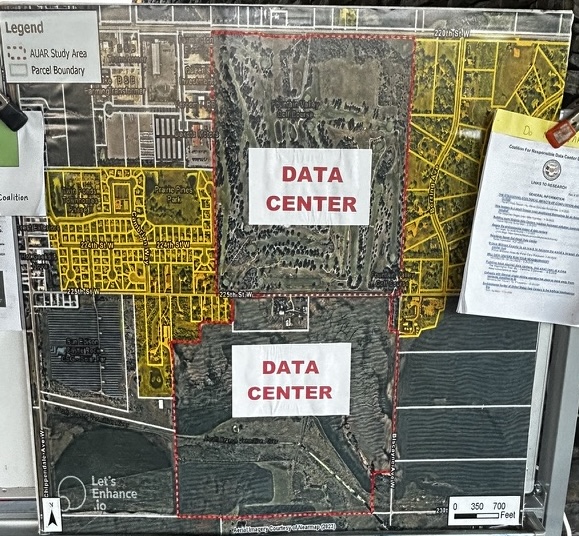
For urbanists and community planners, data centers present a distinct spatial paradox. They consume vast swaths of land—often 100 to 400 acres per campus—yet generate almost no human activity once built. The Meta Data Center in Rosemount sits on 280 acres.
Unlike traditional industrial manufacturing, mixed-use commercial hubs, or logistics warehouses, a data center is largely an unpeopled box. Meta says its 715,000-square-foot Rosemount campus will support approximately 100 permanent jobs.
From a municipal planning standpoint, they create expansive dead zones:
- Infrastructure without integration: They require heavy public infrastructure extensions (roads, water mains, high-voltage lines) without fostering transit connectivity or walkable neighborhood fabric.
- Suburban sprawl: By gobbling up exurban greenfields and peri-urban farmland, they push regional development footprints outward, working directly against compact, multimodal regional planning.
Redefining the Rules of Engagement
Data infrastructure is essential to modern life; nobody argues that servers shouldn’t exist. But the current playbook treats these facilities as passive corporate tenants rather than regional infrastructure disruptions.
Minnesota needs stricter guardrails:
- Mandatory Additionality: Data centers must not merely purchase renewable energy credits (RECs) to “greenwash” their consumption. State rules should mandate that hyperscale operators bring genuinely new, dedicated carbon-free generation and storage onto the regional grid.
- Limiting Cooling Water Consumption: Municipalities and the Department of Natural Resources (DNR) should prohibit open-loop evaporative cooling systems that deplete local aquifers.
- Brownfield First: Incentives should steer development toward sites with existing heavy-power connections—such as decommissioned power plants—rather than converting agricultural greenfields and exurban peripheries.
If Minnesota is serious about meeting its 2040 clean energy mandates and protecting its groundwater, we cannot afford to hand out blank checks to Silicon Valley server farms. This means Minnesota must ensure these digital fortresses pay for their full environmental freight.