
Editor’s note: Metro Transit is offering the public a chance to weigh in on its plan to replace Northstar Commuter Rail service with buses. Two of the four public meetings scheduled have passed; the others are May 7 (downtown Minneapolis) and May 8 (Fridley).
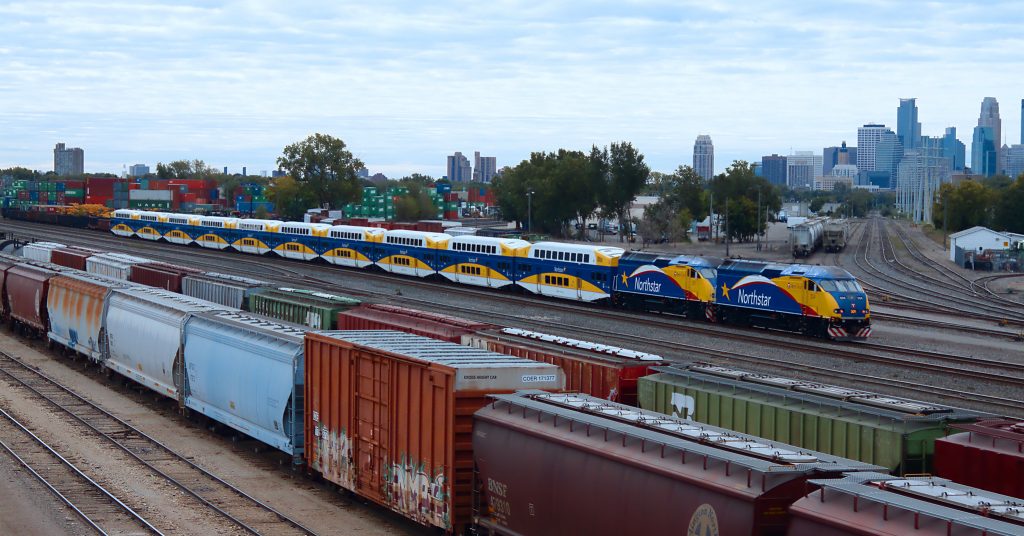
Metro Transit’s Northstar Commuter Rail is not meeting its estimated ridership numbers. The train is gorgeous, and the ride provides beautiful scenery of the Mississippi River. It’s reliable and cheap. So why aren’t people riding it?
Before COVID-19 turned public transit on its head, 800,000 people rode the train every year on a line that runs from Big Lake to Target Field in downtown Minneapolis. Since then, the Northstar’s yearly passenger count has dropped to 127,000. This is a low number, so I understand why legislators are proposing that the service be shut down and replaced with buses.
What critics fail to understand is that the commuter rail did not lose passengers after COVID; instead, we lost in-person work, which still hasn’t returned to pre-pandemic numbers. This means that the Northstar Commuter Rail, whose very name speaks to its original purpose, needs to transition to a new client base, one that it already has experience in serving.
Previously Proven Prosperity
My favorite fact about the Northstar Rail line is this: The only time service has been expanded is to accommodate sporting events, including Twins, Timberwolves and Lynx games. By running on weekends, Northstar Rail is able to accommodate a different clientele — one that travels for leisure rather than for work.
That this change in schedule has become a feature of the Northstar proves its success. By implementing weekend trips into weekly service plans, the state will be able to accumulate more riders whose need for train service is not being served with weekday trips alone. After all, downtown Minneapolis offers many opportunities — beyond Twins home games — for people to get too impaired to drive..
We need to rethink the service away from the currently constrained conundrum in which there is no way to return to central Minnesota, should you choose to ride down to Minneapolis on a Friday. I myself have been forced to drive because I needed to get back to the Twin Cities for work while visiting my family in St. Cloud.
Plus, the Northstar acts as a vital stopgap for I-94 construction, slated to last between the University of Minnesota’s Huron Boulevard exit west to Hiawatha Avenue/Highway 55 through November. By having train service that connects to the light rail service in the Twin Cities, commuters will be able to get to work in spite of construction upending their route, or bad weather making it unsafe to drive.
Move Away from ‘Commuter Rail’
Gov. Tim Walz said in late March that he will require state workers to be in the office at least half of the time as of June, according to the Pioneer Press. However, given that the demand for in-person work overall has fallen, the commuter mindset in which the Northstar was built no longer applies. This does not mean that train service should cease, however, as the infrastructure that we have installed is rip roaring and ready to be used by the general public. Its routes just need to reflect its new purpose.
First and foremost, pivot away from only serving a 9-to-5 commute. While I have seen a great many white-collar professionals board and depart the train, these people are no longer the majority of those who could use the service. Now, family day trips to the Twin Cities’ theater scene and funneling shoppers and concertgoers to downtown Minneapolis will make up the bulk of ridership.
Above all, I am arguing that we move past the dated language of “commuter rail” and toward “regional rail” type service. Not only do I find it disheartening to name a service only usable for traveling to work, but I also want to turn the idea of what the Northstar could be away from its commercial origins to a lifeline that connects Minneapolis to Central Minnesota and beyond.
Get the Northstar to St. Cloud
It’s an inevitable talking point because it’s true. The original purpose of the Northstar was to connect my home, St. Cloud, to Minneapolis. While that goal kind of got completed with the Northstar Link — a bus service that carries riders from St. Cloud direct to the Northstar Commuter Rail Line station in Big Lake — the Link unfortunately slows down service as passengers have to unload from the Northstar train onto the bus.

We Central Minnesotans are acutely aware of the economic advantages that having a train line can bring to an area. In the same way that Anoka, Coon Rapids and Fridley have all seen massive investment from the rail service, so too would St. Cloud. All the more so if we transition service away from the stark ridership route times that serve a passenger base that no longer exists.
With a $250 million price tag to get the line to St. Cloud, I understand that extending the line to its original destination is not a high priority, especially under a Trump administration. We can’t let the perfect be the enemy of the good, when the very purpose of the Northstar line was never fulfilled, even as people now deem it a failure.
The Current Situation
The man leading the charge to kill the Northstar is Rep. Jon Koznick (R-57A). His bill has passed the Transportation Finance committee and now awaits selection by the Speaker of the House to be voted on the floor. If this bill were to succeed, the Northstar Rail service would become the I-94 shuttle bus. While there is no real momentum to move the bill in the senate, there remains the possibility that the Northstar’s fate will become a footnote in this year’s transit omnibus bill.
At this time, there seem to be few vocal advocates for the Northstar’s continued existence as a rail service. Many news outlets are covering the issue as though the decision were set in stone, but this is not the case, so long as we keep fighting. It may fall to public testimony to attest to why the Northstar Rail must continue.
In Conclusion
If the Legislature is too miserly to invest in the other half of the original project, we have to utilize low-cost solutions like reworking schedules to meet the times in which we find ourselves. When the media dub the Northstar the worst train line in America, we need to remember it’s our train. We dreamed the steel titan, built it and have run it for 18 years. If it is to improve, it falls to us to make it better.
When there is talk of wasting government money, I desperately need to ask our legislators why they would throw away the $320 million we have spent on the project. When we invest in the Northstar Line, we are investing not only in downtown Minneapolis but in the state of Minnesota overall. The Northstar needs conductors, engineers and mechanics to keep it operational. It is not a metaphor that the light from the Northstar shines on all it touches. It literally puts jobs in the communities with the custodians who have to take care of the stations and the technicians who program the schedules.
If this is a waste of our taxpayer dollars, then we must be losing money every time we build a road or construct a bridge, because they do nothing for their respective communities after they have been built.