
Last fall, Minneapolis found itself in a pickle over one of its affordable housing programs. The 4d Affordable Housing Incentive, which lowers property taxes on apartment buildings if owners designate a portion of units as affordable housing, had become exceptionally popular. However, because of Minneapolis’ relatively low housing prices, 4d was no longer very effective in its goal: increasing the availability of lower-cost housing in Minneapolis.
The 4d program offers landlords a lower property tax rate if they rent 20% of their housing at specified, “affordable” prices. Until November, the standard was that a household at 60% of the Twin Cities’ area median income (AMI) — for a family of four, that’s about $75,000 — could afford the unit. By the formal rules: $2,161 monthly rent for a four-bedroom unit; $1,398 for a one-bedroom unit.
A Minneapolis renter might be surprised to hear that these prices qualify as affordable housing. In fact, according to local housing research group HousingLink, average market rents in Minneapolis are actually slightly lower than 60% AMI prices. Housing that qualifies as officially “affordable” might not be any cheaper than market-rate housing.
As a result, Minneapolis was offering landlords a tax incentive to rent buildings at market-level prices. On top of this, a 2023 state legislative change made the 4d incentives even more attractive to building owners, by further reducing taxes on 4d units. That’s an easy offer to accept, and accept it they did: In 2024, the number of housing units that were enrolled in Minneapolis’ 4d program (2,338 units) was more than five times as high as the previous annual average.

Across thousands of housing units, Minneapolis was subsidizing landlords in exchange for very little benefit to the city’s housing problems.
The case of 4d also encapsulates one of Minneapolis’ broader housing challenges today. Although housing costs are fairly low — in some respects, paradoxically too low — affordability issues are far from solved. Most glaringly, Minneapolis continues to struggle with homelessness: Despite a downward trend in recent years, Hennepin County still has hundreds of homeless residents. Housing remains especially scarce for those at the lowest income levels (around 30% of the area median income, or a four-person household making $37,000 annually).
But the current level of rents also reduces the effectiveness of some housing policies. It’s not just the 4d program that’s affected. When rents are so low, Minneapolis benefits relatively less from other affordable housing policies, such as inclusionary zoning and tax-credit development, as well as regulatory reforms, such as legalizing accessory dwelling units.
Minneapolis must now tackle this paradox. How can you address housing affordability, when housing is … already pretty affordable? If many of the common tools to address housing affordability aren’t all that effective for Minneapolis, what options does the city have?
From this position, Minneapolis needs to take two parallel strategies:
- Find acceptable ways to lower construction costs.
- Prioritize public resources to attain deeper affordability.
‘Kind of’ Affordable
Minneapolis has been widely recognized for its rent prices growing at a slower rate than inflation. This can likely be chalked up to a combination of successful policies to expand supply (e.g., the Minneapolis 2040 Plan), and flat or declining housing demand since COVID-19. Regardless of the relative roles that supply and demand factors have to play in this shift, the result is that rents simply aren’t that high.
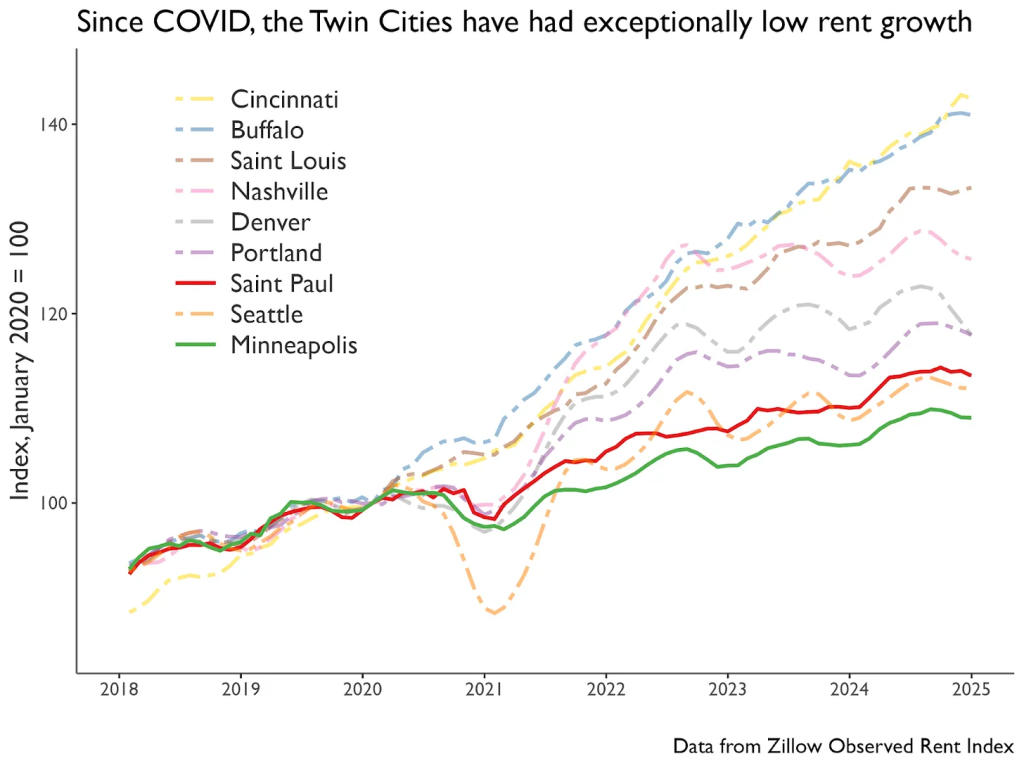
A resulting challenge is that these low rents reduce the effectiveness of targeted, “Capital ‘A’ Affordable” housing programs. This is the category of programs that require housing to be fixed at certain affordability levels, usually in exchange for a subsidy. These programs frequently define affordable rents as being within reach for a 60% AMI household — which, again, is higher than the average market-rate rent in Minneapolis.
As described above, Minneapolis’s 4d program is one example of an affordable housing policy made less effective by such low rents. A tax subsidy was being granted in exchange for landlords giving essentially no discount relative to the rent they would’ve charged anyway.
More broadly, about a third of all affordable housing units in Minneapolis rent at 60% AMI prices. A similar proportion of units built with the low-income housing tax credit — the primary source of affordable housing subsidies across the country — are also built at 60% AMI. And nearly all of the affordable units built under Minneapolis’ inclusionary zoning policy (a rule requiring some affordable housing in new apartment buildings) are at 60% AMI, too.
This doesn’t mean that all housing rented at 60% AMI is worthless (see my Streets.mn article on Minneapolis’ inclusionary zoning and this post by housing expert Daniel Kay Hertz, for further discussion of such caveats). But it does mean that a lot of policy attention and monetary resources are focused on housing that does fairly little to address Minneapolis’ housing issues.
As a different example of how moderate housing costs reduce the effectiveness of certain housing policies, consider the construction of accessory dwelling units (ADUs) in Minneapolis. When I covered this issue in 2023, I noted that Minneapolis and St. Paul have both seen very little construction of ADUs, despite removing some key regulatory barriers to their development. I argued that the biggest driver of lackluster ADU development, however, was the Twin Cities’ fairly low housing prices. Compared to West Coast cities that have built thousands of ADUs, the cost of building an ADU isn’t really worth the returns in Minneapolis, because it won’t earn much revenue. So while ADUs have been highly effective in expanding housing supply for West Coast cities that desperately need more housing, they can do little for housing issues in Minneapolis.

More broadly, when housing costs are low, new market-rate housing is simply less likely to “pencil out.” As I wrote earlier this year, this isn’t strictly a bad thing, but it is an important factor playing a role in Minneapolis’ recent slowdown in housing development.
Under current conditions, many of the familiar tools in our housing toolkit have limited effectiveness. Our affordable housing programs are becoming partially mis-allocated by setting rents at comparable costs to market-rate development, and it’s financially difficult to expand the supply of market-rate housing.
So what can we do? A successful effort to address Minneapolis’ current housing issues should work on two parallel tracks. The first track would focus on how we allocate resources for our subsidized housing programs, while the second would seek to make it cheaper to build housing regardless of whether subsidies are involved with the housing.
Target Deeper Affordability
Because Minneapolis’ market-rate housing is widely available at 60% AMI, many existing affordable housing programs have a weakened impact. The solution to this is conceptually simple, though challenging to implement: We need to focus resources on targeting “deeper” levels of housing affordability. More housing needs to be built at 30% to 50% AMI affordability levels, while we de-emphasize programs that build 60% AMI housing.
Minneapolis’ recent decision to reform its 4d program is an explicit admission that the city doesn’t need to direct its resources toward 60% AMI housing. After reforming the program in November 2024, 4d generally only provides tax breaks if landlords set rents at 50% AMI levels.
The most important barrier to building more deeply affordable housing is that it requires considerably more subsidies. As recent budget fights make clear, neither the state of Minnesota nor our cities have a bunch of spare cash sitting around to pump into affordable housing. There is no easy way around this primary constraint.
For this reason, it won’t necessarily work for Minneapolis to simply snap its fingers and require affordable housing to be produced at deeper affordability levels. For example, if the city raised its inclusionary zoning rules to require deeper affordability in new development, developers might just end up building less housing — both market rate and affordable.
Nevertheless, it should be a top priority to figure out how to allocate our existing pool of funds to better target those with the greatest need.
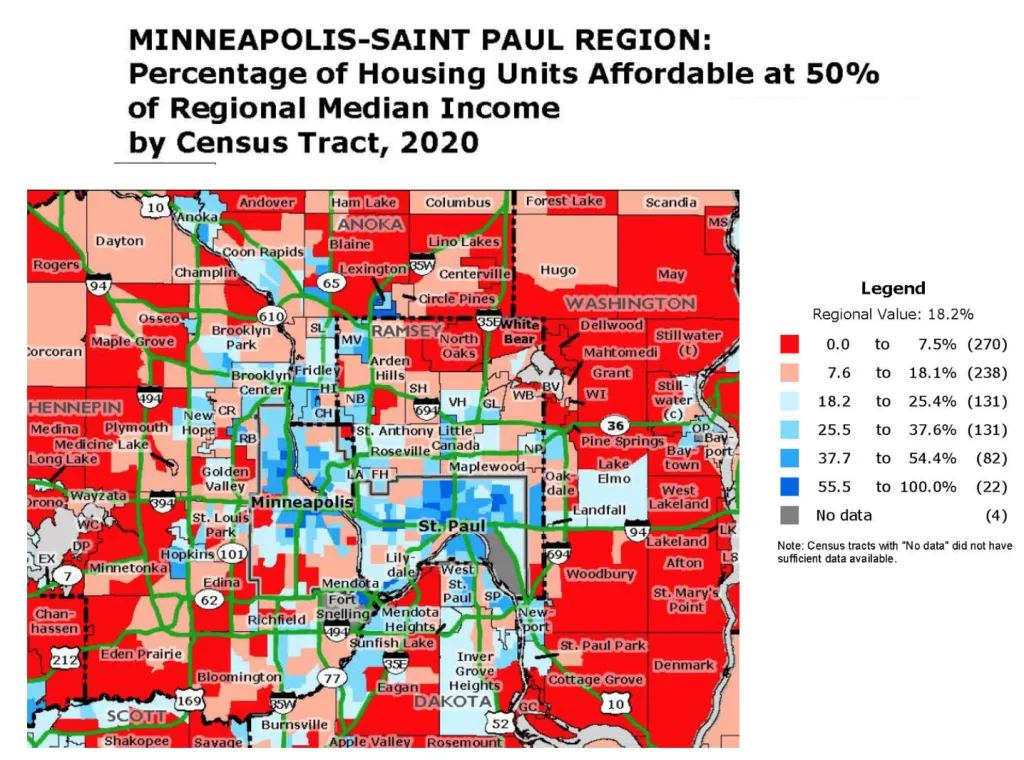
One policy to consider is more geographically based standards for affordability requirements. Because housing prices vary considerably across neighborhoods and jurisdictions of the Twin Cities, there are still pricey areas of Minneapolis, like downtown and South Minneapolis, where a new 60% AMI affordable housing project could be well below nearby market prices.
Innovative forms of public housing and “revolving loans” have captured growing interest from housing advocates in recent years, as they can provide affordable housing without huge ongoing subsidies. Certainly, Minneapolis policymakers should look into these ideas — but they could easily run into the same problems as other affordable housing programs. As housing reporter Rachel Cohen Booth has written, these modern public housing programs still have a hard time serving the lowest-income residents, often building “affordable” housing at moderate-level rents. These new models face the same old cost challenges; deeply affordable housing is still very expensive. Still, they could serve useful — especially to help continue expanding the overalll housing supply when financial conditions slow down.
It’s also worth remembering that subsidies can be “stacked,” which offers one route to increase deeply affordable housing. For example, about a third of low-income housing tax credit (LIHTC) tenants in Minnesota have individual housing vouchers, which can help a 30% AMI household bridge the gap to 60% AMI rents. Similarly, perhaps a public revolving loan can more easily be combined with existing affordability subsidies to create lower-cost housing.
Hennepin County’s Affordable Housing Incentive Fund is one notable success story on this front. The program offers low-interest loans specifically for deeply affordable housing, which often combine with other affordable housing subsidies to help make affordable developments feasible. It has helped to fund thousands of deeply affordable units in the past 20 years. This type of model warrants more attention — and, as much as possible, more funding.
Though it’s well-understood that building more deeply affordable housing is difficult, this problem doesn’t have simple solutions. But because Minneapolis’ baseline affordability levels are much better than many other places, the city may have opportunities to reduce its prioritization of moderately affordable 60% AMI housing, and in turn create more opportunities for deeper affordability. The ideas sketched out in this section offer a starting point, but are hardly a comprehensive suite of ideas.
Reduce the Cost of Building Housing
The other side of Minneapolis’ strategy should be to focus on reducing the costs of building and maintaining housing. While we should push to grow the pool of affordable housing subsidies, that pool will always be finite, making it crucial to lower the cost of market-rate housing, too. Without subsidies, a landlord or homebuilder can’t rent or sell housing for less than the cost of construction and maintenance — and as a result, in the words of housing researcher Michael Andersen, “the price of old homes depends on the cost of building new homes.”
Talking about “reducing construction costs” can make some people uneasy, and perhaps fairly so — a world without building codes could easily look like slumlords renting ill-maintained housing for the poorest renters. While precaution is warranted, however, there are many ways to reduce the costs of supplying housing that don’t entail reducing the livability of housing.
Some of the most straightforward options for this come from land use and regulatory reform, which is a well-trodden space for Minneapolis residents. Some land use reforms, such as allowing multifamily buildings throughout a city, are mostly beneficial because they expand the housing supply, without necessarily affecting the actual cost of supplying housing. Other land use reforms are effective precisely because they lower construction costs for housing, often by removing a costly and unnecessary requirement.
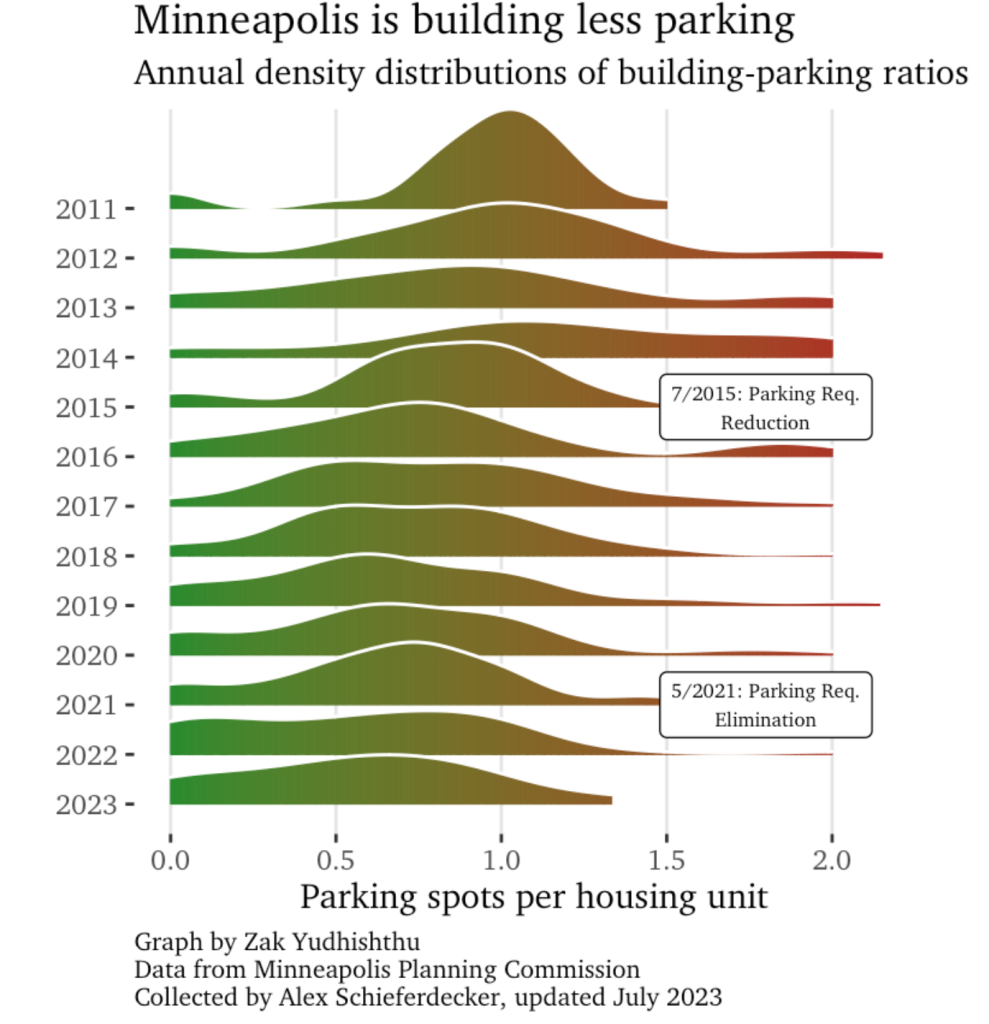
For example, removing parking minimums, as Minneapolis has done, allows developers to build fewer parking spots, potentially saving tens of thousands of dollars for each parking spot that’s not built (otherwise, the cost of parking is indeed passed down to rents). Similarly, Minneapolis’ more standardized zoning code has led to fewer developers applying for zoning variances, making building approvals quicker and less uncertain — this also reduces costs.
Yet while Minneapolis is rightfully seen as a national model for good land use policy, there’s still some low-hanging fruit to lower costs. One of the easiest changes would be to reduce minimum lot sizes below 5,000 square feet, a change recently implemented in St. Paul. Under Minneapolis’ current rules, even if a household would prefer to save money by living on a slightly smaller lot than the city’s standard 5,000-square-foot lots, they have no choice but to pay thousands of additional dollars for a larger lot.
Evidence from Houston and Portland, Oregon, shows that reducing minimum lot sizes can have huge gains for housing affordability, creating opportunities for homeownership at substantial discounts. Such a change should be an easy layup for Minneapolis (some secondary regulatory changes would probably be necessary, too, such as allowing homes to cover more of their respective lots and have more total square footage).
In addition to these zoning and land use changes, other changes in how we build housing can reduce housing costs.
Single-stair reform is one increasingly widespread change of this type — and it’s already being studied in Minnesota. In short, building codes in the United States generally require that buildings taller than three stories must include two separate stairways, which is far more stringent than many other countries. A second staircase can equal 6% to 13% of total construction costs and make it infeasible to build a taller apartment building on a smaller urban lot.
During Minnesota’s 2024 state legislative session, a bill was passed to begin a technical study of how to safely create a building code allowing taller buildings with a single staircase. That study is currently underway at the Minnesota Department of Labor and Industry, which develops the state’s building codes. Hopefully, these kinds of buildings will be made legal in Minneapolis within the next couple of years.
As another example, a recent report from Pew Trusts and the architecture firm Gensler examined how more of Minneapolis’ vacant office buildings could more easily be converted into housing with dorm-style, single-room occupancy (SRO) apartments, which have shared kitchens, bathrooms and common areas.
Because office buildings often have huge floor plans, converting offices into traditional apartment types can be practically impossible. But an SRO-style office conversion could solve this difficult geometric problem by putting small bedrooms around the outside of the building, with shared bathrooms and kitchen areas in the center. See an example floor plan below:

Although office conversions can be technically difficult, the group’s research suggests that SROs could have substantially lower per-unit construction costs than new development, and their rents could be substantially lower than more standard studio and one-bedroom apartments.
Thanks to a 2021 rule change approved by the Minneapolis City Council, SROs are allowed in downtown Minneapolis (although only non-profits or government agencies are allowed to manage SROs in Minneapolis). Unfortunately, Pew and Gensler’s financial modeling suggests that it would be difficult for a private, unsubsidized developer to undertake such a project under today’s difficult economic conditions for development. However, the researchers suggest that with some public subsidy, these single-unit office conversions could serve as a far cheaper way to produce deeply affordable housing. By supporting a lower-cost typology of housing, public dollars might be able to go further in producing affordable housing.
We should be realistic about how far these improvements will go. Reducing construction costs to modestly decrease the price of market-rate housing, or allowing our subsidies to stretch a bit further, wouldn’t solve all of the challenges faced by Minneapolis’ most precarious residents. Still, these are worthy targets for reform that can improve the city’s housing affordability.
Beyond Housing Policy
Ultimately, this discussion makes clear that there are limits to what housing policy per se is able to fix.
For example, recent research has demonstrated that “homelessness is a housing problem.” Relative to factors like rates of drug addiction and mental health problems, housing costs explain much more of the variation in homelessness across American cities. Cities like New York and San Francisco will never be able to tackle homelessness so long as housing prices remain sky-high, constantly pushing new people into homelessness.
But homelessness is not only a housing problem. Lowering housing costs is a necessary condition for eliminating homelessness, but that alone is not a comprehensive solution. Solving homelessness also requires effective services to assist homeless people. These services are closely tied to housing, but are not purely in the realm of housing policy.
There are also more fundamental economic issues that housing policy can’t address. At a certain point, people end up precariously housed because their incomes are simply too low to meet the cost of living. Directly lowering the cost of living is important, but also begins to have diminishing returns. Raising the incomes of precariously housed people (via both economic policy and more redistributive policy) is necessary, too.
While Minneapolis has done many things right on housing, it’s reached a challenging impasse on the “last mile” of housing affordability. Because rents are so low, many of the tools in our housing toolkit don’t seem to work as well as they would in other places. But thoughtful measures to target deeper affordability in subsidized housing, and reduce the costs of building and maintaining housing, can still bring homes within reach for more of Minneapolis’ most vulnerable residents.