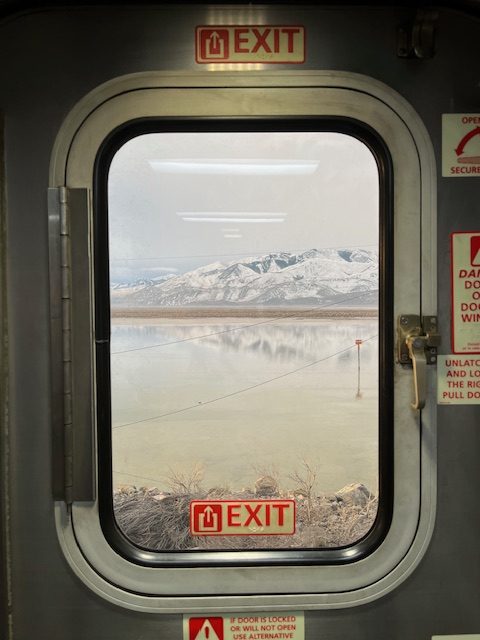
Digging up writing from your past can be excruciating work. You have aged, and those gratuitous semicolons that once rang so profound and sure to impress are now rendered desperate. There is one writing, however, that continues to claw at me, and begs for another opportunity to showcase. It comes out of my senior thesis project, that, despite the semicolons, is something I ultimately remain proud of. The snippet from my thesis that I intend to resurface here requires some contextualization.
I had used an anecdote of the time I rode via Amtrak from California to New York to illustrate how mutual aid can function in daily moments of discomfort, when community is sought and created to make people’s lives not only easier, but more meaningful. If you’d like to read the full thesis, and how I situate this story within a larger literary analysis of the book Octavia Butler’s Parable of the Sower, a work of speculative fiction about a more mature stage of Earthly apocalypse, reach out to me! I am more than happy to provide a copy. Butler’s work is present in this anecdote, as I think through what the word “apocalypse” really means. In the world of science fiction, it is typically a major instance of disaster that leaves a wholly destroyed and unrecognizable world. Parable of the Sower adds nuance to the word apocalypse, and my thesis ponders how the essential and sometimes more subtle breaking down of community fits Butler’s term.
At the time of this writing, I was firmly steeped in a couple works that inform the commentary I am making. I was also on the train while reading these works, experiencing in real time that which I did not yet know I was fundamentally trying to argue. Although the anecdote of riding the train can stand alone, I use it to emphasize this greater idea that I take from Rebecca Solnit’s book, A Paradise Built in Hell, which is outlined in her title: that conditions of “hell” – I also use the word “apocalypse” – can inspire movements of “paradise”, which I also explain to be mutual aid, community-building, etc. It is also important to note that the thing which makes mutual aid a necessary tool for survival is racial capitalism, and the institutions which uphold it. A simple definition of racial capitalism is helpful here, as a concept “that explains how capital accumulation within capitalism in certain societies is achieved through the extraction of social and economic value from people of marginalized racial identities,” (Wikipedia page here). I have made some necessary edits to this writing that help it transition into this publication with less context, and I hope that it can serve to enlighten a fundamental condition of the train as an oft-slower, more communal mode of transportation. At the end I’d like to make the necessary Minnesota connection by imploring a ride on the Borealis train!
In the Winter of 2023, I took an Amtrak train across the country, from Oakland, California, to New York City. This journey was meant to be an individual experience, a time to read my books, write my thesis, and enjoy the shifting scenery across eleven states from coast to coast. I did all of this, and there were moments, hours on end, when I existed in a deep inner consciousness, my thoughts and music encompassing my sensory perception. But immediately upon boarding the train, as I sat in my coach seat and met my seatmate, Sophie, there was a discernible sense of community.
Along the way, the California Zephyr accumulated upwards of twelve hours of delays. A boulder crashed into Engine #1. Engine #2 became flooded (somehow). The band aid solution—freight Engine #3—chugged along at a much slower rate. I would wake up frequently that first night to an unmoving train, somewhere in the middle of Nevada. What started as a sort of funny refrain—chuckling strangers eyeing each other with joking exasperation as the train would slow to a stop, yet again—became the undercurrent of a trip where time expanded and collapsed, hardly playing a role in daily life on the train.
In the lounge car, where seats and tables spread out to face wall-length windows, Coach-class passengers gathered to escape their chair-as-bed in the Coach cars. I could not help but think of the apocalypse movie, Snowpiercer, as the train soon assumed the role for all my living needs in a class-designated layout from car to car. I would catch only a fleeting glimpse of the dining car reserved for the Sleeper-class, as an Amtrak staff member would pass between cars and the closing door would reveal doily-lined tables adorned with blooming red roses and cutlery for waited meals. I elaborate this Coach-Sleeper distinction with the belief that the kind of community formed in the Coach lounge car was noticeably strengthened by a shared discomfort and need to improvise.
In the lounge car that first day, people floated and flitted around in a state of seeking, it seemed. The three days ahead loomed, as did the prospect of solitude. Along with my seatmate, Sophie, I met Emiliano, a poet attending graduate school at the University of Notre Dame, and Iris, embarking on a long journey to her newly rented first apartment after undergrad. On the younger end of the spectrum of our train comrades, we found a comforting commonality, although we welcomed the company of anyone willing to offer it. Accumulating hours and hours of delays, our expected arrival time in Chicago surged right through the departure time of each and every transfer train.
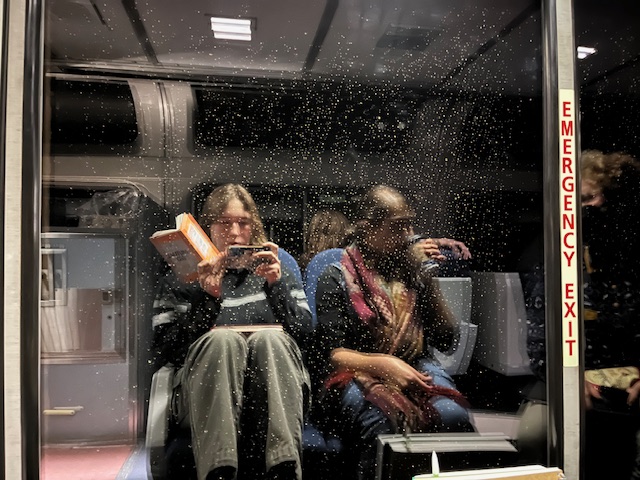
We read Joan Didion, or rather, Emiliano provided dramatic readings from his Joan Didion novel, as the train lay idle for an engine change. We shared snacks, my three friends demonstrating their veteran meal-prepping, nutrient-efficient strategies for train satiation (beef jerky and cheese on a baguette laughed at my plain oatmeal packets constituting most meals of the day). Emiliano plugged in his heated fleece blanket, which I yearned for as I shivered in the fetal position at night in my coach chair. Jenny, the Amtrak Cafe Car worker, a woman in her mid-fifties, sympathized with our discomfort through the delays and offered us free coffee and thrilling, possibly confidential, California Zephyr stories. Together we were without sleep, without satisfying nourishment, and our only exercise consisted of five minute bouts of jumping jacks during infrequent smoke breaks in various midwestern towns.
We sought each other. Every morning, in ritualistic fashion, we moved to the lounge car with our books and distractions for the day, knowing full well that our conversation and company would carry us to the night. Iris kept her hands busy with rainbow yarn, knitting it with ferocious speed throughout conversation and mealtimes. Having watched the movie, Triangle of Sadness, on Emiliano’s computer, the two of us engaged in a dynamic conversation about the absurdity of the capitalistic aesthetic that the film hyperbolizes, to the point of Lord of the Flies-esque island survival amongst various victims of racial capitalism. We determined that greed, power, and beauty compose the three points of the triangle. I read the book, Mutual Aid, by Dean Spade, from start to finish. As we developed our care for one another, as our possessions slowly dispossessed into communal offerings, a faint whisper in my head grew to an excited yell: It’s all here! Once I thought it, it was all around me. This is mutual aid!
On the last night of the train, one extra night tacked on to the original journey due to delays, the lounge car dwindled down to eight. The rest had gone to catch some sleep before being awoken by our Chicago arrival, at whatever outrageous hour of night or morning it might come. Sitting with a boy named Lazaro and a middle-aged man named Jack at the table behind me, Emiliano jumped up and ran back to the Coach car. He came back with a record player in hand, complete with about five records. He returned to his seat, the rest of us five curiously eyeing the table where Emilio sat, fiddling with the record player. I approached and stood in the aisle, watching the three at work.
An elderly couple watched from the table on the other side of the aisle, and Sophie and Iris stood by to complete the improvisational circle that has just formed. The records were passed around, and as I handed them to my left, I learned the names of the couple, Fernando and Catarina from Argentina. They pulled from their bags some homemade cashew brittle and pork jerky, spreading it across napkins on the table for all to share. I wrote down the cashew brittle recipe. Sophie grabbed the remainder of her block of cheese, so I added my box of Triscuits. A sort of cornucopia formed. Jack produced an unopened bottle of whiskey, a gift from his son he just visited, and declared, “I would be honored to share this with you all.” We rejoice and, like pesky teenagers smuggling alcohol into a movie theater, poured the whiskey covertly into lidded cups to avoid a reprimanding from Amtrak staff. Iris made one last trip to the Coach car. She brought back a typewriter, to the excitement of everyone and the eagerness of Emiliano, the poet. We sipped, we ate, we began to tell stories, Emiliano typed.
What are you most passionate about? We dive right in, we listen with intensity and yearning. After a complete first round answering the question, the typewriter ribbon zips with dramatic effect, indicating that Emiliano had finished writing. He reads back to us a poem about eight strangers’ life passions.
How can I describe that it felt like we were on that island in, Triangle of Sadness, surviving. How can I claim that, in fact we were, for Emiliano had written it into being? Well, actually, we all had, for after that first round of typing and questioning, we continued on to many more with the typewriter traveling among us. I began typing:
Jack poured the Omaha bourbon,
Fernando offered homemade pork jerky and cashew brittle,
Catarina showed us Camila Eliza, newborn granddaughter.
Sophie cut up cheese slices,
Iris asked icebreaking questions,
Lazaro explained Detroit-style pizza,
I drank a Blue Moon,
Emiliano wrote a stunning poem.
And then Emiliano put us on an island. We shared and we fought and we loved on that island. And the typewriter went to Jack who shared his whiskey and spent thirty intentional minutes adding to the story of us eight. Jack passed to Sophie. On and on we knit together a story as magical as that lounge car somewhere in Iowa felt, as possible as sharing cashew brittle with Fernando and promising to visit Lazaro in Detroit. There it is again. It’s all here!
As Iris’ stop approached, we divvied up the typed story—everybody gets a page. I accompanied Iris down to the cafe car for a coffee, and she gifted Jenny a completed pair of rainbow mittens. I watched as the two embraced, as Jenny began to cry, as three days of exchanged kindness generated this final act of reciprocation. Trumping any frustration of the long journey was the sheer and palpable excitement of community, in many contexts a radical undertaking. Maybe this all sounds like common sense. People act with kindness. That kindness is exciting. It was a fun and fulfilling train ride. That is kind of the point isn’t it? Mutual aid is so logical. The goal at hand is to estrange what is so illogical (individualization), and yet that has become so naturalized, so that a politics of care can restructure a fundamental orientation towards power and each other. That string of Coach cars on the California Zephyr was the site of a radical restructuring. Lost in time, racing across space, eight people in common circumstance founded a place of community.
Community in Disaster
A paradise out of hell? Surely that last night on the train was no “paradise” nor was a delayed Amtrak “hell,” but as a microcosmic example of improvisational community being built out of solidarity and propelled through perpetual acts of care, a structure of social organizing emerges that dialogues with that from A Paradise Built in Hell.
There is an intimate relationship between mutual aid practices and conditions of disaster (apocalypse). A Paradise Built in Hell begins a dialogue of how moments of disaster can highlight communities’ responses of care and altruism. Invoking the story of Cain and Abel, she asks: “are we beholden to each other, must we take care of each other, or is it every man for himself?” (Solnit, 3). That is the question that I sat with while riding the Amtrak in communal discomfort with others. Through case studies of disasters in recent human history—from hurricanes to instances of organized violence—Solnit finds people acting for the survival and empowerment of one another. In contrast, institutions that are intent on upholding an individualized and competitive citizenry—state and corporate powers functioning within racial Capitalism—the exciting and effectual sense of conviviality that Solnit highlights gets smothered. Solnit writes about mass media hysteria that was produced in the aftermath of Hurricane Katrina, characterizing New Orleans citizens as rapists, murderers and general chaos-creators during the natural disaster. She notes how this propaganda generated a hierarchy of deservingness, which excluded many suffering community members from government aid.
Solnit contrasts this response with that of the community, characterized by expedient efforts to share and sacrifice resources, truly saving lives. The institutions that uplift racial Capitalism, in effect, enforce the individualization of citizens. This kind of fragmented citizenry incites Solnit to declare, “Thus does everyday life become a social disaster” (Solnit, 3). She points here to the everyday disasters, the states of “apocalypse,” that force people to learn to survive. The concept of “disaster” is then expanded to account for a mentality of competition among people that pits one against the other, and fundamentally excludes care from organized society.
The “paradise” that arises from “hell” is mutual aid, and the community-building that generates reliable systems of survival and care, comprised by and for those members a community encompasses, is a joyful experience. Joy, care, happiness—these are all requisite for a just form of social organization, and they are coconstitutive with strategies of survival. Solnit recounts a story told by a friend once caught in a deep fog in California, and therefore forced to spend two nights in a diner amongst similarly stranded strangers. She makes note of how the story, to everyone’s surprise, was told “with such ebullience,” (Solnit, 4) despite the more obvious inconvenience and discomfort of the experience. Here it makes sense to detail a story with exciting similarity from my own experience. I intentionally describe the similarity as exciting, because my own experience of being stranded among strangers is one I cherish deeply and share with ebullience, and so, upon reading the story presented by Solnit, I felt such embodied glee in the intimate understanding of that experience. Solnit situates this story of weather-based inconvenience within a discussion of disaster and the emergence of improvisational communities. I can attest to how such a dinner-party-anecdote powerfully contributes to a study of paradise out of natural and social disasters, as is exemplified in my Amtrak anecdote.
My first, solo, long Amtrak journey was by far my most exciting. I have since tried to replicate the emotions and discoveries of that trip and have fallen short. More recently taking the train from Minneapolis to New York and back again to visit home, out of some acute and stabbing guilt about air travel, I found myself largely alone and crawling with the urge to leave that confining train car. I did, however, still manage to play a couple rounds of cards with two strangers. Thirty minutes out of a total of 36 hours, but still a (slightly) satisfying “eff you” to air travel. I do believe such moments of improvisational interaction come more readily on the train. So, this is a long and convoluted way of saying taking the train can be enlightening, and you should take the Borealis to Chicago sometime. But also, when you do, bring a deck of cards. There is a reason that people are taking the train—that they choose more time in transit—whether it be fear of air travel or a romantic yearning for contemplation. I find that these reasons and the stories that accompany these travelers shape the whole experience of long train rides. It is in the air. It is known and shared—privately or covertly—as people shuffle back and forth through the cars, and scrape out provisional islands of space for their comfort and commitment to the days ahead. Whether or not you take a four-day train to your next destination—and I would not fault you for declining the suggestion—I hope this anecdote can help you take pause, and recognize community in times of shared discomfort.