The view and opinions expressed in this article are those of the author and do not reflect the official policy or position of her organization.
I became interested in local politics by accident when I started bike commuting in Minneapolis in 2011 (ask me about the exploding yogurt on the bike path incident). It wasn’t until well after COVID, however, that I had any awareness of the endorsement process for city-level elected officials, which came from the Wedge Live podcast. I recall references on the podcast to caucuses and city conventions over the years, and they didn’t necessarily sound like something fun to participate in.
Over the last few years, I’ve been frustrated with transportation projects/processes in Minneapolis. I’ve increasingly felt that voices from people like me were being drowned out. With the status of national politics in early 2025, I felt particularly powerless. So when I started hearing about caucus and conventions again on the podcast, the words rang differently in my ears: I heard that delegates have power.
Around the same time, I learned about “Caucus for a Connected City” — an organizing effort to build a movement around prioritizing transit and livability in Minneapolis. I attended an initial Connected City meeting and learned that I didn’t need to support a specific candidate in order to be a delegate or alternate: I could instead support a cause. In this case, Connected City. It was the push I needed to commit to caucus.
Despite my preparations, I still didn’t quite know what to expect when I biked to caucus on April 8. The registration process was a bit chaotic (why not put precinct numbers above the registration tables where they could be easily seen?). Once I made it to my precinct room, I was excited to chat with my neighbors about Connected City, but was disappointed when my first conversation immediately led to someone repeating disinformation about a candidate.
Aside from starting late, issues with “equal division by gender identity,” and a slight kerfuffle when late arrivals were allowed to participate, the caucus process went relatively smoothly. There was space for everyone who wanted to be a ward delegate to do so (including me), but more people wanted to be city delegates than there were spaces. I wasn’t clear how “walking subcaucus” worked, and no one else brought it up. Those of us who wanted to be delegates stood up and gave two-minute pitches on who or what they supported. I was voted to be an alternate, but I’d heard that alternates are frequently upgraded to delegates.
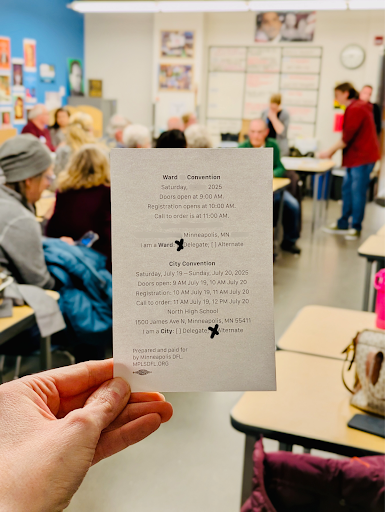
I didn’t research my ward’s city council candidates because I was familiar with the incumbent and knew they aligned with Connected City priorities. I don’t recall being contacted by the challenger, and so I didn’t have a conversation with them. I regret not proactively reaching out to them because I could’ve shared Connected City priorities.
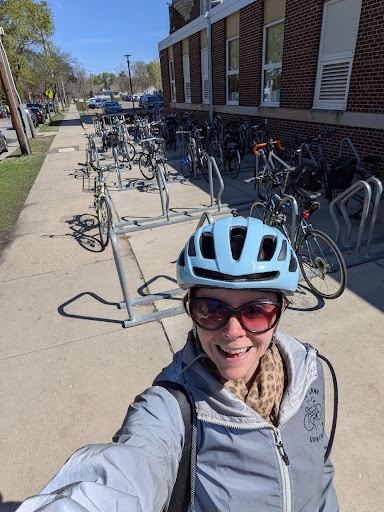
On a lovely Saturday in May, I biked to a neighborhood school for the ward convention. After a much smoother registration process than caucus night, I located a friend who was also new to conventions. It was nice to have someone to compare notes with and observe the proceedings.
One of the first items of business was a motion to make the convention’s end time earlier, which was overruled. I wasn’t excited about the convention going all day, but had heard this could be a strategy to block any candidate endorsement so I was glad it was overruled.
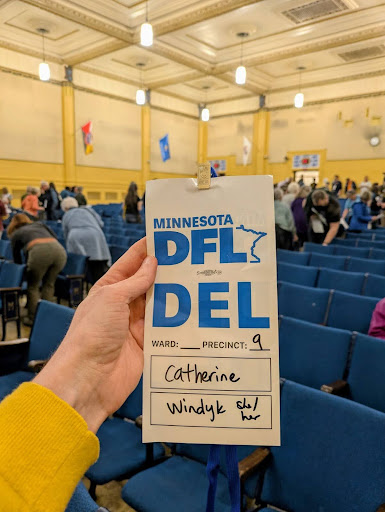
Following candidate speeches—including park board and mayoral candidates—came Q&A with the council candidates. At voting time, I moved to sit with my precinct and found two neighbors I’d chatted with on caucus night who’d expressed interest in Connected City. The paper ballots took a while to count, but there was a clear endorsement made. We were out by mid-afternoon.
After the ward convention, summer arrived and endorsements fell a bit off my radar. I attended a mayoral candidate forum, but by July, I hadn’t personally spoken to any candidates, even though that was what had appealed to me about getting involved in the first place. So when I received a text invitation to a mayoral candidate open house the Saturday before the city convention, I hopped on the next bus to attend. I was happy to have some face time with my first candidate, though it wasn’t as robust a conversation or as strong a connection as I’d hoped.
The Wednesday before the city convention, I scheduled a 30-minute phone call with another mayoral candidate. I spent a lot of time prepping for that call: what I would say, what I would ask, what I wanted to achieve. I was nervous and intimidated, but during the call I was up front with what was important to me. I took care to steer the conversation around climate, sustainable transportation, and their vision around those topics. It was a helpful conversation.
The next day, I received a text to schedule a call with the mayor. I took him up on it. I was even more intimidated than the night before, and had less time to prep, but was excited for the opportunity. We spoke for 30 minutes and though it was not the first conversation I’ve had with the mayor, it was a unique experience.
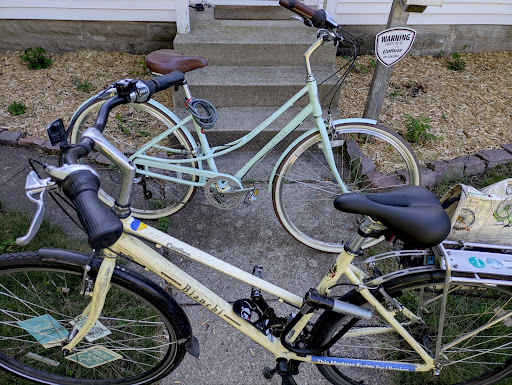
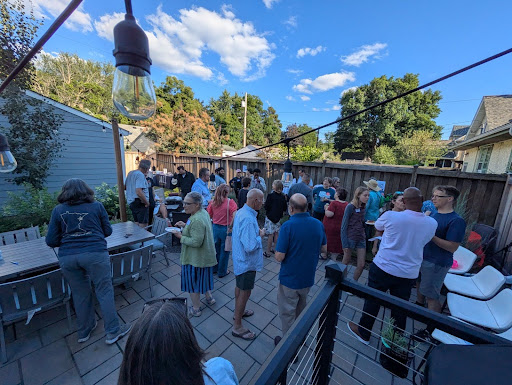
That night, I biked with a friend to a mayoral forum featuring 3 of the mayoral challengers. I was able to chat with one candidate in a small group, and the Q&A session provided some additional insight into platforms and personalities.
The day before the city convention was the big one: I had phone conversations with 1 mayoral candidate and three park board candidates, all while taking transit all over the city on my vacation day. Over the course of the calls, I became more comfortable and confident with guiding the conversations. I made sure to thank them for running, express what was important to me and why, and ask about how they saw the issues.
On July 21, I felt about as prepared as I could heading downtown to the city convention on the light rail, and that felt good.
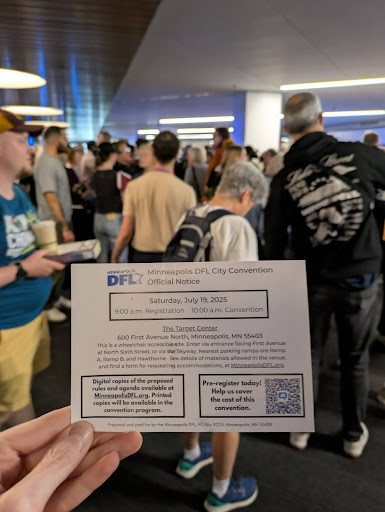
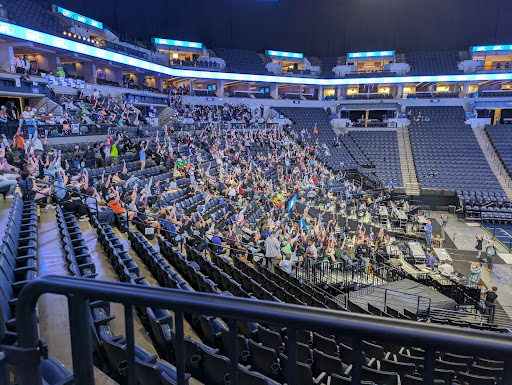
Much ink has been spilled on the events of that day, so I won’t belabor the details. At 10p.m., over 12 hours after I’d arrived, I left the Target Center. I was never officially upgraded to delegate status, so I did not get to vote.
Despite a city convention experience that was frustrating, disillusioning, confusing, disappointing, and stressful, I don’t regret it. It was also exciting, unique, and a privilege to participate. I learned a lot and experienced new things. It was wonderful to see people so committed. I got to connect with many amazing individuals, some of whom I’d met before—former council members, certain podcast hosts, friends in the biking community—and some I hadn’t (waiting in line for an ill-fated upgrade with an elected official is a memory I won’t soon forget). Visiting a candidate suite in search of food, a campaign worker who had helped me set up a candidate call recognized me and thanked me for my cordial correspondence. I thanked her for her work on the campaign. I reconnected with my neighbors from the caucus and ward convention and we bonded over the events of the day. They even offered me a ride home, given the late hour and being neighbors and all.
It was a long journey from caucus in April to convention in July and I am grateful to have participated in the process. Due to my participation, I am more invested in local politics and in Minneapolis. I feel more knowledgeable about the endorsement process. I have more respect for candidates. I hope that even a tiny bit of my conversations with candidates stuck with them. And I think I’ll probably participate again next time around.