Editor’s note: This article is adapted from a version published Oct. 13 2025, by the Minnesota Women’s Press.
Two cities both intertwined and distinct, Minneapolis and Saint Paul have different approaches to solving similar housing problems — whether through city and county services, direct community aid, or both. Housing needs are a prominent issue in both the Minneapolis and Saint Paul mayoral races this year, as well as city council races. This story focuses on two major issues impacting both cities, as well as showcasing community members working to fill gaps.
Issue One: Encampments
Encampments are a highly visible example of the inability to house all residents.
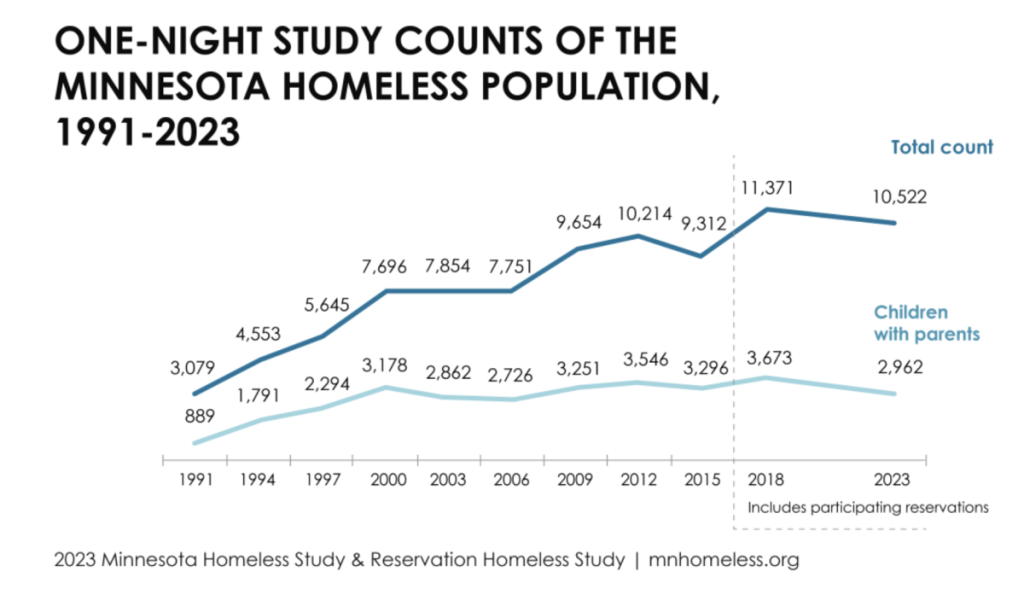
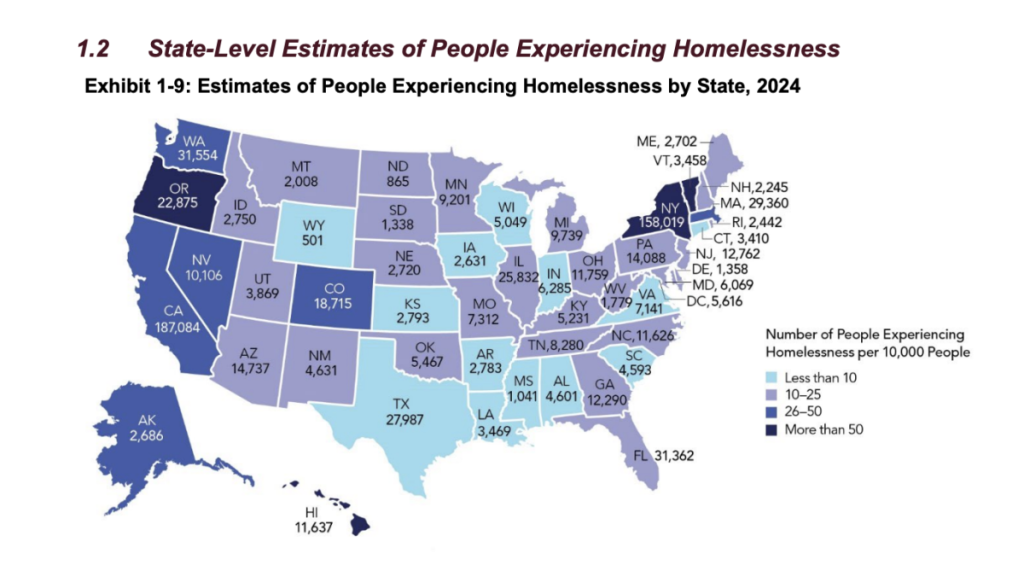
In the January 22, 2025, Point-in-Time count: in Hennepin County, 2,651 people were staying in shelters and transitional housing programs; 427 were experiencing unsheltered homelessness. There is no specific number available for 2025 in Ramsey County; the publicly reported number in 2024 was 1,644. The 2023 Minnesota Homeless Study conducted by Wilder Research tracked numbers on October 26, 2023, finding 1,661 in Ramsey County.
Minneapolis city and Hennepin County officials stressed to us the relative success of their strategies addressing housing security, citing a 33 percent decrease in unsheltered homelessness in Hennepin County from 2020 to 2025.
Minneapolis recently emptied an encampment after a shooting there. In a September 16 statement after the incident, Mayor Jacob Frey said, “We have years of evidence showing that encampments are unsafe. They don’t just endanger residents; they create conditions where some of our most vulnerable neighbors are exploited by drugs, violence, and trafficking. They regularly end with violence, fire, or tragedy. That is why we close them.”
When Saint Paul cleared and bulldozed an encampment in January 2025, citing unhygienic conditions and fire risks, Mayor Melvin Carter was quoted by MPR and Sahan Journal acknowledging the insufficient amount of alternative housing and support available to encampment residents, despite city efforts.
Naly Yang, interim director of Housing Stability for Ramsey County, states: “We work closely with the City of Saint Paul and other community partners to provide resources for people who are experiencing homelessness, at risk of becoming homeless, or need emergency assistance to stay in their homes. Encampments do not provide a safe, healthy, or secure living environment. They are often subject to many calls for police, medical, and fire services, including several multi-tent fires.”
Danielle Werder, Senior Department Administrator for Hennepin County’s Office of Housing Stability, suggests that the media focus given to clearing encampments is not necessarily an accurate depiction of how Hennepin County provides service: “A lot of attention gets focused on encampments that are cleared, dispatched, or dispersed. The reality is that people are moving around every day. We’re constantly working to engage with our clients. We’re working to always know where they are and follow them and make sure that we’re helping them in their housing journey.”
She added that people at encampments are vulnerable to predators, who are not always experiencing homelessness, and that others reject or distrust case workers. “If somebody is not ready to work with us, it is what it is. We’ll keep showing up [and offering services].”
Hennepin County offers a publicly accessible shelter bed dashboard, which offers one-day delayed data about available spaces, and prioritizes a “shelter-all policy for families with children.”
Corruption has also been an issue in the already under-resourced recovery and housing world. Minnesota Housing Stabilization Services was created in 2020 to serve people facing housing instability by using Medicaid funds, but was closed this year because of fraud. Eight people have been charged so far for recruiting individuals to bill for services that were not provided.
The Community-Based Approach to Aid
Some community members are attempting to plug basic gaps and push back against stigmatizing people experiencing homelessness. “I think we can all agree we don’t want people to be living outside, dying,” says Valerie Quintana, executive director of The Real Minneapolis, a nonprofit that provides direct support to unhoused community members in Minneapolis. She says her team has delivered 500 meals per week for the last five years. “The question is, what are we going to do about it?”
She adds, “Some people see providing water and jackets and mutual aid and food as enabling. My position is that yes, it’s enabling. It’s enabling [unhoused community members] to continue to have a beating heart.”
Quintana draws on her own lived experience of homelessness in her advocacy. She says the challenge is to “meet people where they are at.”
She cites a project she ran several years ago, when she created a drop-in center on Lake Street. Folks there could shower, meet with a case manager, and build a sense of security and reliability. She evolved her work from crisis response to building long-term stability — using nutrition as a catalyst for better choices and pathways out of homelessness, and job training. She is blunt in saying the picture Minneapolis officials try to paint — of available services and resources that give people options beyond encampments — is often not the reality.
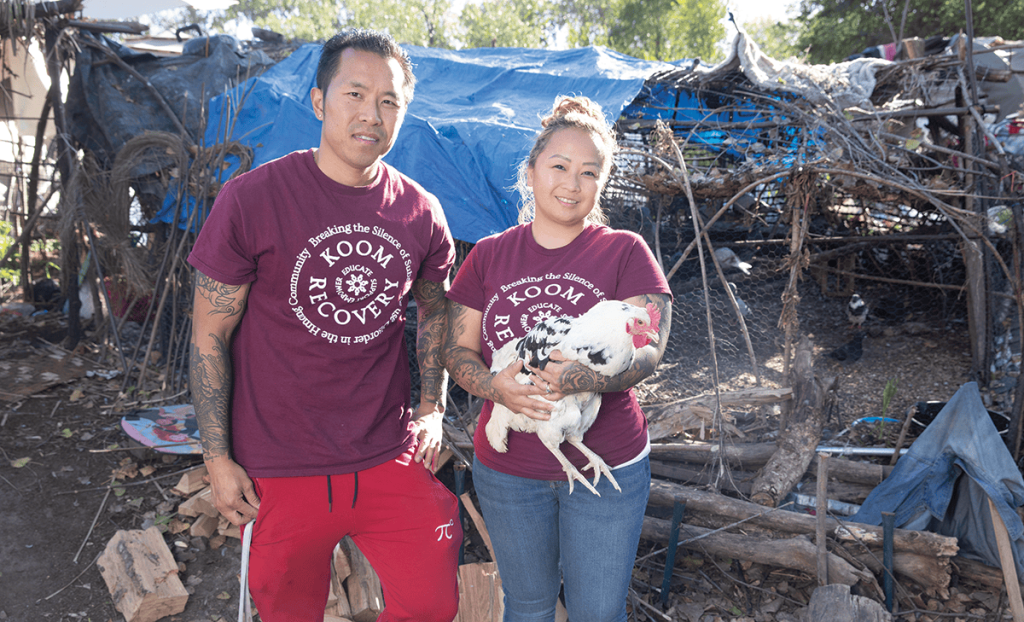
Koom Recovery is a Saint Paul–based organization that supports Hmong community members who are battling substance use and provides direct service in encampments there. It was cofounded by husband-and-wife pair Xianna Moua-Yang and Yeng Moua. Moua told us, “I think the city thinks they’re doing something by closing down encampments. But that doesn’t resolve the main issues. What these individuals are going to do is just migrate to new spots and start all over.”
Some residents have started transforming encampment space into something more like a home. One encampment has grown into a small village, says Moua-Yang. “They have a garden where they grow vegetables, with chickens running around; it’s a bit like being back in Laos or Thailand. There are leaders and people take turns doing chores. A lot of residents that I converse with say the encampment is a place where everyone can connect because they share relatable circumstances.” She says that since affordable housing is so hard to get, people have worked to develop a safe and comfortable community.
Issue Two: Renter Protections
For a majority of residents in Minneapolis and Saint Paul, home is somewhere they rent, not own. According to a 2019 MinnPost story, this is partly because the recession of 2008 burst the housing market bubble, many people lost their homes to foreclosure, and investors swooped in to buy these houses and build more expensive properties. This landscape often prevents younger people from being able to own.
Irene Ruiz-Briseno, of Greater Minnesota Housing Fund, told us in an April 2025 story: “Median home sale prices have increased 4.5 percent over the past year, and rising interest rates have decreased buyers’ purchasing power, particularly our low- and moderate-income families.”
A Pew Research Center report indicated that more U.S. households are headed by renters than at any point since at least 1965. Renter protections (or the lack thereof) are therefore central to housing security and safety for many people.
What shapes those is a complicated web of national, state, county, municipal, and outside private investors. [See our story about the Minneapolis mayoral candidates who discussed this issue recently.]
“If you’re a renter in Minnesota, you benefit from federal fair housing laws,” shares Eric Hauge, co–executive director of HOME Line, a tenant advocacy organization that has served 350,000 Minnesota households over three decades. “You also benefit from state laws. There’s a whole chapter of Minnesota law, chapter 504B, that focuses on the entire tenant-landlord relationship. There’s also the Minnesota Human Rights Act, which actually impacts rental housing as well.”
Individual cities take the lead on rental inspection and licensing rules, as well as discretionary protections (often related to discrimination and displacement) that vary across municipalities.
Hauge notes that Minneapolis has admirably strong protections on the books around inspections. For example, “Minneapolis is the only city in the state that actually has specific rental housing ordinances that relate to mold.” Hauge estimates that around a quarter of the repair issues HOME Line hears about via their free legal helpline for renters are centered around mold.
Minneapolis also has protections against source-of-income discrimination (most applicable to folks who receive Section 8 vouchers or other forms of housing assistance) and offers relocation assistance under certain circumstances. “The city’s rental license and inspection program is a model nationally,” shared a City of Minneapolis spokesperson, who also pointed to the recently released Way Home Progress Report as a “report card” of sorts on affordable housing. She added, “Minneapolis has helped more than 6,100 households and 12,450 renters with legal advice on housing discrimination, security deposit disputes, and eviction rights.”
At the Hennepin County level, officials highlighted their work providing rental assistance — which they say has prevented 7,500 evictions since the beginning of 2023 — as well as legal assistance. Prior to COVID-19, “only about 10 percent of households at risk for eviction had access or were connected to legal representation at housing court,” shared Will Lehman, Hennepin County’s Homelessness Prevention Area Manager. “That obviously has a direct adverse impact on outcomes in housing court, typically leading to an eviction. So the county stepped forward and made this unprecedented provision [to provide] legal representation for any low-income tenant facing eviction.”
Saint Paul seems to have a leg up when it comes to rent stabilization. Though both cities held elections that showed voters were in favor of rent stabilization, only Saint Paul enacted such a policy; Hauge credits the power of the landlord lobby in Minneapolis for blocking stabilization efforts there. Landlord lobbying has also been a factor in Saint Paul, with a group of landlords successfully applying legal pressure to repeal a city ordinance that included just-cause from eviction provisions.
A Minneapolis spokesperson explains the city’s approach. “Rent stabilization is a controversial issue across the country because it balances protecting tenants from rising costs with possible downsides for the housing market,” she says. “Even where there is support for rent stabilization, there are still debates around core features.”
The spokesperson adds that Minneapolis is attempting instead to support affordable housing production and preservation with tools like the Affordable Housing Trust Fund, Low Income Housing Tax Credits, and Housing Revenue Bonds. “We need our state and federal partners to do more to provide rental assistance for our lowest-income residents. The city is doing everything in our power to promote housing production to increase the supply.”
Hauge notes that Saint Paul’s rent stabilization policy has been changed by the city council to add a new construction exemption. “Properties that were built within the last 20 years are now exempt, which from my perspective doesn’t make a lot of sense.”
He suggests that perhaps the ultimate takeaway is that “you can have really progressive, tenant-friendly laws and ordinances on the books, but ultimately, they don’t necessarily benefit renters unless they know about them and unless [cities] are able to enforce them.”
What Come’s Next?
Both cities have mayoral elections that may lead to changes in city leadership in the coming months. In particular, Frey’s challengers named housing policy changes they would make in a mayoral forum that Minnesota Women’s Press covered.
Whatever happens electorally, residents in both Minneapolis and Saint Paul will continue to grapple with housing issues and continue to push for meaningful changes for themselves and fellow community members.
“Homelessness is being treated like a moral failing, not a system failure,” says Quintana, a sentiment echoed by Moua and Moua-Yang.
All forms of housing insecurity are ensnared in a complex system. It can be a struggle to find an affordable apartment with a decent commute, to find a shelter bed in negative-degree weather, and to access wrap-around services in a Housing First model. Community members (and voters) hold that system accountable to improve the options for compassionate solutions that meet people where they are.

Action Steps
Explore housing issues to be an informed neighbor. Some sources:
Connect with giving and volunteer opportunities for the sources recommended to us by people who work with people experience homelessness: HOME Line, The Real Minneapolis, Koom Recovery, Peace House, Align
Offer help to nonprofit shelter providers. A Hennepin County spokesperson said, “They could use support around donations, volunteers, and championing their mission and vision.”
Join us at a housing forum December 1 to discuss solutions for community members to engage in. Sign-up to be notified of RSVP details as they develop: tinyurl.com/MWPHousingForum