Editor’s note: This is part four of an ongoing series about femme/trans/women (FTW) who are leaders — either quietly or overtly — in transportation issues and advocacy throughout Minnesota.
I’ve got two more aunties to introduce you to in this fourth installment: two women whom I met within my first year at BikeMN and who have had an indelible effect on the way I interact with active transportation as a woman.
You’ll hear about Alice Tibbetts, technically a “retiree,” though I have yet to see Alice stop working and advocating; she always has a passion project going on. Alice moved from St. Paul to Duluth and was instrumental in the creation of BikeMN’s chapter there, Vibrant Streets Duluth. Her tenacity and knowledge fire me up every time we talk.
I’ll also tell you about Reyna Lopez, current board chair at BikeMN and someone I am honored to call my friend. Reyna’s presence is fierce and fabulous. Her advocacy for biking, walking and rolling — especially within the Latino community — is inspiring and thoughtful. She recently moved to Minneapolis from St Paul with her husband, Marco, and now I get to call her neighbor, too.
I am grateful for yet another opportunity to keep highlighting the femme/trans/women (FTW) leaders and advocates in active mobility. I’ve got more aunties coming your way in another installment (or two!).
Alice Tibbets, Duluth
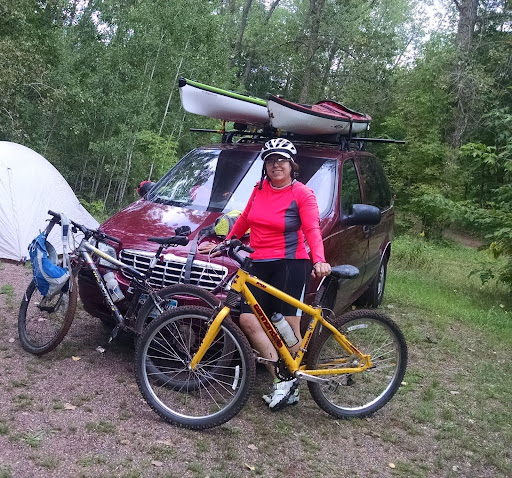
A feisty woman who rarely shies from sharing her opinion, Alice Tibbetts describes herself as “not Minnesota nice and never will be,” which is a quality I appreciate in her. When we first met I said to myself, “I just know this person has been through it.” Alice, now 71, moved to St. Paul in 1977 after growing up in Urbana, Illinois, where she biked everywhere. “The Twin Cities were definitely not as friendly, but because I was a confident rider, I told myself I didn’t need bike lanes to feel safe,” she recalls. “And then I had twins [Patrick and Colin] in 1988, and I decided I wasn’t going to load up two kids and a stroller and whatever else they needed into a car just to go to the park. We were going to walk and bike. That gave me a new perspective on what people need to feel safe. It governed where I let my kids ride for the next 15 years.”
Like many of the folks I spoke with in this Aunties series, Alice says being a parent played a role in her activism. “I wanted my kids to be able to get around and navigate by themselves safely,” she declares. She got involved as a paid consultant to work with the City of Saint Paul, advising on the community process necessary to formulate a citywide bike plan, which originally was unveiled in 2015. She then became involved with Safe Routes to School project, which led to Minneapolis Mayor R.T. Rybak hiring Tibbetts in the early 2000s to draft a strategic plan for the school district and the city.
“Minneapolis was the first big urban district to launch a Safe Routes to School program integrated into the school system, and I take credit for that,” she says. School officials initially told her that families of color would never support it. “But they were wrong and I knew it. Our first two schools to embrace the program were in North Minneapolis.”
Even doing work for which you have a passion “can burn you out,” Alice says. Her longest active-transportation campaign was with Merriam Park Community Council (which later evolved into Union Park District Council), working with the City of Saint Paul for 10 years to get tree-planted medians and painted bike lanes on Marshall Avenue from the Mississippi River east to Snelling Avenue. Their motto: St. Paul is a city of neighborhoods, not a city of streets.
“We got as much done as we could, and it transformed this street,” says Alice, who lived a block north on Iglehart Avenue. “But I told myself, ‘When this project is over, I’m going to sell my house and move.’”
Divorced and with her twins grown, Tibbetts was free to go where she wanted. She chose Duluth, a hilly and chilly place that lacks adequate infrastructure for bicyclists or pedestrians. Noting the difficulty in getting around a city that really didn’t consider the needs of non-motorists, she started We Walk in Duluth, a nonprofit that has since evolved into Vibrant Streets Duluth (a chapter of BikeMN).
Among the group’s first activities: pushing the City of Duluth to enforce its sidewalk snow removal ordinance for both commercial and residential properties. “I ran a frank and assertive campaign,” says Tibbetts, “and the city paid attention,” eventually moving enforcement out of the parks department into the fire department. “What I found funny,” she recalls, “was how many of my allies told me to ‘soften up’ and not be so hard on the city. But I’ve found that doesn’t work. We need to speak truth to power.”
Alice has a knack for seeing the solutions that others often overlook. A recent win is a new Transportation Commission in Duluth (which the City Council passed unanimously in early September), something Alice had envisioned for years. “If you want to build great cities, you build them for women,” she says. “We are the ones out there taking more transit, hauling our kids and groceries around, making lots of the buying decisions, and deciding if our kids can walk or bike to school.”
Getting policymakers and funders to recognize that is difficult at best. “We need to constantly raise these issues,” she told me, “because they never go away. We have to be at the table when policy is set so that we can stop the bad projects before they start. We have to build the cities for families first.”
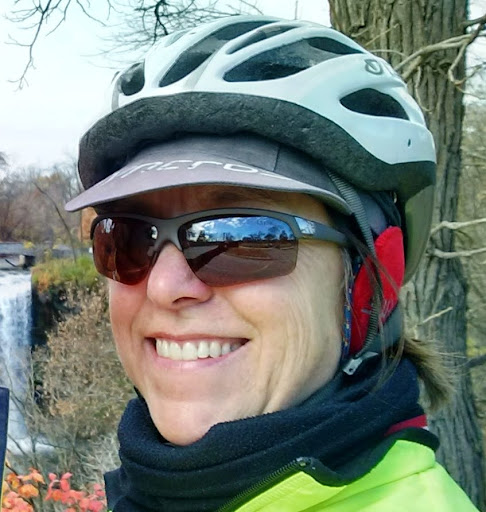
Alice is trying to enjoy her semi-retired life. “I like to sit in my house and look at the beautiful views while I drink my coffee.” She recently bought a more robust e-bike – a Specialized vado SL 5.0 with suspension – that gives her more power and range, plus the suspension helps with Duluth’s “horrible” roads.
But advocates rarely do sit still for long. “We can see flaws in the system. And we just want to fix them.”
Reyna Lopez, Minneapolis
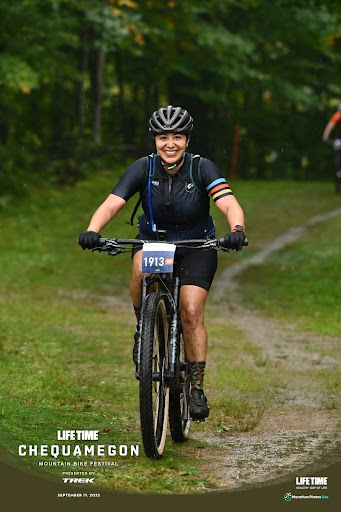
I often introduce Reyna Lopez as ‘“the most glamorous bicyclist” because of her beauty and style, but she is SO. MUCH. MORE. Reyna chairs our board of directors at the Bicycle Alliance of Minnesota (BikeMN), where I am deputy and education director, and I met her in 2021 when she was a newly appointed board member. Reyna has a presence: fierce, energetic, intelligent, thoughtful.
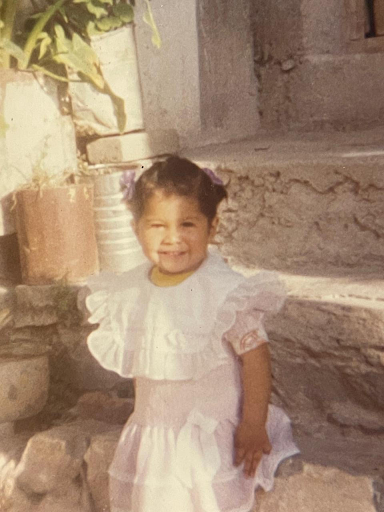
Reyna is from Monterrey, Mexico, and splits her time between Wisconsin and Minnesota since relocating to the United States in 2018. She describes herself as a “bridge” between biking/walking/rolling and inexperienced folks, especially non-native English speakers, by sharing the practice with her community. Her work with Latinos en Bici mn — a bicycling and community-building group that she founded — exemplifies this. “I want Latinos, especially, to learn about biking and getting around here, and learn from one another about where they are from, learn that people can be part of the place, you know? Some people have lived here for 20 years and don’t know how to navigate the trails. I love helping them learn how to navigate the network and feel more confident.” This attitude is exactly why Reyna is one of the favorite instructors for BikeMN’s Learn to Ride program.
Reyna was an active sport and recreational bike rider back in Monterrey, where she met her husband, Marco. When she moved to Minnesota seven years ago with him, she didn’t know anyone. “I really wanted community, to bike and eat, bike and hang out with my friends, connect with other Latinos. Getting on my bike and going on group rides helped me start connecting and meeting people.”
This sense of community building is something Reyna mentioned a lot when we spoke, and it’s clearly a priority through all of her activism. “We can empower communities and vulnerable populations to feel safe and confident, help people realize that we can bike together, we don’t always have to power through things alone. I was able to gain more confidence when I saw other people commuting on their bikes, and Marco and I became a one-car family.”
Reyna sees and experiences the effect of misogyny in active mobility, “As FTWs, we get the advice, ‘Oh, you’re a woman. Don’t go through that part of town, it’s not safe for you,’ but the men in our groups don’t have to face that concern. Lots of us are moms or parents — we need access to equipment, safe ways to get around and knowledge. Community and connection can help with that.”
She also reminded me of the importance of approaching the work with an intersectional lens, considering the many identities that most people carry with them. “For me, it’s not only being a woman. I show up to bike events, for example, speaking Spanish and sometimes people don’t know how to interact with me. I’ve been asked, ‘Oh, who bought that bike for you?’ and I’m like….” She rolled her eyes when she told me this with the “can you believe this guy?” inference that many of us can relate to. “It’s real though, you can’t cubrir el sol con un dedo — cover the sun with your finger. You can’t hide from the big problems.”
Reyna wants FTW folks to feel comfortable and powerful at bicycling and other active transportation events, and make their own choices about how to protect their energies. “If someone is a jerk to you, you can use it as an opportunity to educate them, but you also don’t have to even engage,” she said to me. “I grew up with brothers and was told that women are the ‘weaker sex’ and that inspired me to grow in my power, to hold my own. I’m not afraid to educate someone when they make the wrong assumption about me.”
Knowing Reyna and seeing her in action, I know this is true. As BikeMN board chair, she’s brought in so many different connections to our organization, and I’ve seen her handle tough situations with a deftness and tactfulness rarely matched. Her connections to her community have been vital for expanding our reach and getting more riders at our events.
Though younger than me, Reyna in my eyes is truly an auntie, someone she would describe as “supportive, knowledgeable and will help you do something dangerous. I’ll let you jump out of this plane, but I’ll make sure you have everything you need to land safely.” She is truly a woman trying to make people feel like they are a part of this place — whatever community that may be.
In her spare time Reyna loves hiking, bike packing, reading Brené Browne and listening to podcasts about serial killers.