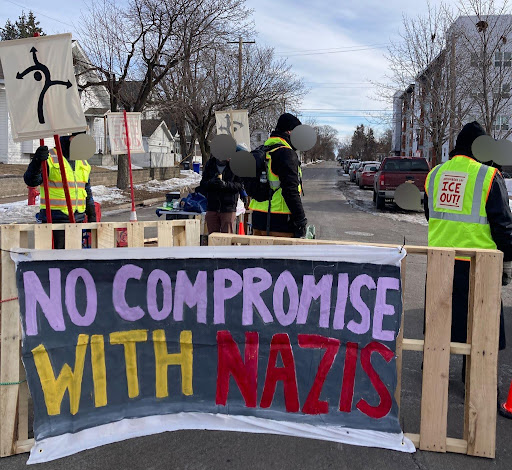
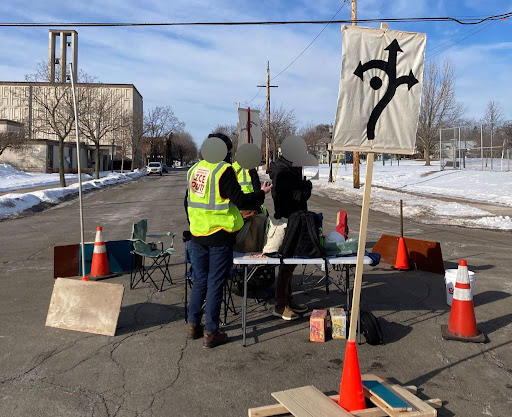
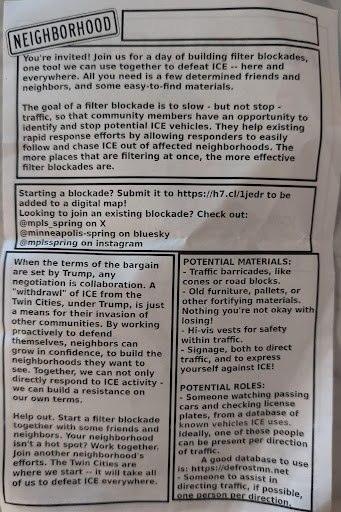
In late January and early February, residents in South Minneapolis erected what they called “filter blockades” at multiple intersections along Cedar Avenue between 32nd and 34th Streets. Using traffic cones, furniture, and makeshift barriers, organizers stopped vehicles, checked license plates against databases, and asked drivers for identification—all in an effort to identify and block potential ICE vehicles from entering the neighborhood.
The practice quickly spread. The Star Tribune reported blockades on Lyndale Avenue, Pillsbury Avenue, and 14th Avenue, with residents describing the actions as “neighborhood meetings” and displaying banners reading “Join Us, Block ICE.” In St. Paul, a blockade was reported near Hamline Park Plaza, though police said they received fewer reports of obstructions there. I personally saw the impact in the neighborhood and on Signal, and for all the hand-wringing, your average National Night Out block party is more disruptive to everyday traffic than these traffic filters.
Minneapolis police and Public Works eventually removed the blockades, citing public safety concerns on “high-traffic and high-speed” Cedar Avenue. But the effort became what the Star Tribune described as “a game of cat and mouse”—residents erected new barricades as quickly as city crews tore them down. Minneapolis officials emphasized their responsibility to “keep our streets open,” while St. Paul police said they would clear any blockades to “ensure that our community has unfettered access to their homes.” But the blockades—which existed for several days—raise fundamental questions about who controls public streets when government institutions fail to protect residents.
This wasn’t an isolated tactic. The blockades emerged aftertwo U.S. citizens, Renée Good and Alex Pretti, were killed by federal agents during Operation Metro Surge, a massive ICE deployment that sent thousands of agents into Minneapolis neighborhoods. As of writing, the operation has been “winding down” to only see this terror campaign foisted upon our suburban and rural communities.Minnesota Attorney General Keith Ellison called the operation “in essence, a federal invasion of the Twin Cities and Minnesota” that “made us less safe.” After a general strike on January 23 that drew tens of thousands of protesters and shut down hundreds of businesses, some residents concluded that if neither federal nor municipal authorities would protect their neighbors, they would have to control access to their own streets.
The Spectrum of Resident Control
For readers of Streets.mn, the Cedar Avenue blockades may sit uncomfortably on a spectrum of community interventions into public infrastructure. We celebrate when residents take matters into their own hands—Alex Tsatsoulis installing solar lights on the darkened Midtown Greenway after years of inaction on copper theft. We organizePaint the Pavement projects where neighborhoods create intersection murals to slow traffic. We champion Open Streets events or bike route projects that close major corridors to cars and turn them into community gathering spaces.
All of these represent residents claiming control over public right-of-way. The difference is permission and purpose.
When Tsatsoulis hung three lights along the Greenway, he was filling a gap in city services—providing basic safety infrastructure the city couldn’t afford to fix permanently. His action was symbolic, he acknowledged, but it demonstrated what’s possible when flexibility matters more than perfect permanent solutions. Paint the Pavement operates with explicit city approval, following specific guidelines about location, design review, and petition requirements. Open Streets requires coordination between city departments, neighborhood groups, and public works to close major thoroughfares.
The Cedar Avenue blockades had none of this permission, as George Floyd Square didn’t years before. They were acts of neighborhood defense in response to what organizers saw as a breakdown of the social contract: when federal agents began detaining residents—including U.S. citizens, families, and children—and killing civilians, some residents concluded they needed to create protective barriers.
The Civil Liberties Trap
Here’s the uncomfortable part: when residents set up checkpoints to stop cars, run license plates through databases, and check IDs, they’re replicating the exact surveillance tactics that make ICE enforcement so invasive. Private citizens don’t have legal authority to detain vehicles, demand identification, or access law enforcement databases. Those actions raise serious civil liberties questions—even when the stated purpose is community protection.
Minneapolis police initially asked organizers to remove the blockades “for fire trucks and ambulances,” but left when protesters insisted they could move barriers if emergency vehicles arrived. The Minnesota Department of Public Safety issued a statement noting that “blocking or barricading public roadways creates a public safety threat because it could prevent or slow police, fire, EMS, or other first responders from getting to” emergencies.
But what happens when residents don’t trust those first responders? When federal immigration enforcement operations involved coordination with local authorities despite questions about sanctuary policies? When federal agents operate with apparent impunity? The blockades emerged from a fundamental breakdown in trust between residents and government institutions at every level.
What Mutual Aid Looks Like on Asphalt
The blockades weren’t just security checkpoints. Photos and videos showed them functioning as community gathering spaces—”block party” style events with music, kids playing soccer, and neighbors connecting. Organizers called for donations of supplies, firewood, and materials to “hold the intersection.” Think National Night Out but around 10-degrees Fahrenheit for the local high.
This echoes the dual nature of many direct action tactics: they’re simultaneously defensive and community-building. Like Midtown Greenway Coalition’s bike patrol program, which provides a “friendly presence” while monitoring for safety issues. Like neighborhood watches that walk streets together. Like cop-watch groups that film police interactions.
The difference is scale and legality. Bike patrols don’t stop traffic. Copwatch observers document but don’t detain. The Cedar Avenue blockades crossed a line by taking physical control of public infrastructure and screening who could pass. And when our institutions fail so profoundly, it’s hard to discount the need for someone to do something.
The Questions We’re Not Asking
Twin Cities urbanists love to talk about reclaiming streets from car dominance. We celebrate European pedestrian zones, we advocate for road diets and bike lanes, we host car-free Open Streets events. But we rarely grapple with what happens when residents reclaim streets for explicitly political purposes without government approval. Remember when the Star Tribune Editorial Board urged Governor Dayton to sign legislation increasing penalties for freeway protests, arguing that blocking highways “presents far more than an inconvenience” because vehicles “have nowhere to go”? The same editorial acknowledged that “protest is foundational to a healthy democracy,” yet concluded that protecting traffic flow from demonstrations was necessary for “the greater good.”
The blockades force us to ask: who has the right to control public space, and under what circumstances? Is temporary citizen control of streets fundamentally different from the way Open Streets has brought nearly 700,000 people to closed major corridors for community events since 2011? Or is the difference simply that one has government sanction and the other doesn’t? And what does it mean when the only way residents feel they can protect their neighbors is by replicating the surveillance state’s tactics? When “community defense” involves ID checks and database searches? When keeping ICE out requires creating another layer of control over who enters a neighborhood?
Perhaps the most damning aspect of the Cedar Avenue and Hamline Park blockades isn’t that residents felt compelled to create them — it’s that they emerged because every level of government failed. Federal agents operated outside of legal limits, and say they will continue to do so. State and local officials filed lawsuits but couldn’t stop the raids. St. Paul police were caught collaborating with ICE on camera, beating observers otherwise protecting innocent people just trying to go to work. Even our hospitals aren’t safe. And as a result, residents (particularly immigrant families) were left to fend for themselves.
In that vacuum, some residents tried to create their own protection. They used public streets as their tool because streets are the commons we all share, the infrastructure we all traverse. When you can’t trust institutions to protect you, controlling who moves through your neighborhood becomes a form of power. And I’d like to think I can trust my neighbors with that power compared to what I’ve seen federal law enforcement demonstrate with theirs.
Where Do We Go From Here?
The blockades are down now, removed by city crews under pressure from federal officials. But the conditions that created them—aggressive immigration enforcement, institutional failure to protect residents, and deep distrust of government at every level—haven’t changed.
Here’s what I believe: I trust in democracy and nonviolence. The residents who erected these blockades embodied both principles. They organized collectively, made decisions as neighbors, and acted without weapons. They weren’t the ones carrying firearms—that distinction belongs to the federal agents whose presence made the blockades necessary. When two unarmed civilians were killed by federal agents, residents responded not with armed confrontation but with traffic cones, furniture, and collective presence.
The blockades revealed something essential: when every institution fails, we have each other. Not as abstract solidarity, but as neighbors willing to stand in intersections together. Operation Metro Surge taught us, as the uprising of 2020 did before, that we need to organize into smaller, more resilient units—block clubs, neighborhood networks, mutual aid structures that don’t depend on institutions that may or may not protect us. The blockades disrupted bus service and created checkpoints that made some residents uncomfortable. Those tensions are real. But streets aren’t truly “public” when federal agents can occupy neighborhoods, detain residents without warrant, and kill civilians with impunity.
Celebrating tactical urbanism means accepting that sometimes residents must act without permission. The Cedar Avenue and Hamline Park blockades belong in that lineage, even if they make some uncomfortable. They’re what democracy looks like when institutions abandon their responsibility to protect residents. They were neighbors protecting neighbors, using the only tool available—control of public space—to create safety that no institution would provide.
That’s the kind of infrastructure we actually need. Not just bike lanes and bus routes, but the social infrastructure of neighbors who trust each other enough to act collectively when our government fails. Our streets belong to us, and when our safety depends on it, we have the right—and the responsibility—to defend our communities together, even if that looks like celebrating National Night Out while in a parka.