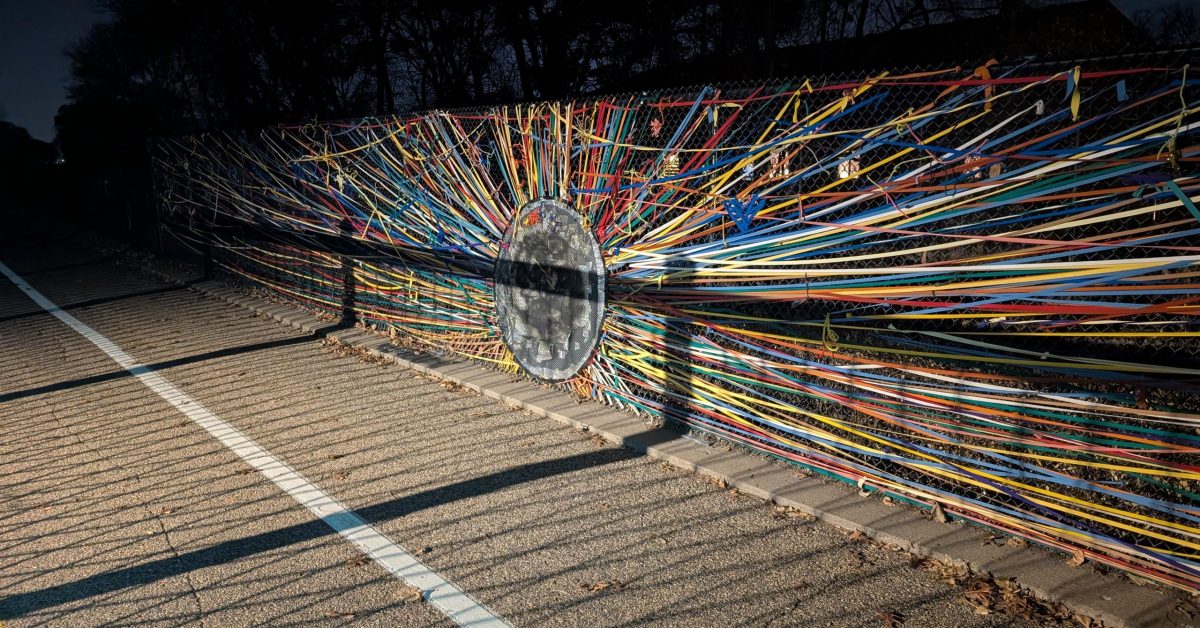
Every evening when I pedal home from work, I enter a tunnel of shadow. The Midtown Greenway — Minneapolis’s crown jewel of bike infrastructure, a 5.5-mile stretch of paved path that thousands of us rely on to get across the city — spends its nights in near-total darkness this time of year. Not because the city didn’t plan for lighting. But because people keep stealing the copper wire that powers the lights.
I ride this route almost daily. My family lives in Hamline-Midway in St. Paul, and I work at a hospital in Minneapolis. Marshall Avenue and the Greenway are my lifelines, the arteries that make car-free commuting possible for me between our Twin Cities. But as fall gives way to winter and the sun sets earlier each week (my regards to the Solstice just around the corner), I increasingly cycle through what feels like a cave. Where there should be pools of streetlight every hundred feet, there’s just darkness broken occasionally by someone’s headlamp or the glow of a phone screen.
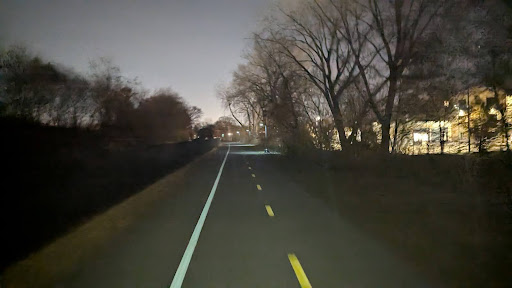
That darkness changes everything about how I move between our twin cities. This isn’t just about inconvenience. It’s about whether working families can actually choose to live without a car. It’s about whether a parent can feel safe biking home after an evening shift. It’s about whether we really mean it when we say we want people to get out of their cars.
The numbers tell a story that should alarm anyone who cares about our municipal budgets. St. Paul spent over three million dollars last year repairing streetlights damaged by copper wire theft — up from $1.2 million in 2023 and just $250,000 in 2019. Minneapolis just committed another million dollars to address the same crisis. We’re hemorrhaging public funds playing an endless game of whack-a-mole with thieves who strip the copper almost as fast as crews can replace it. On one East Side block in St. Paul, Public Works crews showed up nine times to fix the same lights. Nine times.
Como Park looks like a constellation map of darkness when you check the crowdsourced outage reports. Shepard Road downtown — a major arterial — has 250 dark streetlights along a four-mile stretch, all of which are to be replaced in 2026 to the tune of $750,000. Even with new state legislation requiring licenses to sell copper scrap, even with crews welding panels shut and using tamper-proof screws, the thefts continue. Because when copper hits $4.13 per ounce and bare wire sells for $3.65 per pound at scrap yards, someone will always find a way to pry open another panel.
The safety concerns here aren’t theoretical. St. Paul Public Works Director Sean Kershaw pointed to the 2023 death of a pedestrian where a dark streetlight played a role, calling it “a reminder that this isn’t just an inconvenience, it’s a critical aspect of public safety.” When entire corridors go dark for weeks or months at a time, we’re not just inconveniencing commuters: We’re changing the calculus of who can safely move through our cities after sunset. Complaints about dark streetlights in St. Paul rose to 2,573 in 2024, each one representing someone who noticed the darkness and felt unsafe enough to report it.
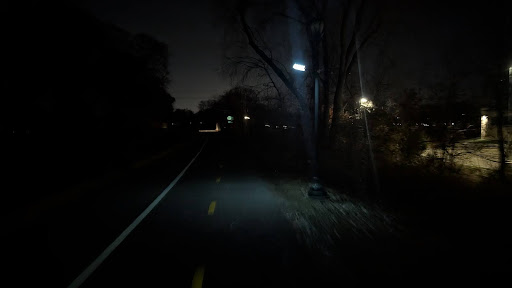
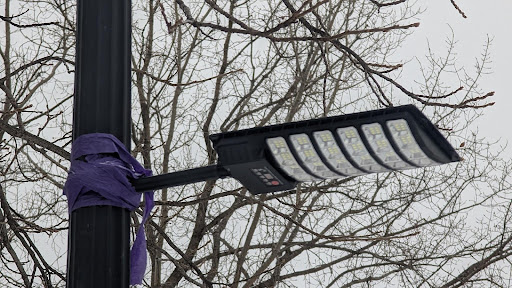
And the Greenway? One cyclist got so frustrated by the darkness that he bought three solar parking lot lights and hung them himself with a ladder. Three lights covering maybe a quarter mile. I took a picture of one, and it was one of the only lights I have down this stretch at night. It’s both inspiring and devastating — a reminder that if one person with a hundred bucks can make a difference, why can’t the city scale that solution? Even if temporarily?
Here’s what kills me about this: We built the Greenway to be safe. We grade-separated it from car traffic. We gave it its own dedicated right-of-way. We made it the kind of infrastructure that cities around the world study and try to replicate. And then we let it go dark.
When people ask why I go on and on about urban infrastructure, this is why. Because infrastructure isn’t abstract. It’s the difference between me feeling confident letting my kid bike to a friend’s house someday, or keeping them trapped in car dependency because the alternative feels too risky. It’s whether someone working a second-shift job or extra shift can safely bike home or whether they need to scrape together money for a car they can’t afford.
This man-made darkness steals more than our sight. It steals choices.
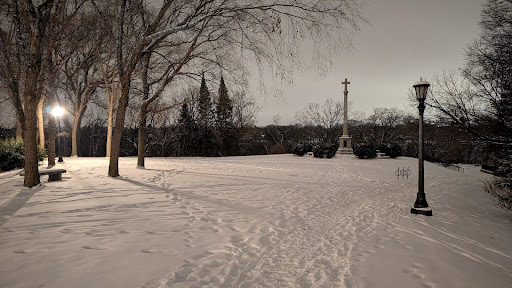
Minneapolis is trying aluminum wiring in some locations since it’s worth less to thieves. St. Paul moved to restrict copper sales. These are good steps, but they’re reactive. We’re still playing defense. Meanwhile, every evening, thousands of us are navigating our commutes in shadow, making split-second judgments about whether that shape ahead is a person, a pole, or a pothole.
I think a lot about guerilla infrastructure: Sometimes you need to try things quickly and cheaply rather than waiting for the perfect permanent solution. That instinct you’ve had to put out your own speed bump, plant that garden in an alleyway, paint that pavement, or put up that official-looking “Drive like your kids live here” metal sign, that’s what I’m talking about. That cyclist who hung solar lights on the Greenway understood something city planners seem to have forgotten: Don’t let perfect be the enemy of the good, and light is better than darkness. If we’re spending millions to replace stolen copper only to have it stolen again, maybe we need to rethink our entire approach for these pedestrian thoroughfares. Solar. Motion-activated. Battery-powered. Temporary. Imperfect. But lit.
Because right now, the message we’re sending to anyone considering car-free life is this: You’re on your own after dark. And that’s not just a failure of infrastructure: It’s a failure of imagination. We can do better. We have to.
Every evening, we ride home in the dark. We shouldn’t have to.
All photos by the author.