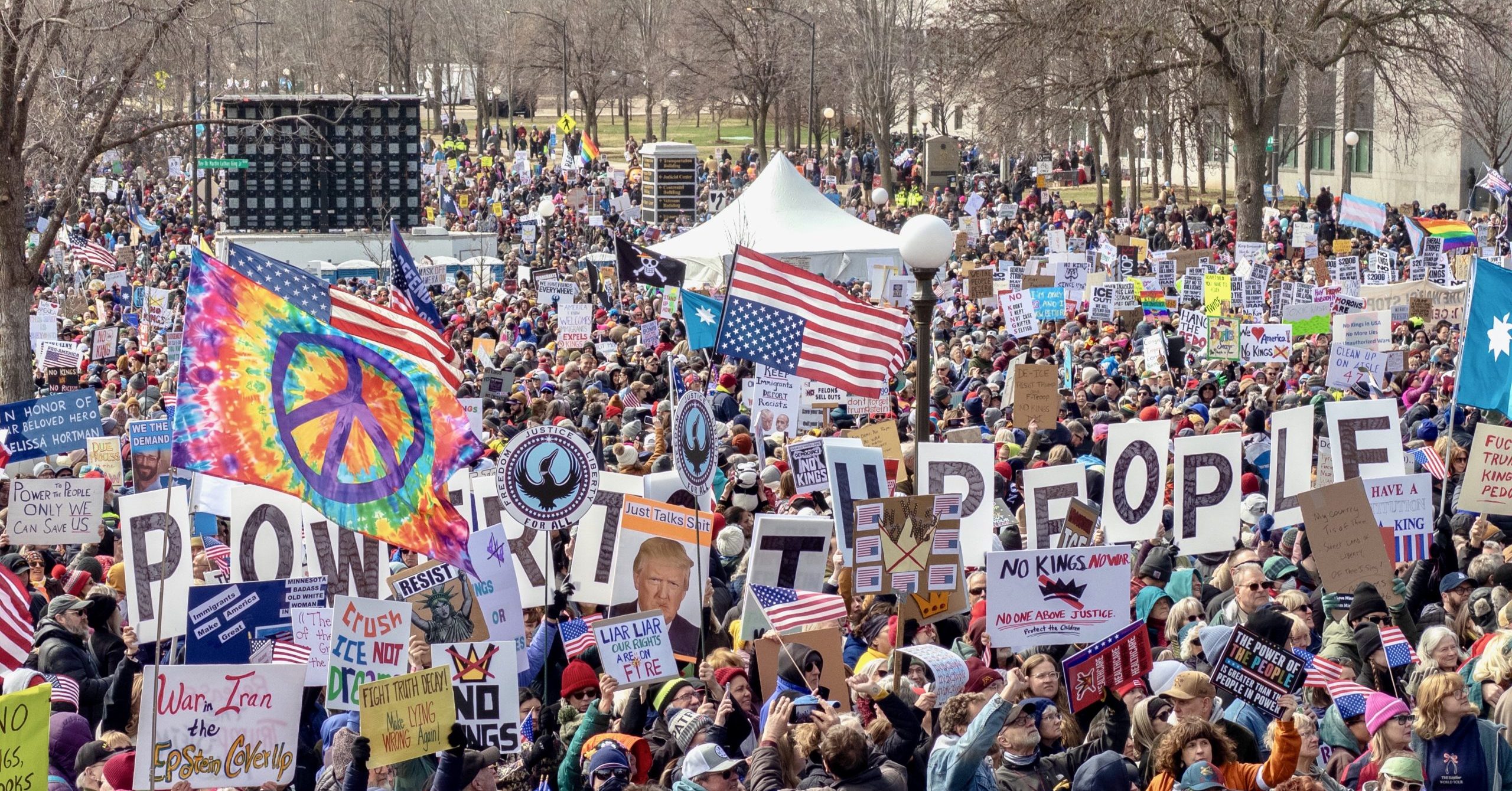
More than 100,000 demonstrators converged at the Minnesota State Capitol on Saturday, March 28 for “No Kings 3” as part of a worldwide simultaneous protest. There were an estimated 8 million attendees. On the front steps of the Capitol, elected officials and local leaders spoke for “radical love” and against the federal government’s Operation Metro Surge targeting local immigrants and the U.S.-Israeli War against Iran that has killed thousands in the greater Mideast region.
As with previous demonstrations in January 2026 and last October 2025, I wanted to document how transportation planning, traffic safety and public transit intersect for a gathering of so many people in one concentrated space in St. Paul, the capital city of 307,000 residents. By comparison, the largest concert venue in Minnesota is U.S. Bank Stadium in Minneapolis, with an expanded capacity of 73,000.
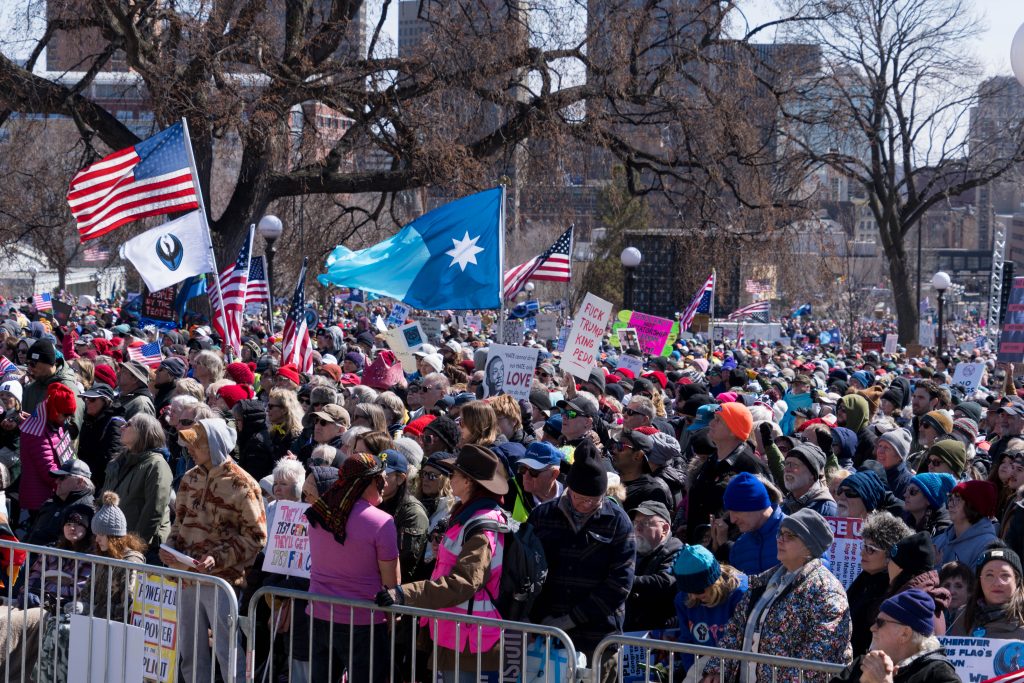
While around 5,000 demonstrators arrived directly at the Minnesota State Capitol by noon, most arrived on the Capitol mall over the following hour, marching from feeder demonstrations, such as those at Harriet Island and St. Paul College. Metro Transit ran expanded three-car trains on Green Line, and there were extra buses in service, especially at the conclusion of the event. Because I was with the media and had about $7,000 in equipment for photo and video, I parked two blocks from the Capitol around two hours before the start of the program.
Minnesota State Patrol troopers blocked off Rev. Dr. Martin Luther King Jr. Boulevard on the west side of the Capitol with squad cars and high-visibility traffic signs. Later on, during the rally, the boulevard and additional streets were blocked off with snowplows as well to offer a flexible roadblock that could allow equipment and structures to be transported on and off the rally site.
My mother parked in Downtown Minneapolis near Target Field and took the Green Line light rail train to the Capitol at Rice Street. She was able to purchase an all-day pass at the senior rate of $2.00, or half-price standard adults. Other friends took the bus from South Minneapolis, including the B Line bus rapid transit along Lake Street. The John Ireland & Marshall Station is next to St. Paul College, where a feeder march was staged.
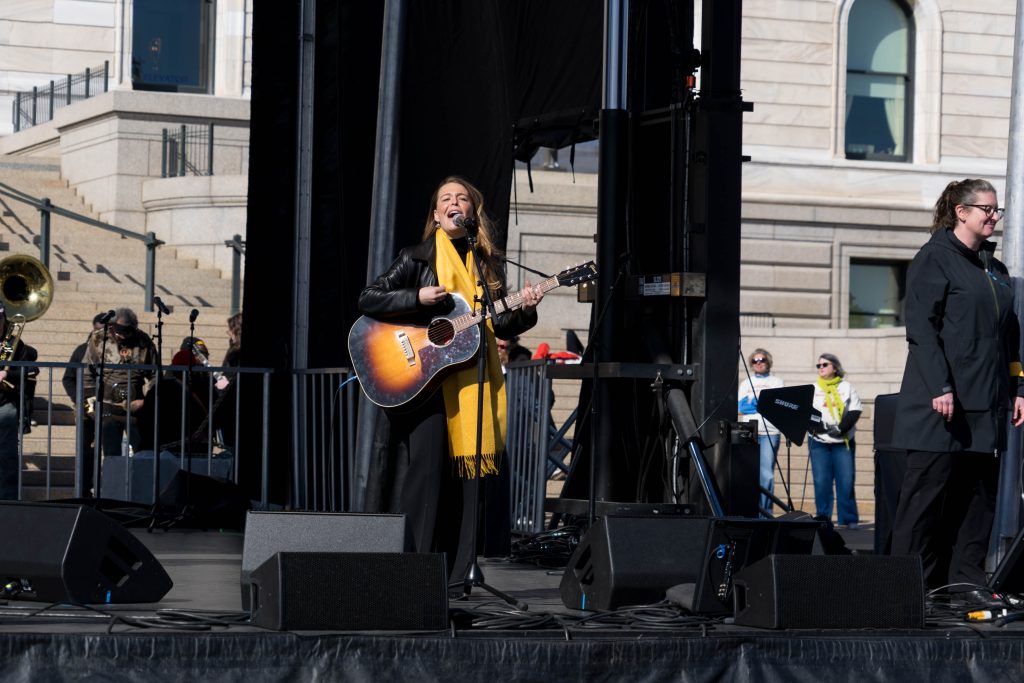
The Capitol grounds offer a wide-open field that accommodates large gatherings like No Kings. Aerial photography showed demonstrators en masse from the Capitol steps to the second radius road. Event planners used video screens and amplified sound at regular intervals to help all attendees hear and see the stage performers and speakers, including Grammy-winners Bruce Springsteen and Maggie Rogers.
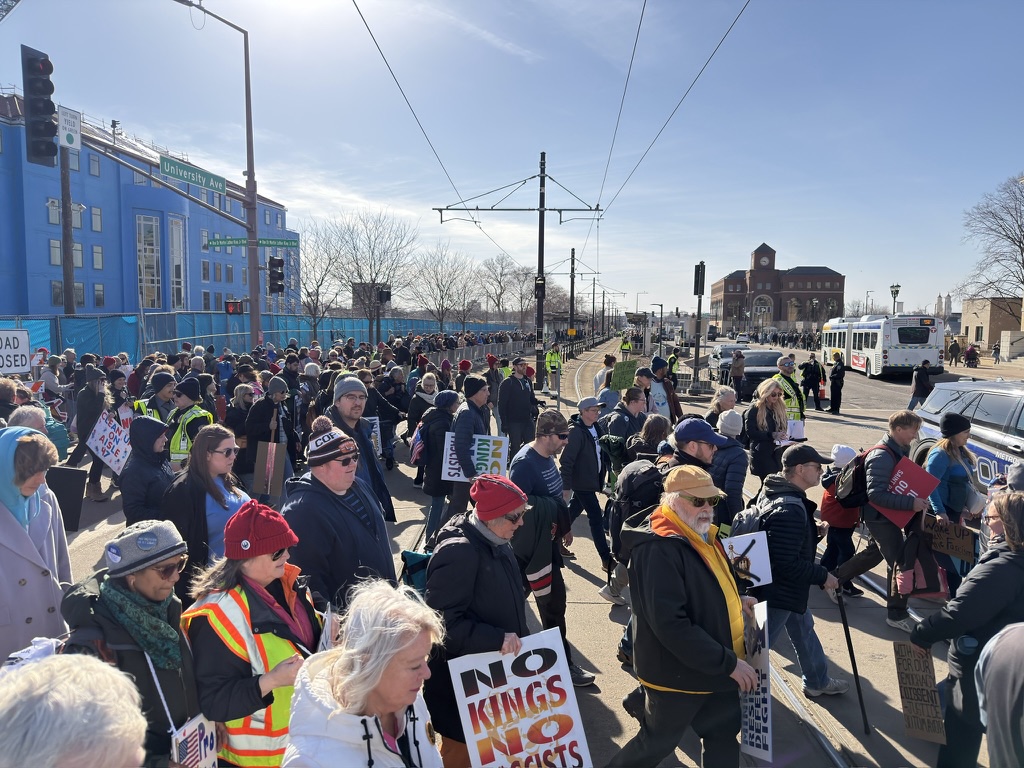
The exodus from the Capitol grounds was more difficult. Troopers created a queue to the Rice Street light rail station. I had texted a map photo of my parking location to my mother in the morning, and so we rendezvoused at my car, then took Como and Energy Park Drive to Dinkytown. Mobile carrier service was nonexistent for most of the rally with so many devices on networks. Organizers used satellite Internet service to create local secure Wi-Fi networks, while broadcast media had their satellite trucks parked near the Capitol. I did successfully use Apple’s iMessage over satellite service with the nearest Globalstar satellite in the northwest sky. It gave me practical reassurance to test out satellite texting in a real-world environment, but it was more practical to send texts with my everyday Earth-bound cell network. Sending the text was only half the distance. My recipient still needed to receive any text messages in the same crowded environment.
It is important to recognize that this test of resilience for public transit is a very rare occurrence, even in a global context. Wembley Stadium in London is the United Kingdom’s largest stadium for any sport, and its capacity is 90,000. Nissan Stadium is Japan’s largest stadium for any sport, primarily baseball, and has a capacity of 72,000. It is difficult for planning staff and decision makers to justify capital infrastructure and operations spending for a level of service needed just a few times per year. Other metropolitan areas that use public transit as the default transportation method are able to expand the envelope of what level of service can be. Average weekday ridership for Metro Transit was 150,276 in February 2026. While attendance numbers vary based on source, having on the order of half a weekday 24-hour period desire to attend one location in St. Paul is difficult with existing routes. If you plan to attend a mass gathering, be sure to plan a rendezvous point with your family and friends. I also recommend downloading an offline map application (like a trail running app) where you can save the United States map in your phone’s storage so that you can navigate even when cellular networks are limited. I use an app called Organic Maps that uses OpenStreetMap data, and then can save important locations like where I parked or where the bus stop is, or where I plan on taking a break or rehydrating. Clear communication ahead of time can save headaches during a large event.
What’s in your bag?
Practical tips for high-attendance events like rallies, concerts, and sports matches.
- Read the rules. Some events like NFL American football games have a specific clear-bag policy. Some concerts have a no-bag policy. Knowing the rules and planning your outfit and gear can save you hassles at showtime. Pro-tip: If your concert has a no-bag policy, encourage one of your crew to wear cargo pants or shorts and use those as a make-do bag for the rest of your team.
- Plan for a sleepover. If you are going to an event, especially one that might end late, plan to bring things that you may need if you need to stay away from home. Common necessities include medication, contact case or glasses, makeup remover wipes and travel size hygiene products. Pro-tip: Buy a screw-top, stainless steel pill case with a gasket. It will not open accidentally, and it’s water resistant, perfect for a rainy night.
- Bring a mobile battery. Many of us have at least a small mobile battery. With ever-cheaper lithium-ion prices, it may be time to invest in a new device. While federal regulations limit travel batteries and devices to a hard limit of 100 watt-hours, the limit does not exist for everyday use outside an airplane. Pro-tip: Many batteries only include amperage (a measure of current). For example, 20,000 mAh (milliamp-hours). If you want to know if a battery is legal for airplanes or actually has better storage, multiply amps by volts to calculate watts. For example 20,000 mAh x 5 volts is 100 Wh, which would be legal for an airplane.


