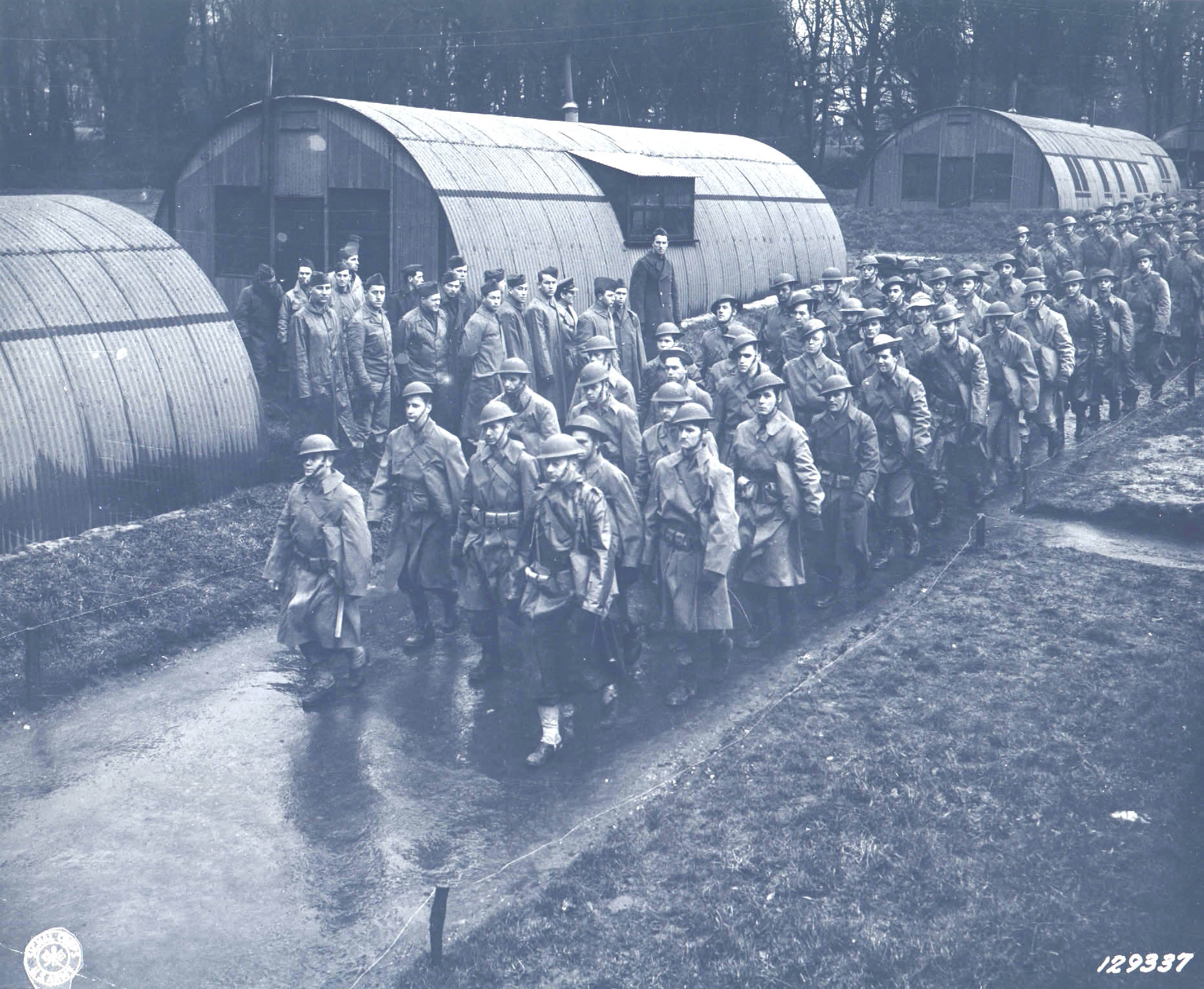
It’s a day that ends with “y”, which also means it’s a day to ruminate on whatever is to be done about the Midway – not just the Snelling ‘superblock‘, but also its surrounding environs along University Avenue – a sea of vacant parking lots, gravel pits, and patches of grass for the better part of this decade. Perhaps out of impatience, or out of desperation, I have thought about methods for infill development that were more expedited than conventional building methods – akin to how protected bicycle infrastructure has been implemented throughout Paris in very short order in part through the frequent use of temporary infrastructure. In the United States, one of the most salient examples of temporary, prefabricated infrastructure takes the form of “a bean can cut in half” – tens of thousands of them – dotting the landscape from the 1940s and beyond.
Across the United States, the end of the Second World War brought thousands of students, and in many cases, spouses and children, to college education – either to continue studies suspended because of the conflict, or to begin studies aided by the GI Bill. With existing college facilities (and college towns for that matter) generally unable to take in the growth, a quick fix was found in the form of Quonset huts, a form of prefabricated building built by the thousands during the Second World War, initially for use as barracks and other military facilities. Their defining feature is their cylindrical shape, a piece of curved steel placed atop concrete or wood pilings. They were lightweight, could be assembled quickly, and without specialized labour or tools. One way to visualize them is to “[i]magine a bean can cut in half.”
Quonset hut developments for college students, using wartime surplus or excess production, appear to have been initially built under the auspices of the Federal Housing Administration, and later transferred to universities, sold privately, or decommissioned. The huts, and other forms of temporary student housing, dotted the American landscape in the years immediately after the Second World War. A cursory regional survey finds examples in Chicago, Cedar Falls, Iowa City, St. Cloud, Cedar Rapids, Minneapolis, East Lansing, Ann Arbor, and with certainty many other towns and cities far beyond these places.
The Case of Pammel Court
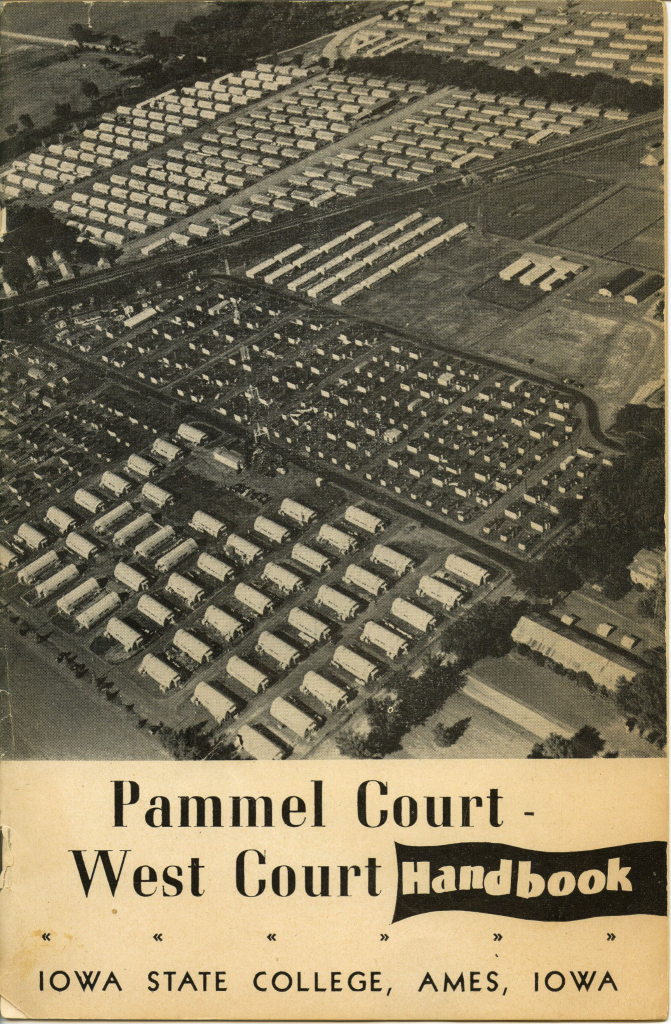
However (as loath as I am to admit this as a Hawkeye), perhaps the most comprehensive documentation of these student housing schemes is Pammel Court, at Iowa State University in Ames. The local history museum provides some figures as to the origin and eventual scale of Pammel Court:
The end of World War II and the return of Veterans to the Iowa State College campus resulted in a serious housing shortage. The fall enrollment in 1945 was 8407, but the following year it jumped to 9216, of whom 1100 were married students … In October 1945 the first steps were taken to prepare for married couples through the acquisition of trailers and demountable houses obtained from the federal government from war production sites where they were no longer needed … In March 1946 a grocery store was erected, utilizing a structure that had previously been a storage bin on the Agricultural Engineering Farm … At peak occupancy, there were 152 trailers, 50 quonset huts (each holding two families), 79 demountable houses, 704 metal barracks (534 two bedroom and 200 single bedroom), and 65 private trailer lots …
Comprehensive archives, from both the university and city itself, present a detailed sense of what life and organization looked like at Pammel Court.
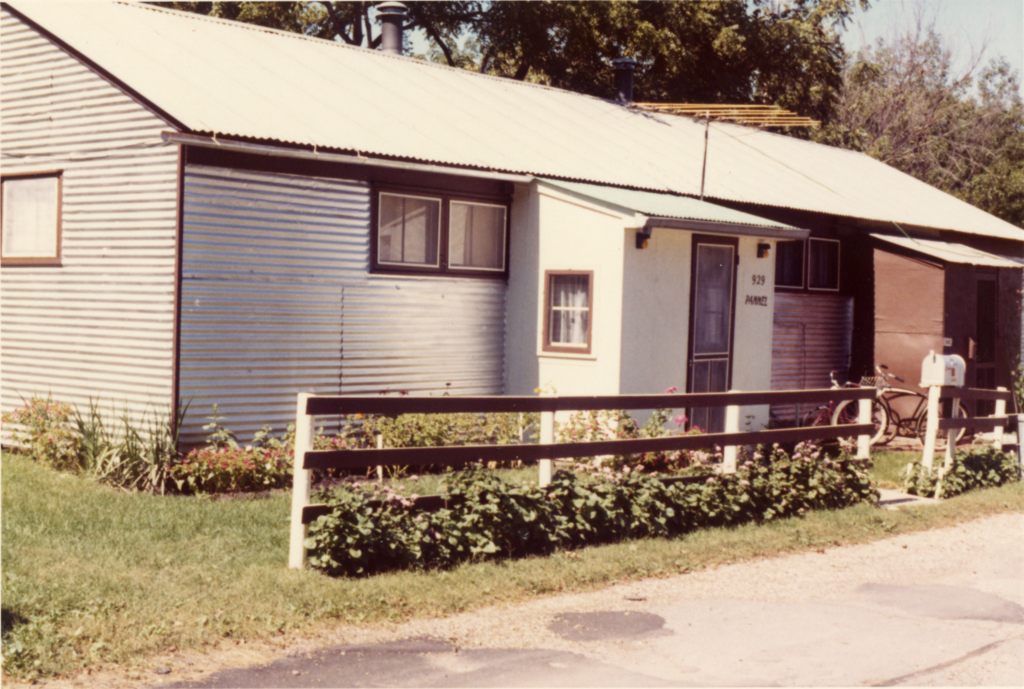
From street views …
To bird’s eye views …
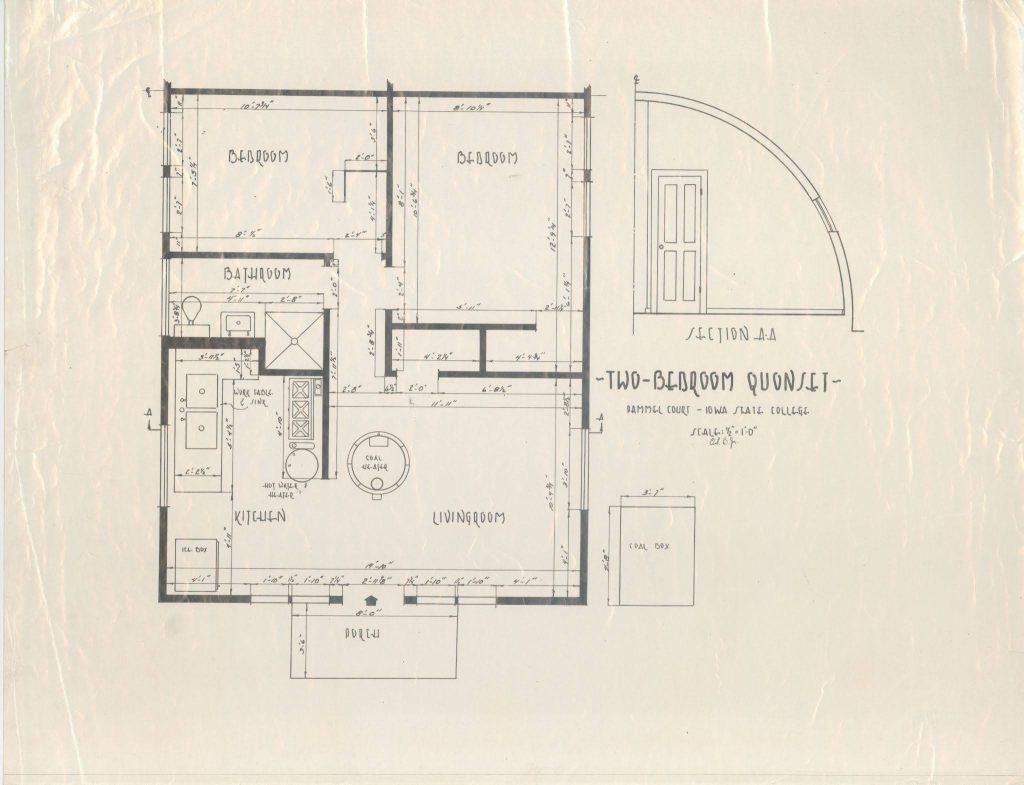
As well as personal accounts of what it felt like to live at Pammel Court.
What does any of this mean for the Midway?
Decades later, I believe that the history of Pammel Court, as well as other postwar student housing schemes, provides some takeaways for contemporary issues in the Midway and beyond – notably in how housing, built “good enough” very quickly, can quench a housing shortage, and maybe even build an urban community at the same time.
Much of the challenge facing the redevelopment of the Midway is in part from grand plans unrealized for a panoply of reasons – perhaps for social or economic conditions, perhaps because of the neglect of private actors – and in the alternative, spaces remaining as little more than patches of grass or gravel for years on end. While hardly perfect, the quonset huts which dotted American college campuses and their vicinities immediately after the Second World War provided crucial space for people to live – who would otherwise be out on the streets, competing for cramped accommodations in existing older housing, or forego opportunities for higher education altogether from an inability to find a place to live.
Lived experiences in the quonset huts tend to reinforce the notion that material perfection is not necessary for adequate (perhaps even memorable) living. Accounts from former residents tend to speak fondly of residents’ experiences in these temporary buildings, in spite of their austere conditions. At Pammel Court, a “sense of community” is recalled from the historical record. From the University of Chicago,
“It may seem that we lived under spartan conditions, but we were the envy of many married students who lived in the neighborhood’s one-room, shared bath-down-the-hall units,” Robert A. Harper, PhB’46, SB’47, SM’48, PhD’50, wrote in the October 2002 University of Chicago Magazine. He and his wife Sally, AB’44, shared a prefab with their baby daughter, Carol. “Moreover, we prefabbers were all in the same boat, struggling to balance school, family, and a bare-bones budget.”
This is not to say everything was sunshine and roses in these buildings however. Buildings appear to have been lightly insulated, if at all – a challenge for both cold Midwestern winters and hot summers (on the other hand, maybe these structures are a testament to the ability for graduate students to live just about anywhere). These structures also demonstrate how “temporary” can be a form of art when it comes to buildings. At the University of Chicago, the “prefabs” were constructed in 1946 and demolished throughout the 1950s (their former site is where the Law School is situated today); in Iowa City, the last Quonset huts were not demolished until 1981. At Pammel Court, the last structures were not demolished until around the year 2000, far in excess of the initial estimated five-year lifespan for the development.
On one hand, the history of Pammel Court is testament to how even temporary buildings can continue being useful in providing housing for people far beyond what projections might suggest. On the other hand, if steel Quonset huts were to grace the Midway along University Ave. for 25-50 years … would that be more or less of an eyesore than what’s currently there? And at any rate, who would be the intended occupants of these huts? Recipients of social housing? Local businesses? Graduate students? From this perspective, Quonset huts on the Midway seem more like a solution in search of a problem.
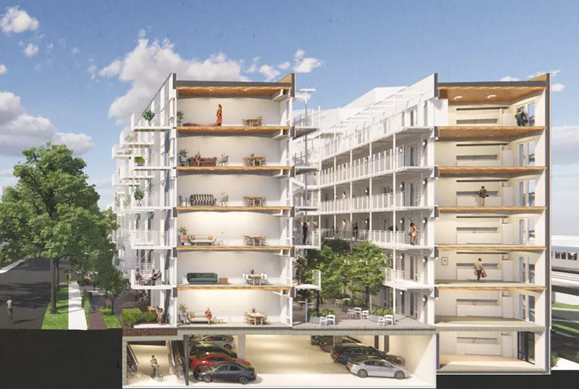
Beyond the absurdity of recalling a time when people lived in steel bean cans – there are better ways to build housing more quickly these days: ways that are more comfortable, and more efficient in an urban setting. In British Columbia, Canada, a provincial state-owned enterprise responsible for social housing in the province, BC Housing, has created a “set of ready-to-use digital building tools and permit-ready designs,”including sample zoning regulations, site assessments, blueprints, modelling, and an online marketplace for building materials, to accelerate the construction of apartment buildings 3-6 stories in height, with 1-4 bedrooms in each unit.
Why bother?
On occasion I’ve wish-casted with compatriots about what an idealized list of shopping options might look like in the Midway recalling the legacy going back to Montgomery Ward – a Uniqlo for the Twin Cities (especially now that Winnipeg has one!), perhaps even a T&T for groceries. However, all of this remains a pipe dream without a sufficient flow of customers for commerce – a tall order at time of writing, given the inauspicious closure of the Midway Cub last summer. In a tangle of local challenges – demand for commercial activity, municipal finances, justifications for the siting of infrastructure – part of the culprit is not enough people residing in the urban core, and thus walking around, shopping, and paying taxes in Saint Paul. More housing nearby – any housing – would do some good to put a dent in this matter. A temporary concrete barrier is to Parisian bicycle infrastructure as a [bean can cut in half] is to housing in the Midway?
The experience of the Quonset huts also reiterates some of the virtues of urban living, with the population density of rows of huts packed closely together acting as an unusual way to arrive at “smart, walkable, mixed-use urbanism“. At Michigan State University in East Lansing,
According to Edna Brookover’s memoirs about living in the Faculty Quonset Village, she did admit that she cried after visiting campus and learning she would be living in a Quonset Hut, but after moving in and settling into her new life, she enjoyed it. She talked about how the Village was a true “cosmopolitan community” with all the various people and children interacting with each other. As stated by Brookover, “there was always a friend around and a pot of coffee ready at most neighbors’ homes. One could always borrow an egg, a cup of sugar, or whatever. We learned to share. We formed car pools, baby sitting leagues, etc.”
In the current year, I don’t think that a ‘good enough’ housing or infill development solution necessarily ought to look like rows of steel huts plopped wherever there’s an empty lot. But I do think the circumstances and history of the humble quonset hut and college students – from the combined government interests in higher education and housing, the “chaotic good” of how these developments were assembled, just how quickly they were put together, and the communities that were formed by those who lived in the quonset huts – are instructive in how we might go about addressing the challenges of today.