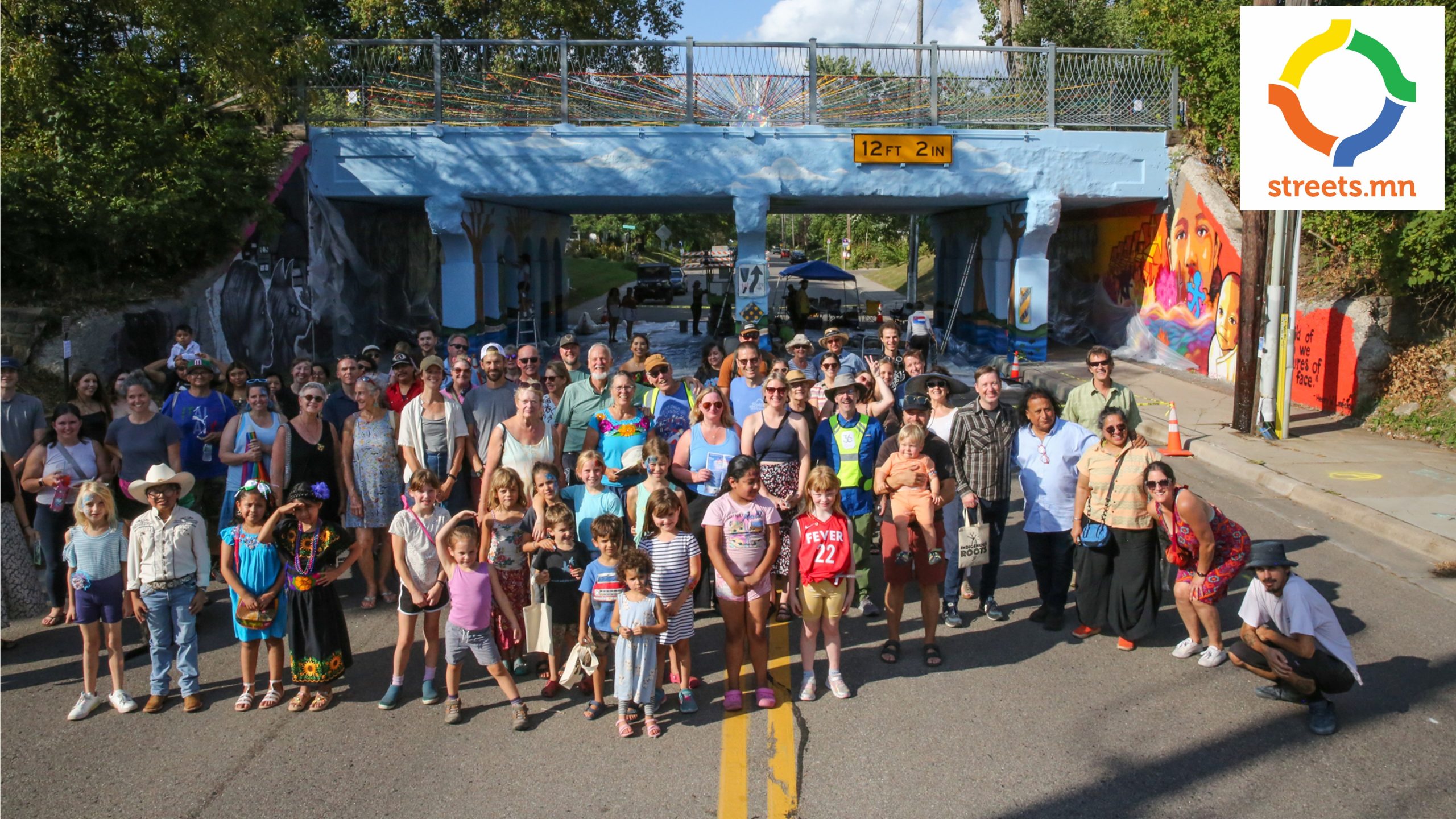
What happens when a group of artists notice that drivers are traveling dangerously fast through their neighborhood? They organize and fundraise to paint a huge mural under a bridge, of course!
Links
Attributions
Recorded, edited, and transcribed by Ian R Buck.
Music: Puck’s Blues by Erik Brandt and the Urban Hillbilly Quartet.
Many thanks to Jack Becker, Zac Barnes, and Don Howard for making this video possible!
Transcript
[00:00:13] Jack: Here’s the River Memory murals under the 36th Avenue Greenway Bridge painted in two phases. In 2023, the two walls along the sidewalk were done with a group of artists working with students from the Hiawatha Collegiate High School.
[00:00:36] Ian: I love that we had the rocket there as part of the mural.
[00:00:40] Jack: And the rocket’s now a landmark in the community and portrayed in the mural. So because the bridge is actually the dividing line between Seward to the north, where we are now, and Longfellow to the south, the theme of the two murals on the walls are Seward and Longfellow and a little bit of their history, a little bit of their housing stock, a little bit of their characteristics. The students did all this research on the context. And then they got some great graffiti artists to create the Seward title on one side and Longfellow on the other. And then, of course, after those two murals were done, it just made the rest of the bridge look that much worse. So before we take off, there’s a whole background story of even how this whole thing got started and all the work that went into planning and trying to get the funding for the artists and forge a partnership with the school and the fact that the school had a public art club, which I didn’t even know about until I went there to vote. And then they said, well, we’d love to have our public art club work with you on the bridge mural, but that’s too much time. And they’re just an after school thing. And what you really need is a public art class. You know, if there’s a teacher who wants to do a public art class, you’d be all set. And then they introduced us to the guy who runs the maker space in the school. And he goes, “I’ll do a class.” And so we had the very first public art class in a high school in Minnesota right here. Take on working with this group of artists to do the two walls in 2023. And it took three months and it took about $36,000. And these students were amazing and they worked with the artists and they developed all kinds of skills and they learned how to do stencil work and work with spray paint, you know, aerosol. And they worked on design and they researched, like I said, the neighborhoods, Seward and Longfellow. “Longfellow, who’s what’s that?” Well, it’s after Henry Wadsworth Longfellow. So that’s why Longfellow is in the mural and a quote from him on the Longfellow side. Oh, interesting. Yeah. And on the Seward side, there’s other things that you could spend a lot of time just going and photographing or videotaping, because as we’re cruising under it, you’re just going to get the drive by and you won’t capture most of the detail that the artist put into it. You know what I mean? That’s more of a slow stop, walk, talk, kind of a situation. So then, because like I said, after those murals were done, everybody loved it. We thought we got to do the rest of the bridge. So I said, all right, I’m going to see if we can find funding because here we’ve got momentum. If we could find funding to do literally the whole rest of the bridge, the front, all the pillars, even the ceiling underneath the bridge.
[00:03:47] Ian: Yeah, I remember it was all gray before.
[00:03:49] Jack: You’ve got to power wash it, you’ve got to prime it, you’ve got to then paint it. The only way to paint the underside of this bridge, I figured out just like in the middle of the night, I go, “I know how to do this. It has to be a paint-a-thon!” One weekend where we could just close down the whole street. And is there anybody, is there any artist that could do a paint-a-thon? Turns out there is a team of artists who are right here in Seward in the Ivy Building who do these paint-a-thons.
[00:04:22] Ian: Usually much farther away from home.
[00:04:24] Jack: Usually, and it happens to be led by an indigenous artist named Thomasina Topbear. And she goes, “I could do that.” And she proposed it and we hired her. And then I had to go out and raise a bunch of money, which took a lot longer than I thought. And we raised about $40,000, of which about $35,000 went to all the materials and all the labor. And you’ve got to block traffic, you’ve got to rent these street closure things. And we wanted a festival by the bridge for the final day of the paint-a-thon.
[00:05:01] Ian: I mean, once you go to all the effort to close down the street and have a permit to do that and everything, you might as well have a party, right?
[00:05:08] Jack: It was partly that. It also just happened to be coincidence. Because we picked September 14th and 15th, and looking on the calendar, what’s going on that weekend? It turns out September 15th is the first day of National Hispanic Heritage Month. And the school is made up of 90% Latinx students. So they were all on board to do some sort of launching of Hispanic Heritage Month and they gave us their parking lot. And we worked with a group out of St. Paul called Indigenous Roots to organize this festival, which took place while the artists are continuing to paint on Sunday afternoon, right? And they said, “well, we’re not done yet, Jack. So we’re just going to keep working till midnight,” because that’s when we had to take the barriers down.
[00:05:52] Ian: They seemed pretty sleep deprived by then. Yeah.
[00:05:56] Jack: And of course, I have to mention the week before September 14th and 15th, when the paint-a-thon was going to take place, is the Greenway Glow. And the Greenway Glow is, as you know, anybody that wants to propose a project on the Greenway, want to do some kind of yarn bombing on the fence on top of the bridge for the Greenway Glow. And it’s the week before, maybe the county will just let us leave it up. So it would be up during the paint-a-thon.
[00:06:28] Ian: Yeah, yeah, yeah. And it’s still up now.
[00:06:29] Jack: And it’s still up because the county decided, well, we’re not getting any complaints, so go ahead and leave it. Yeah. So that’s how the fence got done. And of course, I wanted to make sure the artist that was doing the bridge, Thomasina, the artist, was fine with my idea for what I wanted to do with the fence. And as you can see from here, there’s a disc in the middle. It’s sunshine on the other side. It’s moon on this side. And all of the fabric ribbons are raised coming out of that, which anybody could come and help do. So we had hundreds of people come and help add those lines out from the disc in the middle and attach it to the fence.
[00:07:11] Ian: I’ve never noticed the moon before because that’s on the side that faces towards the train tracks. And I’m typically not on the train tracks.
[00:07:18] Jack: And as you get closer, it disappears.
[00:07:20] Ian: Right. Yeah. But from down here. Yeah. Yeah. And I have to admit, like, I do not come under the bridge very often.
[00:07:31] Jack: Yeah. And it’s dangerous with cars and bikes on this bridge. So here you might want to scan left and right slowly. And then you’ll notice the murals on the side with the names of the artists, the students involved. And then as we go under the bridge, you get the full effect looking up and see the clouds and the trees on the columns. And then you see the effect of the mural coming through the columns. And it’s a constantly changing visual that most drivers can’t appreciate because they’re going straight ahead and usually too fast.
[00:08:11] Ian: And that’s kind of the idea here is using public art as a traffic calming measure.
[00:08:18] Jack: It was one of our goals for sure. Yeah.
From the 36th ART May 2026 newsletter: Defaced Mural Restored, Artist to the Rescue!
Portions of the River Memory murals were badly defaced in early November, about 2 years following their creation. 36th ART quickly developed a restoration strategy and contacted Peyton Scott
Russell. He was the lead artist with SPRAYFiNGER, who worked closely with students from Hiawatha Collegiate High School to design and paint the two 80-foot walls under the bridge. With help from Longfellow Community Council, we set up a GoFundMe campaign, which covered the cost and allowed us to start a maintenance fund. We’re very grateful to the dozens of community members who supported the restoration of the murals. Special thanks to Peyton for his artistry, generosity and speedy response!
[00:08:41] Ian: So this this was kind of the first iteration of that. Yes. Yes. And the organization, 36th Art, you know, the name kind of implies that you’re going to be taking this further. Are there other projects along 36th for utilizing public art in this way?
[00:09:02] Jack: So the group that formed to do something about this bridge decided to start taking on the rest of the corridor from 25th Street all the way down to Lake. And the name 36th ART was really short for 36th Avenue Revitalization and Transformation. And I had a familiarity with this corridor already because I was the project manager on the Bracket Rocket. This project that went up in 2007. And now the group wants to focus on how do we get lighting on this rocket ship? And I’m working with somebody to help us figure it out with solar powered light.
From the 36th ART May 2026 newsletter: Rocket Lighting Event! Saturday, September 12 4-10pm.
36th ART is hosting a Brackett Park Rocket Lighting event during the Greenway Glow Festival in conjunction with the 3rd annual yarnbombing of the fence atop the bridge, led by Jack Becker. We are seeking artists to help illuminate the rocket in a variety of fun and entertaining ways, including multi-colored projections, LED string light programming, and a youth-orchestrated flashlight flash mob, accompanied by dramatic lift-off sound effects and billowing steam. Imagine the Brackett Rocket “taking off” while a circle of community youths—using colored gels over their flashlights—simulate a fiery lift-off! Plans call for a community potluck picnic, a bonfire, live music, and lawn games (permit pending). Special guests will include Randy Walker, the artist who created the sculpture Return Journey in 2007 using the original rocket ship that stood for decades in the playground. Stay tuned for details!
[00:09:42] Jack: And there was vacant storefronts down on Lake Street. And they said, is there anything we can do to make that corner look better? So we started looking at ways that artists could transform that storefront. And they ended up putting a fence around that building. And I organized an exhibit of art on the fence around the building. But you could see this avenue has some interesting characteristics. One of them is 36th Avenue. It’s a little wide. And cars will tend to speed when there’s a lot of width to work with, especially in this stretch right here where there’s no homes. And there’s just the park on one side, the school on the other. It’s like just hit the gas pedal and head under that bridge. Even the city buses go 40, 50 miles an hour sometimes. So we started thinking of other ways we could use public art to start calming the traffic. You know, because we complained to the city and other neighbors complained to the city about cars speeding around this neighborhood. Some of which was actually caused because there’s a lot of teenagers at this school who park around here. And you know how teenagers are with their cars. And a lot of the neighbors are complaining because some of the students were parking blocking their driveway or whatever. So it wasn’t a big surprise that enough calls came into the city with concerns about traffic and safety. That the school actually became a venue for a community meeting with our city council member. Some public works traffic engineering folks and others to have a little discussion around traffic safety in this area. So we thought as 36 ART. Well, this is a great opportunity.
[00:11:37] Ian: I don’t remember if it was the United States Department of Transportation or if it was one of the state ones. But some, you know, traffic engineering, you know, and safety kind of entity declared that like using painted crosswalks was not allowed. You know, it was like, oh, that’s going to be too distracting for drivers. That’s not going to be safe, even though the whole goal of, you know, doing that kind of project was let’s indicate to the drivers like, hey, you’ve got there’s a lot that needs your attention here. You should slow down.
[00:12:13] Jack: Not to distract, but to attract their attention.
[00:12:15] Ian: Right. Right. Did did 36th ART like encounter any pushback from official sources about like, “oh, yeah, we can’t we can’t have you painting stuff this close to the street. Otherwise, it’ll be too distracting.”
[00:12:30] Jack: Yeah, that’s a really good question. And here’s a big bump right here. I was frankly, I was frankly a little surprised that nobody did bother to say anything about what doing a crazy mural. They didn’t even know what it was going to be, under the bridge might have as an effect on the traffic. Yeah, yeah, yeah. So isn’t that interesting, right? Like they could have and they maybe should have. But we weren’t doing a crosswalk and we were definitely beautifying what was really a century old bridge. Yeah, yeah. And it didn’t have any lighting under it either. So we also petitioned the city and the public works department to add lighting. There are some things that can be done legally and there are some things that could be done just on the fly. Like, could we just put a bunch of, you know, signs along the sidewalk that motorists would see? Remember the Burma shave commercials? You know, there was a poem with four lines and the last sign was, you know, something to do with Burma shave. But it got drivers attention to read the successive lines of the poem with a little joke at the end.
[00:13:42] Ian: Yes, yes, yes. I’ve seen that kind of thing a lot of times on like people’s farmlands. They’ll have several different signs in a row.
[00:13:50] Jack: Right. Yeah, right. I got fascinated as somebody who’s spent their whole life and career in the public art field, wondering if there had been any studies about public art and its effect on traffic coming, intentional or unintentional. And turns out there are no studies. There have been studies about these crosswalks, as you were mentioning, and now Bloomberg Philanthropies has a national program for helping communities that want to do paint the pavement and asphalt work.
[00:14:30] Ian: Sorry, just getting footage there.
[00:14:35] Jack: So I reached out to a former colleague, Tom Fisher, who runs the Minnesota Design Center at the University of Minnesota. He’s like he knows so much about transportation and autonomous vehicles and his program at the U. Actually puts students to work on urban design issues, right? And they were involved in a project when I called him to help the city deal with the reopening of Nicollet when the Kmart comes down. And so these students would do research on that kind of situation and what’s been done elsewhere to help inform the city and developers as to what could be done on Nicollet. Right. So I asked Tom, “is there any studies on public art and traffic coming? And would that be something you guys and your Minnesota Design Center students would be interested in researching?” And he said, “well, when we’re done with this Kmart project, we actually have an opening. And I think that would be interesting. And it would be great to get the students at the school involved. Maybe they could help monitor the traffic speeds and stuff like that, like the before and after.” Right. It turns out a statistics teacher at the school got very excited about having her students do this data collection. Traffic on this corridor, which we’re right on top of now. And I got super excited about the idea. And then one of the one of the team members said, “well, I’ll start collecting data on any research and any project that’s ever been done on public art and traffic calming.” And I started drooling on just that because I’m a geek when it comes to public art. I want to know examples of what’s worked where and what kind of impact did it have? And any any example of something that worked elsewhere might be a thing we could try here. So that’s what got me excited.
[00:16:30] Ian: Data driven approach.
[00:16:32] Jack: And 36th ART was thinking, well, what we do here might be a benefit to other neighborhoods that have issues with their traffic in their neighborhoods and safety. And how can we help collect data on what we’re doing so that we can not just say, “well, we did this project and it’s really cool.” We could actually say, “and it actually had this impact.”
[00:16:51] Ian: Right. But, Jack, how could you possibly get the word out about this?
[00:16:57] Jack: [laughter] That was a challenge. Thank goodness, one of our team members, Zac Barnes, thought, I wonder, I just wonder if that podcast guy would be interested in this. And I thought, well, if if the University is doing a study and they’re going to put out a report, that would be really worth checking out.
BREAKING NEWS: The University team just released their report on July 10! It comes complete with a traffic study, student workshop, and recommendations for traffic calming measures. Link in the show notes.
[00:18:17] Jack: So this is Jack Becker, 36th ART reporting from the Midtown Greenway. I’m here talking with Don Howard.
[00:18:26] Don: Hi, Jack.
[00:18:28] Jack: Don, what are we riding in?
[00:18:30] Don: Well, this is what we call a trishaw. This is a group, a local chapter of an international organization called Cycling Without Age. And my short form of saying what we do is we’re volunteer cyclists who provide free rides to seniors.
[00:18:51] Jack: And seniors means anybody over the age of 65?
[00:18:57] Don: Yes. So we provide rides really to anybody who wants to take a bicycle ride but has mobility challenges and can’t ride the bicycle themselves. So it’s just a great opportunity. Yes, seniors can be sort of our typical group that we give rides to, but we don’t limit it to that. We’re called Without Age and we take that literally. It doesn’t matter what age you are. As long as you want to take a ride, we’ll provide it.
[00:19:29] Jack: So “trishaw” play on “rickshaw,” which is a form of transportation with the driver in back and the riders in front.
[00:19:37] Don: Yes. And “tricycle.” Tricycle and rickshaw, trishaw.
[00:19:41] Jack: Yeah. So is there a difference between this trishaw and what I think of as a pedicab?
[00:19:50] Don: Well, we do this for free. We do it because we want to promote this great way of social transportation. You might get that sort of that same benefit from a pedicab, but we’re all about sort of free ride. We also just have a bunch of volunteer cyclists who enjoy sort of the, you know, sharing their love of bicycling, enjoy the time of storytelling.
[00:20:27] Jack: Right.
[00:20:29] Don: So yeah, I guess that’s the difference.
[00:20:31] Jack: They get to bike and help somebody.
[00:20:33] Don: Yes. And, you know, part of what I say when I’m talking with volunteers or potential volunteer cyclists, is I say most of us are happy making other people happy. And that’s just a phenomenon that totally happens in this on these rides.
[00:20:56] Jack: Right. I could totally relate to that. Driving an art car, I spread joy just by driving around.
[00:21:02] Don: There you go.
[00:21:03] Jack: And I volunteer by delivering surplus food from the co-op to a food shelf. And it’s the easiest volunteer gig ever. And when I show up with my art car and free produce, I get, you know, high fives and smiles and it’s a great feeling.
[00:21:21] Don: It’s worth every minute.
[00:21:23] Jack: Well, it must be really rewarding. I mean, you’ve spent a lot of time working on this.
[00:21:28] Don: Yes.
[00:21:28] Jack: How many volunteer bike, bicyclists do you have?
[00:21:33] Don: We have about 15.
[00:21:35] Jack: Wow.
[00:21:36] Don: And they consist of people who are retired, who have more time, more control over their schedule. Also, you know, nine to five-ers who might work on the weekends. Yeah, everybody from young people to not so young. Really, if they like to bike and they like to have this mode of social transportation, it’s a great fit for them.