In 2013, my rent for a one-bedroom apartment at the Marshall Co-op in Dinkytown, built in 1963, was $900 per month. Over 12 years later, the next apartment down the hall, also a one-bedroom around 543 square feet, rented for $1,000 per month. If the price of rent at the Marshall Co-op had risen at the price of inflation, the current rent would be $260 higher. In an economy strained by high inflation on everyday expenses like groceries and gas, the lack of that same inflation in housing rent over decades is remarkable.
According to the Zillow multifamily time series for the Minneapolis-St. Paul metropolitan area, rent inflation in the Twin Cities has averaged 3.2% over the last 11 years. That is very near in line with overall U.S. inflation. By contrast, the index for single-family homes in the Twin Cities has risen on average 5.2% per year over the last 11 years. The home value for a typical single-family home in the Twin Cities has risen 164% since data started in 2000, according to Zillow.
How did the neighborhoods surrounding the University of Minnesota in Minneapolis beat housing rent inflation? Part of the story is building new apartments. Another part of the story is multi-tenant single family homes and apartments that were legalized. All these solutions were spurred by policy changes at the city level. Collective legislative action and private investment powered one of the largest increases in residential population in the history of Minneapolis, all while keeping rents for preexisting apartments relatively stable.
ZIP Code 55414
American Community Survey estimates published by the U.S. Census Bureau paint a picture of the overall demographic changes in ZIP code 55414, which includes much of Dinkytown, Marcy-Holmes, and Prospect Park. From 2013 to 2024, the resident population increased from 27,702 to 35,007, or more than 26%. The wave of new apartments built over that decade housed over 7,000 new residents. Likewise, the tenant share of residents increased, from 81.5% in 2013 to 87.4% in 2024. At the same time, median earnings doubled, from $12,470 in 2013 to $26,621 in 2024. While any new sources of income are not represented in data, the overall buying power of resident students helped fund more housing. Less than half of median income for Hennepin County may seem incredibly low for working adults, but most undergraduates have funding through grants and loans, both public and private. The undergraduate population turns over every year, and the new undergraduates arriving in 55414 had more buying power to afford new apartments than previous students.
These changes in population were not driven by an influx of international students. In fact, the share of residents who were not U.S. citizens (separate from foreign-born overall) dropped from 14.0% in 2013 to 10.8% in 2024. International enrollment at the University of Minnesota has struggled since the COVID-19 pandemic. The fall 2020 incoming international class was 14.2% smaller than the year before, and has recently plummeted with changes in immigration policy starting in 2025. The overall share of foreign-born (which would include staff and faculty who are naturalized) also dropped, from 18.4% in 2013 to 16.5% in 2024.
The total number of all housing units in ZIP code 55414 — including single-family, one-bedroom, and even five-bedroom apartments all counted as single units — increased from 10,371 in 2013 to 16,410 in 2024. The average household size (all residents in a housing unit), decreased from 2.67 in 2013 to 2.13 in 2024. That means it would take over 25% more apartments to house the same number of residents, even if the residential population did not change. This shrinking of households is potentially caused in-part by the doubling of resident median income. With more income and funding from grants and loans, student residents could afford to have fewer — or zero — roommates.
These changes to population, housing, and demographics were not a fluke accident. A number of incremental changes to housing policy have unleashed an apartment boom, while pushing down the inflation-adjusted rents of older apartments.
More Roommates, Lower Rents
One change was legalizing “intentional communities.” The best record of this debate from 2016 is at Wedge LIVE!, and thank you to John Edwards’ journalism for keeping a better record than the City of Minneapolis. Before the zoning code change in 2016, lower-density districts like those in the single-family housing of Marcy-Holmes had a cap of three unrelated residents living together. Essentially, only three roommates, or a couple and one roommate. But not four roommates. In illegal practice, many homes and quasi-frat houses in the Marcy-Holmes area had many more residents, but there was a pressure to design homes as actual apartments and limit the number of residents per keyed door.
As the Wedge LIVE! post mentions, there was spirited debate around who these changes helped and who was left out. The effective result of all these changes is that it is now more tolerated, even if not always by the book, to have a greater number of cohabitants who are unrelated in single family homes. While this did not directly lead to construction of new housing units in 55414, it was a level of legislative power to expand the effective housing supply for tenants who would like to split costs and live together in older, existing housing that was not designed as a duplex or other multifamily housing. While the overall average household size in 55414 decreased, the household size in these older homes could potentially increase as compared to before.
Minneapolis 2040 Comprehensive Plan
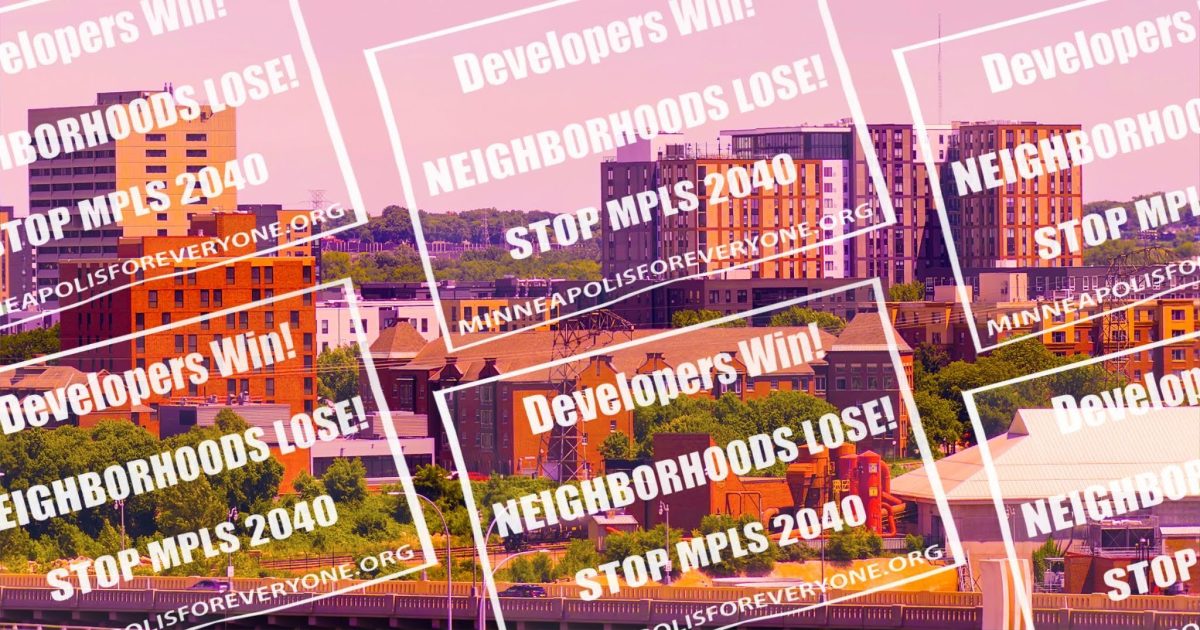
The second major change was the Minneapolis 2040 Comprehensive Plan that legalized higher-density development around the University of Minnesota. The Minneapolis 2040 built-form zoning went into effect in January 2020. Most of Dinkytown, Stadium Village, and the surrounding area saw marked increases in allowed density, including the Transit 15 zoning along the Green Line light rail corridor and Corridor 6 in Dinkytown. The massive apartments built in Prospect Park with the successful Fresh Thyme grocery store near the Prospect Park light rail station were a direct result of Minneapolis 2040. While the grocery store and apartments above opened in March 2018, many other housing developments in the neighborhood added a healthy customer base, and were only legalized by further “upzoning” that allowed higher density apartments near the new METRO Green Line light rail station.
From 2013 to 2024, the city of Minneapolis built 32,553 new units of housing, according to the U.S. Department of Housing and Urban Development. This included 94.6% of all new housing in new multi-family developments with at least five units total. Housing construction peaked in 2019, when credit markets had historically low interest rates before the global COVID-19 pandemic. With higher interest rates in recent years, construction has cratered to a small fraction of previous records.
City of Minneapolis planning staff are just beginning to start development of the Minneapolis 2050 Comprehensive Plan, which will be implemented in 2030, less than four years from now.
With the 2040 plan, opponents of the zoning changes used an environmental review lawsuit to temporarily block implementation and revert to the pre-plan zoning map. A state law change now protects city governments from legal attacks by way of environmental impact lawsuits. City staff have also said they expect the 2050 plan to be more incremental and not make major changes to the existing zoning map or related ordinances.
The housing growth of the last decade worked because of a confluence of higher housing demand from new residents, relaxed and legalized housing policies, and low interest rates. Policy makers only have limited control over only one of those factors. But the legacy of housing construction and its damper on rents will be felt for decades into the future.
Answering Common Questions About Housing
Does new home building, especially luxury home building, measurably lower rents?
Yes. Economic research, including a 2023 paper with microdata block by block, shows that higher-income households move to new “luxury” apartment buildings and reduce demand — thereby reducing rents — in the immediate area for preexisting older apartments. If there is not an increase in the supply of new housing, older properties are renovated or even have higher rents without any improvements as higher-income households outbid existing tenants in a neighborhood.
What are current tenant rights and renter protections in Minneapolis and St. Paul?
Across Minnesota, we have a Tenants’ Bill of Rights, revised last year, that protects tenants and landlords from common issues when renting an apartment or home. In Minneapolis, tenants have 30 days after rent was due before a landlord can start the process for an eviction, and low-income renters have the right to an attorney in eviction cases. In St. Paul, there are many protections for tenants. Applicants cannot be denied based on their credit score alone or certain criminal convictions. The notice period for eviction procedure is also temporarily 60 days through December 31, 2026. On January 1, 2027, the notice period reverts back to 30 days.
What is the status of rent control or rent stabilization in Minneapolis and St. Paul?
Every income-qualified apartment or rental home in Minnesota is stabilized by the Area Median Income (AMI). If you rent an apartment or other rental property that is subsidized or publicly owned, you likely pay rent based on an affordable limit of certain levels of AMI. In 2026, the AMI in the Twin Cities metro for a family of four is $131,500.
Let’s give the example of a single adult living in Minneapolis looking for an income-qualified apartment. The working adult makes $46,050 per year (about $23 an hour full-time), and thus qualifies as 50% of AMI for a one-person household in Hennepin County. With some paperwork, they could qualify for a one-bedroom apartment at a partially income-qualified apartment building in the Mill District of Downtown Minneapolis with a monthly rent of $1,233, which is about $250 less than market price. That rent is just over 32% of their pretax income.
For entirely market-priced properties, there is no rent control or rent stabilization in Minneapolis or most of Minnesota. However, St. Paul does have a rent stabilization policy. Landlords in St. Paul can raise rents up to 8% per year with City evaluation annually. With a City-approved staff process, landlords can raise rents an unlimited amount, for example if an older property was completely redeveloped.