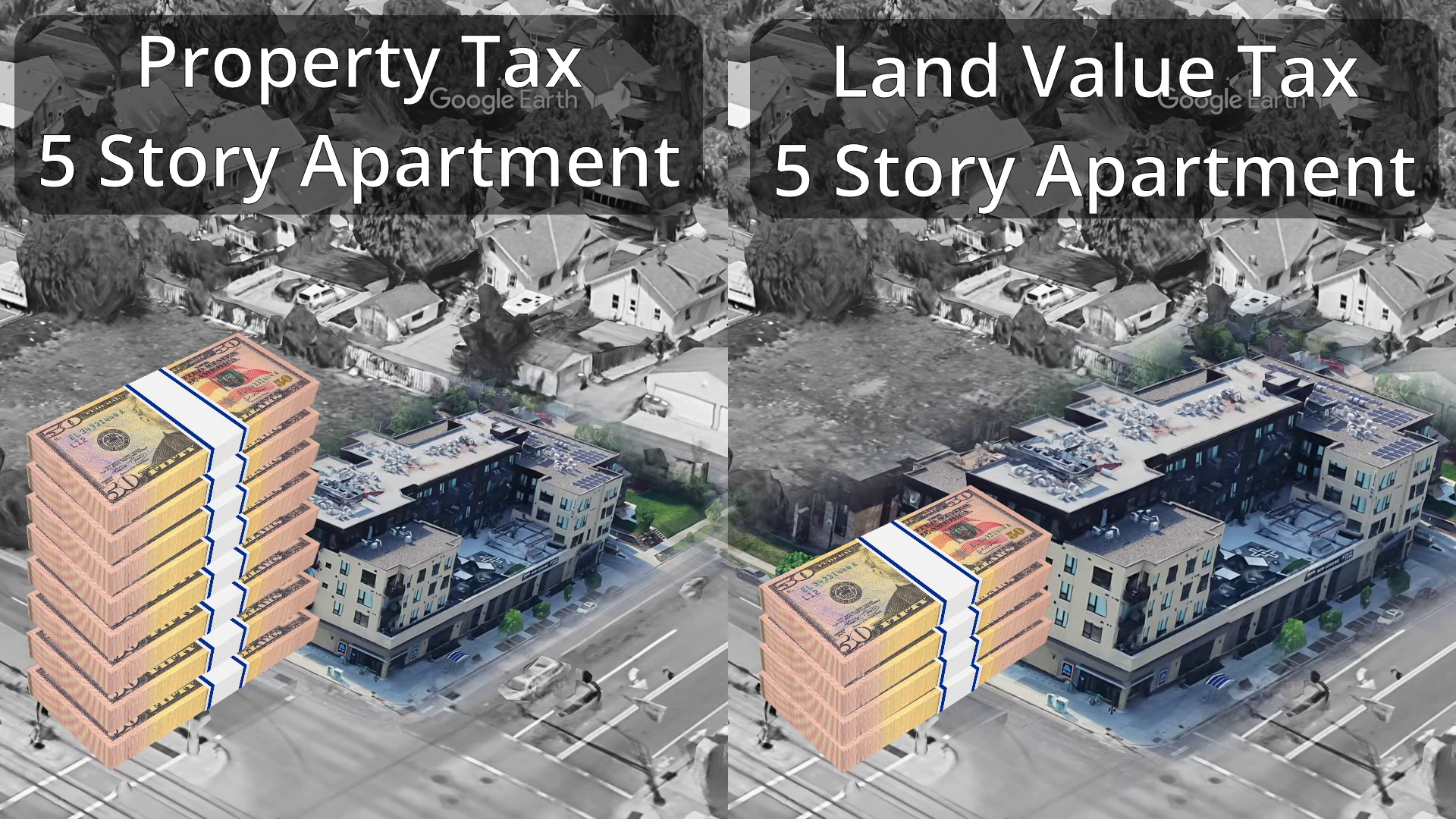
Land Value Tax is a powerful tool for addressing underdeveloped properties. Whether in the Midway, the West Side Flats, or the Sears Lot downtown, every neighborhood has problem properties that drag the community down.
Land Value Tax is not a new tax, but a new way of calculating property taxes that focuses on the value of the land itself rather than the property built on top. By doing so we encourage walkability and disincentivize land speculation.
Links
- Learn more about Land Value Tax from Neighbors for More Neighbors
Attributions
Many thanks to Mike Reynolds for sharing his expertise!
Produced by Matty Lang.
Transcript
[00:00:00] Mike: We are in the Hamline Midway area, across a light rail line and one of the busiest intersections in the Twin Cities, from the hollow shell of a CVS that has sat vacant since 2020. Since its abandonment, it has become one of the most hated buildings in the Twin Cities, a monument to inaction and stagnation and the broader consequences that underdevelopment and empty properties create in the neighborhood all around us. And it’s just one in a long list of national chains and big box stores that moved in in the 90s and 2000s only to shut their doors and leave us in the last few years. Now after significant outcry, the CVS is finally being demolished, leaving behind a flat empty dirt lot owned by an out-of-state shell corporation. For St. Paul, a city already facing budget challenges, that means even less tax revenue. The property’s taxable value will drop from over $3.5 million to just above $1 million, costing the city alone more than $12,000 each year.
[00:01:04] Mike: But this video is not about the past, it’s about the future. It’s about how we ensure that this lot doesn’t stay empty, but is filled with something useful to the neighborhood and the city at large.
[00:01:15] Mike: One of the boldest ideas for the future of Midway and so many other underdeveloped commercial areas in our communities is a fairer approach to property taxes called the land value tax. Land value tax is not a new charge to property owners, but a different, more equitable way to calculate property tax. Under a traditional property tax, what you pay is assessed chiefly on the value of the development on top of the land. This makes sense when more productive development generates more revenue and income for the property owner. But it also means that predatory or negligent landowners, like the owner of the CVS, will have a perverse incentive to not develop. They will leave the land vacant or underdeveloped so that they can pay lower taxes.
[00:02:01] Mike: In the meantime, while they pay lower taxes, they will still profit via land speculation. They will refuse to sell the land to entities that might do something useful with it, instead holding onto the parcel for years and waiting for everybody else to develop land all around it, increasing the value before selling it to cash-in.
[00:02:20] Mike: Land value tax flips that system on its head. Instead of taxing the building on top, you tax the value of the land underneath. This means that you pay the same amount whether you develop or not, and if you don’t develop, you leave money on the table. CVS would have all the incentive to develop the property into something that benefits the community, like transit-oriented housing or local businesses, or sell it to somebody who will do that.
[00:02:48] Mike: The implications go beyond just one CVS. What if we created a revenue-neutral land value tax district in the Snelling and University area? This would mean a shift in the tax burden off of properties that make the most use of their parcel onto any low-value property squatting on the land. For the Midway, preliminary data shows that homeowners would see lower taxes. Buildings that serve the community and house lots of residents and local businesses like the Pitch, the Pivot, Hamline Station, and the Spruce tree would all see lower taxes.
[00:03:21] Mike: The biggest tax reduction goes to residents and owners of infill housing like duplexes and triplexes. Meanwhile, vacant and underdeveloped properties like the CVS or the big box stores in their empty parking lots will need to start paying their fair share. Land value tax is a tool that is both pro-neighborhood and pro-development. Empty lots are neither.
[00:03:44] Mike: Through land value tax, we encourage sustainable density, infill development, and walkability that will benefit the whole community. Whether in the Midway or the Westside Flats or the Sears Lot downtown, every neighborhood knows a spot that is underdeveloped or blighted and needs a push. Land value tax can provide that push. Share this video and please comment to share spots in your neighborhood that would benefit. Let’s bring land value tax to Minnesota.