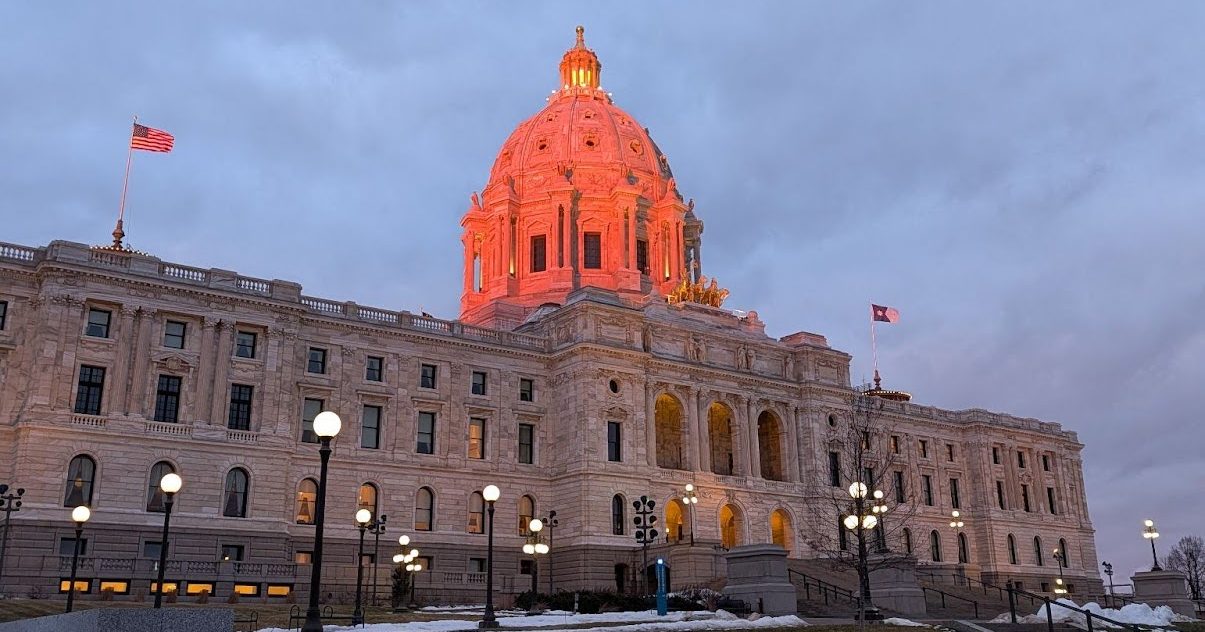
In 2023, when the newly minted DFL trifecta took power at the Minnesota Capitol, the late Speaker Emerita Melissa Hortman summed up her governing philosophy in three blunt words: “Let’s f—ing go.” Hortman understood something fundamental about legislative power: Political capital isn’t meant to be hoarded; it’s meant to be spent. And spent it was.
The 2023–2024 Legislature delivered generational victories, including universal free school meals, reproductive freedom protections, paid family and medical leave, and a commitment to 100% carbon-free electricity by 2040.
Four years later, after two years of divided government and legislative gridlock, voters returned the DFL to control of the House, Senate, and governor’s office. With the 2027–2028 biennium approaching, lawmakers have another opportunity to challenge the systems and policies that have entrenched inequities and wasted public resources for decades.
The 2027 Legislature (the first year of the two-year biennium) will write the state’s next two-year budget amid concerns about long-term fiscal sustainability. But some of Minnesota’s most pressing equity problems cannot be solved by appropriations alone.
Minnesota cannot build an equitable, climate-resilient future by tinkering indefinitely around the edges of existing policy—or by continuing to dilute and defer the conversations that matter.
There are dozens of debates awaiting the 2027 Legislature and Governor-elect Amy Klobuchar. But three unfinished conversations deserve immediate attention: exclusionary zoning, environmental protections, and highway-first transportation spending.
Legalize the Housing Minnesota Needs
During the 2023 budget cycle, lawmakers poured historic state dollars into affordable housing. But those extraordinary investments were heavily dependent on one-time funding. As the Legislature approaches the FY 2028–2029 biennium without a comparable surplus, Minnesota cannot rely on subsidies alone to address its housing shortage.
According to Minnesota Housing’s 2026–2027 Affordable Housing Plan, 27% of Minnesota renter households earn no more than 30% of their area’s median income. Yet only 4% of newly constructed housing is affordable to households at that income level.
The state’s housing inequalities are also deeply racialized. Minnesota Housing reports that Native Americans are 31 times more likely to experience homelessness than white Minnesotans. We know these disparities won’t disappear simply by permitting more duplexes or townhomes. Extremely low-income households will still need substantial public investment, rental assistance, and deeply affordable housing. But zoning reform is an essential part of a broader solution.
Across Minnesota, exclusionary zoning limits the construction of smaller homes, duplexes, townhomes, and other forms of missing-middle housing. These restrictions can prevent lower- and middle-income households from accessing neighborhoods with strong schools, employment opportunities, parks, and reliable transit. They also encourage outward development that consumes agricultural land, increases infrastructure costs, and makes car ownership more necessary.
The Minnesota Starter Home Act offered one possible path forward. Versions introduced during the 2025–2026 biennium sought to reduce local restrictions on housing development and make smaller, more affordable housing types easier to build. But the proposals encountered substantial municipal opposition, and the House version failed to advance out of the House Elections Finance and Government Operations Committee in March 2026 after a 7-5 vote.
In 2027, lawmakers should bring statewide missing-middle housing legislation back for serious consideration, including reforms to minimum lot sizes, parking requirements, and restrictions on smaller multifamily housing. They should also pair zoning reform with investments that protect tenants, prevent displacement, and expand housing for the state’s lowest-income residents. If state subsidies are constrained, refusing to touch local exclusionary zoning is a choice to preserve segregation and car-dependent sprawl by default.
Protect Minnesota’s Water Before It Becomes Someone Else’s Business Model
Minnesota’s land and water face growing pressure from industries old and new, while state permitting rules struggle to keep pace.
At the Capitol, data centers, mining, and utility rates are often treated as separate policy debates. But these decisions are connected by a fundamental question: How seriously are we protecting our water?
Consider the rapid expansion of hyperscale data centers. Minnesota is a state defined by its water. Our lakes, rivers, and aquifers are not incidental features of the landscape. They are central to our ecosystems, communities, economies, and collective identity. Yet Minnesota is increasingly being asked to accommodate an industry whose appetite for electricity, water, and land raises fundamental questions about whose interests our environmental policies are designed to serve.
Hyperscale data centers’ enormous infrastructure demands can reshape local electricity systems and place additional pressure on water resources, while the benefits of their operations flow largely to some of the wealthiest corporations in the world. And Minnesota has chosen to subsidize that expansion.
During the 2025 legislative session, lawmakers ended the sales tax exemption on electricity consumed by qualifying data centers while extending equipment tax exemptions that could continue through 2077. The Legislature also adopted additional water-permitting provisions for facilities proposing to consume more than 100 million gallons annually.
But the existence of a permitting process does not answer the more fundamental question: Why should Minnesota use public policy and tax incentives to encourage an industry whose resource demands could impose lasting costs on surrounding communities?
Nor does reviewing individual facilities adequately address the cumulative consequences of an expanding industry. Multiple data centers drawing on shared water supplies, demanding new electrical infrastructure, and increasing pressure on the grid raise questions that cannot be resolved by examining projects in isolation.
The Legislature should stop treating hyperscale data center expansion as an inevitable feature of Minnesota’s economic future. Lawmakers should reconsider the industry’s extraordinary tax preferences, require rigorous cumulative environmental assessments, protect residential ratepayers from infrastructure costs, and establish enforceable limits on water consumption.
Northern Minnesota presents another version of this debate.
For years, environmental advocates and lawmakers have pushed Prove It First legislation, seeking stronger requirements that companies demonstrate whether sulfide-ore copper mining can operate without contaminating surrounding watersheds.
The stakes are particularly high in the Rainy River Headwaters Watershed, where pollution could threaten the Boundary Waters Canoe Area Wilderness and the communities and businesses connected to it.
In August 2026, Gov. Tim Walz issued an executive order directing state agencies to stop permitting and environmental review work on nonferrous mineral mining projects in that watershed.
That was a significant protective action. But executive orders are not permanent substitutes for legislation. Under Minnesota Statutes section 4.035, an executive order generally expires 90 days after the issuing governor leaves office, unless an earlier expiration applies. The 2027 Legislature will have an immediate choice: turn temporary administrative protections into lasting law, or allow them to expire just months into the new biennium. Governor Walz has already instructed the DNR to prepare proposed legislation prohibiting nonferrous mining in the Rainy River Headwaters Watershed.
Minnesota’s water, land, and electricity infrastructure are not limitless resources available for private extraction without meaningful public accountability. Environmental equity means refusing to treat Minnesota’s aquifers, electric grid, and the Boundary Waters as sacrifice zones for corporate balance sheets. The 2027 biennium must put binding water-use caps, ratepayer protections, and Prove It First mandates front and center.
Stop Treating Highway Expansion as the Default
Finally, look at how Minnesota budgets for movement. In May 2026, lawmakers passed a $1.24 billion capital bonding bill that directed roughly $177 million to roads, bridges, and highway maintenance—and left public transit with $0. As Sen. Scott Dibble pointed out on the Senate floor at the time, “folks that argue for transit aren’t as politically powerful as those that argue for pavement and concrete.”
That power imbalance is baked into state statute. While MnDOT projects a $19 billion to $27 billion-plus highway funding gap over the next two decades, state transportation policy continues to treat highway expansion as an automatic priority and transit access as an afterthought.
Minnesota needs to reconsider that hierarchy. During the 2026 legislative session, Rep. Katie Jones introduced HF 4449, legislation intended to better coordinate transit planning, roadway projects, and transit-oriented development. The proposal called for a Metropolitan Council Transit System Investment Framework, with transit performance measures and requirements to align certain road projects with regional transit goals.
The House Transportation Finance and Policy Committee heard HF 4449 in April 2026 and laid it over for possible inclusion in an omnibus bill. The legislation never reached a House floor vote.
Minnesota should also revisit how it interprets the constitutional requirement that certain transportation revenues be used for highway purposes. Advocates have proposed clarifying that this language can encompass infrastructure supporting multiple transportation modes along state highways, including pedestrian facilities, bicycle connections, and dedicated transit infrastructure where appropriate.
The Legislature should evaluate transportation investments based on accessibility, safety, climate impacts, fiscal sustainability, and the ability to connect people to their destinations—not simply the number of vehicles a roadway can accommodate. A transit-first approach recognizes that an equitable transportation system must work for Minnesotans whether or not they own a car.
Don’t Waste the Moment
As the next Minnesota Legislature prepares to set the state’s course for 2027 and 2028, the stakes for our neighborhoods, transit riders, and watersheds could hardly be clearer. Lawmakers shouldn’t treat their restored majority as a fragile museum piece.
Put statewide missing-middle zoning reform back on the committee docket. Demand stronger environmental and ratepayer protections for data centers. Make lasting protections for the Boundary Waters a legislative priority. Give transit-first transportation planning the serious consideration it deserves.