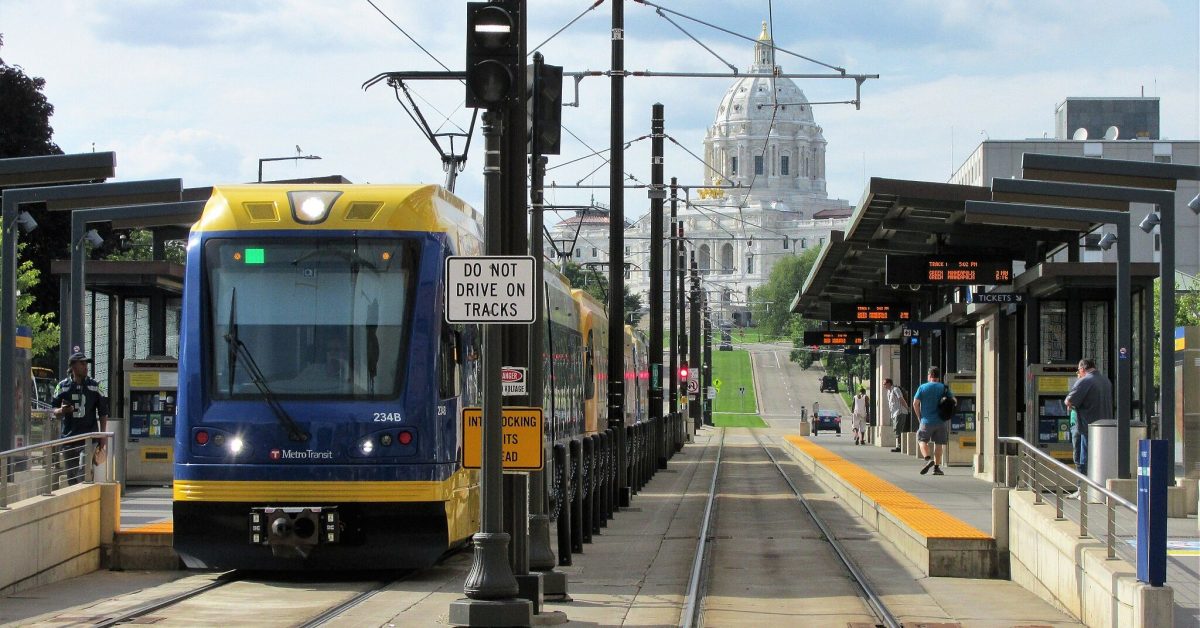
When Minnesota lawmakers return to the State Capitol on January 12, 2027, they will confront familiar questions about how the state grows, where people can afford to live, and how our state and local governments should be investing in the infrastructure residents depend on. Housing affordability, zoning reform, public transit funding and infrastructure investment have generated significant debate in recent legislative sessions. Yet progress has been uneven, with some proposals becoming law while others stalled, were scaled back or failed to advance.
The 94th Minnesota Legislature, which convened in 2025 and 2026, operated under markedly different circumstances from the Legislature that approved historic investments in 2023. A tighter state budget outlook and a closely divided House of Representatives made compromise essential on major spending and policy decisions.
Despite those constraints, lawmakers approved new housing investments, created incentives linking local zoning decisions to affordable housing funding, strengthened protections for homeowners living in associations, and authorized significant investments in transportation and public infrastructure. Other proposals, including comprehensive statewide zoning reform, failed to become law, leaving important questions about housing development and transportation priorities unresolved.
Following the November 2026 elections, the Democratic-Farmer-Labor Party is projected to hold a 77–57 majority in the House and a 39–28 majority in the Senate, with recounts pending in several close legislative races (as of November 20). With Governor-elect Amy Klobuchar preparing to take office, the DFL will once again control both legislative chambers and the governor’s office, potentially altering the prospects for proposals that stalled over the previous two years.
The 2027 session marks the beginning of a new legislative biennium. Although bills introduced during the 2025–2026 biennium will not carry over, many familiar proposals could return under new bill numbers, potentially with revised language or different names. Before those debates begin again, it is worth revisiting what the Legislature accomplished during the previous biennium, what it left unfinished and what those decisions mean for Minnesotans.
What Changed: Housing Dollars, HOA Guardrails, and Infrastructure Investments
Even in a divided Capitol—and without the massive budget surplus that fueled earlier investments—lawmakers found common ground on infrastructure spending, targeted housing investments and homeowner protections.
In May 2025, lawmakers approved an omnibus housing budget (SF 2298 / Laws 2025, Chapter 32) that provided approximately $184 million in general fund appropriations for Minnesota Housing programs, including $46 million for rental assistance, alongside authorization for $50 million in housing infrastructure bonds. The bonds provide financing for the development and preservation of affordable housing.
Rather than overriding local zoning ordinances, the legislation established a temporary scoring preference, scheduled to expire at the end of 2029, in competitive state housing funding programs for communities that voluntarily adopt certain pro-housing policies. Housing proposals in jurisdictions that allow qualifying housing types, reduce certain development restrictions or adopt inclusionary zoning can receive additional points when competing for state funding. The approach encouraged local governments to change development rules without requiring statewide zoning reform.
Lawmakers followed up in May 2026 with a housing package totaling approximately $163 million in investments (HF 1141 / Laws 2026, Chapter 100). Rather than relying on new general fund revenue, the package used investment earnings, reallocations and previously appropriated funds. It included authorization for another $100 million in housing infrastructure bonds and $40 million for the Family Homeless Prevention and Assistance Program, which helps households avoid homelessness and maintain stable housing. The legislation also provided targeted support for workforce housing in Greater Minnesota and manufactured home communities.
One of the biennium’s most significant structural housing changes wasn’t about zoning at all. It was about governance. In May 2026, Gov. Tim Walz signed the Homeowners Association Bill of Rights (SF 1750 / Laws 2026, Chapter 82), a substantial overhaul of provisions governing homeowners associations and common-interest communities.
Most provisions take effect January 1, 2027. Among other changes, the law prohibits local governments from requiring developers to establish homeowners associations (HOAs) as a condition of certain residential development approvals. It generally caps fines for individual rule violations at $100, subject to exceptions and provisions allowing association members to approve higher amounts, and places new limitations on late fees and interest.
The law also requires associations to solicit at least three competitive written bids for certain contracts exceeding $50,000 and makes it easier to dissolve qualifying HOAs consisting entirely of detached single-family homes without common property. While the legislation did not fundamentally change where housing could be built, it established new limits on how residential communities are governed and how associations exercise authority over homeowners.
Following a roughly $700 million capital investment package approved during the June 2025 special session, lawmakers passed a $1.24 billion capital investment package in the final days of the 2026 session. The larger 2026 bonding bill (HF 719 / Laws 2026, Chapter 130) passed the House 122–11 and the Senate 60–7. A separate cash-capital measure (HF 2484 / Laws 2026, Chapter 129) provided additional funding.
According to numbers from the Minnesota House of Representatives , the bonding package included approximately $420 million for water infrastructure and $177 million for transportation projects. Transportation investments included $47 million for local road improvements, $25 million for local bridge replacements and roughly $54 million for specified city transportation projects. Housing-related capital investments included $17.5 million for public housing rehabilitation and $10 million for emergency shelter facilities. These investments addressed existing public housing conditions and shelter infrastructure rather than broader changes to local housing development rules.
Transit retained its dedicated sales tax, but faced funding cuts. During the June 2025 special session, lawmakers preserved the dedicated metropolitan-area transit sales tax established in 2023. However, the transportation budget also reduced general fund support for transit in both the metropolitan area and Greater Minnesota. A proposed reallocation of county sales tax revenue to support bus rapid transit capital investments did not survive negotiations. The legislation also modified registration surcharges for electric vehicles and introduced a surcharge for plug-in hybrids.
The biennium brought some additional transit-related changes. Lawmakers made permanent free regular-route bus and rail rides for Metro Mobility-certified riders, extending a pilot program intended to improve access to conventional public transit for people with disabilities. Lawmakers also established a base transfer of approximately $8.3 million annually to the state’s active transportation account beginning in fiscal year 2028, following reductions to active transportation funding in the 2025 budget.
Preserving the dedicated transit sales tax, however, did not mean expanding transit investment across the board. While existing revenue remained available to support metropolitan transit, the Legislature did not include funding for transit capital projects in its 2026 bonding package.
What Didn’t Change: Zoning Preemption and Transit Expansion
Efforts to legalize more missing-middle housing — including duplexes, triplexes and smaller multifamily buildings — and curb exclusionary zoning failed to cross the finish line in either year. In 2025, proposals to require cities to allow duplexes, accessory dwelling units (ADUs) and additional residential development in commercial districts were scaled back or stalled.
In 2026, a bipartisan coalition returned with a revised Starter Homes Act (HF 3895 / SF 4123), offering cities greater flexibility in how they could meet statewide housing requirements. The bill would have required municipalities to allow ADUs on residential lots with single-family homes and remove certain local design requirements, such as mandates for porches, shutters and minimum garage sizes. It also proposed a menu of 11 additional land-use reforms, including eliminating minimum parking requirements, allowing buildings with up to eight residential units and offering incentives for housing development.
Larger cities would have needed to adopt more of these reforms than smaller municipalities. The approach sought to expand the types of housing that could be built while allowing municipalities to choose among several policies for accommodating additional development.
Supporters argued that reducing local zoning restrictions would create more housing opportunities and lower barriers to construction. Opponents, including municipal officials, argued that the proposal would undermine local control, impose administrative costs and overlook other factors influencing housing prices.
On March 23, 2026, the House Elections Finance and Government Operations Committee voted 7–5 against advancing HF 3895. The result left broader statewide zoning reform unfinished, despite bipartisan interest in expanding housing options.
Transportation legislation faced similar obstacles. Although lawmakers approved substantial funding for roads and bridges in 2026, the $1.24 billion capital investment package included no funding for transit capital projects.
Other proposals to rethink how transportation investments are planned and coordinated also failed to become law.
HF 4449, introduced as Transit for a Resilient Metro, proposed new requirements connecting transportation planning, highway investments, transit performance and transit-oriented development. The legislation sought to establish transit performance measures and an investment framework, limit certain highway projects and modify land-use requirements associated with transit development.
Another proposal, HF 4111, sought to consolidate suburban transit providers under Metro Transit, bringing metropolitan transit operations into a more unified regional system overseen by the Metropolitan Council. Supporters viewed consolidation as an opportunity to improve coordination and reduce administrative duplication, while opponents raised concerns about preserving local responsiveness and control over suburban transit services.
On the Table for 2027
When the Legislature gavels in on January 12, 2027, lawmakers won’t be starting from a blank slate so much as picking up unfinished arguments. This time, however, those debates will unfold under different political circumstances.
The November 2026 elections returned the DFL to control of both legislative chambers, with Governor-elect Amy Klobuchar preparing to take office. The shift from a closely divided House to a DFL majority could change which proposals are introduced, debated and potentially passed during the 2027–2028 biennium.
Statewide zoning reform could return for another round, particularly as housing affordability remains a persistent concern for communities across Minnesota. Whether lawmakers pursue an approach similar to the Starter Homes Act, broader statewide zoning requirements or more targeted changes remains to be seen.
Transportation funding presents another set of unanswered questions. The Legislature preserved existing metropolitan transit revenue while declining to fund transit capital projects through the 2026 bonding package. Future debates may again center on the balance between maintaining roads and bridges, expanding transit and coordinating transportation investments with housing and land-use decisions.
Proposals addressing regional transit governance and the relationship between highway construction, transit investment and land use could also return. Whether the new Legislature will pursue those reforms — and how they might differ from proposals introduced in 2026 — remains uncertain.
The 2025–2026 biennium demonstrated that lawmakers could reach agreements on targeted investments, even under difficult political and fiscal circumstances. Whether the next Legislature can move beyond those agreements to address broader questions about housing development and transportation priorities remains to be seen.