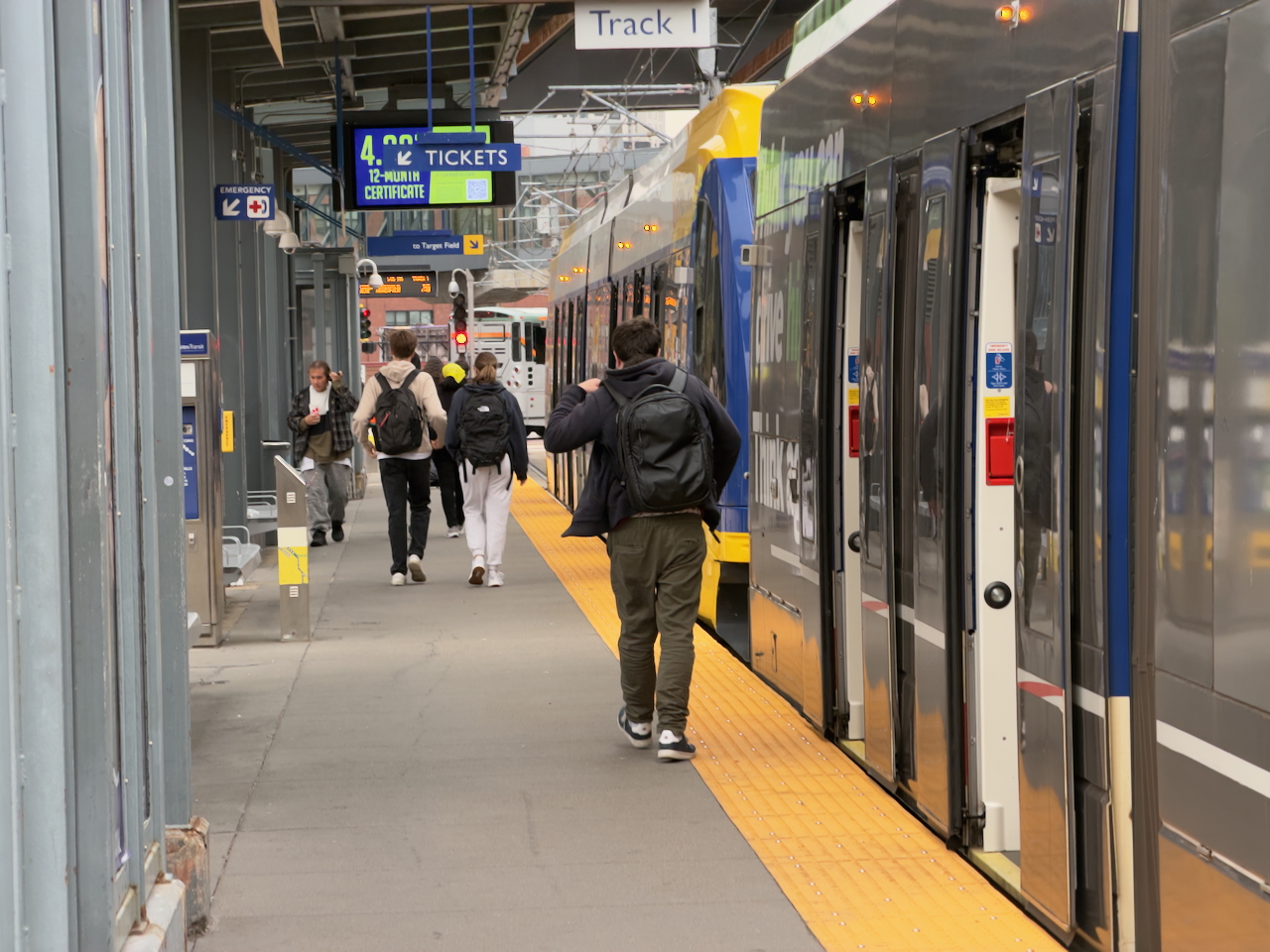
Many people are moving to the Minneapolis-St. Paul metropolitan area recently for good-paying jobs and better social freedoms than other parts of the United States. A question first-time arrivals sometimes ask is, “how do the trains work and where do they go?”
The Twin Cities’ Metro Transit has two METRO light rail lines named “Blue” (started service in 2006) and “Green” (started service in 2014). There are other color lines, like Orange and Gold, but those are Bus Rapid Transit lines that were intended to be served by rail at some point in the future. Both the Blue and Green lines are adding expansions to the southwest and northwest from Downtown Minneapolis. The soonest the westward Green Line extension will open is 2027, while the northward Blue Line extension isn’t fully approved or started construction.
Here are some helpful tips on what to expect and how to make your METRO light rail experience better.
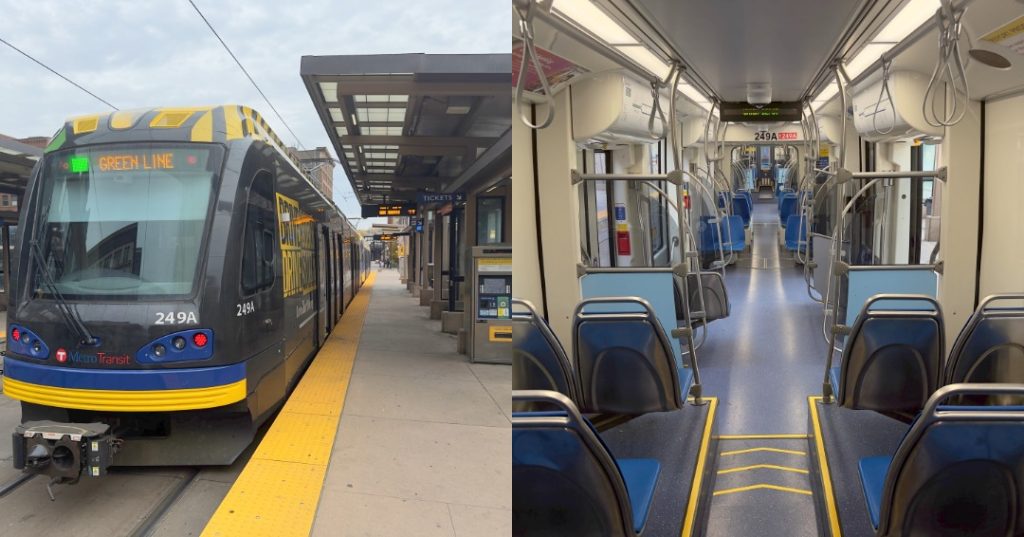
Where do trains go?
Both the Blue and Green Lines meet at U.S. Bank Stadium station in Downtown Minneapolis, where the Vikings play. From there to Target Field, home of the Twins, both lines share the same tracks and stations. Thus, if you are traveling anywhere between these venues in Minneapolis, you can use either a Blue or Green Line train.
For the Blue Line southbound from U.S. Bank Stadium, the line goes diagonally southeast along Hiawatha Avenue (MN-55) with stops at waypoints including Lake Street, Minnehaha Park, the Minneapolis St. Paul International Airport and the Mall of America. If you live along the Blue line, the METRO Line is a fast and convenient route to travel to both airport Terminals, each with its own independent light rail station. In the event that you have a connection between Terminal 1 and Terminal 2, riders can travel the Blue Line between these two stations free of charge.
For the Green Line, eastbound from U.S. Bank Stadium, the Line follows University Avenue through Minneapolis and St. Paul, then loop in Downtown St. Paul to arrive at Union Depot, which is the Grand Central or Penn Station of the Twin Cities area. Union Depot also has Metro Transit local bus and intercity bus connections. I recently wrote about riding the Amtrak Empire Builder to Chicago departing from Union Depot. However, if your starting point is Downtown Minneapolis and your destination is Union Depot, the Route 94 bus is far faster than the Green Line light rail. Major stops along the Green Line include the University of Minnesota Minneapolis campus, Prospect Park with a Fresh Thyme grocery store, Snelling with Allianz Field where the Minnesota United “Loons” soccer team plays and the Minnesota State Capitol.
Before the Green Line started service in 2014, I often took Routes 16 and 50 from the University of Minnesota Minneapolis campus to the Minnesota State Capitol complex where I worked in the legislature. The Green Line replaced both of these University Avenue buses, but did not markedly improve service speed. In 2025, there are no intersections along any Metro Transit route where buses or trains have signal priority over a regular street intersection. Often, light rail trains will stop in either downtown waiting for the light to change.
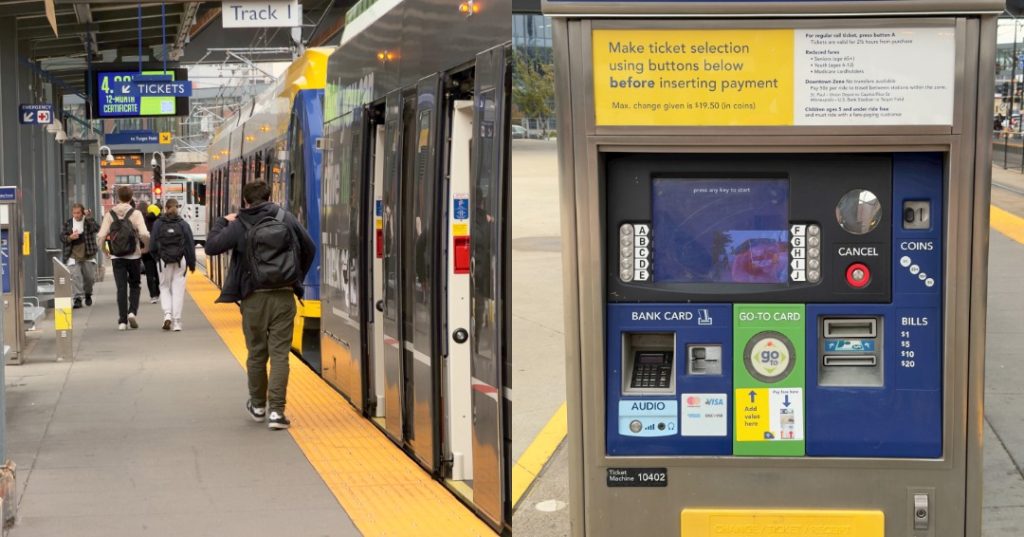
How do I pay for a ride?
Metro Transit fares in 2025 are $2 for all times, good for two hours-and-30 minutes of travel time. You can also buy a $4 day pass for unlimited rides until 2:00 a.m. the next day. There is also a Downtown Zone in Minneapolis along Nicollet Mall with bus service or other buses and light rail between U.S. Bank Stadium and Target Field, approximately. The Downtown Zone fare is $0.50.
To pay a fare, there are several options. My go-to way to pay is through Metro Transit’s mobile app — it’s faster than the kiosks and you don’t need to worry about paper transfers. You can buy tickets in advance if desired and then activate them instantly with the convenience of your phone. The mobile app is also more reliable than the payment kiosks and there is no need to keep a transfer slip. You can also get a Go-To Card (like an Omni Card or Oyster Card) and put on credit and pay like other transit systems of the last decade.
By late 2026, Metro Transit plans to add tap-to-pay for phones and contactless cards. As long as you use the same method of payment and card, you will be able to validate your fare when asked by fare enforcement on light rail.
How do I find a good trip route?
Metro Transit has open sourced its NexTrip real-time trip data, so many popular mapping and routing apps use NexTrip GPS-based data. Popular apps include Apple Maps, Google Maps, Moovit, and the Transit app. You can also visit Metro Transit’s website to use a simple version of NexTrip if you want to know when the next bus or train will arrive at a particular stop. I highly recommend first using one of these routing apps to plan your trip, then using NexTrip to check when your bus or train will arrive if you plan to stay outside only a short time. When you are at a party and the last bus leaves before you do, that’s an expensive ride home now. For example, on the Saturday schedule, the last northbound Blue Line train leaves Mall of America at 12:10 a.m., the last southbound Blue Line train leaves Target Field at 11:17 p.m., and the last westbound Green Line train leaves Union Depot at 11:14 p.m..
Are the METRO light rail cars safe for me?
Like any large city’s transit system, the Twin Cities’ trains reflect a mix of people and experiences. You may see unhoused riders, loud music or the occasional strong smell of cannabis — all increasingly typical of urban systems nationwide. In my recent trips, though, I’ve noticed more visible fare enforcement and Metro Transit Police presence, and the overall atmosphere feels calmer than a few years ago.
Each rider has a different tolerance for behavior on public transit. In 2012, a fellow rider with delusions was yelling at me and other passengers. A couple years ago, I saw somebody smoke crack on the Blue Line and smell up the car. However, I am happy to report that things have really improved significantly in recent years with TRIP fare enforcement agents and greater presence of Metro Transit police.
Of my three recent light rail trips, there was fare enforcement on two of three trips. Bus drivers typically enforce fares on local buses. While there is some degree of sheltered and unsheltered homelessness, my most visible and audible concerns are mostly minor. You can expect a fellow rider to play TikTok on full volume, especially if you sit in the back of the train car or bus. You can expect the smell of cannabis or other smells, but not typically open use or smoking.
These experiences, however, are typical for major cities in states that have legalized cannabis like Minnesota. More unruly rider behavior or illicit drug use is far more rare in recent years.
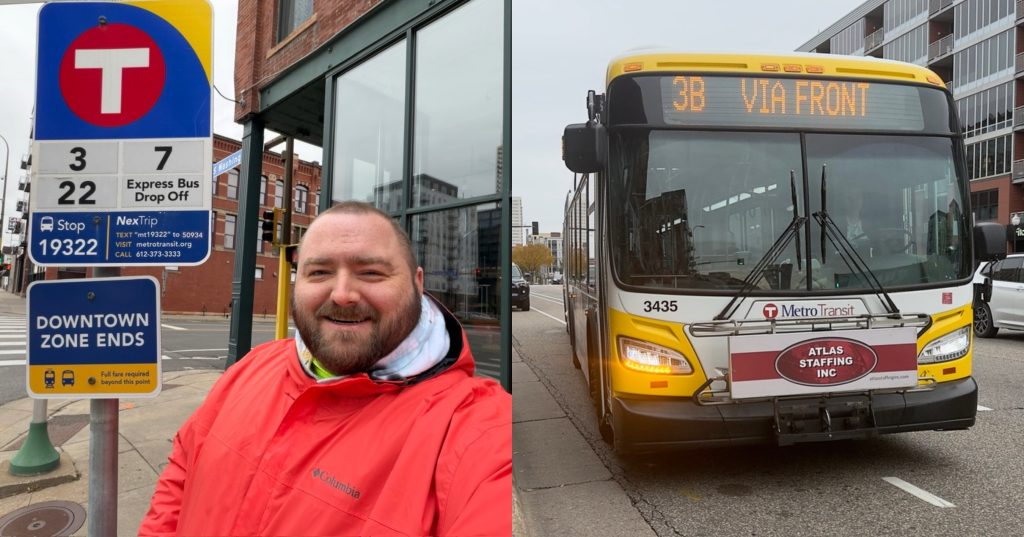
Do I, the author, ride Metro Transit often?
I am a Metro Transit rider of convenience. I live next to Route 3 in Downtown Minneapolis and sometimes take it on the way home instead of walking in the rain or snow or cold. When Metro Transit adds tap-to-pay by year-end 2026, that will make those game time decisions much more easy and convenient. I could be at Trader Joe’s, see a bus coming down Washington Avenue, and decide spur-of-the-moment to hop on. Every trip I take reminds me why continued investment in public transit matters — affordability, climate, and access all depend on systems like these.
With air travel, riding the METRO Blue Line to Minneapolis St. Paul International Airport is highly convenient. I live about two-thirds of a mile walk from U.S. Bank Stadium station and then the train goes directly to Terminal 1 for Delta. This can save $34 or more compared to a typical Lyft or Uber ride hail fare. Because all Metro Transit service ends around midnight, this is not always available for early morning or late night trips, for example coming back from an international flight. But I appreciate having the best public transit accessibility in the state of Minnesota and try to take Metro Transit as a first option when it makes sense.