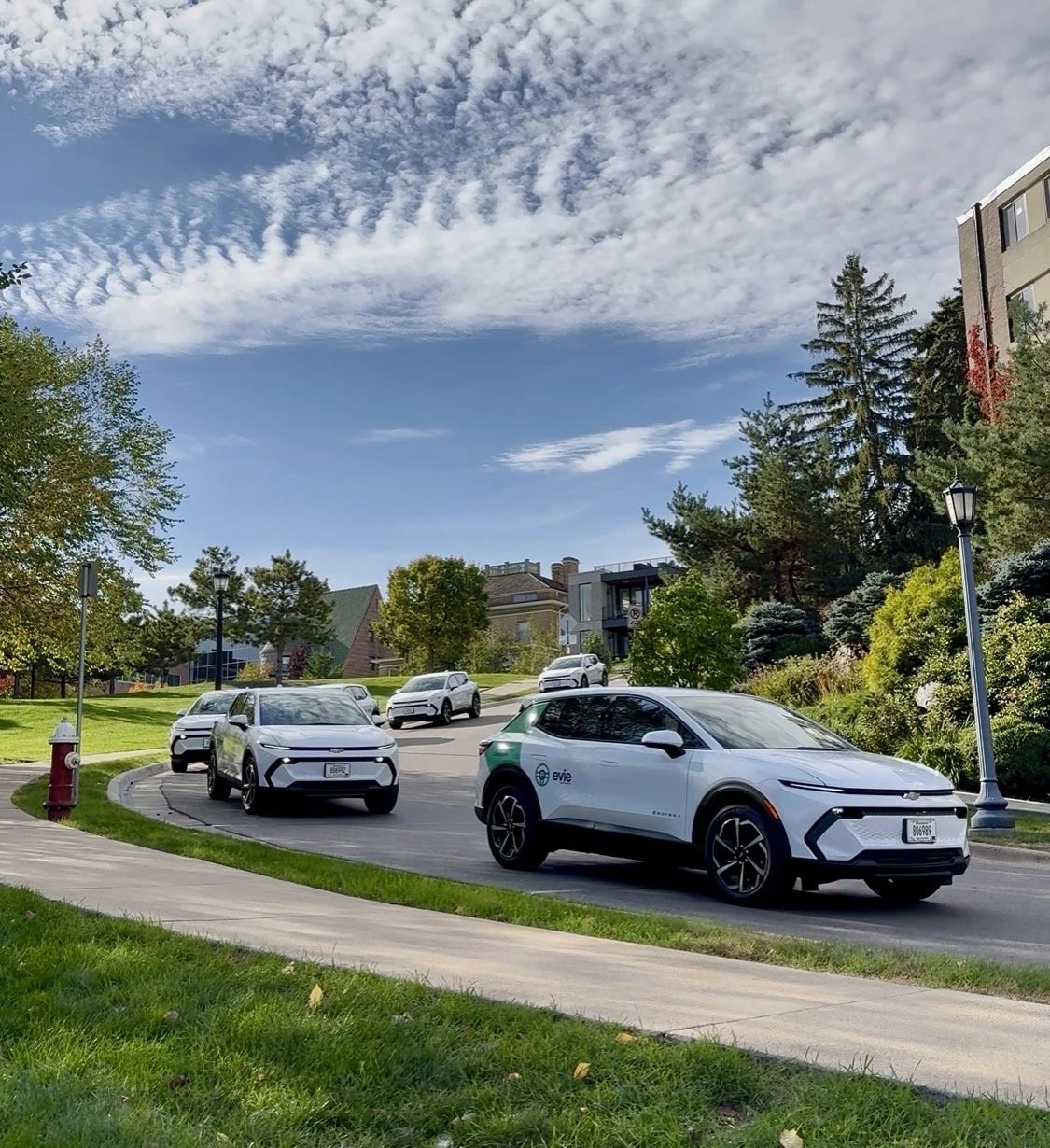
I am a self-proclaimed and longtime scavenger when it comes to mobility. Hailing from a New Jersey, car-forward suburb, then adapting to a small college campus with no reason to escape a one-mile, walkable radius, I have been navigating the disruption of now living in a city with severely entrenched car infrastructure, without a car. Minneapolis does have decent public transportation options. I am a frequent busser, and I tend to get where I want to go in the time it tells me it will take on Apple Maps. It also has celebrated bike infrastructure that is sustained and reinforced by a passionate bike culture. I know I could be the person with the panniers, the winterized bike, and the mental fortitude to pack a change of clothes everywhere I go, and I’d be a better person for it. But I’m not. The bike lifestyle just never nabbed me, and while I’ll ride mine here and there in a pinch, it has not supplanted the yearning for ease and comfort I often have.
When I discovered HOURCAR’s Evie Car Share program, it completely changed my life. I took a job in 2023, before I knew about Evie, where I would have to commute to Saint Paul, thinking that I would take the hour and 15 minute train/bus combo each way, every day. Mind you, this is a 15 minute drive. I suppose I would have, too, if I hadn’t discovered Evie about a week before my first day. I took $3 trips each way (just wait until I would find out about the drive credits earned from parking at a charging location), a dollar more for an hour less time. Since then, my job has changed, as well as my relationship to the Evie program. It has become a tool for me, a second-resort mobility option to fill in the gap for when I’m strapped for time, or just plain lazy.
During a webinar I attended in 2024, I heard public transit expert Jarret Walker discuss his book, Human Transit: How Clearer Thinking About Public Transit Can Enrich Our Communities and Our Lives. My main takeaway, and strongest resonance with his thesis, had to do with a spectrum he presented, with Car-usership on one end, and Bus-ridership on the opposite. The takeaway went: we are all positioned somewhere on this spectrum, and are much closer to the middle than we might think. Essentially, he argues that, there are many reasons why a car-owner might not use a car all the time, and there is often a larger network of mobility options for non-car-owners, muddying the binary quite a bit. Walker also argues that, ease, comfort, and reliability heavily impact one’s choice of transportation, and therefore, owning a car does not equal using that car, if there is another option.
I had the opportunity to talk with Megan Ryan, who works in Communications, and Amy Brendmoen, Interim President and CEO, for HOURCAR. Up until this conversation, the act of selecting a tiny blue icon on a map, and discovering a vehicle waiting there for me to operate it, remained a magic act. After our conversation, I had a more clear portrait of the organizational and financial structure of HOURCAR’s collaboration with the City of Saint Paul.
Our conversation started with an anecdote of mine. A friend and I played a simple mental game of breaking down the cost of owning a car to find the daily expense. Considering wear and tear, yearly maintenance, and gas prices, this equaled about $10-15 a day. We didn’t factor in insurance. As someone who relies on an Evie about 3-4x a week, with a ride typically costing me something like $4 (if I’ve been bad and neglected to leave my Evie at a charging station for $4 of drive credit), I felt validated.
With Ryan and Brendmoen, I learned about the different funding streams and organizational actors within HOURCAR. A quick distinction: HOURCAR is both the name of the organization as a whole, and the branch of the carshare program that is hub-based, requiring that a user return the vehicle to the spot they received it from. Evie is the branch that offers one-way rides, and can be parked mostly anywhere within the covered area spanning large parts of Minneapolis and Saint Paul. HOURCAR, as an organization, partners with the Cities of Saint Paul and Minneapolis in order to expand access to the program through citywide infrastructural changes and cooperation. This is applicable exclusively to the Evie branch of the program. The HOURCAR branch of the program remains within the organization’s financial purview. The City of Saint Paul, as applicant, receives the Met Council’s Regional Solicitation funding to help cover the cost of Evie vehicles. A separate partnership with Xcel Energy was initiated for the charging stations: Xcel Energy installed them, and HOURCAR membership and driving fees pay for the cost of energy. These same fees, in theory, also pay for the cost of operations.
I asked Ryan and Brendmoen about challenges, and heard the unsurprising answer, that membership and driving fees do not always cover the operations costs. They also gave me a glimpse into HOURCAR’s future and plans to leverage self-driving car capabilities to enhance the process of vehicle movement and maintenance. In short, the plan is for mis-parked Evies to be more quickly and cost-effectively moved to a proper area, using less staff time.
I asked about program feedback and heard a very unsurprising answer—they need a bigger fleet! The biggest user issue is not having an Evie within reasonable proximity when wanted. This leads us back to Jarret Walker’s theory, of how ease and comfort can shift the scale, and produce higher usership. I’m inclined to agree with him, and so believe that more Evies will mean more users. And then I start to envision a world in which the depth of options that people have for accessing the world around them is inviting, rather than limiting. And I also see a more distant world where cars could be not privately owned but rather communally shared, and how common sense would that be, to expand the opportunity for folks who do not wish to spend $30-50 a day to own a vehicle (factoring in insurance now).
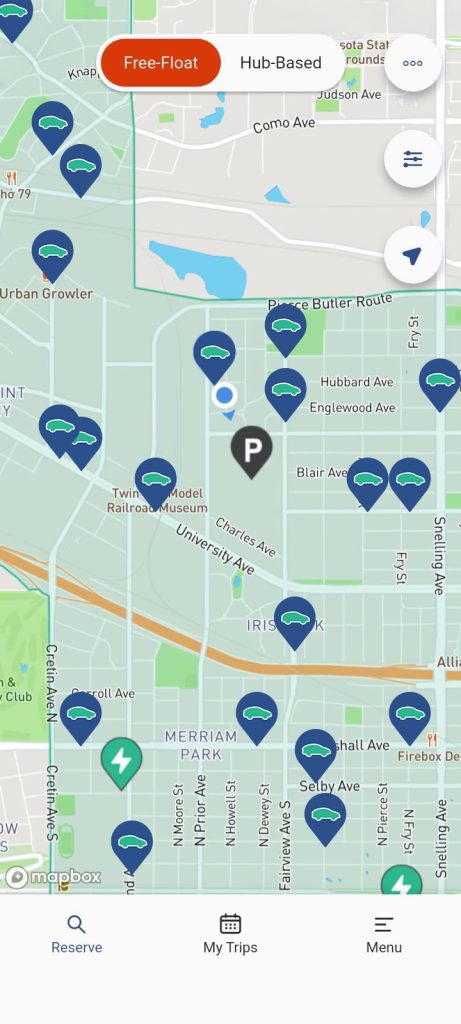
What most energized me about my conversation with Ryan and Brentmoen was the emphasis on the provision and co-creation of a common good. When an Evie user ends their trip at a charging station, they receive a $4 drive credit. This is because a well-maintained and ready-to-use vehicle is beneficial for all users, and it also delegates ownership over this good to the users themselves. They indicated the organization’s interest in delegating more responsibilities to the users, of course in exchange for drive credits and other perks, but with the snowballing benefits of lower organizational costs, meaning more funds for fleets and functionality, meaning more users and user-satisfaction, and all the while uplifting a spirit of co-ownership. The example given was: a user that helps move an Evie during a snow emergency would get drive credits. This increases the personal stake of that user in the maintenance part of the lifecycle of an Evie, which might contribute to the ideal that this public good is truly shared.
More than anything, I hope to open up more dialogue about the flexible space in transportation discourse. A broad mosaic of mobility options is what one faces in their daily commutes, and I am interested in adding one more disruptive and impactful piece to that. Does this do anything to attack car-centric infrastructure that often harms our communities and environments? Not really. It adds more vehicles (albeit, electric) to the map, and invites new users to the car-having demographic. It does ask, however, if private ownership over vehicles is altogether necessary. Furthermore, as a cheaper alternative to ownership, it begins to disrupt the financial qualification that exists for movement through space—and access to place.