Last summer, I had the privilege of riding along the Michigan Line with some friends on the way to Montreal. A higher-speed rail corridor, it connects Chicago and Detroit primarily on tracks owned by both Amtrak and the Michigan DOT. It’s an incredibly underutilized piece of infrastructure, where three daily trains with a maximum speed of 110 mph somehow have a worse average speed than the Borealis. Both problems are due to congestion near both termini, and both Amtrak and the relevant states have plans to fix this.
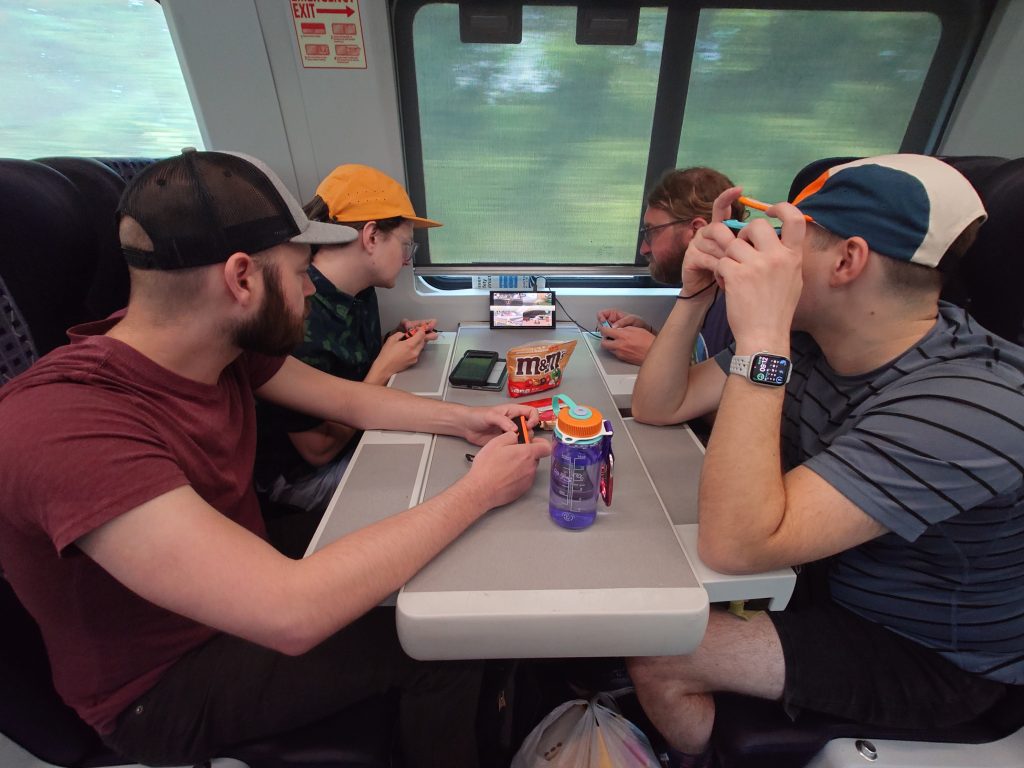
While it took forever to get out of Chicago, once we passed through Portage, Indiana and started accelerating to our maximum speed, the current usefulness and future potential of such a line quickly became apparent. As usual, I found myself wondering if and where we could use such a line. The “if” is mostly a question for the reader. I think the answer is yes as any dedicated passenger route will be faster, more reliable and even cheaper to run on a per-passenger basis, depending on the level of build-out. Counterintuitively, trains get cheaper the faster they go as they can make more trips with the same amount of crew and equipment, while also attracting additional riders.
As for where, well, the Borealis is already in service, and there’s not a lot of spare right-of-way there. The Northern Lights Express is hanging on by a thread, and I’d hate to throw a wrench into things this late into the process. I know the next two projects are lines to Fargo and Kansas City… hang on, doesn’t MNDOT own half of the old Great Northern main line to Fargo?
The Otter Tail Route
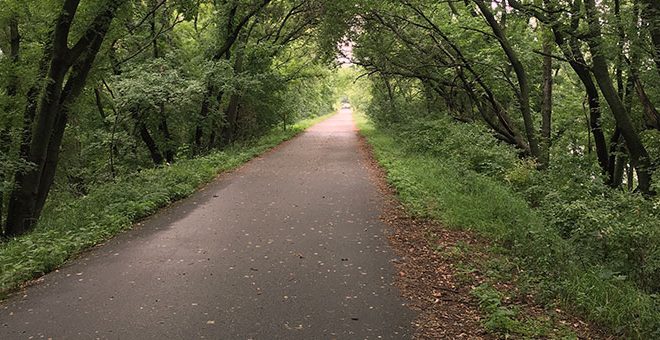
A quick search revealed that yes, I was remembering correctly. Both the Lake Wobegon and Central Lakes trails are “railbanked” — bought by a governing body i.e. MnDOT for the purpose of ROW preservation in case a future need were to ever arise. The line was made redundant by the Burlington Northern merger in 1970, as it sat between the Staples Subdivision (formerly Northern Pacific and current route of the Empire Builder) and the GN’s own secondary main via Willmar.
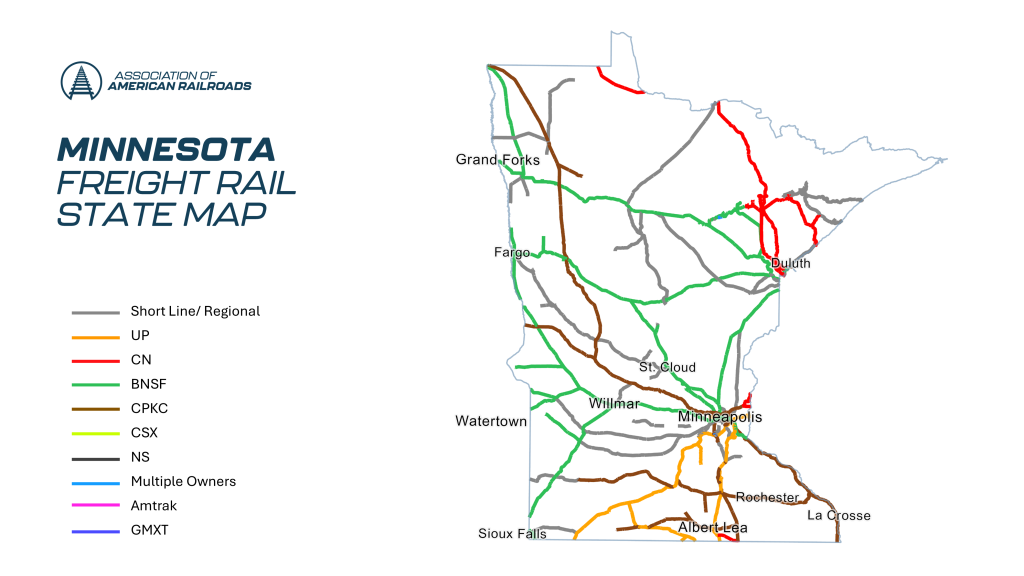
As the line was now only used for local traffic, BN sold most of it to the Otter Tail Valley Railroad, except a small piece near St Cloud, which they abandoned so the route couldn’t be used for through traffic. There wasn’t a lot of business on the line, and in 1991 the section east of Fergus Falls was abandoned. The line west to Fargo is still lightly used by the OVTR.
Moving east, Northern Lines Railway handles some local switching in the St. Cloud area. The line was abandoned between St. Cloud and Monticello, while the remaining segment to Minneapolis is still owned by BNSF and sees between two trains per day and one every four months. Fun fact: this rare customer is the Monticello nuclear generating station, which receives dry storage casks by rail.
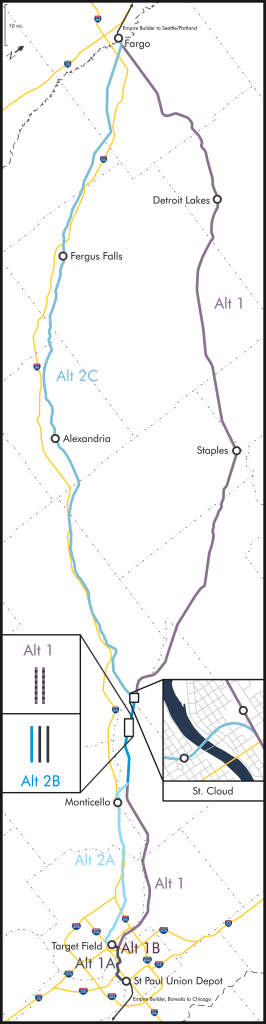
This means that out of around 230 miles, 104 is already owned by the state of Minnesota, another 100 are marginal branch lines (read: cheap), two use busier existing lines near each terminal, and the last ~25 get a bit tricky. I think I’ve figured out a solution, though.
The old GN roadbed isn’t salvageable here. There’s been too much encroachment, especially in St Cloud. There is, though, an existing line a few miles to the north: the aforementioned Staples sub. Even more conveniently, the entire area between the two is owned by Xcel Energy for the Monticello plant and the Sherco coal/solar stations. Dealing with one entity vs a bunch of individuals makes land acquisition slightly easier.
That just leaves BNSF. I doubt they’d be interested in selling a critical portion of their northern transcon, and if so the price would be eye watering. The way I see it, there’s two options:
- Connecting to the existing line and just pay for some upgrades.
- Go the Virginia route and buy a sliver of the ROW to build our own line.
Decisions, Decisions
There’s a degree of modularity to this plan. As it meets existing ROW in multiple places the project can be split in two or even three, and each one can be built with different top speeds. I of course, am going to make the case for the whole thing all at once, but I’ll leave examples on how to cheap out and why that may or may not be a good idea.
Top Speed?
For starters, what should the maximum track speed be? I would argue that since almost all new rolling stock such as the Siemens Airos, Ventures and Chargers are rated for at least 125 miles per hour, that marks the practical limit. This is also the maximum speed where grade crossings are still allowed, although this carries some risk. The Federal Railroad Administration has no design criteria for grade crossings at speeds above 110 mph, instead taking a “know it when we see it” approach. This probably would lead to cost and time overruns as the state would have to guess what it is the FRA wants. I’ve heard similar stories related to equipment certification, and they’re… rough, to say the least.
Speaking of equipment, not all existing rolling stock is rated for 125 mph. The Superliners used on the Empire Builder are only rated for 100 mph, the P42 locomotives 110mph and the MP36/Bombardier Bilevels used on the Northstar somewhere in between. Actually, it might be lower. I don’t have a spec sheet on those, just the Sunrail ones. According to the RFP, the Superliner replacements will also be rated for 110. So, depending on whether or not MnDOT buys new or scalps the old Northstar equipment it may not be worth it. Regardless, the way FRA track classes are set up, if you build for anything greater than 90 mph, you might as well go to 110 mph.
Again I’ll argue it’s worth it to buy new and build to the max, as the speed increase allows for four daily trips using just two trainsets. Below is a table comparing the existing route and the Otter Tail Line between Target Field Station and Fargo’s Amtrak stop. You can check my methodology here. Fair warning: it’s very long and technical, even by my standards.
| Alignment | Max Speed (MPH) | Average Speed (MPH) | Travel Time per direction | Max Feasible Trips per trainset, per Day |
| St Paul-Fargo, existing | 79 | 50.4 | 5 hrs. | 2 |
| Minneapolis-Fargo, Staples Sub | 79 | 56.1 | 4 hrs 20 mins | 3 |
| Minneapolis-Fargo, OTL | 79 | 67.9 | 3 hrs 23 mins | 3 |
| 110 | 82.3 | 2 hrs 48 mins | 4 | |
| 125 | 85.3 | 2 hrs 42 mins | 4 |
…huh. I was expecting a larger gap between 110 mph and 125 mph to be honest. I will say this is without any curve straightening, which will cut proportionally more time off at higher speeds. Higher speeds require broader curves, but lower speeds require more curves straightened for the same amount of time savings. Which approach is better is a very nuanced question I can’t answer, but I do know that another half hour in savings could allow a 5th round trip, and that’s only possible at 125 mph.
Niche Benefits
I’ve briefly touched on some of these, but the new alignment has additional benefits. Not only does this tie Minneapolis into the national network, it would also provide a direct connection to the Northern Lights Express, as opposed to having an inconvenient double hub tied together by the Green Line. It also gains some of its speed by being about 20 miles shorter than the existing Staples sub, and completely bypasses all of the busy yards between Fridley and St. Paul. St. Cloud would also benefit with a new station next to downtown, as opposed to across the river. Those just riding through on the Empire Builder will get a faster, more reliable trip as well.
The new line would benefit existing and future freight customers too, with MNDOT either allowing exclusive rights to existing owners as a bargaining chip, like Norfolk Southern has on the Michigan Line, or opening bidding to anyone. Either way, the higher speeds, increased trackage and/or increased competition would be a boon to all online shippers while bringing in additional income.
I hate to sound like I’m beating a dead horse, but the line could also serve a revived regional rail service, filling gaps in the timetable on the Minneapolis to St. Cloud route. Not only would this benefit our transportation network for reasons I’ve previously talked about, it would also be incredibly funny if we shut the Northstar down only to shift it over by five miles and reopen it.
Electrification?
Normally, I’m a big fan of overhead electrification as it’s the one zero-emission propulsion technology that works. Well, other than nuclear powered ships, but you’re not fitting a reactor into a locomotive. Indeed, if these are all dedicated corridor trains, I’d say string up the wires! However, if a significant portion of trains continue outside the corridor to say, Chicago, Winnipeg, Seattle, or wherever else, then it probably isn’t worth it. Any time savings would get cancelled out by having to stop and change locomotives at one or both ends.
I’m sure BNSF would also object to overhead wires anywhere near their track due to “clearance issues” or whatever. It’s a junk argument, both the Russians and Indians run larger trains than we do under wire just fine. Nevertheless, it’s a risk that needs mitigating. In my semi-educated opinion, skip it for now. The modal shift will save enough emissions.
What about the trails?
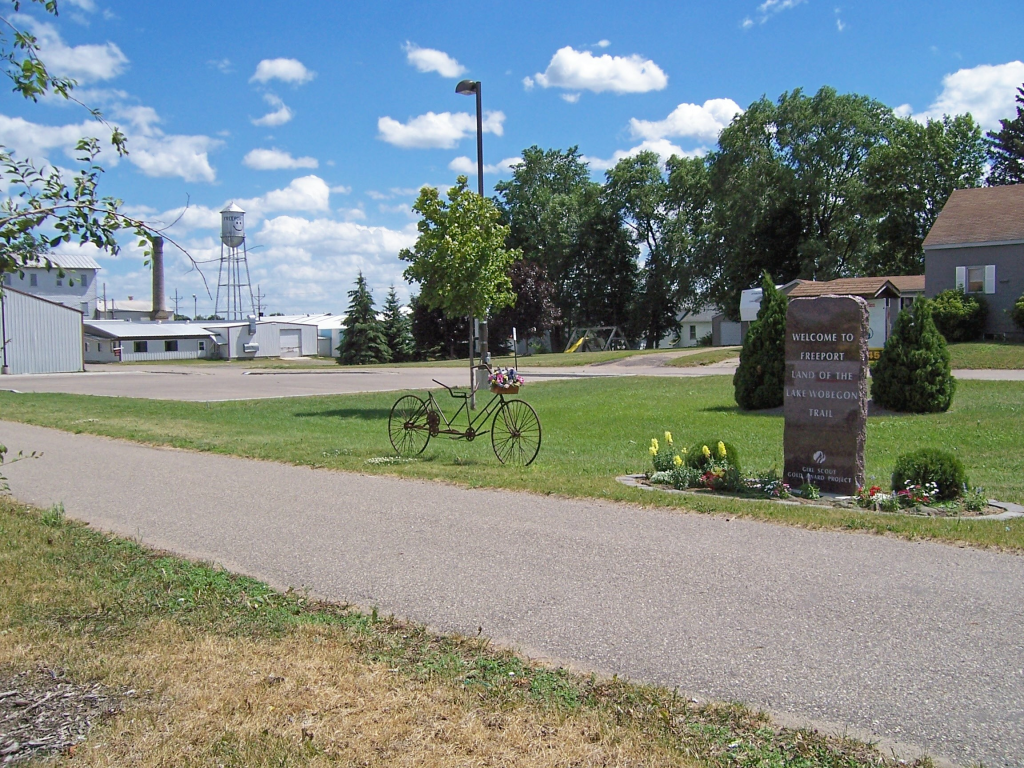
I’ll admit I’m a bit out of my element here. Obviously, you can’t just have a bike trail right next to vehicles traveling around 10 times faster than they are without any protection. Whether that’s a simple fence, a buffer zone or if it’s better to relocate next to nearby roads and highways, I’m not sure. Lower speeds would allow for more relaxed protections, playing into the cost-benefit tradeoff. Getting rid of the trail entirely would be the cheapest option, but I would again argue against it. Outside of the recreational value, biking is basically the only car-free method of transportation in this part of the state and would provide last-mile connections to the train for people living on the line.
What about the existing stations?
I’ve got something of a reputation for supporting trains of marginal usefulness, but usually the idea behind that is to upgrade them into something better in the future. This project is that upgrade. Perhaps unfortunate for the towns of Staples and Detroit Lakes, but I’ve done the overnight out-and-back and let me tell you, those 3-4 a.m. stop times are brutal. As much as I dislike intercity buses, I’ll concede a connecting bus to the Empire Builder plus one or more daytime buses would be much more useful.
In Whole or In Part?
Based on the above, it should be obvious why I push for the full build-out. It’s the only option that can fit four or even five round trips into convenient daytime hours with just two equipment sets. Getting rid of the north end negates most of the speed benefits, but dropping the south end eliminates the Minneapolis through stop and physically lengthens the trip. Older, slower rolling stock can’t make the most of the route, and threatening to remove the existing trails could end the project before it starts.
Go the Extra Mile
If this plan sounds interesting to you, please reach out to you elected officials today! HF3176 and SF2887 will set aside funds to study a Borealis extension to Fargo, but that’s not enough. Without explicit language stating to do so, it’s highly unlikely MNDOT will look into a dedicated passenger rail corridor. Furthermore, is one additional train really enough? All around the country, trains like the Borealis and Mardi Gras are smashing all ridership estimates and records. We shouldn’t have to prove that trains work and that people want them every single time we expand the system, but we do. Likewise, we shouldn’t plan these expansions as timid half-measures, but we do. So please, reach out to you elected officials and tell them to support the Otter Tail Line:
Minnesota Senate
Sen. Scott Dibble, Chair, Senate Transportation Committee – 651-296-4191
Sen. John Jasinski, Lead Republican, Senate Transportation Committee – 651-296-0284
Sen. Erin Murphy, Majority Leader of the Minnesota Senate – 651-296- 5931
Minnesota House
Rep. Erin Koegel, Co-Chair, House Transportation Committee – 651-296-5369
Rep. Jon Koznick, Co-Chair, House Transportation Committee – 651-296-6926
Rep. Lisa Demuth, Majority leader of the Minnesota House – 651-296-4373
Find your representatives here.
Minnesota Governor
Governor Tim Walz –- Phone 651-201-3400