Editor’s Note: Through an ongoing partnership with the Minnesota Historical Society, Streets.mn is republishing stories from MNopedia, the digital encyclopedia of Minnesota history published by the Minnesota Historical Society. The original text is reproduced here through a Creative Commons license (CC BY-NC-SA 4.0); photos are used with permission.
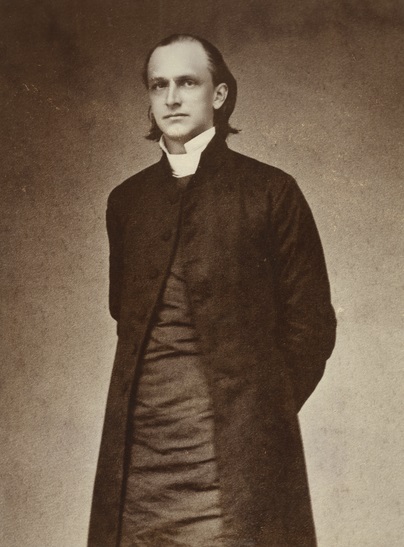
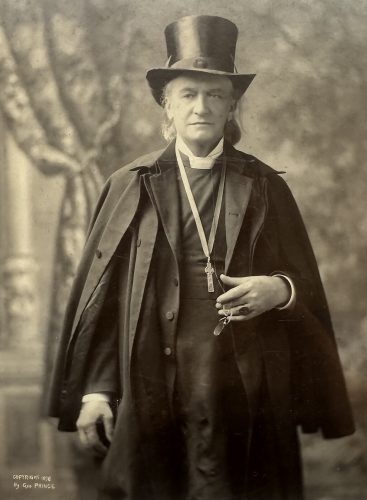
Henry Benjamin Whipple, the first Episcopal bishop of Minnesota, is known for his missionary work among the Dakota and Ojibwe and his efforts to reform the U.S. Indian administration system. After the U.S.–Dakota War of 1862, Whipple was one of the few white men to oppose the death sentences of 303 Dakota.
Life and Work
Whipple was born in 1822 and educated in New York. After serving as rector and priest of Zion Church in Rome, New York, for eight years, he moved to Chicago in 1857 to help organize and become rector of the Church of the Holy Communion. His missionary work became well known among Midwestern businessmen, politicians, and churchmen, including Episcopalians in Minnesota. They elected Whipple as their bishop in 1859.
Before moving with his family to Faribault in 1860, Whipple toured parishes and American Indian missions throughout Minneapolis, St. Paul, and St. Anthony in 1858. When Whipple visited the St. Columba Mission at Gull Lake, led by Ojibwe deacon John Johnson Enmegahbowh, the mission’s conditions of poverty alarmed him.
Treaties forced the Dakota and Ojibwe to live on reservations. The influx of white traders, loggers, farmers, and entrepreneurs to the region limited their options for traditional hunting, gathering, and farming. After his visit to Dakota country, Whipple dedicated his missionary work to promoting Indian welfare.
Whipple’s attitude toward Indians was paternalistic. He believed that whites needed to rescue Native people from poverty, alcoholism, and “spiritual wandering.” He also stressed that Indians needed to be “civilized” in the Euro-American ways of farming and education. He was also, however, more attentive than government agents to the concerns of the Dakota and Ojibwe.
A New Reformation
Whipple wrote to and visited Native members of his diocese. The Dakota and Ojibwe, he learned, had longstanding grievances after dealing with traders, agents, and missionaries for two decades. Through treaties with the U.S. signed between 1805 and 1858, the Dakota and Ojibwe had ceded most of their territory in Minnesota. In exchange, the U.S. government had promised annual payments of cash and goods, the construction of mills and schools, and agricultural training.
However, government agents delayed or withheld the payments. Addressing his protests to the press, public officials, and Presidents Buchanan (in 1860) and Lincoln (in 1861), Whipple criticized the government for making fraudulent deals and failing to enforce the treaties. He also called for an overhaul of the U.S. Indian administration, denouncing it as “a stupendous piece of wickedness.”
Whipple proposed specific reforms. He asked the U.S. government to treat the Dakota and Ojibwe as wards or citizens rather than as sovereign nations. He proposed that it provide supplies rather than cash payments and organize reservations by tribal band. He also recommended that agents prevent the sale of alcohol to Indians, encourage Indians to acquire land, and hire Christian teachers of farming and “the arts of civilization.”
Whipple became a more vocal critic as tensions between the Dakota and white immigrant communities erupted in the U.S.–Dakota War in August 1862. In September, a military commission headed by General Henry H. Sibley brought 303 Dakota men to trial. Many white Minnesotans threatened to riot if all 303 were not hanged.
A Plea for Justice
In letters to Senator Henry M. Rice, President Lincoln, Henry Halleck, and various newspapers, Whipple argued that the government did not have the right to order a mass execution. He blamed the U.S. for prompting the conflict with years of treaty violations. He also protested the legal basis for the trials, the haste of the prosecution, and the lack of a competent defense. Yet in December 1862, Lincoln authorized the hanging of thirty-eight Dakota in Mankato.
Whipple’s appeals during the U.S.–Dakota War trials earned him a national reputation as a spokesperson for Indian affairs. He served on a number of commissions, including the Sioux Commission (1876), the Northwest Indian Commission (1887), and the U.S. Board of Indian Commissioners (1895–1901).
Late in his life, Whipple continued to expand the Protestant Episcopal Church in Minnesota. In the 1890s, he established a number of diocesan schools, including schools for Indian children. He remained in Faribault until his death, in 1901. He is the namesake of the Bishop Henry Whipple Federal Building (1 Federal Drive, Fort Snelling), built in 1965.
Timeline
- February 15, 1822: Whipple is born in Adams, New York.
- November 1849: Whipple is ordained as rector of Zion Church in Rome, New York.
- March 1857: Whipple is ordained as rector of the Free Church of the Holy Communion, the first “free” church (charging no fees for a pew seat) in Chicago.
- 1857: Whipple attends the First Episcopal Convention in Minnesota.
- June 30, 1859: Whipple is elected the first Episcopal bishop of Minnesota. His diocese includes Minneapolis, St. Paul, smaller towns, and the Ojibwe missions of E. Steele Peake and John Johnson Enmegahbowh.
- Spring 1860: Whipple moves with his wife and five children to Faribault and establishes it as the see of his diocese.
- April 9, 1860: Whipple sends his first letter to President James Buchanan on behalf of the Dakota.
- March 6, 1862: Whipple sends a letter to President Lincoln requesting Indian administration reform.
- August 1862: During the U.S.–Dakota War, Whipple helps care for wounded people brought to St. Peter.
- September 28, 1862: The trial of 303 Dakota men by a military commission begins.
- December 4, 1862: Whipple sends a letter to Lincoln explaining the causes of the U.S.–Dakota War and urging clemency for 303 condemned Dakota men. The letter includes a petition on behalf of the Dakota, signed by the Protestant Episcopal General Convention.
- December 26, 1862: Thirty-eight Dakota men are executed at Mankato.
- 1876: Whipple ordains the first Ojibwe deacons in Minnesota.
- 1895: Whipple is appointed to the Board of Indian Commissioners in February.
- September 16, 1901: Whipple dies in Faribault.
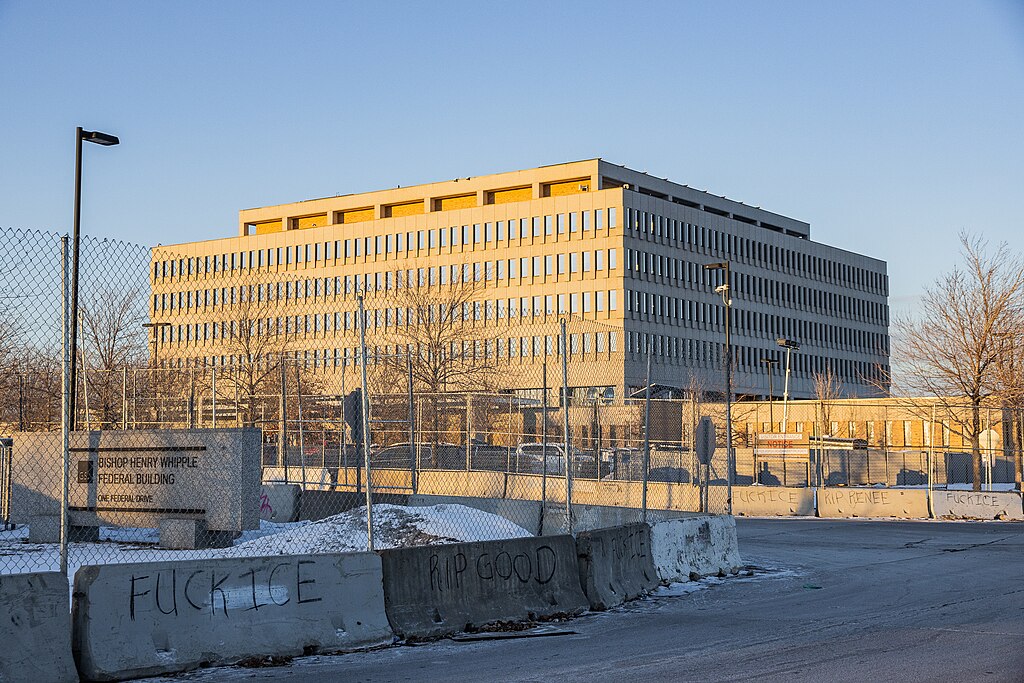
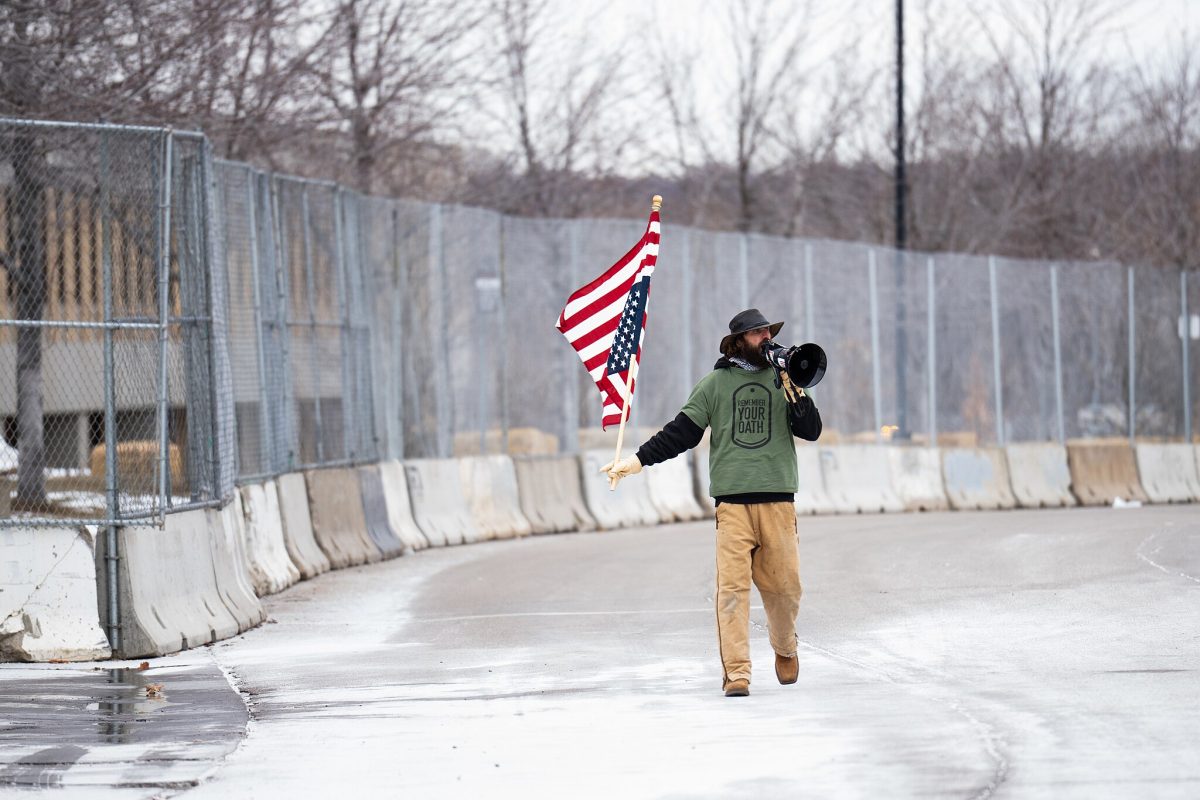
Editor’s Postscript: At the time of republishing this MNopedia article, the Bishop Henry Whipple Federal Building is being used as a base of operations for federal Immigration and Customs Enforcement (ICE) operations under the Trump Administration’s “Operation: Metro Surge.” Citizens and neighbors throughout the Twin Cities have peacefully protested on the building’s grounds through tear gas and flash bangs. Others have been caught up in ICE operations, forcibly taken from their homes, neighborhoods, and places of work, and detained in the building itself. Knowing something about the life and convictions of its namesake underscores the injustices being committed there.