Most Streets.mn readers know what a third space is, even if we have never used the label. It resonates somewhere deep, where our humanity resides. It’s the café where the barista knows your name and order. The same one where friends have been playing chess every Thursday for decades. It’s the pizza joint that smells just like your favorite childhood birthday, discordant singing and all. It’s the bar with warmth enough to be worth the tromp through a blizzard. It’s the park bench with a great sunset view. It’s a bus ride where you randomly run into a friend. It’s the place of worship where grief and gratitude share the same pew. It’s the school gym where folding chairs line up for concerts and graduations.
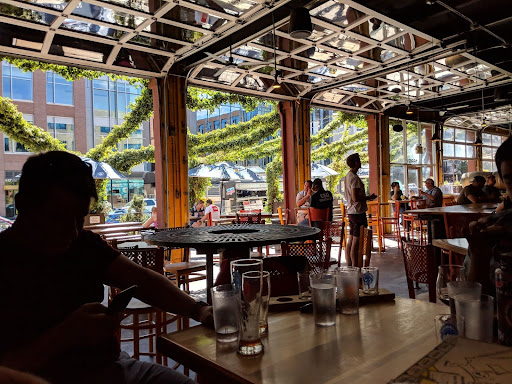
Third spaces are where we practice being human together. They are not home. They are not work. They are where community happens. And when one of those spaces is harmed, we feel it in our bones. When a favorite restaurant has a kitchen fire, like Herbivorous Butcher, we don’t just lose a building — we lose a ritual. When a house of worship is attacked by a bigot, like we saw at Dar Al Farooq and so many others, the damage is not just to brick and mortar — it’s to a sense of belonging. When a school becomes the site of violence like at Annunciation, the trauma seeps into lockers, hallways, playgrounds, childhoods. The space itself feels altered. The ability for these spaces to weave more social fabric frays.
This is true at 38th and Chicago, George Floyd Square, which is to say nothing bad of the dedicated volunteers who steward that space. Police murdered a man there and the world felt that grief. It will be true at 34th and Portland. It will be true at 24th and Nicollet. Long after the flowers stop being fresh cut, and long after the news cameras leave.
Our neighbors were killed there. They were good neighbors. We understand instinctively that these places require care, reinvestment, ritual, and repair. We hold fundraisers. We rebuild. We gather. We refuse to let violence have the last word.
So rarely do we talk about our streets this way.
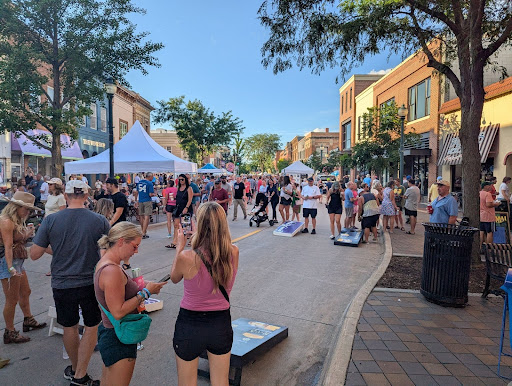
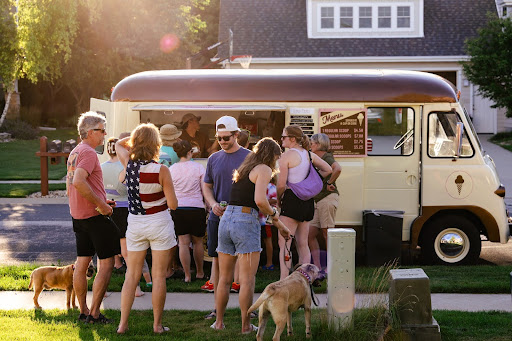
Our streets are third spaces, too. Or at least, they should be. They are the widest public rooms we have. They run past every home, connect every block, and stitch together every neighborhood. They are where children learn balance on two wheels, where elders take evening walks, where our dogs make friends that make us friends. They are where neighbors pause mid‑errand for a conversation that runs longer than expected, where we smell that it is dinner time or laundry day, where chalk art fades slowly under summer sun.
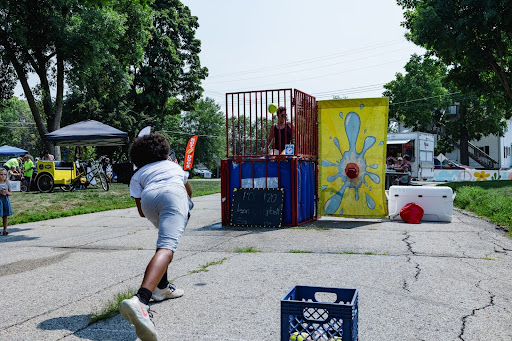
Not every neighborhood has equal access to safe third spaces. Not every block has a park within walking distance. Not every family can afford patios and coffee shops. This equity critique resonates with the argument made in Streets.mn’s Play Streets Promote Equity, Community for All Ages, where play streets are described as mechanisms that allow neighbors — especially children and families — to use the street as a safe public space for play, connection, and community building.
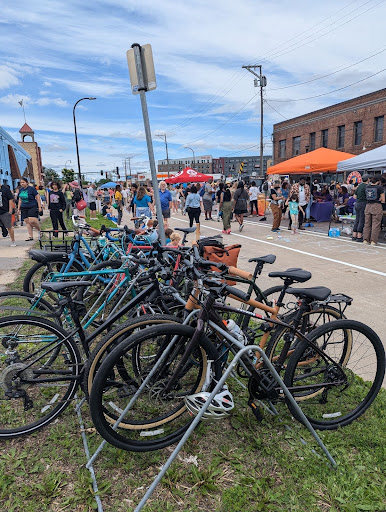
In many communities — especially lower‑income neighborhoods and racially‑marginalized communities — the street is the only public room available. But too often streets have been designed for speed, enforcement, and extraction rather than safety, play, and belonging. Reclaiming streets is not nostalgia. It is redistribution — of safety, of space, of visibility, of belonging.
We have local examples of this all over Minnesota. Minneapolis was once a forward-thinking champion of Open Streets and could be again. Rochester closes blocks of their downtown to cars every Thursday through the summer. St Paul has a history we’ve showcased on Streets.mn, Play Streets and Block Parties: Reimagining Residential Streets, describes how neighbors in St. Paul turned a quiet side street into a Play Street where children played freely, adults talked, toys were shared, and people felt more connected. If these events can do that in one St. Paul neighborhood, what might happen if they spread across every ward and every block?
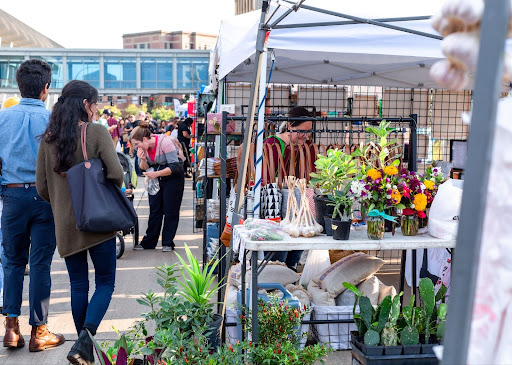
There is a deep and growing body of research that points to how these gatherings are more than just symbolism. In Philadelphia, scholars have measured neighborhood “community vibrancy” using block party permit data and found that blocks with a higher proportion of spontaneous block parties tend to experience lower crime trends — suggesting that resident‑led gatherings reflect and may help build informal social organization and collective efficacy. Likewise, block parties have been shown to act as indicators of social capital — the dense network of trust, familiarity, and mutual aid among neighbors that supports collective life and resilience. Research on similar street‑opening events, like open streets, also shows that when public right‑of‑way is reclaimed for people — for walking, play, gathering, and chance encounters — participants report greater social cohesion and physical activity, both of which are linked to healthier, more connected neighborhoods.
For months, our streets have also been used as a canvas for federal violence: arrests, intimidation, deadly force. It is a heavy choreography of power playing out on asphalt meant for daily life and a loud chord in a chorus of harm that echoes far beyond the moment itself. You can feel it — the hesitation, the way our public space feels charged and spikey instead of welcoming, the way streets have become corridors to move through quickly rather than places to linger. Trauma changes how we inhabit space. It shrinks us. It teaches us to scan instead of settle, to pass through instead of gather. When violence is written onto our streets, it erodes their ability to function as social infrastructure and it weakens the everyday trust built not in grand gestures, but in small, repeated encounters.
We cannot afford that erosion. Social infrastructure is not decorative. It is protective. We are told safety comes from police patrols and presence, but real safety comes from recognition — from knowing the kids on your block, from knowing who needs groceries when the power goes out, from having enough connection that harm cannot hide in isolation. Social infrastructure allows neighbors to check on one another when disaster strikes. It turns strangers into familiar faces. It makes mutual aid possible, collective action imaginable, resilience real instead of aspirational. Streets that are safe enough for a block party are streets safe enough for a child to bike to school, for an elder to cross without fear, for a wheelchair user to move without obstruction, for a transit rider to wait with dignity. That is mobility justice. That is spatial justice. That is what a healthy and just public life looks like.
So close the block. Fill out the permit — even if the systems need reform — or gather your neighbors and just reclaim it for a few hours. You’re not throwing a festival. It’s dinner and some music in the street. Put up the barricades. Hang handmade signs. Drag folding tables into the middle of the asphalt. Bring out the grill, the speakers, the projector and screen, the bikes, the jump ropes, the sidewalk chalk. Let toddlers wobble down the center line. Let teenagers claim the pavement for a pickup game. Let elders sit in the shade and watch the choreography of community unfold.
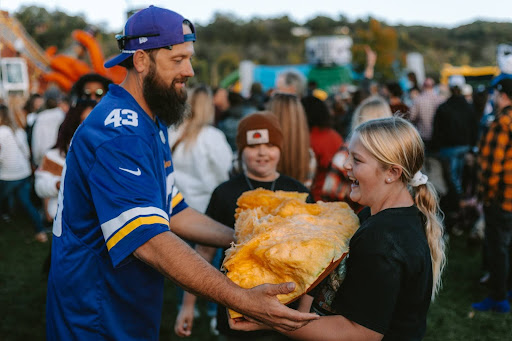
Your neighbors are worth celebrating. Kids will be graduating this spring. Celebrate them — 4th into 5th grade can be a big deal! Did your neighbor get into homebrew? Celebrate her, host that beer tasting. Did new people just move into the lot down the way? Make it easy for them to meet everyone!
Don’t just invite your friends. Start with the neighbors who are often left out: the renter, the new immigrant family, the elder who doesn’t drive, the single parent, the kids without a yard. Let the gathering reflect the block, not just the loudest voices on it. And imagine if this wasn’t just your block. Imagine if dozens of blocks did this. If entire neighborhoods began practicing public life again.
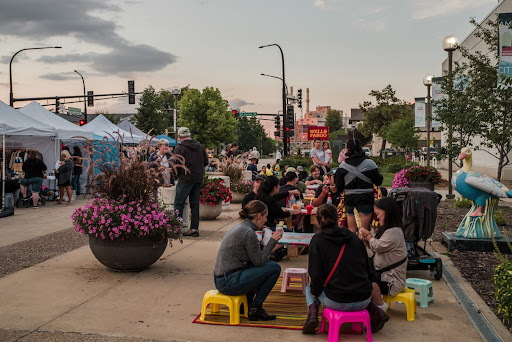
Cities should make this easier. If permits can be waived for one kind of gathering, like National Night Out, they can be waived for all sorts of small scale events. The City of Minneapolis already issues block event permits that allow residents to close residential streets for gatherings; the permit fee is just $50 and is waived for certain community events like National Night Out. If we believe streets are public space, then access to them should not require months of lead time or financial barriers that only well‑resourced neighborhoods can navigate. Ask your councilmember what it would take to create a fast, free, neighborhood‑led street closure permit.
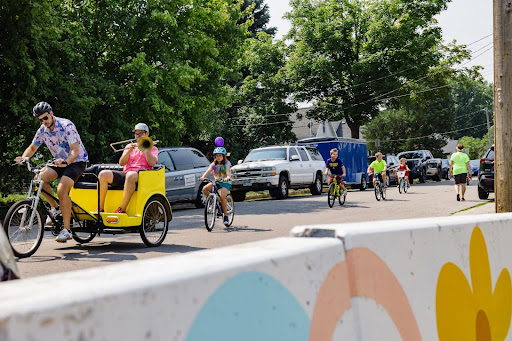
Throw the block party. Not as escapism. Not as denial of what we have experienced. As repair. When we close a street to cars and open it to people, we are not just creating a pleasant afternoon. We are rewriting the story of that space. When you throw a block party, you are insisting that the loudest chord will not be violence, but laughter; not sirens, but music; not fear, but familiarity. When you throw a block party, every very shared meal on the asphalt is a stitch. When you throw a block party, every bike ride down the center of the block is a declaration and every conversation across folding chairs is reinforcement.Joy that does not widen access is decoration.
Joy that widens access is justice.For a few hours. For a day. Close your street this year and open it to community.
Permit Guide for Our Key Readership Communities:
Minneapolis, MN
Residential Block Parties
Permit required to close a residential street or alley.
Fee: $50 (typically waived for National Night Out)
Deadline: Apply at least 5 business days in advance. Late applications are not accepted.
Requirements:
- Traffic/barricade plan (applicant arranges barricades)
- Basic security plan
- Cleanup plan
- Event must generally occur between 10 AM–10 PM (including setup)
Residential block party permit page:
https://www2.minneapolismn.gov/business-services/licenses-permits-inspections/special-events-temp-permits/block/residential/
Note: Commercial or business district events have different fees, insurance requirements, and timelines.
Saint Paul, MN
Permit required for any block party or street closure affecting public streets.
Application is submitted through the Saint Paul Police Department Special Events process.
Timing:
- New events: at least 60 days in advance
- Recurring events: at least 90 days in advance
Typical requirements:
- Event map with proposed street closures and barricades
- Petition from affected neighbors (submitted approximately 30 days before event)
- Possible insurance documentation depending on event type
Special Events Application page:
https://www.stpaul.gov/departments/police/administration-office-chief/community-engagement-division/special-events-application-sppd
General event permit overview:
https://www.stpaul.gov/departments/police/connect-with-department/event-permits
Rochester, MN
A Special Event Permit is required if your event:
- Closes a street or sidewalk
- Uses amplified sound
- Includes food or alcohol service
- Impacts public right-of-way
Block parties that close streets require a permit.
You may also need:
- Right-of-Way obstruction permit
- Food or alcohol permits if applicable
Special Event Licenses page:
https://www.rochestermn.gov/departments/city-clerk/licenses-and-permits/special-event-licenses
Duluth, MN
Special Event Permit required for events on public property that interfere with traffic or require city services. There is a specific block party application within the special event process.
Fees (based on size and timing):
- Fewer than 50 participants:
- $25 if submitted 30+ days in advance
- $100 if 14–29 days
- $400 if fewer than 14 days
Deadlines:
- Under 500 participants: typically 30 days
- 500+ participants: 90 days
Requirements may include:
- Traffic control plan
- Insurance
- Notice to neighbors
Special Event Permitting page:
https://duluthmn.gov/city-clerk/licenses-permits/special-event-permitting/
Mankato, MN
Special Event Permit required for outdoor public events or events that significantly impact city services, including street closures.
Fee: $30 application fee (additional fees may apply depending on event classification)
Deadline:
- At least 45 days in advance
- Large events (1,000+ attendees): 90–120 days in advance
City staff may require modifications before approval.
Special Event Permit page:
https://www.mankatomn.gov/residents/permit-and-license-applications/special-event-permit