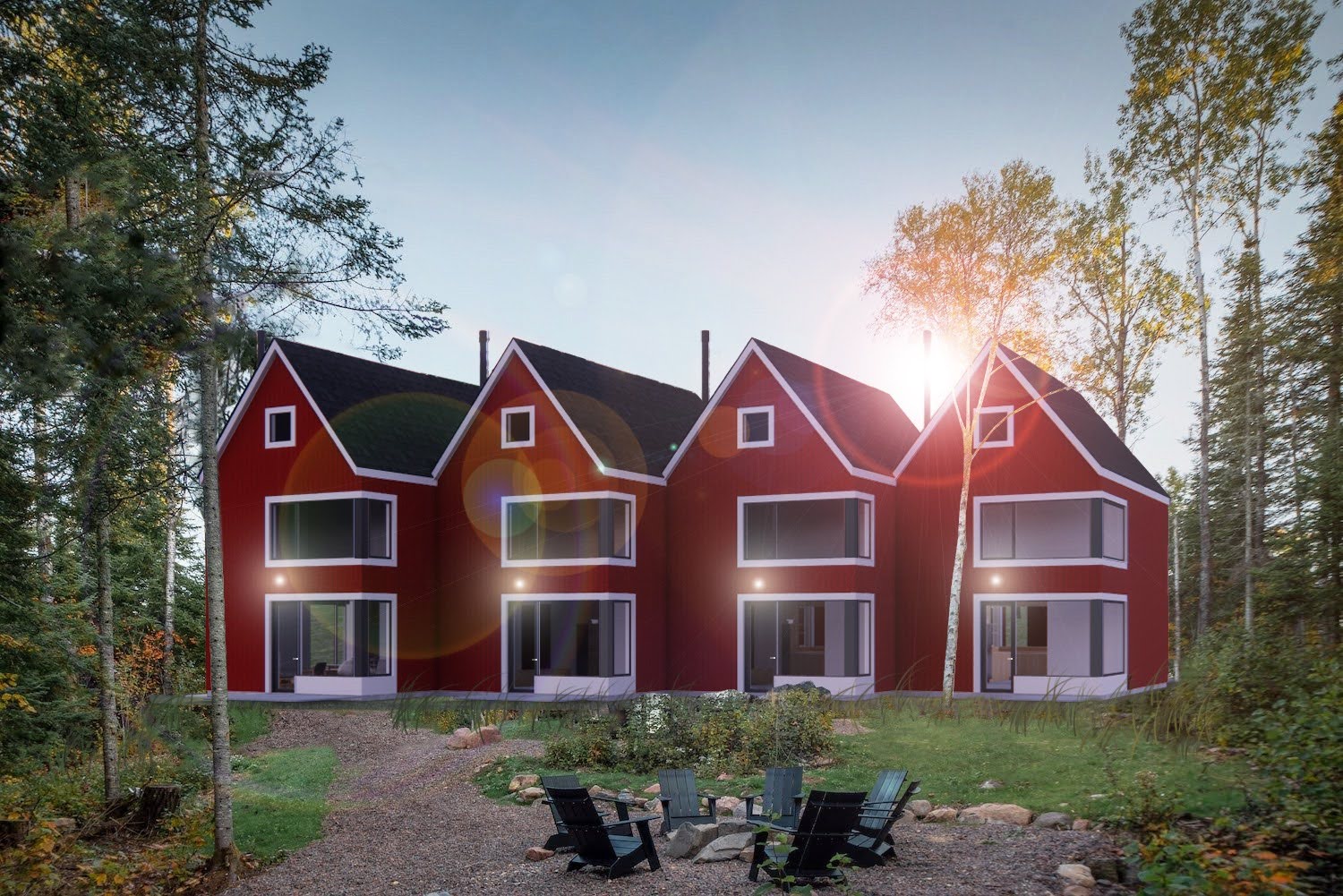
Author’s Note: As an architect with expertise and experience in developing new homes, particularly townhomes, I regularly share my experience with local planning boards and city councils where I am working to develop new homes. Recently, I had the chance to testify in front of the Minnesota Legislature on behalf of the Starter Homes Act (HF 3895 / SF 4123). Here is an adapted version of what I shared with the Committee.
For the past several years, I have been working to bring a townhome development from idea to reality in Grand Marais. Like most Minnesota cities, Grand Marais desperately needs more homes affordable to local residents. I am a residential designer and a housing advocate focused on creating the next generation of attainable housing. Over the past decade, I have focused on strategies to expand our housing stock and on the challenges that befall it. The Starter Home Act is an important first step toward setting statewide standards to allow more homes.
The Starter Homes Act would ask all Minnesota cities to do something to address our shared housing needs by setting baseline standards that allow more housing types (accessory dwelling units, townhomes, and smaller houses on smaller lots) to be built in residential zones. Larger cities and towns would also be asked to allow duplexes, triplexes, and fourplexes in some parts of their communities, and apartments along commercial corridors.
Minnesota wouldn’t be the first to set statewide standards that allow more homes. Over 25 states have enacted some form of statewide law allowing accessory dwelling units, more homes near jobs, and other home types. Opponents claim such standards preempt “local control” and deauthorize local governments to make housing decisions for their communities.
We all know that Minnesota communities have a shortage of housing, from Minneapolis to Grand Marais, and from Fargo to Rochester. Our state needs nearly 100,000 more homes to meet the needs of the people who live here today, and those new homes need to be smaller, more affordable, and located near jobs.
The project that I was hired to design in Grand Marais is a proposed residential community with fourteen market-rate townhouses, a few artist cabins, and five townhouse units reserved for income-qualified households that annually make less than 115% of the Area Median Income (AMI). These twenty-one homes will offer the benefits of homeownership for local, long-term residents. Eight of the townhouses could have an optional Accessory Dwelling Unit (ADU), which could be rented to other long-term residents.
These townhomes could be the perfect home for many – whether it’s a retired couple looking to downsize and sell their single detached home to a young family, or a single parent with young kids who works in the community. We heard from employers who could not find people to work for their company because of the limited housing stock. These stories are not unique to Grand Marais, nor are they unique to Minnesota.
After passing the Planning Board unanimously, these townhomes needed final approval of the City Council, and neighborhood opposition to the project by a few neighbors brought the project to a halt, in spite of all the careful planning and consideration, investment, and possibilities these homes would bring, the project was denied.
The architects, engineers, builders, and housing advocates who read streets.mn, could fill pages and pages of conditional use denials and projects that withered on the vine. “Death by committee” purports to be a democratic process, but is actually quite unrepresentative of the current and future constituents that would benefit from a proposed housing project. The current public hearing process empowers neighbors and elected officials to decide the fate of a project, resulting in an overwhelming pattern of denial, de-densification, and concentration of poverty.
Other states that have passed similar legislation have seen the positive outcomes of their work – more homes in more communities, more homes of different sizes, and most importantly, more homes at lower prices.
If you’ve ever had a project denied through a conditional use process, or tried to find a home you could afford in the neighborhood of your choosing but failed, or watched as a few neighbors kill a good project, I would encourage you to speak up now. The Starter Homes Act needs our help after the House Elections Finance and Government Operations Committee voted 5-7 against advancing the bill to the floor, as discussed in the 2026 Urbanist Legislative Agenda Mid-Session Check-In, and we all know how meaningful it could be. Not another year should go by before we begin the truly meaningful work of building homes that more Minnesotans can afford.
I would love to see a future where my services are not strictly needed to realize a project like Björkberg. In order to secure a prosperous housing future for everyone, we need to reduce the friction between what someone wants to build and what they can build. We need enterprising solo developers and DIYers to be able to build more homes in their neighborhoods lot by lot, block by block. We need families to expand in place instead of moving out. If we are going to relieve this housing crisis by alleviating the housing shortage, everyone will need to contribute units, large and small.
Editor’s Note: This article was updated at the request of the author on April 23 to reflect several clarifying edits.