Transportation in Duluth had a pivotal year in 2025. The resurfacing of Sixth Avenue East in the Hillside neighborhood made a previously unapproachable corridor more pedestrian-friendly. Duluth also welcomed a new BikeMN chapter, Vibrant Streets Duluth, and city councilors voted unanimously to establish the city’s first transportation commission.
In early December, members of Vibrant Streets Duluth, supported by Councilors Azrin Awal, Deborah DeLuca and Roz Randorf, introduced a motion to explore redesigning First Street downtown as a “Flow Street.” The proposal asks the new transportation commission to study the concept and return with recommendations within nine months of its first meeting.
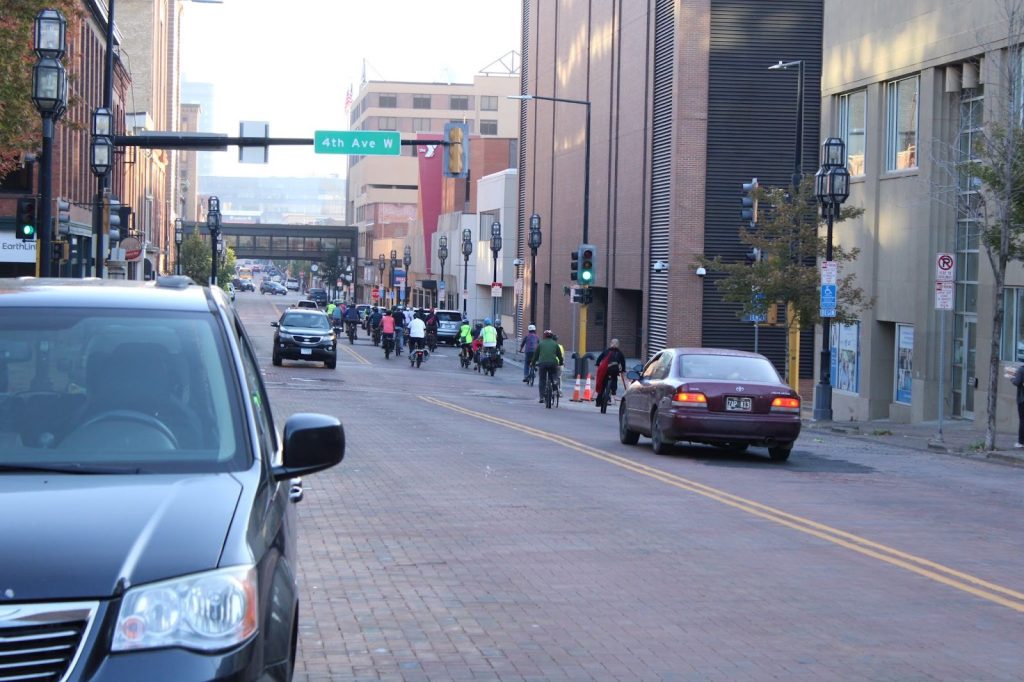
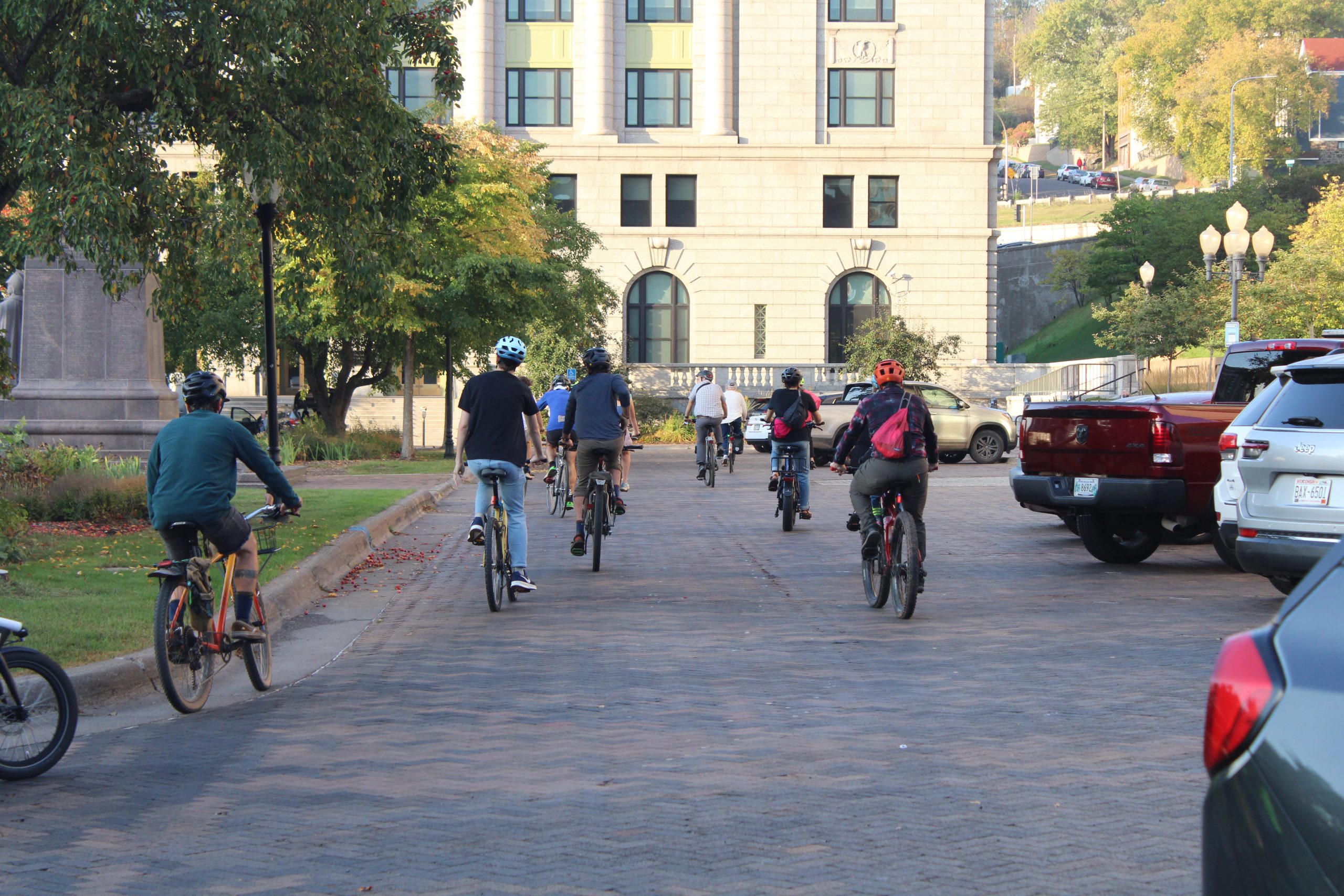
Riders head down First Street from City Hall in Duluth during a Flow Street demonstration ride on October 3, 2025. Photo by the author
What is a Flow Street?
Flow Streets build on the Slow Streets movement, which began in Europe and Canada and expanded across the United States during the COVID-19 pandemic. Cities sought safer ways for people to move and exercise while maintaining distance. Since 2020, versions of Slow Streets have appeared in cities such as San Francisco, Portland and Seattle.
Slow Streets typically include speed limits under 20 mph, signage discouraging cut-through traffic and protective elements such as bollards near crosswalks, sidewalks or bike lanes.
Flow Streets expand on that approach. Vibrant Streets Duluth describes them as “safe, comfortable, low-vehicle-traffic routes that prioritize community-building through active transportation.” Rather than eliminating cars, the concept aims to rebalance spaces with slow speeds so walking, rolling, biking and driving can coexist more safely and comfortably, all while allowing for cars and delivery vehicles to maintain access to properties and parking.
Why First Street?
Just one block uphill from Duluth’s main downtown corridor, First Street was recently converted to two-way traffic. About 25 blocks — from Sixth Avenue West to 21st Avenue East — are being considered for the Flow Street concept.
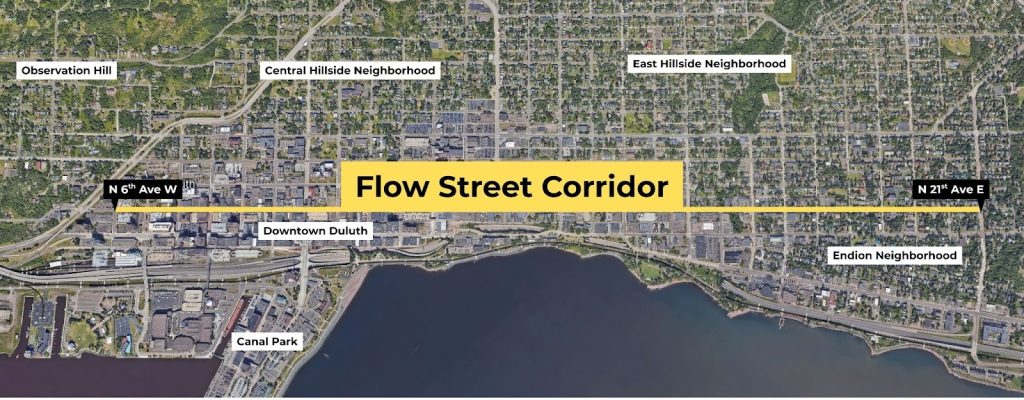
Map layout of the proposed Flow Street project area. Image by the author
This stretch runs past multiple downtown destinations, including municipal buildings like City Hall and the Chamber of Commerce, a string of people serving non-profits including Safe Haven, PAVSA, the YMCA, and United Way, and accesses many of Duluth’s healthcare buildings like WE Health, Essentia Health, and Aspirus. First Street is also home to several long-standing historical buildings and spaces, such as the Building for Women and the Clayton Jackson McGhie Memorial.
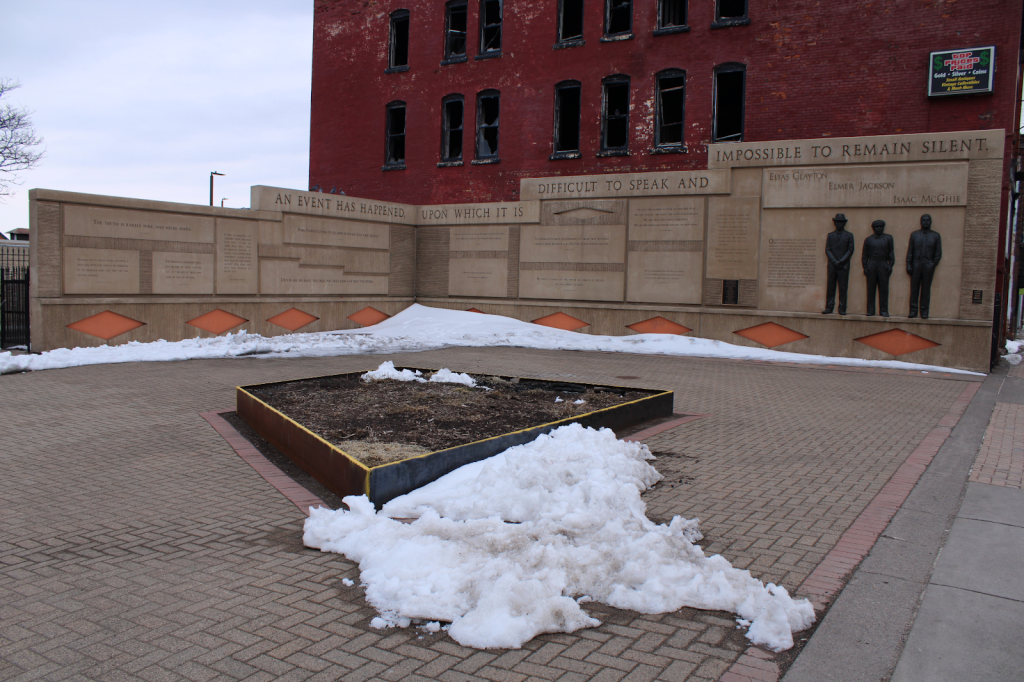
The Clayton Jackson McGhie Memorial honors the lives of Elias Clayton, Elmer Jackson and Isaac McGhie, three Black men wrongly accused of raping a white woman, who were tortured and lynched by a mob on First Street in Duluth on June 15, 1920. Photo by the author
Libby Bent, a founding member of Vibrant Streets Duluth and longtime bike commuter, says First Street has long served as a practical route through downtown because of its relatively low traffic volumes, flat terrain and proximity to amenities. As Duluth works to revitalize downtown, Bent says a calmer, multimodal street could help people more easily connect with local businesses and organizations — interactions often missed when traveling by car.
At the same time, parts of the corridor show visible disinvestment, including fire-damaged buildings, vacant lots and underused properties. Mary Faulkner, Executive Director at the Program for Aid to Victims of Sexual Assault (PAVSA), located in the Building for Women on First Street notes; “The proposed changes would increase the accessibility and safety of our neighborhood and create a more conducive environment for seeking healing and wellness. Our First Street neighborhood has so much potential and is ready for revitalization efforts that have been so successful across Duluth.
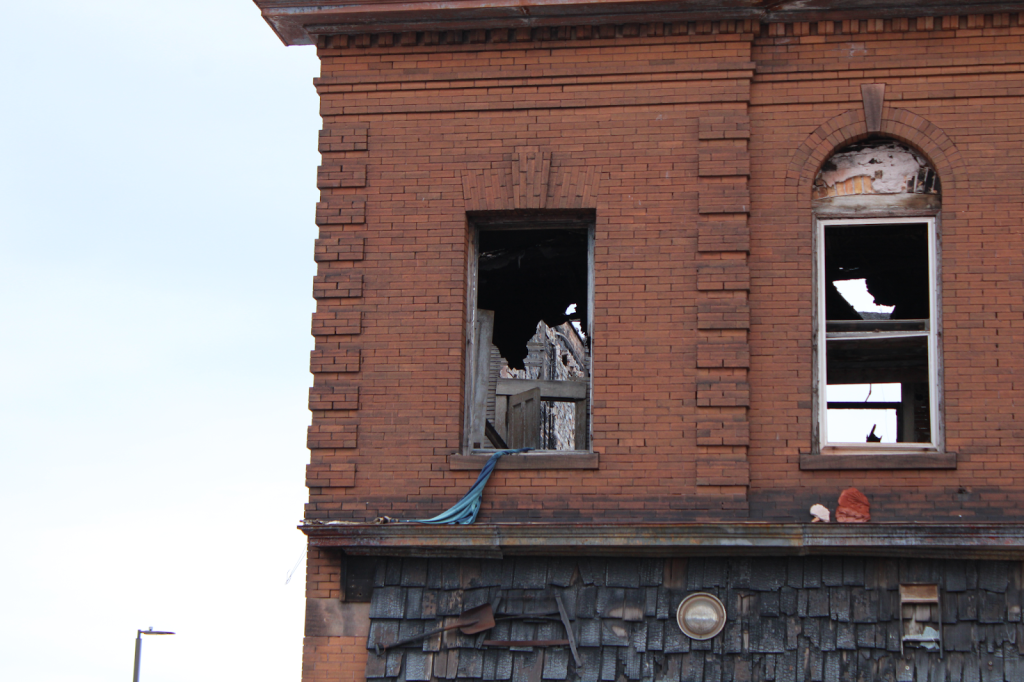
Upper floor of an abandoned building along First Street. Photo by the author
A Flow Street could help reshape not only the physical environment but also the daily experience of the area by encouraging steady, human-scale activity. Other advantages, cited on the Vibrant Streets Duluth website, include a pedestrian alternative to the popular Lakewalk and a connection between downtown and Lincoln Park.
Behind the scenes: Urban Excellence Institute
Formal study of the Flow Street concept won’t begin until city staff and City Councilors appoint members of the new transportation commission, expected to happen yet this spring. But work continues through the newly formed Urban Excellence Institute. That initiative connects stakeholders, including staff from the City of Duluth, the University of Minnesota Duluth, business owners, community non-profits and community residents, to advance projects aligned with Duluth’s Imagine Downtown Work Plan. Goals include improving safety, growing local businesses and promoting the interconnectedness of neighborhoods.
Jennifer Webb, an associate professor of art history at the University of Minnesota-Duluth, and Duluth City Planner James Gittemeier, who teaches an “Introduction to Urban Planning” course at UMD, are incorporating the Flow Street concept into their courses, engaging students in the Flow Street project and other downtown initiatives.
“We want to find ways to build capacity and include student engagement,” says Webb, adding that the university is well positioned to work with Duluth and Superior, Wisconsin — commonly known as the Twin Ports — to be collaborating. Their classes will merge efforts on a demonstration project ideas over the next few months, implemented along First Street in summer 2026.
When a Duluth Flow Street becomes reality will hinge on the city’s new transportation commission.