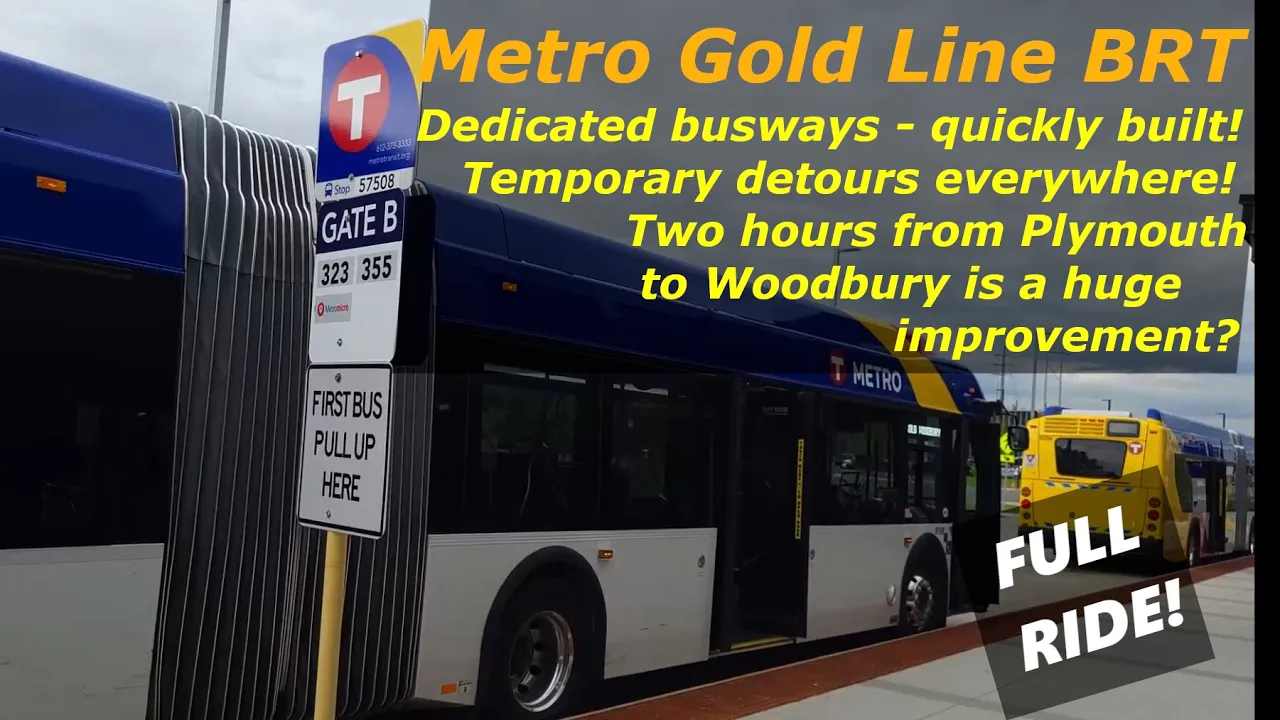
Metro Transit’s Gold Line BRT is open & operating from downtown St. Paul to the east metro suburb of Woodbury. I’m headed out to ride this new line with all its dedicated busways constructed within the right-of-way along Interstate 94 & I’m going to do it using mostly public transit! From Plymouth to Minneapolis, crosstown through State Fair traffic & then into downtown St. Paul we’ll expose & examine how this ambitious BRT project is operating after its first summer.
Video description
Handmade, 100% AI-free & hopeful Metro Transit does something about the infiltrating geese before this line turns out like the Green Line did!
Google Maps image in intro, other map imagery via Metro Transit.
Featured music under free license via YouTube Creator Studio
Produced by Megandsteve Travel, 2025.
Recorded August, 2025.
Transcript
Transcribed by Ian R Buck.
[00:00:00] Steve: Metro Transit’s color-coded BRT lines run from suburbs into the Twin Cities and have been featured in years past on my channel. They differ from the arterial BRT routes with lettered designations by running on highways versus city streets and having fewer scheduled stops. The Red Line goes from Apple Valley to the Mall of America. The Orange Line runs from Burnsville to downtown Minneapolis. The Gold Line we’re taking today currently runs from Woodbury in the East Metro to downtown St. Paul and will be extended in the coming years to serve downtown Minneapolis. Our trip out on transit to ride the gold line begins on the other side of the metro in Plymouth and will require a ride aboard a rush hour express bus from Plymouth Metrolink station 73 Park and Ride to downtown Minneapolis.
[00:00:51] Steve: I’m at station 73 Park and Ride in Plymouth, Minnesota because I’m going to go over to the east side of town today and we’re going to use the new Metro Gold Line BRT. But is it BRT? We’ll find out. It’s the reverse commute! I’ve lived here a year, it’s very beepy in here and I didn’t realize how beepy it was because I haven’t been here in a year. This Park and Ride usually only runs buses during rush hour which we’re part of right now. That’s weird for me.
[00:01:22] Steve: Any later trips beginning past the morning rush hour would require an alternate route via Metro Transit bus routes at either Ridgedale Mall or within the city of Robbinsdale to get downtown. Typically, this route 774 coach bus would run efficiently into downtown via Interstate 394’s reversible express lanes. But those lanes are under construction as of this recording in August 2025, so our driver takes a historic route down Glenwood through the Bryn Mawr neighborhood and ultimately right through the Royalston Farmers Market neighborhood featured in my Green Line Southwest Extension video to reach downtown Minneapolis.
[00:03:04] Steve: Once downtown, I always take a route 94 bus between the cities if it’s conveniently timed which isn’t always possible so occasionally I take a Green Line train but I really prefer the bus. Okay, we got downtown. We stopped at the Orange Line stop which is on Marquette which is wrong and now we are going to catch the 94 express bus across town which will someday be replaced by the Gold Line BRT. There’s a piano at this bus stop. I’m at the Capella Tower which is actually the tallest building in Minnesota but the IDS has some sort of technicality that it usually wins on. I probably just started an argument in the comments. With all the construction going on in town it’s impossible to tell whether the buses will be on time. All this construction has most buses just running detours like we just saw but the Gold Line is only detoured through part of the east side of downtown because the Kellogg Avenue viaduct over the railroad tracks in the former swamp.
[00:04:11] Steve: The trip across downtown via Interstate 94 is much more efficient by bus and more pleasant of an experience compared to the people that can often hold the doors open on the Green Line train. The efficiency issue will be improved upon by the eventual extension of the Gold Line BRT across town and I guess they can’t hold the doors open while the bus is running down the highway. It’s said to be part of a larger project to improve Interstate 94, a route which divided St. Paul in the 1960s. They’ve been working toward HOV slash bus slash toll lanes on the freeway for years and it would seem the Gold Line would utilize those on the same routing as our Route 94 bus trip today. Going from frequencies of about every half hour at best to every 10 minutes here would be a likely more significant improvement for Metro Transit’s system reliability than the Gold Line’s initially constructed segment through St. Paul’s east side we’ll be riding in a short while might be.
[00:05:38] Steve: I alight near Excel Energy Center, aka the former Civic Center, and soon to be some other new name, I think Treasure Island Casino, and walk a couple blocks to just outside the Smith Avenue Transit Center that is presently where Gold Line buses begin and end their run. The station is across the street and close by a newly redeveloped block. It feels about average for downtown sketchiness. There’s a large center for people without homes nearby and they can be seen queuing up blocks away. But this early in the morning, there’s little activity of any sort besides some slightly elevated levels of people and vehicle traffic due to the state fair going on miles away on St. Paul’s Edge near the suburb of Falcon Heights. The Gold Line BRT currently starts over here at Smith Avenue Transit Center.
[00:07:01] Steve: So I think it’s Gold Line buses go into this parking garage to lurk and B Line buses come up the other way. One of these ways. I don’t know. We’ll know when we see one.
[00:07:21] Steve: [camera pointed at sign saying not to poop or pee on the bus] Don’t be doing that!
[00:07:32] Steve: It’s in 13 minutes. I just missed it by a little bit. If I just would have rode further into downtown, I probably could have coordinated this to be faster. But every 13 minutes and you’re calling it BRT, OK.
[00:07:44] Steve: [camera pointed at Xcel Energy Center] They’re going to change the name on that soon, but at least they don’t have to call it crypto.com.
[00:07:49] Steve: The real advantage to building the Gold Line is it increases service to the East Side. It links a few routes that run north to Maplewood Mall within St. Paul, but it really establishes any kind of transit presence in South Maplewood, Oakdale, that corner of Woodbury. Some of it’s microtransit, but I took a look at the app and it seems straightforward. We’ll have to look at the timing when we get out there. We might use that. We might just skedaddle back toward Minneapolis, catch the earlier first bus that hits station 73 in the afternoon. We’ll see.
[00:08:28] Steve: Boarding Gold Line buses like the other highway and arterial BRT routes in Metro Transit system is proof of payment via tickets purchased at each bus station via ticket machine, on the Go-to card tap cards which get validated at each station, or on the Metro Transit app such as I use today. This facilitates capability of all-door boarding of buses on the line, but many people still go to the front door and try to pay the driver anyway. The Gold Line is the first of the BRT lines to run on a significant portion of newly constructed dedicated busways, rather than lanes shared with other vehicles. The Gold Line runs east out of St. Paul along Interstate 94, Hudson Road, and eventually Bielenberg Drive south into Woodbury, where the line terminates near Valley Creek Road and I-494 at a large park and ride located within walking distance of a large retail development. It’s also nearby where I used to live. Along the way we’ll pass several other retail centers, residential neighborhoods spanning over a century of development, and finally the East Metro suburbs, much later to develop and thus far less densely so than on the west side of town where we all began this trip. All in all this trip will require about two hours of bus riding in each direction, a time frame exacerbated by summer road construction, and just under an hour of time spent laying over between bus schedules, mostly at the U of M awaiting my final bus back to Plymouth. A couple new routes to and from Plymouth, a familiar crosstown ride, and figuring out how this additional investment in infrastructure separation of the Gold Line might pan out in the Twin Cities given my 20 year history of riding Metro Transit and a few other routes around the country. If we take a look at the Met Council’s webpage for the Gold Line, there “What Is Happening on the Gold Line” section details in somewhat vague terms how the funding for the project was categorically invested across the cities covered by the project. It details that 94% of housing permitted along the line is categorized as affordable housing. Whether they are speaking to the actual monthly cost of renting or referring to the income restricted housing is unclear, just as it also is whether this is only houses constructed recently or also includes legacy developments, and exactly what they mean along the line is also somewhat vague. There are a decent number of new residential builds happening along the line that give off the vibe of being built for 20-somethings not yet steeped in debt. Other notations on the page tout access to the places where this so-called investment has fueled rezoning and emerging development as beneficial to the existing communities along the line. Through St. Paul’s East Side, it’s really only possible to work within very narrow parcels of land still unoccupied to build these kind of new projects. That is, unless entire city blocks are converted from former government buildings, schools, or commercial and industrial sites, as has often been the case in recent history. Like those projects, the Gold Line was built between the north side of Interstate 94 and the neighborhoods that end at the highway. Some bridge viaducts and a lot of sound walls were employed over a three-year construction process that also saw streets reconfigured for bus-only lanes when the adjacent busways couldn’t be worked into the landscape.
[00:13:55] Steve: That landscape really begins here in far eastern St. Paul. Directly after the U.S. Highway 10 and 61 interchange, the busway dumps into a residential neighborhood before ascending a grade toward stations set up near underpasses for the established city corridor streets of White Bear Avenue and Ruth Streets. Prior to the Gold Line, the closest road to St. Paul’s East Side was the St. Paul The closest bus routes were the 63 and 74 from downtown. The 74 would run to Sunray Transit Center, and some buses would continue a modest distance into Maplewood. This route still does exist and is complementary to the Gold Line in a way. A transfer to these routes exists at Sunray Mall, just behind the mall. There you can also catch the Route 323 bus which runs east to Woodbury via a route south of the Gold Line corridor through a number of neighborhoods including my former neighborhood. Compared to the buses that came before it, the Gold Line offers a more direct way for commuters to get between neighborhoods and stores, bypassing the I-94 traffic that quickly builds up at all times of the daylight hours. But it’s still reliant on either the proximity of riders’ destinations being within a reasonable walking distance of the Gold Line, or their willingness to make a transfer to one of the few bus routes that parallel, or run perpendicular to it, further out toward the edges of the suburbs. Further out in the suburb of Oakdale, Lake Elmo, and Woodbury, there exists the further option of Metro Transit’s new Metro Micro service, as well as park-and-ride facilities. The micro transit zoning around the Gold Line covers a fair bit of landscape, especially near the shopping landscapes of Woodbury, and some of the residential developments kind of break into it. But anyone looking to come from further flung cores of these East Metro suburbs, or the exurbs beyond, is invited to drive to the parking garage at the Gold Line’s eastern terminus in Woodbury. The planning of the micro transit zones is fine, and there seem to be more than a few of the jitney-style minibuses circulating around the route, but I’m an engaged rider that looks for these options as part of planning a commute. I could use these services to get beyond the Gold Line to stores, neighborhoods, and parks without too much challenge to how I normally operate. But among the folks I talk to that don’t utilize public transit, it’s because so much of Metro Transit is unfamiliar, and requires the added need to coordinate their lives to a schedule, with frequencies of every 10 minutes, that they consider the simplicity of being in their own vehicle through the whole of their commute to be their best option, because it’s less for them to consider to go from place to place in one vehicle versus making connection on public transit. But if parking costs downtown are high enough, that stands to be the most appealing feature of the Metro lines that will get people to utilize a free park and ride like the one out in Woodbury, and then take a ride in on BRT or LRT. But on a day-to-day basis, there’s less folks commuting downtown for jobs than ever before. And if one’s objective is just to run errands, it’ll still take them twice as long to accomplish their target runs via the Gold Line with supporting bus routes or microtransit. Though the Gold Line is more frequent than existing bus service, it will never align with the high bar for convenience that a majority of people here place on their daily lives. They don’t mind spending a portion of their day in congested traffic if they get to do so in the same vehicle from home to their destination. Such is evidently the realization afforded by Metro Transit’s plan for the decade forward. They are positioning themselves to fulfill the needs of people commuting without vehicles for one reason or another as a mission statement. But they’re really only trying to model future service patterns based on current ridership needs. Expanding the base of riders isn’t as important as shoring up current services and supporting existing transit corridors with improvements to routes and lines such as these BRT conversion projects. It honestly seems like a very passive but safe stance to take. But if 20 years of riding Metro Transit has taught me anything, it’s that the agency prefers to play it safe so as to justify its continued funding as not getting into the ire of taxpayers in the Twin Cities that agree transit is important for those without access to vehicles, but who all the same wouldn’t utilize public transit for reasons of unfamiliarity and inconvenience.
[00:21:01] Steve: Overall, the Gold Line is a transit project that is initially providing better frequency across a corridor that was previously only served by express routes bypassing the stops along the corridor now served somewhat more directly by BRT. In time, the stop signs along the route will go away, the Kellogg Viaduct will reopen, and businesses along the line will hopefully see a better flow of transit riders through their door so as to justify the project’s investment and intended economic fulfillment for the communities. This level of infrastructure establishment can be viewed as having made a positive impact if Metro Transit provides a reliable and safe service that improves the lives of those using it. But I feel its success will be decided ultimately by how many people it can attract to live along the line and be turned into the kind of transit rider that Metro Transit would view as integral to its future ridership base, meaning how many will really not have cars and how many will only selectively use Metro Transit depending on the cost of parking where they’re going. People should want to ride this system, but Metro Transit has to maintain public safety on the line as much as it needs to operate within an efficient schedule. Riding the bus shouldn’t be a sketchy affair for anyone, whether they’re riding because they have no vehicle or because they choose to park-and-ride to get downtown for some event or just day-to-day errand running. Connecting suburban riders with microtransit is fine, but regular route buses shouldn’t be off the table in the future should the Gold Line really seek to deliver on its ridership goals. At some point, there won’t be enough minibuses to serve a large enough customer base. That’s when the scalpel of Metro Transit will need to be traded for the machete of regular route buses to maintain the same caliber of service driven by the Gold Line. That service expansion would be a sign that this was a worthwhile investment of tax dollars and land in service of people’s needs to get around, if it ever gets to that level of success.
[00:23:37] Steve: The potential for BRT to establish better ridership in the East Metro is there, but the system needs to run with the right goals in mind. As it stands, just delivering for riders that have no choice but to take public transit isn’t enough. Metro Transit needs to step outside their comfort zone and support all of its routes as well as it does at the start of the prestige BRT projects, and look beyond its current boundaries to work with more suburban transit operators on coordinating better service pattern. The more often timely bus running and connections can be made, along with a pleasant onboard atmosphere, might persist over time and drive enthusiasm for additional service, just the way as it had upon the opening of the Blue Line in Minneapolis two decades ago.
[00:24:35] Steve: If it weren’t for all the stop signs and parts still left undone, that would have been a pretty efficient ride, but construction considering, as has been the whole trip today, I guess I wouldn’t have been able to get out here a year ago like that. Yeah, it’s already pretty good. Hopefully it’ll get better.
[00:24:56] Steve: The challenges of the current ridership base also exist in suburbs to a growing number of people that have moved into town and live outside the city core. Transit needs that aren’t connected to downtown do exist, and will need to be looked towards as workable future goals rather than identifying entire suburbs as people that don’t ride the bus.
[00:25:17] Steve: [whispering] Fresh bus!
[00:25:18] Steve: But if Metro Transit proceeds without involving communities beyond its current system, it will only continue to be supporting what it has already built, rather than following growth patterns that are favoring folks living further away from the city core. The mere existence of the Met Council as a government entity between the state and local level complicates this process. Suburbs against funding public transit beyond demand-based services for those in extreme need see the Met as being their tool to prevent more of their income from going to tax bases outside the communities, all the while still touting everything offered by those communities as a great reason to live in the Twin Cities as a region, especially their community, just only to be accessible by the safest and most convenient form of transit, the personal vehicle. Thus, the Met gets stacked with representatives that advocate for keeping potholes filled and keeping large-scale infrastructure projects to a minimum, a great recipe for longer commute times and higher slash more complicated cost structures for those without vehicles to take rideshare services out of pocket or to coordinate billing of their trips with private transportation providers via social network funds. I mean, seriously, has anyone beside me noticed how prolific the privately operated transportation company vans have become in recent years in the Twin Cities? They are all over town.
[00:26:39] Steve: Anyway, that’s my take on the Gold Line. It’s a better engineered BRT than the other lines in town, and it promotes more useful public transit along corridors utilized by people living in both the city core as well as the suburbs that they touch. But just like earlier attempts at BRT in the Twin Cities, if any of the features or frequency of the Gold Line were to be degraded, its effectiveness would likely be negated. And the uphill battle for future expansion of metro transit system by either new territory served or increased frequency of existing lines will be harder to achieve. The Purple Line to White Bear Lake BRT project is a whole other topic in its planning stages that has proven how hard metro transit has to work to improve its public image to communities beyond the first generational ring of suburbs it already serves. If more citizens of the region had better options of metro transit and the Met Council’s operations, they might be more supportive of their local and state tax dollars going to work for better engineered streets and mass transit alternatives to driving. But as it currently stands, metro transit needs to show they can provide a livably convenient system with access to places beyond the city centers to be useful for new riders.
[00:27:47] Steve: The Gold Line could be a good foundation to support future BRT or maybe even LRT infrastructure across the metro. Much more likely BRT though. I mean, if it can work in Woodbury and fractions of Oakdale and Lake Elmo, why not elsewhere?
[00:35:26] Steve: So that was interesting. I like the use of infrastructure where it’s available; where it isn’t or where it’s under construction make for a really difficult time. That corridor could have a lot of potential if they build around it. Microtransit even seems useful. I looked at the app. It seems straightforward. Maybe sometime we’ll have to go run some errands out there. I just had to make this quick dash back here to get this bus out of the U of M at noon and then back over to station 73. There’s two hours apart up until rush hour where buses will run out there. So really tight, but we should be able to make it. So by virtue of being twice as frequent with its own infrastructure, the Gold Line becomes twice as efficient as the existing bus route, which the 323 is still pretty useful going through the neighborhoods it does. The Gold Line is kind of equal to that considering that there was that much investment in it to just make that get started and it had to be kind of shoved into the right away as it was. It’s kind of interesting. It’s more like BRT than the rest of it. But unless a significant amount of development happens and stays around that line and or additional bus routes get made besides the micro transit, that could be the best route to success there. It just relies on that density that is only in development now and people being attracted to it. But if you don’t give them enough bus routes, eventually they’ll be back in a car somehow.
[00:37:56] Steve: And what was I saying? Look at where I am back in my van. See, now, if we’re ever going to get people out of their cars, we need to increase their access to public transit. The Gold Line is a good foundation for the East Metro like that. But overall, I took two hours to get out there, milled around for a cumulative one hour, and then it was another two hours coming back. That’s not going to convince a whole lot of people to not use a personal vehicle for that purpose. It was less stress. I felt relaxed the entire time and it cost me about as much as I would have cost in gas and deferred maintenance over time to my vehicle. So I like it. I like the prospect of it. But I would need a whole day to really make it work, taking micro transit out with it. Again, it’s all the basis for a good system, but it’s most useful to people that live directly around it. And as we’ve seen, the values for rent and commercial property around transit lines go up quite a bit, so much that the people who could really benefit the most from taking them aren’t able to use it as much because of those costs. Always having a park and ride opens it up to people. But if you were to look at the time it took me to do that and say, you know, stop what you’re doing, park and then get on transit and then keep on your way versus just keep driving. Obviously, you keep driving because our lives are based around convenience. But if we had more of more frequent transit, that might change. But in the Twin Cities, even as the population grows, we’re still quite a ways away from that. But this is a good start and I’m glad you came along with me today for it. If we’re ever in town and need to go to the east side of the metro after we’ve already made it downtown, I’m sure I’ll end up back on the Gold Line. Hopefully they can get rid of some of those stop signs. Thanks.