To say I enjoy the great outdoors is an understatement. I joined scouts as a Cub in the first grade and advanced all the way up to Eagle. Not satisfied with that, I also obtained the Bronze Eagle Palm, was a member of the Order of the Arrow, and joined a Venture Crew briefly in college. Scouts notwithstanding, outdoorsmanship runs in the family. My sister was a Girl Scout and later a guide at their canoe base up north, and my dad has a similar yet much longer laundry list of lithospheric lodging. Growing up, his family almost exclusively camped instead of spending money on hotels during family road trips. My other grandpa, as county commissioner, helped establish the Jackson County park system (my mom, probably through osmosis, has slowly warmed up to these things as well). There was a time when between scouts and family trips I was camping almost every other weekend from late spring to early fall.
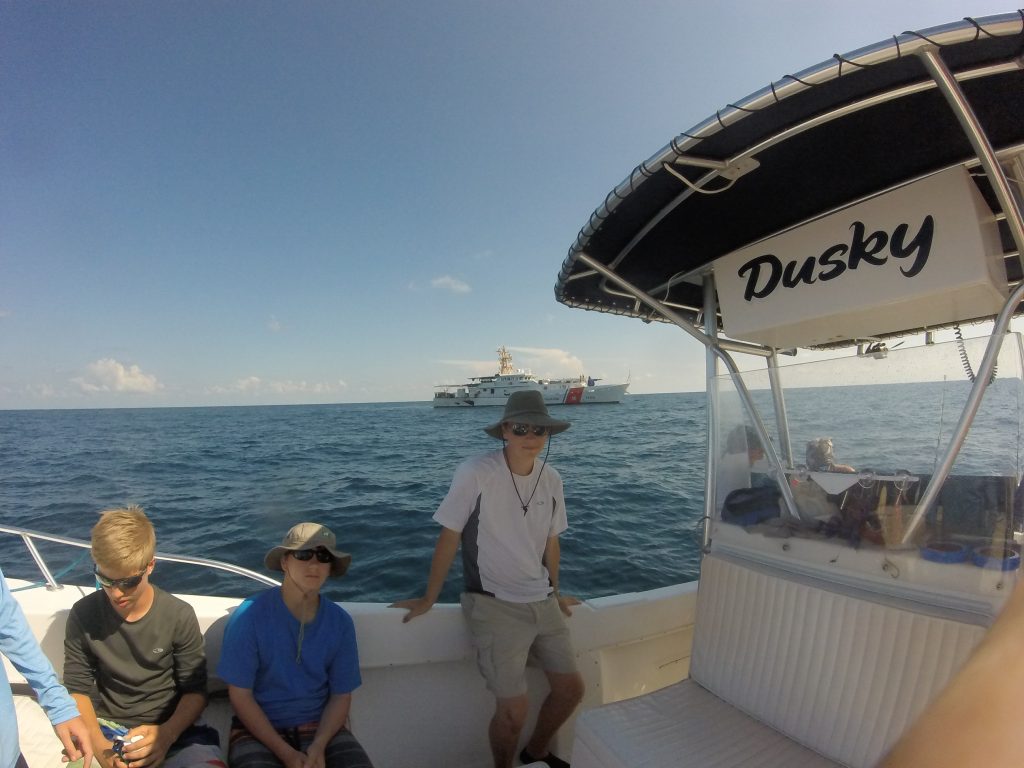
Myself, age 17, posed in front of the Coast Guard cutter we had to call because my scout troop found a bundle of weed in the ocean.
From the Boundary Waters to the Black Hills to Big Munson Island in the Florida Keys, I’ve hiked, biked, skied, camped, canoed, kayaked, cribbaged, and kicked back in at least a dozen of these states united. As such, I’ve always found it odd that there is so little discussion about tying our park systems and other outdoor spaces into the broader conversations about transportation and land use.
When urbanists talk about parks, it’s almost exclusively the thin patch of grass down the road with a playground and maybe some tennis courts; not those of the national, state, or even county variety. When we talk about the environment, it’s often in cold, scientific terms. Climate change, sea level rise, wildfires, mass extinctions, toxic mining runoff, these are all important things to be sure, but it’s incredibly cold and clinical. It’s missing the human connection, where these subjects intersect with lived experience and emotion. The language we use often treats the great outdoors as something out there, something unreachable, outside the core human experience. Indeed, for a certain class of people they are, as we don’t often think about car-free accessibility beyond the edge of the suburbs
Advertisement
Then I got a random video recommendation from a friend.
Industrial Tourism is a threat to the national parks. But the chief victims of the system are the motorized tourists. They are being robbed and robbing themselves. So long as they are unwilling to crawl out of their cars they will not discover the treasures of the national parks and will never escape the stress and turmoil of those urban-suburban complexes which they had hoped, presumably, to leave behind for a while.
How to pry the tourists out of their automobiles, out of their back-breaking upholstered mechanized wheelchairs and onto their feet, onto the strange warmth and solidity of Mother Earth again? This is the problem which the Park Service should confront directly, not evasively, and which it cannot resolve by simply submitting and conforming to the automobile habit. The automobile, which began as a transportation convenience, has become a bloody tyrant (50,000 lives a year), and it is the responsibility of the Park Service, as well as that of everyone else concerned with preserving both wilderness and civilization, to begin a campaign of resistance. The automotive combine has almost succeeded in strangling our cities; we need not let it also destroy our national parks.
Edward Abbey, Desert Solitaire
I first heard this quote in a Noah Caldwell-Gervais video essay titled “The Other Half of the West“, one of several such essays where they explore the United States in some sort of beat up old hooptie while sharing their thoughts, experiences, and lore from the video game series Fallout. I’ve listened to them all multiple times – along with some of their more typical ones about video games – and while all of them are excellent, nothing else has stuck with me quite like this quote and the context in which it was given.
They talk about “The Fudgies”, A specific kind of day tourist who travels to Mackinac Island just to buy the fudge, and then go home. Many of whom never once think about the wondrous car free environment they stumbled into, I might add. More generally, it’s tourists who are there simply to do the thing the place is famous for and then immediately move on. They mention how Rocky Mountain National Park is chock full of fudgies due to its proximity to Denver International Airport. They even call themself the ultimate fudgie, never spending more than a couple days and more often hours in one area. Most importantly, they argue that a good portion of the populace has never seen a tree outside a store parking lot, and that such people need some sort of a jumping off point, somewhere to dip their toes, and how they themself wouldn’t have been able to see a third of the places they did while on this trip without a vehicle. It’s these last two points I take the most issue with. Not because they aren’t true, indeed I’m sure they are, but because we’ve built a society where such things can be true.
I think most of us can agree at this point that cars are, on the whole, a bad thing. If you have any doubts, you must be new here. I encourage you to go read one of the manyotherarticles other contributors have written about the topic.
Advertisement
Unfortunately, they’ve proven excellent for exploring the great outdoors. That perfect blend of freedom and convenience, filling the niche of personalized and decentralized travel. At a moment’s notice you can pack your rucksack into the back of a hatchback and be in the middle of nowhere in no time flat, and it’s hard to compete with that.
But it didn’t used to be this way. The automobile is a relatively recent invention, though it still predates the modern conservation movement. However, there was a time when it was the railroad that was the primary driver of national park traffic. The Union Pacific, Northern Pacific, and Milwaukee Road all offered vacation packages to Yellowstone, the Great Northern to Glacier, Canadian Pacific to Banff, and so on.
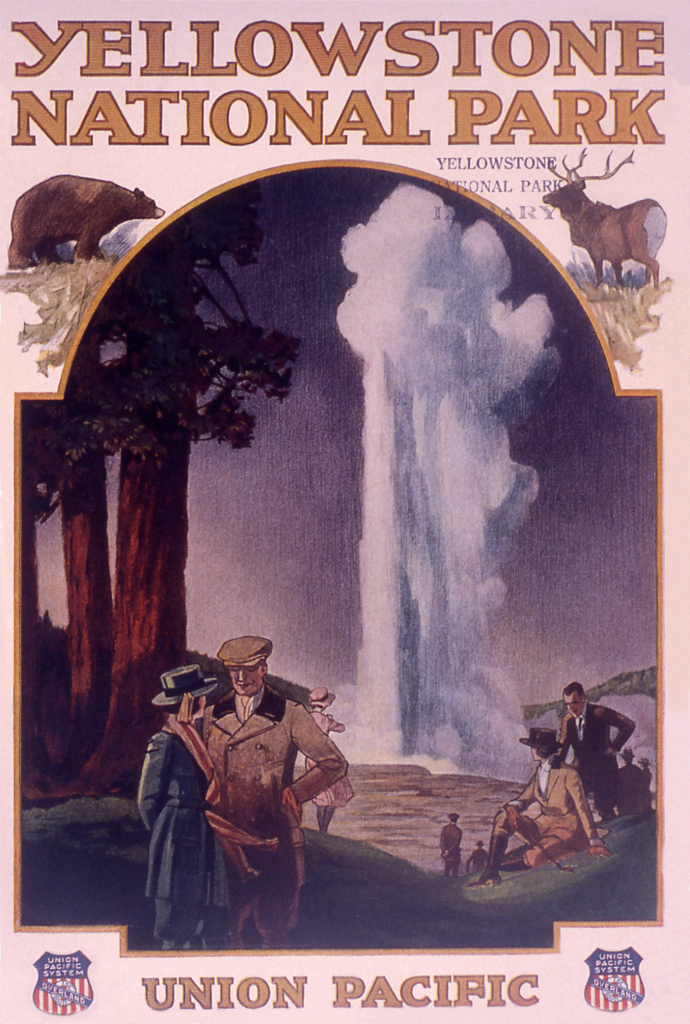
Cover of the Union Pacific Railroad brochure “Yellowstone National Park”; Artist unknown; 1921 From the NPS.
Indeed, Amtrak continues this legacy through its Amtrak Vacations program, so it’s kind of a shame that I don’t like that style of trip. “Canned Fun” is what I call it, where every moment is dictated before you even have a chance to experience it. For you and hundreds more the exact same experience, as consistent as a McDonald’s cheeseburger. Now let’s all get in a circle and share your name, where you’re from, and a fun fact about yourself. What’s worse, some rely on rental cars, defeating the entire purpose of a train trip!
Of course, it doesn’t have to be this way, and I know it. I’ve seen and experienced the alternatives, at least partially. As much as one who doesn’t know the full extent of the solution can. While their camping options are lackluster, Amtrak does run the Winter Park Express, and can get you within transit distance of Whitefish and all the major Utah ski resorts. Closer to home, you can take MVTA route 412 to Buck Hill, or dial-a-ride to Afton, all topics covered on the podcast.
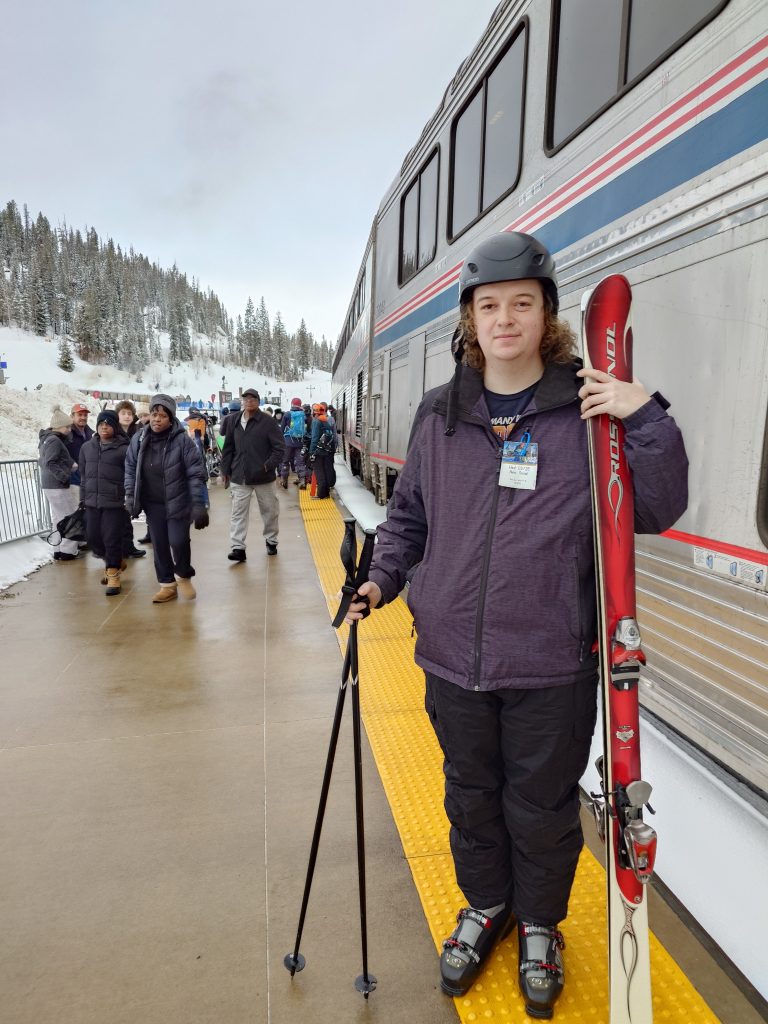
Myself, posed next to the Winter Park Express at Winter Park station
Skiing seems to lend itself well to transit, so long as we choose to serve it, but what about the other 6 months of the year? Dial-a-Ride is still an option, so long as you stick to the seven county Metro. Another option is bike camping. The outer fringes of the metro are home to some great state and regional parks, and if time is no object, I’d say this beats vehicular travel to a degree. Now the journey really is part of the adventure! There’s stakes! Will I or won’t I make it? I’ll be honest, I haven’t always, but that’s just part of the fun.
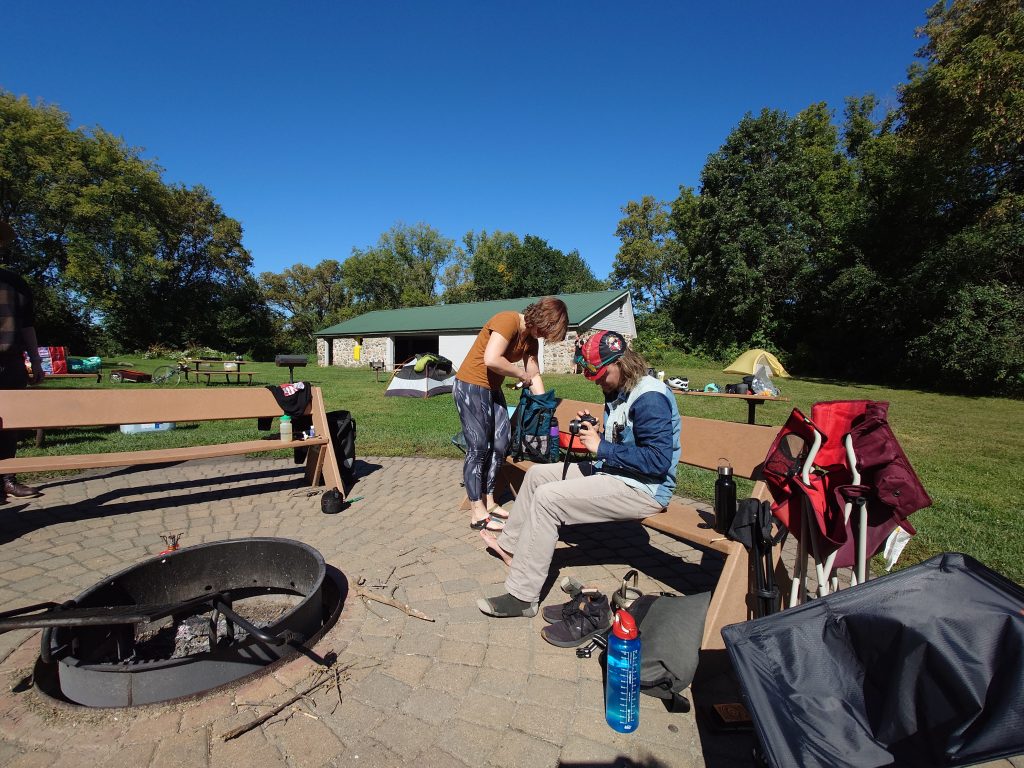
Zumbra Lake group camp at Carver Park, the morning after we all biked out. This time I made it there AND back
But this isn’t truly out there now is it? Unless I decide to get real serious about bikepacking (I doubt it) this only gets me, at most, about 50 miles from my downtown apartment. Far from what Thomas Wolfe described as “all the unknown places”
We walked along a road in Cumberland and stooped, because the sky hung down so low; and when we ran away from London, we went by little rivers in a land just big enough. And nowhere that we went was far: the earth and the sky were close and near. And the old hunger returned —the terrible and obscure hunger that haunts and hurts Americans, and makes us exiles at home and strangers wherever we go. Oh, I will go up and down the country and back and forth across the country. I will go out West where the states are square. I will go to Boise and Helena, Albuquerque and the two Dakotas and all the unknown places. Brother, have you heard the roar of the fast express? Have you seen starlight on the rails?
Thomas Wolfe, Of Time and the River
This quote to me perfectly describes the desire to “get away from it all”. It’s a nearly universal impulse. To discard life’s responsibilities and put either a mental block – like cosplay or renfaire – or physical distance between oneself and reality. Am I really fulfilling that goal when I’m close enough to have my sister bail me out from biking home, or grab spare gear from my parent’s house?
Furthermore, what about those who can’t or just don’t want to bike even that far? What about those who have different ideas about what it means to “get out there” and “enjoy nature?” They’re just as deserving to see the natural wonder of the world as anyone else. I disagree with Sir Edward Abbey here. “Let the people walk” is a great sentiment but best not be applied literally. Ableism is not how we solve an exclusionary problem.
This is ultimately the question I’m getting at: how do we ensure fast, easy, and convenient access to all our outdoor spaces for everyone, especially those without cars?
For once, I don’t know the answer. I’m left here, like a blind man feeling an elephant, trying to grasp a problem with only a fraction of the information. And so I ask you, dear reader, to join me. If you’ve ever asked yourself these same questions, or if you’re now convinced this is an issue worth tackling, take it head on. Find one of these unknown places, research what’s around, train, take the train, do whatever it takes to get there so long as you don’t use a car. Whatever it takes. Find what works and what doesn’t for you, talk to others about what does and doesn’t for them, write to me, us, the podcast, your local paper, your middle school pen pal, and whoever else may be interested (and I promise we here at Streets.mn are interested).
This isn’t a problem we can logic our way through, I don’t think, so that just leaves doing. Enough experimentation, enough data, and we can start to look at broader trends. What worked here, what didn’t work there, and what may take some more refinement. To get cars, trucks, and campers out of our parks is a worthy goal. After all,
We have agreed not to drive our automobiles into cathedrals, concert halls, art museums, legislative assemblies, private bedrooms, and other sanctums of our culture. We should treat our National Parks with the same deference, for they too are holy places. – Edward Abbey