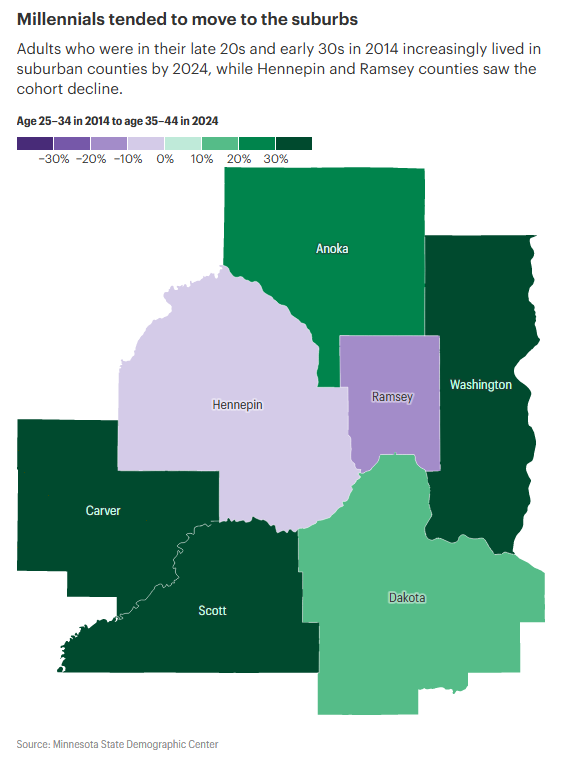
Recently, I came across an article in the Star Tribune titled, “Suburbia is getting a millenial [sic] makeover” – tracking, and attempting to explain to some extent, recent demographic trends where young people are increasingly trading the cities for the suburbs. Last year, I wrote about a notion of a suburban “donut” in between Minneapolis-Saint Paul and deriving its heft not only from urban flight, but also from patterns of decline in rural Minnesota. The Star Tribune article suggests a new era for the “donut” beckons – perhaps call this, “the donut with sprinkles”.
Although the Star Tribune article offers some discussion as to what has led some younger people – including self-professed urbanites – to the suburbs, it offers little in the way of discussing the collective consequences of these collective decisions – not only for the cities they have left, but also for Minnesota as a whole. Indeed, in its use of the word “suburbs”, the Star Tribune flattens distinctions between suburban communities in the Twin Cities as well.
An already-simplistic narrative in the newspaper – millennials migrating beyond the metropole – is amplified by examination at a more granular level. A map produced by the Star Tribune, using state demographic data, shows that the young adult populations of Hennepin and Ramsey Counties have declined, while the populations of the other five metropolitan counties have increased. Extrapolating this indicates that the suburban growth the Star Tribune is talking about is beyond the suburbs immediately or closely adjacent to the Twin Cities proper in Hennepin and Ramsey Counties – and instead taking place in further-out rings of the suburbs, or even exurbs.
The Star Tribune’s decision to limit their analysis to the seven-county Metro may even overlook another trend in increasing years: sprawl beyond the seven counties.
The Star Tribune presents an idyllic portrayal of suburban life for the old-young-adult: more space, schools nearby, peace and quiet, and “restaurants, bars and parks”. Yet behind the Star Tribune’s cheery photos of new houses, lake days, street festivals, and a bicycle pump track, some externalities begin to emerge. For starters, municipal finances in the metropole. Population stagnation (or decline) is a culprit in Saint Paul’s ongoing budget deficit – meaning not only reduced civic services and staffing, but also increasing property tax burdens for everyone who remains in town.
Enrolment continues to decline at both Saint Paul and Minneapolis public schools, in no small part because of “fewer families choosing to raise children in the city”. Extrapolating contemporary trends paints an ominous picture: lower enrolment in urban schools means less funding, in turn resulting in fewer teachers and staff, closed schools, and fewer resources for students. In turn, this may lead to more families choosing to enrol their children (or move entirely) to schools in the suburbs, accelerating the downward trend. It also bodes poorly for teachers, school staff, and other educational workers, who have fewer opportunities for work in the city. The suburbs then beckon for them, as well.

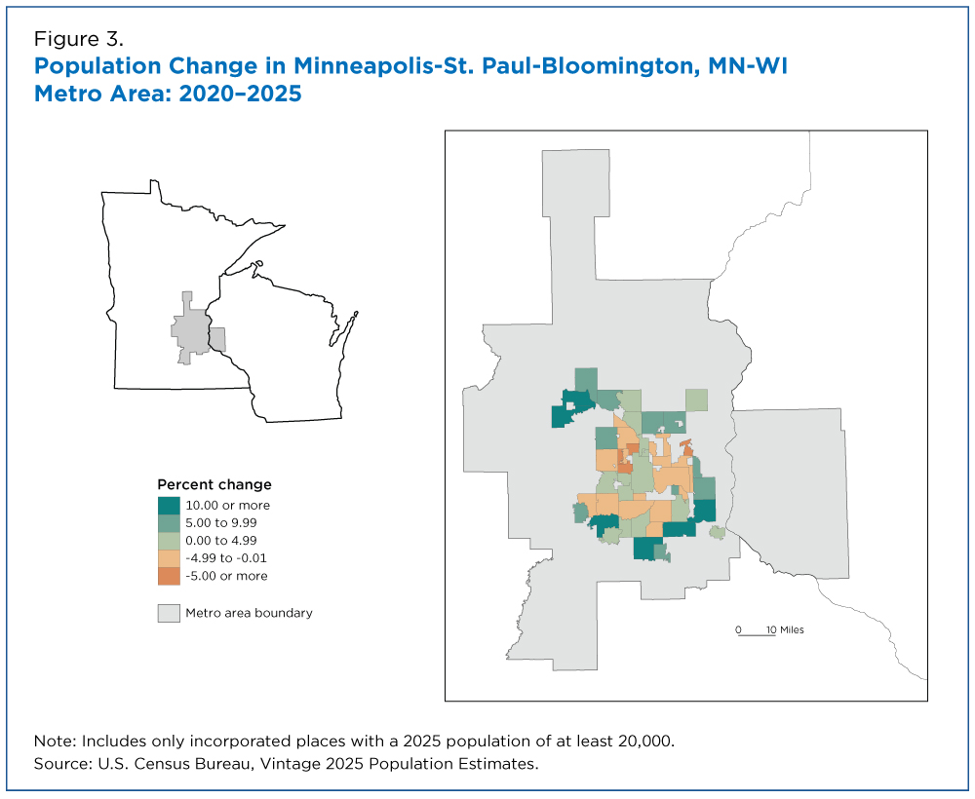
Things aren’t looking good for transportation or climate either. As laudable as Metro Transit’s new investments in light rail or bus rapid transit expansion may be, these new routes mostly go to places within Minneapolis-Saint Paul proper, or to inner suburbs within Hennepin and Ramsey counties – not as much, or not at all to places further afield experiencing the most growth, such as Carver, Scott, Anoka, or Washington Counties. Urban-esque amenities aside “like restaurants, bars and parks”, imagining decent public transit expanding out to these areas is either a flight of fancy or cost-prohibitive, given the distances concerned and issues over cost for existing projects. Transportation remains the single-largest source of greenhouse gas emissions in Minnesota, and for people and business to be that much more spread out – this invariably means more driving, in spite of state targets for people to reduce the amount they drive year-over-year.
People are of course free to move as they please, and the Star Tribune is under no obligation to function as a didactic urbanist mouthpiece. However, it is nevertheless curious that the article does not touch upon some of these implications in what functionally reads as a puff piece for exurban flight. It waxes poetic about the “tranquility” of suburban life – never mind the six-lane roads and the traffic, or the peace, quiet and trees that grace most of the streets in Saint Paul or Minneapolis.
There is a contemporary narrative, ground in the labour and actions and beliefs of its people, to be proud of in Minnesota – a place dedicating itself to environmental protection and “neighborism”, in the spirit of a pluralistic society and civil protection against hostile intruders. But when it comes to the movement of its people, I find the narrative to be challenged.
There is something almost Biblical about moving, insofar as it can be placed within the schema of a passage in Ecclesiastes. Moving for opportunity; moving away from desolation. Moving to form a household; moving for separation. Moving to be closer to happenings; moving for distance and quiet. Moving to begin a new life; moving to close one out. Moving to discover; moving to return; moving to escape.
But fundamentally, moving is usually a decision made within one’s individual mind, or no further than the confines of a household unit. Individual decisions multiplied by the hundred – by the thousand – nevertheless, in due course reveal collective consequences. The Star Tribune article suggests that the collective gestalt of these moves is the continued amplification of the “donut”, and the continued loss of amenities, work, resources, and opportunities from the cities to the suburbs, paid for with the loss of the sorts of whimsical, walkable, sustainable, diverse experiences that can only be found in places like “good old Saint Paul.”
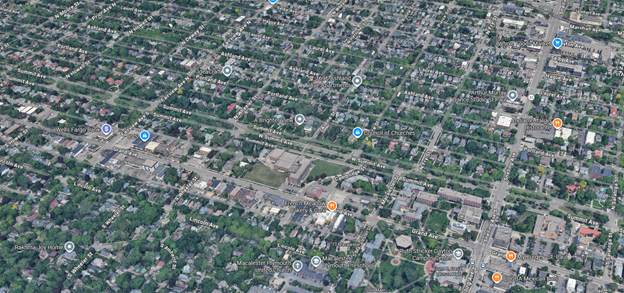
A truer sense of “neighborism”, in my view, derives from people deliberately choosing to live closer to one another, rather than further apart. It would mean more people living in localities where the public’s resources could be pooled together for streetlights, school buses, and city buses, rather than the public’s dollars being forced to be spread over an increasingly wide geographic area. And it would mean a place where it would not be so simple to clock where someone lives, simply by assessing their skin colour or the length of their tenure in Minnesota.
What is To Be Done? Short of invoking a specious good idea fairy (“there is no mission more grand or noble than extolling the virtues of urban living”), I am sympathetic to notions of a more assertive and reformed Metropolitan Council enforcing urban growth boundaries to halt the further replacement of farmland with tract home spaghetti. I am even sympathetic to the notion of jurisdictions placing a moratorium on new road construction – as a way to channel new housing construction towards densification of existing built-up areas, as well as a way to save public funds and place more emphasis on maintaining existing infrastructure.
But for sprawl that is taking place beyond the Metropolitan Council’s boundaries, I ask about the possibility for the state government to present a more affirmative direction as to limiting aimless sprawl in lands beyond the Seven Counties. The State Demographic Center has long projected these trends as a dispassionate matter-of-fact, but as a German philosopher once commented, “The philosophers have only interpreted the world, in various ways. The point, however, is to change it.”