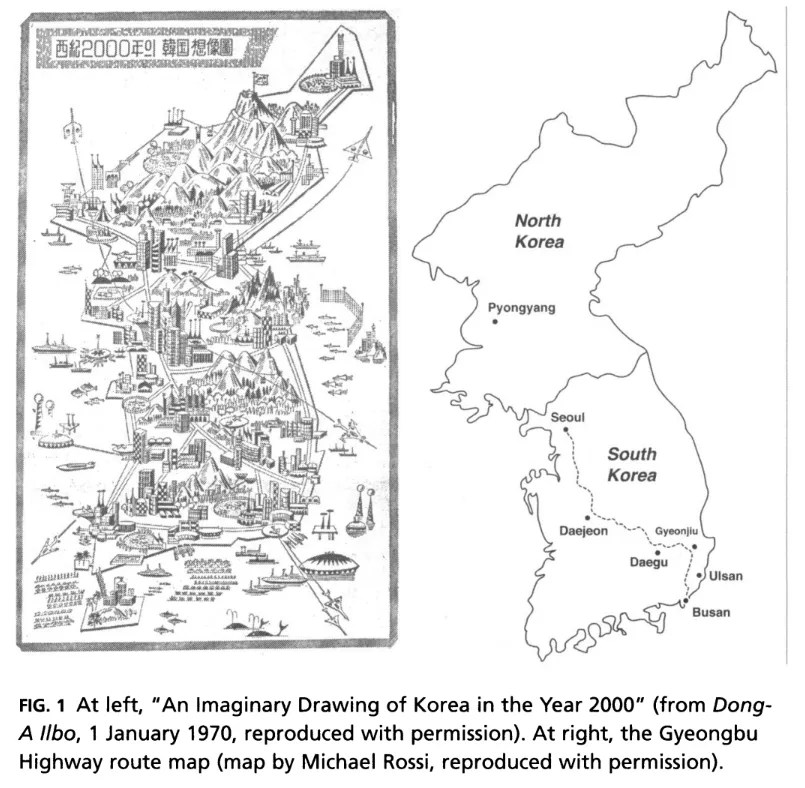
Recently I came across a drawing featured in the 1970 new years’ issue of The Dong-A Ilbo (“East Asia Daily”), a Korean newspaper of record. It is a fantastical vision of what was then 30 years into the future – “An Imaginary Drawing of Korea in the Year 2000” – replete with skyscrapers, supersonic airplanes, offshore platforms, aquaculture, electric and telecommunication lines, and highways criss-crossing the peninsula.
What is astounding about this vision is not only its delusion (at the time per capita GDP in South Korea was about $282, compared to $5,284 in the US at the same time), but also that save for unification, it was mostly achieved. In just a few decades, the Korea of M*A*S*H – dirt roads, wooden huts, pitiful peasants – had become the Korea of KPop Demon Hunters – a land with glistening skyscrapers and endless opportunities for discretionary and conspicuous consumption. Compare that to the pace of change in Saint Paul’s Midway over the same timespan. Setting aside visions of futuristic fancy, maybe its condition has even reversed over time, with the loss of the once-imposing Montgomery Ward?
Seeing this map – and its translation into reality, at least south of the 38th parallel – led me to dwell on the extent to which there are any similar notions in Minnesota. The plans are there, but compared to the picture once in The Dong-A Ilbo, contemporary plans are more amorphous and disjointed.
“Minnesota in the Year 200026″
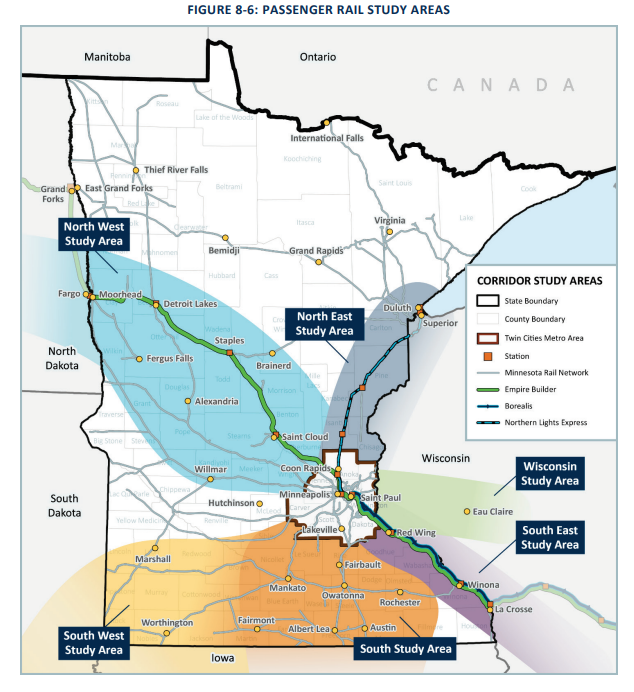
(Now)-Senator Klobuchar has a plan to build more homes if she were to be elected governor come November, but where exactly those homes might go – or what they might look like – remains unclear. There’s a state rail plan – that remains more conceptual than actual. A vision for downtown Saint Paul in 2015 (c. 2008) – including a high-speed rail line between Saint Paul and Chicago, and a mixed-use development atop the Central Green Line station at 4th and Cedar – remains mostly unrealized. The Minnesota Chamber of Commerce does have a vision for 2030 – 30 years into the new millennium – but naturally is focused more on the health of private commerce alone, short of a complete view of the state.
One of the few places there are traces of a vision of the future in the US akin to “An Imaginary Drawing of Korea in the Year 2000” is Ezra Klein and Derek Thompson’s Abundance – especially in its introductory techno-futuristic vision of a grand future built around mass clean energy, desalinated water, cheap and mass manufacturing, and artificial intelligence. However, the extent to which “Abundance” exists as anything resembling a mass popular movement, rather than merely as a labelling exercise among the chattering class, tempers expectations for what it may achieve.
“[To] Construct As We Fight”
The fanciful depiction of “Korea in the Year 2000” was at least partially grounded in the Geyongbu Highway – Expressway No. 1 – which broke ground in 1968 and was completed in the summer of 1970. Construction of the highway took place with national defence imperatives in mind – not only in a highway’s utility in ferrying men and materiel from the rear to the northern frontline, but also in the ways in which the highway could spur economic development. More money in South Koreans’ pockets strengthened the defence-industrial base and improved people’s standards of living as well – thus proving to fellow citizens, North Korea, and the wider world the superiority of South Korea’s anti-communist way of life. This notion was summed up in a maxim from then-president Park Chung-hee, “Let us construct as we fight”.
In Minnesota today, there is no “demilitarized zone” to man (ok, maybe the border with Iowa), nor a global ideological struggle to win (ok, maybe against a “new fascist international“) – and yet it is impossible to ignore the salience with which defensive rationales for construction can be drawn. Absent major, unexpected population growth, Minnesota is set to lose one seat in the House of Representatives, and one vote in the electoral college, come 2030, reducing the influence of Minnesota in Congress and selections for the President.
The federal occupation in the winter of 2025-2026 cost the City of Minneapolis alone an estimated $700 million, and even this was constrained compared to what could have been – “baseless, unethical, and possibly illegal” federal investigations into democratically elected officials, moves to invoke the Insurrection Act to deploy federal troops in Minnesota, and perhaps funny-until-it-is-not – motions potentially in concert to deploy elements of the 11th Airborne Division (Arctic) to Minnesota at the height of “Operation Metro Surge”. All the while, federal infrastructure in Minnesota, such as Forest Service stations and public health funds, are being cut in what is nothing less than a “campaign of retribution against Minnesota.”
In the depths of the winter, Governor Walz drew comparison between civil resistance to federal security forces and the 1st Minnesota Infantry Regiment at the Battle of Gettysburg. Today, in warmer, brighter months – at least for now – the Truth Council in Minnesota bears some resemblance to truth and reconciliation commissions around the world, including one that is part of the South Korean government. But at a more tangible level – and one more fitting for an urbanist blog – I ask to what extent tangible actions in the built environment – like the ones depicted in “An Imaginary Drawing of Korea in the Year 2000” – can form part of defending “the good life in Minnesota”.
As fanciful as a drafter with a pen can imagine – what sorts of construction would improve quality of life for the people of Minnesota now and in the future, and demonstrate to the rest of the union that life is indeed better here? Would it be more housing for a larger population – and if so, what kind? Would it be more transportation links – highways like the Geyongbu Expressway, or something different? And who would take responsibility for this construction, between the state, cities, counties, and the private sector? And what about development in rural areas?
A theme I would like to suggest is a notion that construction in Minnesota no longer confers only economic, social, or environmental benefits, but defensive ones as well. Just as “neighborism” protected people of all stripes this past winter, construction – like the regularly sold-out Borealis, or the more-popular-than-anticipated METRO E-Line, serves a defensive purpose in affirming a tangible sense of the common good, here in Minnesota. Zoning reforms, like the ones spurred by the 1-4 Unit Housing Study in Saint Paul, may create more options for people escaping from discrimination elsewhere, like transgender people.
Critical views on developmental delusions
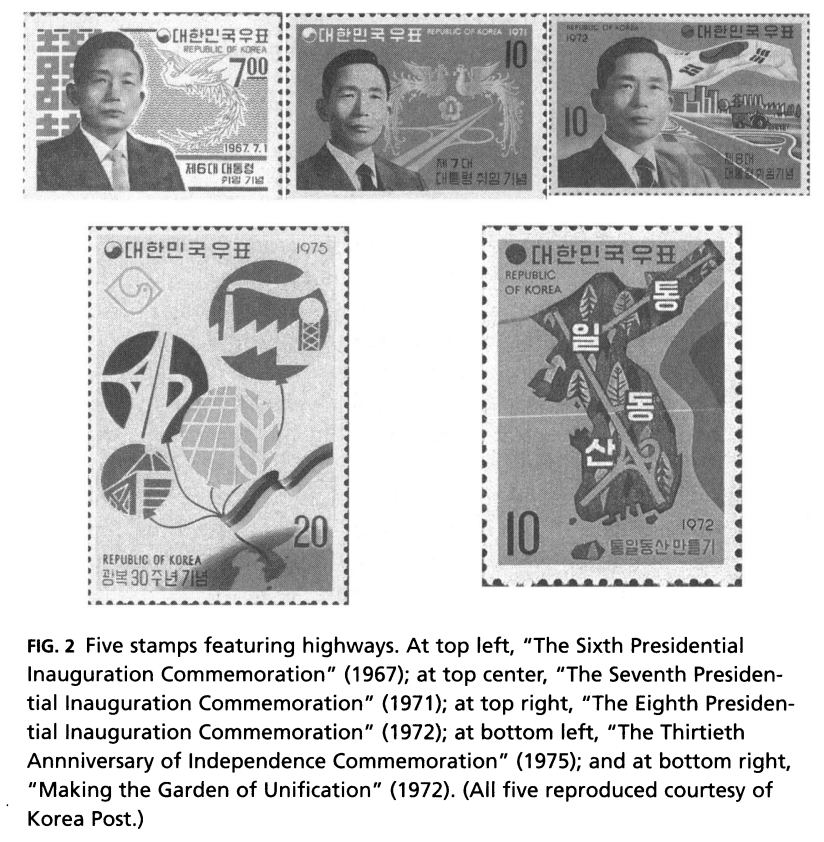
Developmental projects like the Geyongbu Highway were constructed in fits of spite and delusion by President Park. South Korea was unable to secure foreign aid from the World Bank to build the highway – perhaps in the Minnesota context, somewhat analogous to cuts in federal funding. This was in part because there were so few cars in Korea at the time – about 60,000 in 1967, compared to about 5.2 million light-duty vehicles in Minnesota today – and because this one stretch of road alone would account for at least a fifth of the national budget. For another Minnesota comparison, this would be generally analogous to the state government attempting a public works project with a $14.5 billion price tag. Thus, “[t]he pressure for quick and cheap construction” was informed not just by theatrics or a vague notion of “Abundance”, but in an imperative to limit costs wherever possible, in what initially amounted to a vanity infrastructure project.
Rapid development was accomplished with a variety of accounting tricks, including rushed and poor-quality construction, drawing upon labour from college students, people with leprosy, Buddhist priests, and South Korea’s vast conscript army, as well as the ruthless suppression of any social or political dissent. Seventy-seven workers died in the construction of the highway.
Park’s will to build was also at least partially informed by his education and service in the Imperial Japanese military, where it was taught that enough human willpower could overcome any material shortcoming. Indeed, Park’s presidency – including its conduct in 1970 – was placed under the microscope in South Korea’s Truth and Reconciliation Commission; attempts to replicate any of his militaristic and anti-democratic tendencies in Minnesota would be antithetical to the very nature of the state. Nevertheless, Park enjoys a complicated legacy in South Korea today, not least because many credit his drive and vision for the country’s economic prosperity – and maybe even democratic governance – today. The Geyongbu Highway, running alongside many of South Korea’s major cities – Seoul, Taejon, Taegu, and Busan – is today the country’s most travelled highway.
Between 10,000 lakes and 3,000 ri
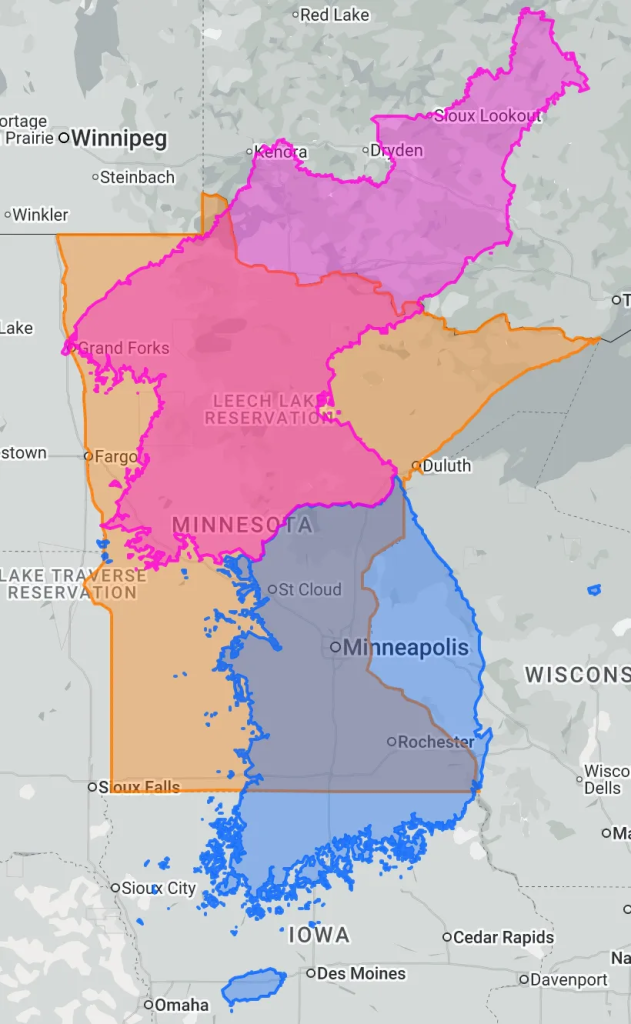
Much in the way that Minnesota is sometimes referred to as the Land of 10,000 lakes, a folk saying for Korea is that it is a land of 3,000 ri from end-to-end – a traditionally Chinese unit of distance that is about half a kilometre, or a third of a mile in length. As things turn out, Korea altogether is about the same geographic size as Minnesota (223,172 sq. km vs. 225,163 sq. km respectively), albeit with a much higher population (~77 million vs. 5.8 million). Perhaps this Minnesota-as-Korea is centred upon Saint Paul’s Midway, around Mirror of Korea, Sole Cafe, Kim’s Market, and possibly in due course – an H-Mart all in proximity.
The year 2000 is now close to 30 years behind us (and 1970 almost 60!). However, counting from today, given a few years and some change, 30 years from now beckons the 200th anniversary of Minnesota’s foundation as a state – 11 May, 1858 to 2058.
Leaning into the analogy – mirroring the five-year plans once employed in South Korea for projects like the Gyeongbu Highway, counting the years towards Minnesota’s bicentennial provides just enough time for six such plans:
First plan 2028 – 2032
Second plan 2033 – 2037
Third plan 2038 – 2042
Fourth plan 2043 – 2047
Fifth plan 2048 – 2052
Sixth plan 2053 – 2057
Bicentennial 2058 (11 May)
It is natural for precarious times to shrink visions – downgrade the train to a bus, towers in a park to just a park, stake out a turf in the suburbs over life in the city. But I think this cartoon in a newspaper, from a faraway land in a faraway time, suggests that dour times are precisely a moment to think in grandiose, wacky, or even delusional fashions. It is easier to pare back something grand, than to try to spool up something initially small. “An Imaginary Drawing of Korea in the Year 2000” was more or less accomplished by the target year, exceeding the wildest dreams of contemporary developmental economists – save for the parts of it in the north. Without such visions, perhaps South Korea would have remained a backwater – M*A*S*H still on TV.
In this piece, I bring up notions of “The Good Life” in Minnesota incessantly because conversations around it consistently dwell upon what was or is with “The Good Life”, rather than what ought to be. Perhaps Minnesota is a place prone to recollection as a default affect. There’s the stature of the Historic Society as a state institution, the dwelling upon one TIME Magazine cover for half a century – the attendant ruminations about “the good life” or lack thereof – and (albeit critically), the Lake Wobegon of it all. Interestingly enough however, the phrase “the good life” was first coined in 1973 – just three years after The Dong-A Ilbo ran its picture of Korea in the future. In considering what the built environment could (or should) look like for a good life in Minnesota, fit for the future – I think we can all take a little inspiration from An Imaginary Drawing of Korea in the Year 2000.