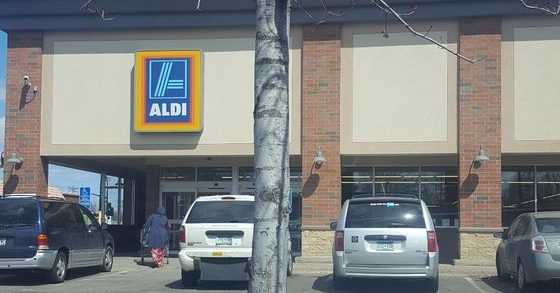
In Feb. 2023, the Aldi location in North Minneapolis announced its closure. The store, one of just a handful of grocery stores in North Minneapolis, was located near the corner of Lowry Ave and Penn Ave — Aldi began operating at that location in North Minneapolis in 2008, according to reporting from Sahan Journal released at the time.
An Aldi spokesperson, cited in Sahan Journal’s reporting, noted the closure was both due to the expiration of their current lease and an issue of land use, specifically, “the inability to renovate the store to accommodate our larger product range.”
In many places, urban and rural, grocery access can be a challenge. In North Minneapolis, healthy and affordable food access has been a longstanding conversation— from community gardens with Project Sweetie Pie aimed at shifting the local economy, to youth-focused urban agriculture with Appetite for Change to produce delivery and various food access initiatives at Pillsbury United Communities’ Oak Park Community Center. All of these efforts are about land use and spatial access to the land. Organizers ask the question, “Who feeds North Minneapolis?” and when the answer is a diminishing list, projects like the ones just mentioned get built.
In 2025, Colonial Market & Restaurant opened up in the space. According to reporting from WCCO, North Minneapolis had been a “food desert” in the two years between Aldi and Colonial Market. According to the USDA Economic Research Service, a food desert is designated when two things are present in a specific census tract: a poverty rate of 20% or higher or median family income at or below 80% of the relevant median and at least 500 people or 33% of residents — in an urban community — must travel more than one mile to reach a supermarket or grocery store. In rural communities, that number is ten miles.
Many individuals challenge the language of food desert — they say that “food desert” indicates that lack of access to healthy and affordable food is a natural phenomenon. They counter the language of food deserts with “food apartheid.” Feed Black Futures argues that “food apartheid” better captures the systems of racial and economic injustice, including policies made and failed to be made, that have led to unjust food access in communities like North Minneapolis.
Feed Black Futures, a Bay-area organization seeking to build Black food economies, notes that many so-called food deserts were made into food deserts due to histories of redlining that killed opportunities for generational wealth to be built in Black and Brown communities. This is echoed by Share Our Strength, a DC-based nonprofit focused on ending childhood hunger by addressing “the root causes of hunger and poverty.”
Share Our Strength discusses the unofficial, but still very real, “supermarket redlining.” The practice of supermarket redlining meant that grocery stores were leaving cities for suburban communities where they could operate near highways and in busy neighborhoods and build stores with larger footprints. Share Our Strength also notes that urban communities can feel more policed and surveilled. Target, a Minnesota-born general merchandise retailer, has been under fire for years for its development of the Safe City program. Bloomberg reported in 2021 about the program: “[the program] poured money into police and sheriff’s departments to install neighborhood surveillance systems and fund equipment. In Minneapolis, Target worked with the City Attorney’s Office to have petty criminals banished from the downtown business district through what are called geographic restriction orders. Eight out of 10 people expelled were Black or American Indian, according to an analysis of city data.”
There is not a Target in North Minneapolis, but questions about grocery access, land access and control and histories of “supermarket redlining” remain.
In North Minneapolis, just having access to a grocery store isn’t necessarily enough to ensure access. North Market, a project of Pillsbury United Communities, closed temporarily in Feb. 2026 to plan for a new format and amidst financial pressures. Colonial Market is also struggling—between tariffs, the impacts of Operation Metro Surge on customers and employees, and the closure of the Lake St. location, the owner of the newest North Minneapolis grocery store is hoping to use a GoFundMe to help cover payroll and rent gaps. The GoFundMe is currently set to $4,500, as of Aug. 23, but the originally reported fundraising goal was $50,000.
Thinking Forward
The instability plaguing Northside grocery stores is not an inevitable reality; it is a policy choice. For communities like North Minneapolis to achieve true spatial control and secure long-term food stability, state and city lawmakers must look beyond traditional corporate tax incentives toward policies that treat food access as public infrastructure and as a public good.
One immediate path is the expansion of commercial land trusts (CLTs). By allowing a nonprofit or community collective to permanently own the underlying real estate, CLTs can restrict speculative resale and lower overhead through long-term ground leases. This structural insulation may give local operators the stability to weather low profit margins without fear of sudden landlord non-renewals.
Additionally, community right of first refusal policies could support local grocery access and stability, alongside land use control. Such ordinances would require commercial property owners to give local non-profits, worker-owned cooperatives, or city-backed entities the first opportunity to purchase real estate before it is sold to outside speculators.
Finally, state and city leaders could redefine food access by treating grocers as vital public utilities. Rather than expecting thin-margin retail to shoulder urban infrastructure costs alone, municipalities can deploy targeted public-private subsidies — utilizing property tax abatements, municipal utility relief and Tax Increment Financing (TIF) economic development districts — to permanently stabilize neighborhood food hubs.
If we are to disrupt the food apartheid in Minneapolis, including the Northside, and if we are to create the conditions for grocery stores to survive, we need to think beyond just the basics of profit. We need to reimagine the policies of land use that make it possible for grocery stores to succeed.