Editor’s note: This is part five of an ongoing series about femme/trans/women (FTW) who are leaders — either quietly or overtly — in transportation issues and advocacy throughout Minnesota.
It has been some time since my last “Aunties” article was published. With Operation Metro Surge, changing job duties for my role at BikeMN, and my own personal health journey (I’ll write another article about that someday), I haven’t had the time to devote to wrapping up this final (for now) piece.
But something that this last year has solidified for me is that the aunties are out there doing the work. In my neighborhood, who was doing most of the organizing and community aid during Metro Surge? Aunties. Who has shown up for me with advice, commiseration, and endless patience? Aunties. Who do I still see out there in the street at school patrol and neighborhood events? Aunties.
Whether it’s our role in society, our socialization, understanding of marginalization or some trauma response, the femme/trans/women folks I know show up, especially when shit gets rough. Aunties have a tendency to roll up their sleeves and slog through with competency, compassion, and an “okay, listen to Auntie” attitude. So now that I’ve had some emotional distance from what I can only describe as “a real hard time for most everyone,” it’s time to lean into celebrating this triptych of aunties to wrap up my series.
Jo Anne Judge-Dietz
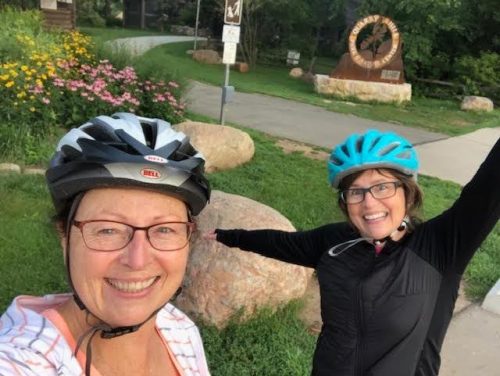
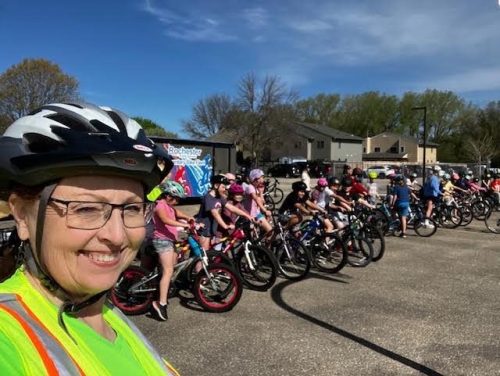
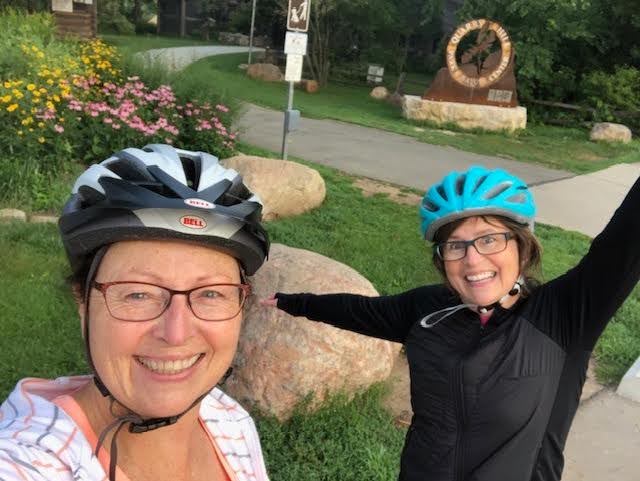
“Oh, I was talking to Jo Anne about that….” is the start to many sentences when doing any kind of transportation related work in Olmsted County. Jo Anne Judge-Dietz is a bit of a legacy, and someone I was introduced to early on in my career at BikeMN. Now retired, Jo Anne worked as a Public Health Nurse for Olmsted County Public Health for decades, spearheading initiatives centered on people, not just the “place.” She championed safer schools through her work representing SHIP (the Statewide Health Improvement Partnership) on a national webinar Vision Zero for Youth, worked closely with the school district on all sorts of projects facilitating life skills like bike riding, and developed an incredibly valuable tutorial on Bike Rodeos. That last project was one I had the pleasure of consulting on, and I still share it with people to this day.
Jo Anne just knows things. When I was learning the “new language” of active transportation in the first year of my job, she could always connect me to a person or an idea to help me “round out” whatever I was trying to do. I don’t even know if she realizes this, but Jo Anne was also instrumental in my understanding that infrastructure alone isn’t enough to facilitate meaningful mobility — you have to serve the people using it. I didn’t always understand the connection initially. I thought, “okay, build bike lanes and it will be safer. Problem solved!”, but my conversations with Jo Anne always grounded me in the reality of infrastructure use. She often prompted me to think about “who is going to use this and do they know how to use it?”
Jo Anne has a habit of, as she calls it, “coercing” people into bike rides with her. “I’ve got a friend who I really coerced into biking with me when I first got back into it,” she told me. “I said ‘let’s dust off the bikes and get back into it!’ She was really my partner to get out and about.” This “coercion” really speaks to me about the importance of connection and community when we think about getting around because, as Jo Anne put it, “it’s good to have bike buddies.”
All of her projects, her “bike buddies” and her incredible breadth of knowledge all help keep a sense of safety at the forefront. While talking about the importance of gender in transportation conversations, Jo Anne said, “I was going to bike with my friend on a trail once and she couldn’t go, so I went alone for the first time. It’s really amazing…I started out early in the morning and no one was out and I felt more unsafe out there alone in the country than I did when I was working alone downtown [Rochester]. There really is something to biking as a woman. My son-in-law goes mountain biking all the time by himself and is totally confident. That day on the trail was the first time I really thought ‘wow, I don’t feel safe right now.’”
On a high-comfort bike path, we are safe — right? Less risk of car danger, smooth lanes just for biking…yet biking alone on a secluded trail as a femme person often brings about these feelings of vulnerability. To me, Jo Anne’s story is a perfect example of the interconnectedness of infrastructure, education, and connection. We have to build, and we have to build more than what we think. Not just a bike lane, not just a community, not just ways for understanding that are meaningful for real human lives — but all of it, at once and together.
Jan Matheus
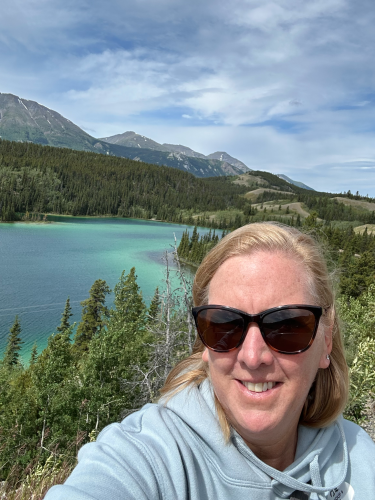
As a League Certified Coach, full-time HR professional, athlete, and now a board member for BikeMN, Jan Matheus is one of the busiest people I know. She’s also just so happy to be on her bike, joy on wheels personified.
Like so many of the Aunties I’ve mentioned, I have my job at BikeMN to thank for meeting Jan. I met her through the facilitation of my first LCI (League Cycling Instructor) seminar with the League of American Bicyclists. Right away I was in awe — Jan is so confident and comfortable in front of a room of learners, and her bike skills are top notch. Watching her perform hazard maneuvers on her hot-pink bike (which I not-so-secretly covet, by the way), I thought “okay, that’s a lady who BIKES.”
Since then she’s introduced me to a whole world of biking skills, theories, and bike-related pedagogy. But beyond the wealth of knowledge she’s given me, it’s her enthusiasm for riding and bike/ped education that I really try to absorb from her. She told me, “My job in HR doesn’t really have anything to do with biking or transportation — but I’ve realized I can find other outlets and opportunities to share my love for biking with people. It’s what I love!”
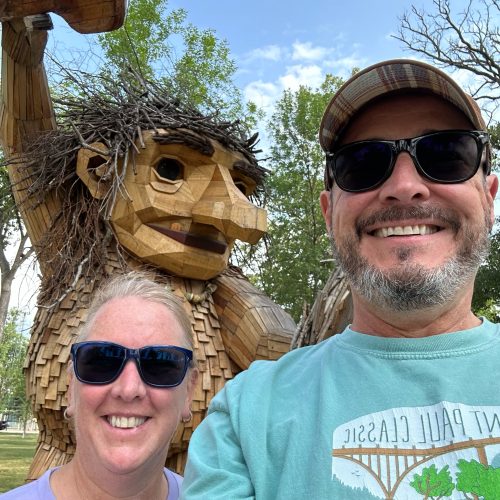
Jan grew up in Iowa on the edge of a small town, where her love for biking first sprouted. “If I wanted to go anywhere, I had to bike. I learned so early on that it’s so important for me to be able to move on my own, on my bike. To me, it’s better than sitting in a car because you EXPERIENCE the world, not just watch it go by.”
As she moved into adulthood, she found herself in situations without a bike but returned to it in her 20’s, after moving to Minneapolis. “I was finally around people again who were biking and suddenly it was cool to bike.” That love for biking started to expand towards advocacy after visiting a “health and wellness” fair in Richfield in 2012. “I stopped by a table hosted by the Statewide Health Improvement Partnership (SHIP) and ended up getting involved with a local group. It really spoke to me, how biking was part of an entire system of being healthy.”
That’s the thing about Jan — she sees a project or program and goes “Cool! How can I help?” That’s the same trajectory that led her toward becoming a League Cycling Instructor, and then a Coach, with the League in 2018. She’s now an organizational coach for BikeMN: “I absolutely love inspiring people to ride, especially teaching people who have never biked before.”
Certainly an Auntie in my mind, I asked Jan what an “Auntie” represents to her. “Someone cool and fun who can be responsible for you when they really need to. My aunt took me to get my ears pierced when I was younger and said ‘Let’s tell your mom later,’” she laughed, “because she knew it wasn’t going to ruin anything or hurt me. She taught me things can be cool, scary, and fun all at the same time.”
Now in Richfield, Jan continues to advocate for safer streets and representation of women in cycling. “When I first became an LCI there were hardly any women. It’s like…once you get past one barrier there’s another one and I just think we need to have safer roads for everyone. Our LCI group is working to make biking safer and more accessible to women — we have to make a space safe enough for someone to get started and then they can decide what is safe and comfortable for them.”
I could go on and on about all the things Jan does — teaching Learn to Ride for BikeMN, riding in RAGBRAI and Bicycling Around Minnesota, gardening, traveling, concerts…but the takeaway is that Auntie Jan shows that advocating for safer streets isn’t limited by your job or location. It’s expanded by your love, passion, and joy.
Amy Gage
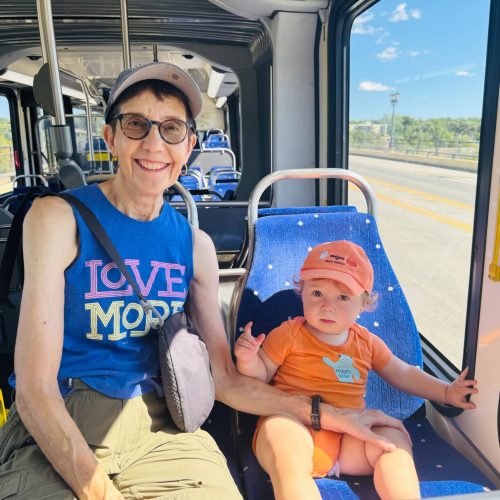
It is only fitting that I end this series with the Auntie who helped me start it. If you’re familiar with Streets.mn, then you know Amy Gage as the previous Managing Editor and a longtime contributor. She also has an amazing blog, The Middle Stages: Between Midlife and Old Age, where she thoughtfully chronicles her various changes, struggles, and experiences. She’s a frequent volunteer for BikeMN and the editor for our print publication, SHIFT. She bikes, she reads, she advocates, and she inspires.
“I’m 69,” she started when I first interviewed her. “It’s important for me to say my age right off the bat because we need to be talking about our age and aging and what that means for us.” Moving as she has aged has been important to Amy, especially as a woman who, several years ago, faced the scary diagnosis of thinning bones. I distinctly remember her sharing this with me one of the first times I met her at the BikeMN office. We had been talking about health and movement, and she gave me advice I think about frequently: “Be strong,” she had told me then, “as women get older we lose bone density. We have to keep moving, build strength.” (Check out this post on her blog for more on shifting from “skinny to strong.”)
The ability to move her body, and to do it safely, has been a driving force behind Amy’s advocacy. “I’m blessed to love to move. I wrote a blog post after I was diagnosed with osteoporosis — it absolutely flattened me!” Amy credits the bicycle, and active transportation in general, as one of the keys to unlocking her active lifestyle as she’s aged. “I can’t talk about active mobility without talking about exercise and mental health AND about the importance of women having the ability to gain strength and express themselves through moving.”
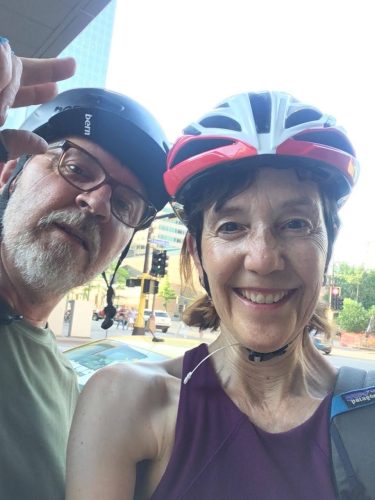
I think about Amy’s words a lot. As a young woman growing up in the ’90s I of course was assaulted with the “heroin chic” images of models and celebrities. I idolized the idea of being just a little slip of a person, of taking up less space. Now, approaching 40, I am so grateful to have Aunties like Amy to remind me that FTW folks have the right to take up space with our physical bodies and our presence. And that means moving throughout the world freely — and feeling safe while doing it.
“Safety, that’s the very first word,” Amy told me when I asked her about considering gender in micromobility. “It’s so hard to see women my age or older who won’t take transit or go out because they don’t feel safe. It’s hard to feel that myself.” She’d also like to see more prioritize active transportation to do their part for a warming climate.
Amy prides herself on being visible as an older woman, even while relishing no longer having to put up with the catcalls and eyeballing that young women endure as they move through the world. She walks 18,000 steps a day, prioritizes strength training at her gym, and recently started a weekly dance class again, an activity she loved as a teenager. “When I taught aerobics and Body Pump during my 40s,” she says, “I used to tell women that they won’t be consistent exercisers until they find movement that they love.”
To her, movement is the fountain of youth. “I am blessed to love exercise and to have always had the privilege of being able to afford good bikes, sturdy walking or running shoes, seasonally appropriate clothing, and a gym membership. But you don’t need fancy equipment to begin.”
That refusal to wear the cloak of shame while moving through the world as an aging woman is so important. I see her biking, at events, writing in her blog, and it’s an important reminder that our right to safe mobility and a healthy presence in our bodies doesn’t have to decline as we get older.
Like all the Aunties I interviewed, Amy’s section of this series could be an entire book. She has an energy and enthusiasm that inspires me each time we talk. She also has an absolutely unparalleled level of empathy and emotional intelligence evident in her approach to thinking and writing about active mobility. I’ve admired her work for a long time, but getting to work with her and call her my friend? It’s an absolute delight.
Wrap Up
As I wrap up this series (for now), I cannot get over the overwhelming sense of dizzying gratitude I feel to know all the Aunties I’ve written about. Telling me about themselves, inspiring me, helping me in my career, sharing with me the messiness and discomfort and joys involved with increasing mobility in their communities…all of this is an invaluable gift that I will carry in my shriveled little heart each time I swing my leg over my bike or step up onto a bus.
Now you know some of the Aunties. You know that there are femme/trans/women folks of different ages and backgrounds across our state out here living their best lives while enhancing ours. You know their names: Rose, Laura, Alice, Cristina, Seaarra, Cindy, Reyna, Pacha, and now, Jo Anne, Jan, and Amy. You know that it’s not just retired 3M execs in spandex biking down Summit Avenue or showing up at the city council meeting to advocate for the protected bike lane. You know that the tireless and often thankless job of the mother, caregiver, protector, advocate, teacher, and neighbor has been vital to your own ability to move around by foot or wheels.
One person on one bike seems small. I mean, the national mode share is less than 9% if you combine bus, biking, and walking (here is a Streets article on Minneapolis/St. Paul mode share). But I feel like any time one of us, one of the Aunties, steps outside our door it’s a small triumph. It’s as if to say, “Okay, this road isn’t built for me, but I’m going to use all my tools to make it work.”
All the Aunties and I share some of the same vulnerabilities in navigating the world as FTW folks. Like looking over our shoulders when walking home, thinking twice about what time we will be taking the train, or carefully calculating our bike route to stay in the most lighted path. It’s cyclical — who we are affects how we get around and how we get around affects how we feel. However, I for one feel so much better knowing that we have people out there like the Aunties of Active Mobility who are biking, walking, rolling, taking transit and taking up space. I feel safer knowing that the push for more inclusive roadways is being led by the Aunties of Active Mobility.