
If you missed our live event about electing transit champions, fear not! We recorded the panel discussion and are presenting it on the podcast this week.
Chapters
- 00:00 | Intro
- 04:39 | How can land use and transportation support each other?
- 09:59 | Finding common ground
- 21:18 | What strategies does electing champions unlock?
- 31:54 | Making the legislature more accessible
- 36:44 | Preventing burnout
- 41:47 | Audience question: constitutional amendment
- 43:25 | Audience question: heavy rail
- 45:32 | Audience question: not getting stalled by moderates
- 54:30 | Outro
Links
Images
Attributions
Our theme song is Tanz den Dobberstein, and our interstitial song is Puck’s Blues. Both tracks used by permission of their creator, Erik Brandt. Find out more about his band, The Urban Hillbilly Quartet, on their website.
This episode was produced by Stina Neel and was hosted, edited, and transcribed by Ian R Buck. Many thanks to our guests for coming on the show! We’re always looking to feature new voices on the show, so if you have ideas for future episodes, drop us a line at [email protected].
Transcript
[00:00:02] Ian: Welcome to the Streets.mn Podcast, the show where we highlight how transportation and land use can make our communities better places. Coming to you from beautiful uptown Minneapolis, Minnesota, I am your host, Ian R. Buck. We recently hosted a live panel discussion about electing transportation champions to the state legislature, and we recorded it for those of you who missed coming in person. A quick note, the audio equipment in the room gave the recording some clipping, and I cleaned it up as best as I could. Everything in the episode is understandable, but you’ll certainly notice a difference in quality from our usual. So if that bothers you too much, I would recommend reading the transcript on our website. And with that, I’ll hand you off to Stina, who is hosting the live event.
[00:00:50] Stina: So good evening everybody. My name is Christina Neal. I’m a Streets.mn board member and a chair of the events committee. So I would love for each of you to give me a who you are. What’s your organization? What’s your role within your organization? Good evening, everyone. My name is Eric Noonan. I’m also a Streets.mn, but my day job, I am the communications manager at the Bicycle Alliance of Minnesota, aka BikeMN. The statewide bike and pedestrian advocacy organization. I primarily do education. We’re in every school district in the state. We have chapters that are active all over the state. Basically, if you’re wanting to do urbanism outside of the Twin Cities, or even in places within the Twin Cities, we’re kind of it. And I will be sitting in this first chair all night hearing really good ideas as we go down and thinking of other things I should have said.
[00:01:41] Zack: Hello, my name is Zack Farrell. I am a board member with Sustain St. Paul. Sustain St. Paul is a land use advocacy organization based around St. Paul. And it covers the overlap between environmental sustainability and fiscal sustainability, which in the case of urban land use, those do go very well hand in hand, much more than people would expect. And I’m sure we’ll talk about some ways here today.
[00:02:12] Brit: Good evening, everybody. Thank you for joining us. My name is Brit Anbacht. My pronouns are they/them. And I am here representing Neighbors for More Neighbors. We stand up for secure abundant housing across the state and in Minneapolis and St. Paul as well. And I am a volunteer board member. And I also am one of the leads on our state policy task force. And we’ve been doing state policy work for the last three years. So we’re going into year four this year.
[00:02:39] Joe: Before I jump in with an introduction, I just wanted to give another quick shout out and maybe a round of applause here for Dane, Eli, Stina and Regina for putting on tonight’s event. Really want to make sure we recognize that. Thank you. A ton of hard work, logistics, things that I never consider my day to day. I get the fun wonky stuff thinking about highways and bridges and buses and trains. Anyway, my name is Joe Harrington. I use he/him pronouns. I’m the policy manager at Our Streets. Our Streets, we do a lot of different things. Our advocacy work spans highway removal, like our campaigns along Olson Highway and Twin Cities Boulevard, all the way down to the minutiae of state policy on potholes, buses, bike lanes and funding. We’re also the host of Open Streets, not Open Streets hosted by the mayor, but Open Streets MPLS that we’ve done for 15 years here in Minneapolis. And are super excited to hear from our panelists tonight and be here with all of you and think about session.
[00:03:33] Peter: Hey folks, my name is Peter Wagenius. I’m the legislative and political director at Sierra Club North Star Chapter. Sierra Club is the nation’s oldest and largest grassroots environmental organization. And in Minnesota, amongst environmental organizations, and there are many of them, we are the recognized leader in land use and transportation. So for example, when there was lawsuits against the city of Minneapolis for implementing the 2040 plan to build dense housing, I, Sierra Club, we led the way to pass comp plan clarity. The bill that ended that litigation so that dense housing could be built and it needed to be an environmental organization that led that effort because it was an environmental law that was being abused by NIMBYs. So that’s an example of how Sierra Club leads amongst environmental groups in the land use and transportation space.
[00:04:24] Brit: Yeah, it was great to be in coalition with you on that bill, especially neighbors where neighbors was also a key partner in helping make sure that the Minneapolis 2040 plan actually got passed.
[00:04:38] Stina: So this event is land use and transportation advocacy organizations. So for those unfamiliar, how do you see transportation advocates support land use and vice versa?
[00:04:50] Zack: So I actually came to urbanism and land use from a environmental perspective. My first and main priority in getting involved in advocacy was climate advocacy. And after, I feel like after spending enough time in the issue, you get a picture of, okay, yeah, we can get this energy thing figured out. But this big, what about transportation? Okay, yeah, so we should do public transit instead of cars, that makes sense. But it’s how do we get that to work well? It seems like it’s so hard when everybody’s so spread out, you’d have to have so many buses with all these lawns in between, you know, these big McMansion lawns, how do you serve that? Oh, no, we have to fix land use first. And so that’s that’s kind of the path that I took to getting into here. And so I view those things as highly related.
[00:05:42] Erik: How many of you biked or walked here tonight? Or as part of your journey? That’s a key piece of this. I think that, you know, back in the day when a lot of these urbanism or organizations started, they started with bikes, because there was an identity attached to it. And that is a good thing. And that is a bad thing. It’s a little bit of a step up. And it’s a little problematic because of the demographics who associate themselves with being somebody who bikes. And when you’re getting around on foot or by bike, you are so aware of your surroundings. I walked here tonight. I walked across Hiawatha. It is just an absolute car sewer. It’s the other end of something of my friends at Our Streets are working on, you know, same highway a little bit up north. And it’s something it radicalizes you. You’re so aware of the issues with how we have chosen to develop our communities in ways that separate us. That identity of how we are moving around in the world and the way that that impacts how we view the spaces around us and are aware of those problems and are spurred towards a desire to change them. I think that that is that is the connective tissue. And that is something, you know, you’re aware of the transportation element as you are moving. But you are also aware of the fact that where you’re moving to is located in a way because of rules that somebody made probably arbitrarily like 70 years ago. And that’s nonsense. And we can change that.
[00:07:04] Brit: Oh, God, those rules drive me crazy every single day. So the APA did a study in the 1990s, which said that, you know, in order to have walkability, you need to have about 20 homes per acre as a minimum. When you ask Metro Transit, how many homes do you need to run a bus? They say about 30 to 60. 150 would be great if we want to have trains. And so when you ask yourself, you know, how many homes per acre does Minneapolis have? The answer is eight. Okay. And so when we are looking at that and we’re looking at what the suburbs are doing, the suburbs are like one to four on a good day. That makes it very hard for us to expand our transit infrastructure. And it also makes us very hard for us to have walkable communities where we can actually have a corner store that isn’t also a gas station, which is a big part of what I got into this for; because, like, I want to be able to go to a grocery store on a regular basis. And the nearest one to me is a mile and a half, a mile away. I can’t do that. And a lot of places, you know, people move to the Wedge because they’re able to get all of their needs met in a walkable, bikeable community. But I don’t know if you all have noticed the Wedge is pretty expensive to live in. And it’s because people want to live in walkable, complete neighborhoods.
[00:08:31] Joe: You know, I’ll keep it brief and take a slightly different angle on this. Our Streets, a lot of our work sits at the intersection of race and class and thinking about the way that people experience their communities in the same way that other panelists have talked about. And we do a lot of grassroots organizing. We’ve knocked over 200,000 doors in Minneapolis, St. Paul and first ring suburbs. And when we talk to people, people don’t say I’m a land use advocate, I’m a transportation advocate. They just want to move around their community and get to the places they need to go. They want to see their family. They want to get to school. They want to get to health care, their job, the grocery store and back again. And a lot of the places that we organize are communities that live along highways that have been intentionally destroyed, disrupted, otherwise divided by these infrastructures that were made. Basically, not for them, not to serve them, but to create land use change somewhere else, far away, deep in the suburbs and concentrating those harms along the community where they live. So for us, it’s really thinking about how do you bring people up to the same standard of quality of life in communities that weren’t divided by highways where these land use and transportation decisions were not made in tandem to lead to these outcomes. And of course, we know at the time and still today, those decisions were intentionally made to leave black and brown communities, immigrant communities, low income communities out from that benefit. So for us, it really is critical to work on both. And it’s two sides of the same coin. That’s from the policy perspective, but also from the lives that people live every day and how they experience their community.
[00:09:59] Stina: So similarly, how do we find common ground across different coalitions? And how can we find common ground across party lines in the legislature? And this is directly for you, Peter.
[00:10:15] Peter: Partisanship. How do we find common ground across party lines? Oftentimes we don’t. We don’t. And we don’t deliberately. Two reasons, because sometimes the juice is not worth the squeeze. And because the price you pay for bipartisanship is to water down the bill to the point that it’s useless. I’m not saying that’s always the case, but there is this kind of centrist preoccupation with bipartisanship as an end in itself. And that’s f***ed up. The objective is to pass a bill that will help people. And if the way you help people is passing a bill with only Democrats, then you better lean on those f***ing Democrats to be strong so they pass the bill you need to pass. So here’s my experience on this one. It does depend on the issue. There are some opportunities and land use might be one of them, and certainly it’s been the case in some other cities. But there are other issues where don’t kid yourself. Sierra Club has been leading on the funding part of we need to pass more funding for transit. And in 2023, after decades of work, we finally got the legislature to pass a three-quarter cent metro-wide sales tax for transit walking and biking. And let’s be clear, not a single Republican voted for it, and they never were going to. There was no argument they were waiting to hear, and they would suddenly come around. The reality is they would, even if we had persuaded them in their dark little hearts, they would have been pummeled within the political structure of the Republican Party had they supported a tax increase for transit walking and biking. Don’t kid yourself. So our success depended entirely on not diluting ourselves on that point. I also work in the energy space. Transportation is my passion, but in Sierra Club I work on energy. And when I first came to Sierra Club, everybody said, everything we do has to be bipartisan. And there was the senator from Rochester, a throwback, the last moderate senator. And they said, we’re going to work with Dave Senjem to pass these energy bills. These bills were microscopic. Because they were bipartisan, they were microscopic in their impact. And in the end, what did we discover? How many other Republican votes did Dave Senjem bring along with him? Zero. Nothing. So people watered down the bill for nothing. So this is what you have to remember about bipartisanship. It’s often, the juice is not worth the squeeze. And the watering down the bill achieved nothing. Comp plan clarity, which I mentioned a moment ago, which Brit is right, we all supported. It was a particular lift to get environmentalists to support it, because we were amending the applicability of NEPA and, you know, the landmark environmental law. That was the point I was trying to make. But the first version of that bill included language to provide Met Council a mission. A lot of people think that Met Council has a mission to build a sustainable region. They do not. That is not written down anywhere. That is a myth. Their mission is to build out the region in an “orderly and economical way.” Those are the literal words, “orderly and economical.” Well, you can pave the way to hell in an orderly and economical way. You can maximize climate emissions in an orderly and economical way. So in that bill, we added language to give them a mission to build the region sustainably, to reduce sprawl, to increase infill development. And we made the mistake of using the words “climate change.” And I was told, “you got to take that out, Peter. You got to take that out, because the Republicans won’t like it.” And I’m thinking, “why are we taking out, because they’re not going to vote for the bill anyway?” Well, we did take it out. They didn’t vote for the bill anyway. And we passed it with only Democrats. I think you’re hearing the theme. And I’ll just end on this. And I could give you other examples on the federal level. We got to do this on a case-by-case basis. If we have an opportunity to pass, say, a missing middle bill with some Republican votes, because we need a handful of Republican votes to make up from low-wealth communities, to make up for not having a handful of Democrats from high-wealth communities, like you saw out in Oregon, great. But even in those states, the overwhelming number of votes came from Democrats, if there was a blue state, because you need leadership to go along. So we need to be really realistic about this, and not worship the centrist pundit, obsession with bipartisanship, because a lot of times it ain’t worth the squeeze, and you water down your bill to nothing.
[00:14:35] Brit: Thank you, Peter. Really appreciate that perspective. I will say that Neighbors for More Neighbors is one of the leads on the Yes to Homes Coalition. The Yes to Homes Coalition is a bipartisan bicameral coalition where we have had both Democratic and Republican lead authors on all of our bills so far. Has that led us to getting out of committee? No. That is really frustrating. But the thing that I will say about that is that the people that join in opposition are primarily people from wealthy suburbs. They’re primarily people that are older and have been housing secure for their entire lives. And they’re primarily people that want you to build more homes somewhere else. And that is the part that makes being bipartisan sometimes necessary, because you are going to continue to have people like Representative Patty Acomb show up and say, “oh, this isn’t guaranteeing affordability, so therefore I can’t support it.” And what we’re trying to say is, “hey, we can’t guarantee that a market rate building is going to be affordable, but if we had more of them, more of them would be more affordable for more people.” Because currently what we have is artificial scarcity, because 75% of cities do not allow multifamily homes. They don’t allow you to build an apartment in 75 to 90% of most cities in our state. They don’t allow you to build a duplex in any of those places either. Because what they are saying is, “hey, you are not allowed to have more than one home per lot” and that those lots have to be big enough to host, I don’t know, half of an acre, half of the time. And so I would love to be able to pass really strong Democrat only bills that say, “hey, you can’t have a parking mandate. Hey, you have to allow more homes and more places. Hey, you have to allow apartments in your entire city.” Get me the votes for that and I will absolutely pass it every day of the week. But until that point, we do have to get the votes that we can and we have to figure out where the line is and that can be really hard.
[00:17:02] Erik: The perspective that I want to add to this is a lot of the work that my organization does is around roadway safety and that is something that you would think would create bipartisan agreement 100% of the time and it doesn’t. And tonight we’re going to be talking a lot about that kind of state legislative efforts, but these are state legislative efforts that tee up being able to do the best version of the thing at a local level. And when you get down to that local level, I mean half of our state is not Democrats. Half the state lives in deeply red portions in communities where they don’t care who voted which way at the state level. What they care about is their kids getting to school safely. What they care about is having recreational amenities in their community that allow them to opt out of a car sometimes or the convenience of when they age out of being able to drive that they have something that they can rely on. And I think that the other piece of this is we’re in an incredibly polarized time in our country which is, you know, somebody had to say it. I hope we don’t have to say it again tonight. It’s obvious. And there were points in the state history where that we were able to accomplish things in ways that weren’t as polarized as that. I spent some time down in Rochester. Rochester is an incredible trail system that is a little bit recreational but it is teeing up. It’s the backbone of what will be an incredible act of transportation network as soon as they connect it to downtown, which is a whole other thing. But when that was passed, it was it was funded in the late 70s through the 80s in an era where basically they had never had non-conservative state leadership coming from that. Their city council was deeply conservative in a business sense, in a different sense than we would maybe use that word today. But they funded over 30 miles of trails at a time when the state legislature was conservative. There was a DFLer it was the governor, but they were able to get that done. And it’s one of those things where we can’t stop trying to have those conversations because ultimately while we all live in the Twin Cities, the rural areas deserve transportation equity too and we can’t lose sight of that.
[00:19:14] Peter: I just want to add that what you’re hearing from the three of us is not necessarily intention. I’m pleading for us to be realistic about legislators because legislators are elected on a partisan ballot. It is also true. Everything you said about folks on a local level is absolutely true and one of the things we know about land use is that every small town in Minnesota has got a main street and this is a way we can build bridges across difference. The main street might be a downtown like Minneapolis or St. Paul or the six communities that have fixed route transit, Mankato, St. Cloud, Moorhead, Rochester, Winona, Duluth, or it might be Kensington near my parent’s farm where downtown is literally a block long, but they all have downtowns and that’s something we can work on for the sake of building and understanding about what a sustainable community looks like because the sustainable community in Kensington, Minnesota might be a fourplex next to the city hall next to the post office in the downtown and the fourplex doubles the size of downtown. It’s meaningful in that context. So what we’re saying is not necessarily intention and the path for different bills can be different. I don’t take any issue with what Brit said about a missing middle bill and the need to get bipartisan votes for that. The path for a TOD bill, transit-oriented development, I would argue is entirely different. We had to set aside any notion of passing a TOD bill these past two years because the Republicans in the house aren’t interested in TOD because they object to the first letter in TOD because it stands for transit. So there wasn’t a path over the past two years so we just kind of set it aside because we know how the legislature works and we worked on you know comp plan clarity and missing middle and starter homes etc etc. So different bills can have a different path but that’s my point. We need to know that different bills have a different path and the TOD which was not viable these past two years will absolutely be viable if we win a democratic trifecta in November.
[00:21:17] Stina: That is something I wanted to bring up is so let’s say it’s not if it’s when. Let’s say when we elect our favorite transportation and land use champions that are on the ballot. Let’s say we we get all of the ones that we want this fall. Wouldn’t that be magical? It’s possible. How does that change, like what strategies does that unlock for your organizations in the legislature if we know we have a trifecta if we know we have a huge majority. How does that change things?
[00:21:51] Brit: How how big is the majority? It’s my question. Because it matters. Like you’re you’re always going to have some people that are DFLers that are not going to be down for for transit and land use for a variety of reasons. Some of them just don’t like it when we talk about parking. You know some of them have they they prefer to be car drivers and and they don’t understand that all of these things are the way that I refer to is it’s one big hydra. You know every time we we cut off a head there’s another one there and we have to keep fixing and fixing and fixing until we actually get to what we want which is a walkable sustainable you know complete neighborhood complete communities where people can live where they want to where they can you know be able to age in place be able to start a family. So yeah I would love to see a majority that actually cares and one of the good things this year is that we do have about a 20 turn over in the legislature. That means that we have a lot of education work to do this year for new incoming people but it also means that like 20 percent retired and a lot of those were older folks that you know maybe weren’t as connected to housing and transit and land use as newer folks might be. So that’s really exciting for me.
[00:23:07] Joe: Yeah I think there’s a lot of opportunities and I want to take a look back at the last two years I know we’re looking ahead but really looking behind is really important too and as Peter and others were talking about the last two years the last biennium was challenging in a number of ways but we actually did lay the foundation for a transformative year next year if we have the legislature to back it up. In 2025 which was a budget year the state has to put together a budget and they had to do it in bipartisan fashion in the year given the makeup of the house. We did a lot of work really intentionally focusing on key elements that we could move forward and we knew we weren’t going to pass them that year. We had to try anyway though because it changes the conversation and over time when we have a trifecta again we’re ready. One of the big pieces of that kind of the keystone we worked very closely with Peter and others over many years including you know BikeMN and other advocates is clarifying trunk highway purpose and that’s super wonky. I know this is a room that appreciates wonky things so I’ll go on a brief aside right up there in the state constitution with your right to free speech and freedom of religion is the trunk highway fund and the formula that decides where that money goes how it’s raised and what it can and can’t support and you know it’s insane to think I mean these these amendments were put in place 1919 and then in the 1950s and really that’s kind of the way that our transportation system has evolved and it took advantage of matching federal funds at the time and again the prime directive of the Minnesota Department of Highways as MnDOT was known at the time was to build our highway system and over time of course as we know and during the you know even at that time transportation has all these different modes so back in 1919 when the amendment came on in the first place they actually didn’t say roads and bridges for cars primarily because people use street cars they use horses they walked they biked they got around their community in a lot of different ways and today that restrictive definition or at least interpretation of a definition means that highway funding only supports roads and bridges for cars and trucks so with our allies in 2025 we were nearly successful at clarifying that definition to include transit and biking and walking which is critical because honestly money is policy and we can have the best policies and we really did move forward in 2023 but if we’re able to change the state policy and the way that money is spent we’re able to build the transportation system that works for everyone so I’m really excited about that opportunity but there’s a lot that goes along with it to reorient MnDOT to actually deliver that system because again they’re oriented to think about how many cars going move as quickly as possible through an area and you know there’s a lot of good staff within MnDOT that want to do better and want to do more but we need to create the space and the system for that to happen that means maintaining our roads before expanding them that means adequately understanding environmental justice and climate impacts of the decisions that they’re making that means understanding how land use and transportation are related that means really planning for multimodal systems that are truly multimodal in every part of the state so there’s a long list of things that we could prioritize but I really want to focus on the values that we’re building our system behind like we have transportation goals in law that look like this room of people sat down and wrote them they say that we want a multimodal system that does no undue burden on one community or another and that’s safe and that prioritizes transit and biking and walking and we just aren’t oriented to deliver that and it’s not connected to what gets built so if we have a trifecta really reorienting MnDOT to deliver that system for everyone is what we need to do.
[00:26:38] Zack: So one thing with continuing the theme with turnovers even if you know the majority doesn’t change there’s some specific people that are not pursuing office again that have blocked some legislation in the past due to committee position leadership positions that really open up some things. Land value tax in particular is something that Sustain St Paul is very excited about the short of that is when you pay property taxes there’s two components of that there’s the value of the land and then there’s the value of the stuff built on that land; and usually you don’t really think about that it gets conflated together. But if you think about in a downtown context, let’s say, if there is the whole areas built up everybody you know is doing a whole lot with your area and then there’s an empty lot. That empty lot pays almost nothing because there’s nothing built on it currently. Under a land value tax system that empty lot would pay the same as its next door neighbor because it’s taking up space just the same it’s just not doing anything with it. So this really encourages use to be balanced out in a neighborhood. And this is something that we’ve been pursuing for several years and it’s always got caught up in committee. So the kind of journey that a policy takes to becoming a law is it has to go through a number of committees they each have to schedule hearings and have their input on it and then vote to approve and this is all very vulnerable to the feelings of the leadership of different committees. So it’s not just about getting you know 50 percent of legislators to sign on to something, it’s about getting the key decision makers in this process to think it’s a good idea too. And so there’s a number of turnovers in those sorts of positions that may unlock quite a number of things, land value tax included.
[00:28:54] Erik: I think that there’s a lot of optimism about DFL trifecta happening and I think that we all know why there is that optimism and I’m not wanting to like throw a bucket of water on anything I have some optimism about this as well and when we talk about a DFL trifecta we’re excited because we think back a few years in 2023 when we accomplished I mean I can speak for my organization we had like a 10-year wish list that we pretty much kind of cleared everything we wanted that year. And and that was incredible and weird but that that did not happen solely because there was a trifecta it happened because there was incredible party leadership that like pushed through so many bills in in that brief amount of you know window of opportunity within a legislative session. And as we look ahead to this session or even as you’re looking at where to be door knocking and having conversations with people the issues that are important to you that brought you here tonight those are the issues that you need to be reinforcing how important they are for your elected officials to be prioritizing their time and bringing up during this legislative session because they have a lot of people talking to them a lot of things that they they think that they’re running in order to represent and you need to be the conversation that you know has them you know waking up at night being like, “gosh yeah if we passed that that would really solve all of these other things that are priorities to me or priorities my constituency.” So that I think if you’re gonna leave here with one thing is that that idea that like the trifecta is only going to be (if we get it) is only going to be as effective as as we make it and if these issues are important to you push push on those.
[00:30:33] Peter: I wanted to agree with what Erik said but I also want to highlight something Joe said: in 2023 we passed (and we’re only one of two states in the nation that did this) a climate impact of highways law that requires MnDOT to, if a proposed project is going to exceed our goals for climate emissions being reduced or vehicle miles traveled being reduced if it’s going to exceed either of those two they have to change the project, pair it with another project that’s going to reduce to meet those goals, or cancel the project. It is a breathtakingly forward thinking bill and ours is the only one that includes VMT as a specific target. I’m so proud of that bill passed with only democrats because it’s in that category they’re not all in that category but it’s in that category. But that while law will not survive unless we do what Joe just said open up trunk highway dollars and make it legal for MnDOT to build good projects. If it’s illegal if it remains illegal for MnDOT to use their own money even when they want to to build things like highway BRT, then they’re not going to. They’re not going to have a way to abide by the climate impact of highways law and eventually the climate impact of highways law will die so that’s a past victory but the future victory is going to seal the past victory and keep it going in the future.
[00:31:53] Stina: I want to say thank you for bringing up some past wins that we’ve had and not to to my organization’s own horn but a little toot toot: we do at Streets.mn we on the podcast episodes we have a recap of the legislative session every year. So I highly recommend folks listen to that between now and when you pop over to the to the voting booth. So when I moved to Minnesota and all of a sudden all of my friends are like really politically engaged which is amazing it’s so fun like half of my friends are in this room right now the other half are busy like door knocking tonight; but how do we make the legislative session more accessible to more Minnesotans? Like especially lay persons and especially folks who don’t live in St Paul don’t live in Minneapolis who are out in the rural areas. How do we make the legislature more accessible?
[00:32:43] Erik: So Streets.mn has always had this dream (how old are we? 2012, where’s Bill?) of being able to do really effective coverage of land use and transportation throughout the legislative session now we’re community driven which means that anybody can write we’re going to help you to have that be like really really polished when it comes out the other side. But that awareness of a very complicated, I mean our lobbyists are like struggling to keep up with you know all of the different committees and meetings throughout it but to have that public understanding of when we all need to be pushing on something uh again to that idea that like this session is only going to be as effective on the topics that we care about as we make it; knowing when that’s going to happen and if there are issues that are you’re really passionate about and you know that you’re going to be tracking on them throughout that legislative session please please write for Streets.mn.
[00:33:37] Brit: So I will say that like a lot of time you only hear about a hearing two days before it happens which makes it really hard to turn people out. So what we have done, Neighbors for More Neighbors, is that we have a volunteer state policy task force um we do also have a lobbying team um and we are a part of the Yes to Homes coalition, but uh if you want to get involved and know what’s going on, for us at least, please come volunteer with us please come and help us talk to people in suburbs currently we are also doing a new candidate elected education around land use and housing reform. And so you know getting involved I think is my main thing to say there. I’m not sure how to make the two-day turnaround more accessible that would be a great thing I would like to learn.
[00:34:29] Joe: Yeah, I think it’s important to acknowledge the legislative session the process and state government is intentionally designed to be inaccessible. It was designed you know 150, 200 years ago to maintain the status quo in a lot of ways and everyday people especially working people can’t you know drop their day in the middle of the day to go to a hearing on some you know highway purpose or some other wonky piece so it is a real challenge. And I feel grateful to be one of the people who gets to show up and work for people. I don’t have an election certificate but I feel accountable to the people that we serve and organize with. That’s all of you that’s everyone that where we knock doors in the communities that we work that’s everyone who engages with our work in different ways. So I feel grateful to be able to show up and do that work but there are a couple specific things: one we knock a lot of doors. We’re not a you know c4 but we really do engage people right where they’re at literally because you know again even coming to an event has a lot of barriers that could be child care or I mean who knows all kinds of reasons. So we want to make it as accessible as possible and make sure that people who are most impacted by transportation decisions are the ones who are driving the solutions. That’s how our campaigns began on Bring Back Sixth and on Twin Cities Boulevard. And a lot of our policy approaches are learnings from those campaigns so we’re really wanting to address lived experience. So to us in in practical terms that’s a broad answer in practical terms we’re at the Capitol every day; we’re doing a weekly blog post on everything that happened in committee so I encourage you to check it out. It’s what happened and why it matters to folks like us. Again trying to demystify the process. This year we’re really excited to be doing a couple of day off the hills so we do day on the hill events but we’re going to do legislative events in the neighborhoods where we work so people can come engage in the evening have their legislators come to them instead of the other way around. And in general like to whatever extent we can we’ve done a good job of this tonight really make this work accessible through you know using minimal acronyms trying to meet people where they’re at and their understanding because you know we play a lot of insider baseball for better or worse and I’m really grateful to have good friends and colleagues and all of you in the audience to do that with but also understanding most people don’t have the time and attention to do that and make sure that we can meet them where they’re at and bring them along with us.
[00:36:44] Stina: So famously, working in politics and making laws happen and things is uh a little stressful you could say. So a question that came to us from someone who RSVPed (thank you) is what keeps you motivated and how do you prevent burnout in your work?
[00:37:01] Brit: Hi I am motivated by spite. You tell me I can’t do it I’ll say, “oh I will make your boss do it absolutely.” So that’s my motivation comes from.
[00:37:15] Zack: I mean you know the motivation part uh is because uh it’s important. You know I strongly feel the importance of uh like getting uh solutions for climate change figured out now; 10 years ago would have been better but like now. And so yeah that that helps with uh you know staying involved, and then the the other side of that coin uh how do you uh keep from burning out uh, don’t know.
[00:37:46] Erik: We avoid burnout by growing the number of people involved. We all have people in our life who almost get it and I think that’s something that we as a movement really struggle with is that we’re a little bit too wonky we really want to talk about the data we want to talk about “oh my gosh we this is going to be you know reduced VMT by this much,” that doesn’t mean anything to most people. Most people when they’re moving around their community what what what means something to them again it’s their kids getting to school safely, it’s it’s them you know being able to afford the home that they live in, it’s them you know maybe not needing to own two cars. You know dollars to donuts you go to a community in greater Minnesota and if you ask them what the worst street to be on is it’s it’s going to be like a county highway. And and those are those are solvable problems but we need to to expand the movement we need to find the people who are almost getting it and get them to come to this next thing get them to come to one of Our Streets’ legislative sessions, get them to read the blog posts, get them to be talking about these topics in a way that makes sense to them and to the people that we’re not connected to but they are. I think the other piece of that is is what’s giving me what’s what gives me energy I have so so much climate anxiety. And that is energy that is as long as you keep moving on that that’s hope and it’s optimism and and that’s infectious because it brings people along with you and that’s something that you can be spreading to the circle around you because the things that make you worried about the future make the people in your life worried too and you can do something about that and we can do something about that together.
[00:39:23] Brit: I just want to follow up really quick on on Erik’s point which is that like Neighbors is really focused on like we want walkable complete communities and I really want my kids to be able to walk to their school. I really want my kids to not have the same kind of housing instability that I had when I was growing up. And the only way we can do that is to have enough homes for everyone in our communities and we don’t have that right now.
[00:39:49] Peter: Amen to what was just said. For me the line between personal and political is barely exists. When I worked for the mayor of Minneapolis (not the current mayor, the two previous mayors) I got to be the point person on getting Central Corridor LRT built between downtown Minneapolis, downtown St Paul. And I live on the line and I have seen how the train has transformed my neighborhood we finally have a grocery store we finally have a senior high-rise we have these things that my neighborhood wanted forever and the train made them happen. And so I’m livid when it seems in this moment that the legacy of southwest LRT (I know people have LRT burnout because of southwest LRT) but the legacy of southwest LRT cannot be the southwest LRT gets every penny it wants to avoid people in Minneapolis and the downstream effect is we don’t build blue line extension through north Minneapolis into the northwest suburbs because all the people who said southwest LRT was an “equity train” won’t stand up and fight for Blue Line extension which is the equity train that southwest LRT pretended to be. I want the people in north Minneapolis to have everything that I have. I want them to have senior high rises, I want them to have access to grocery stores. LRT is transformative and you usually hear me as the king of BRT that’s what we’re advocating for all the time, but that’s because you can’t build LRT everywhere and there’s only one place left in the region we can build it and it’s the place that is at the bottom of the list because it goes through black and brown communities and the less wealthy suburbs. Why the f*** would we build southwest LRT move heaven and earth to make sure the wealthy suburbs have everything they wanted but we can’t make Blue Line extension happen? Please contact the governor and your legislators and your county commissioners and say please make Blue Line extension happen. It’s the last of the four and it’s BRT from here on out. But north Minneapolis and the northwest suburbs deserve everything the wealthy suburbs got. So rage is part of what motivates me for equity.
[00:41:42] Stina: and with that are you okay with some audience questions?
[00:41:45] Owen: my name’s Owen. I guess this is more of like a nitty gritty question I guess. But I guess I was really interested in the changing MnDOT rules to expand use of trunk highway funds and when I heard it was in the state constitution, does that mean that it would have to go to voters on the ballot to change that since it’s in the constitution or would that just be a law that changes in the legislature? That’s my question.
[00:42:13] Joe: Thank you really appreciate the question. You certainly could do a constitutional amendment although that is a very difficult and long process and you may or may not win. What we’re trying to do is pass a law that clarifies the intent of highway purposes. So again this has been a conversation for I mean decades since the 1950s in one way or another. Our law essentially would change the definition clarify what MnDOT can and can’t spend that money on and include transit and active transportation. And you know the interesting thing about it is in the 1950s right after the constitutional amendment that created highway purposes came in, there was a court challenge and it was over a case where the state of Minnesota spent highway money to relocate utility lines for a company and the court, the Supreme Court of Minnesota upheld a broad not strict definition of highway purpose and highway in their words is supposed to serve all of the many purposes that a highway could serve in society today and any day for that matter. So we feel really confident that you know the legal precedent and case law is supportive of this change but it would be a law and not a constitutional amendment. Great question. Audience member: are any of you working on heavy rail in the state and intercity connectivity in the legislative session?
[00:43:35] Peter: heavy rail hasn’t been our primary focus but there is a group called All Aboard Minnesota; and Barb Thoman, raise your hand! Make sure to talk to Barb afterwards. They do go together and uh it was in part through our support and Barb’s work that we were able to get the second daily train to Chicago. We still have funding in place for the train to Duluth which will be crucial. And we’re pushing for the next logical step which is a train that will go through Des Moines to get to Kansas City and the folks in Texas are moving the other way to get to Kansas City so we can meet in Kansas City and get people all the way up and down the corridor. So that is in the mix as well.
[00:44:12] Erik: so we have a chapter program and our chapter up in Duluth is Vibrant Streets Duluth. And they want to be everything, they want to be everything that we’re doing at a local level. And key to that where the train would end up there is an existing depot, they still run trains on it. There’s a recreational route that goes up up that it’s beautiful go do it. But what the investment that would come from that would revitalize a climate critical, it’s like the most climate resilient city in the US, and and it is contingent upon us getting that train to go up there so that they can reimagine what the core of their city looks like and so they’re laying the groundwork at a local level of excitement of what what that could mean for that community. I mean they started growing again recently but like it is weird how flatline the population of the Duluth has been for I mean probably your entire lifetime (that of anyone who’s up here).
[00:45:03] Peter: Don’t look at me!
[00:45:05] Erik: I was pointing at Joe, the elder up here! And that piece of it is critical because building the momentum towards that and you definitely please talk to Barb afterwards they did some incredible work in this last legislative session getting a bunch of smaller communities to rally behind the idea of bringing these corridors back because of all of the things that the that would mean for the people who live there and the people who want to visit. Audience member: Thanks, we talked a little bit about bipartisanship and I felt that was kind of like polar like the polar ends. But as we know in Minnesota we have a phenomenon where there’s a blue banner above somebody that’s still trying to delay and stall and stop a lot of land use transportation density efforts even though they still may call themselves outwardly a liberal. You know all these things happen in Minnesota and as other blue states and blue cities how do we have either more conversations or more appropriate fights when necessary to try to have a little bit more progress when we’re being stalled by essentially the same side of a party in terms of the representatives or the voter base?
[00:46:09] Brit: Land use issues again don’t break on party lines; they break on wealth lines, they break on um what you’re used to in a lot of ways. Like a lot of suburban areas are really low density at the end of the day and they don’t really aren’t able to imagine what it might look like. And so you know when we are talking about to people across Minnesota one of the things we are talking about is like you know I had a really good conversation with my uh dental hygienist actually. She lives in one of the suburbs and um her kids came back from college in in Madison. They moved back to the suburbs and they were like “I really want to be able to you know live the same life that I had in Madison in suburban Minnesota.” And the mom had to break it down like that’s just not possible here and they had to buy a car and and all this stuff. And I had a conversation with her where I was like, “what if your kid could live in downtown [your city] and actually be able to walk to their job and actually be able to have a low car lifestyle across Minnesota?” And so a lot of what it is is about visioning, it’s about having that conversation around like what could downtown look like if we didn’t have parking minimums, what could our cities look like if we reimagined them to be more walkable more complete neighborhoods? And I think a lot of that is for me talking about what old downtowns feel like. I went to college in Houghton-Hancock up in Michigan in the UP, and it was a mile from the the campus to the downtown there and I could walk to the grocery store there and like it’s a town of like I don’t know 10,000 people 3,000 when the students are out of out of session. It’s a small place but it is a walkable community and I think that bringing that forward in conversation is really important.
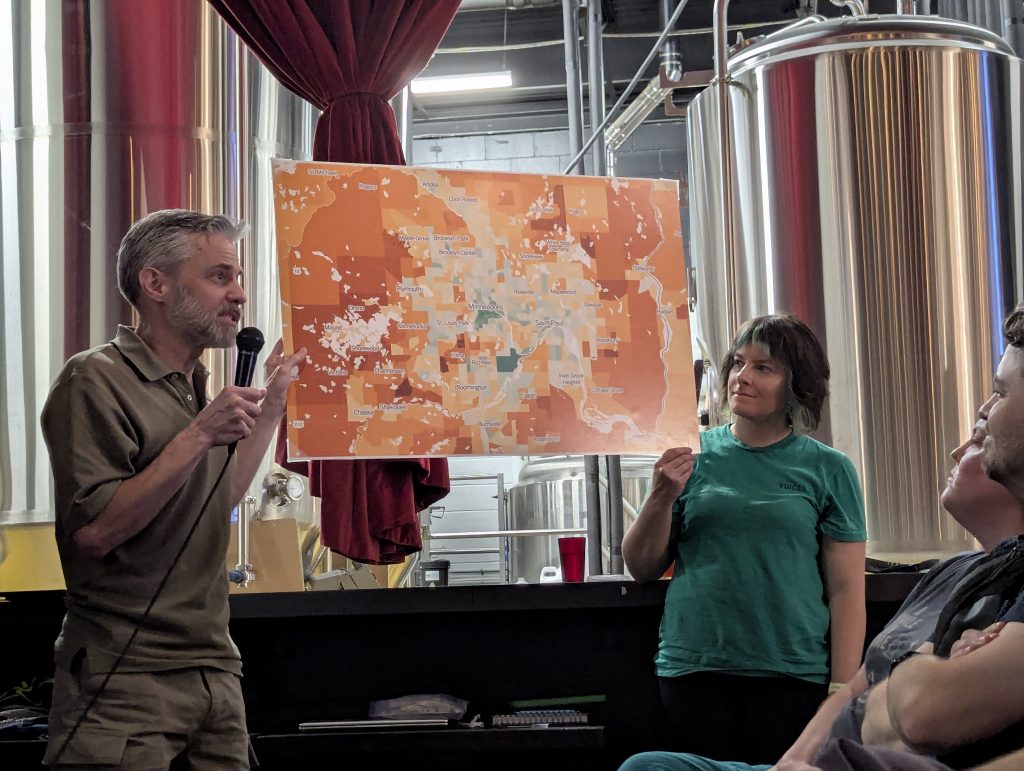
[00:48:15] Peter: Brit gave a great example, I’ll give another great example: partisanship is not everything, geography is another. We can be really smart about geography. How did we get a 34 to 33 vote in the state senate to approve a sales tax to fund transit expansion for transit walking and biking the metro area? We did it by having the sales tax apply only in the metro area. So i could sit down with the democratic senator who represents St Cloud explained to him everything we’re going to buy and he’s like “yeahh, okay…” And I said, “and your constituents don’t have to pay a goddamn cent because the metro area is going to pay for its own transit.” That was kind of a mind bender for some old school democrats who are obsessed with their version of tax equity from 1973. But that senator and the democratic senators from Mankato and Duluth and Rochester and Moorhead all said “yes yes yes yes yes!” Being smart about geography can get us a long ways and I would say and (can you help me with my visual aid here?) I brought it so I might as well show it to you. This is from the New York Times article “The climate impact of your neighborhood mapped.” This is per capita emissions in the metro area. The red areas are the areas where people don’t have access to transit; and if they do drive they have to drive a huge huge number of miles right? It’s both. But you notice Minneapolis and St Paul aren’t bright orange. They’re green. People in Minneapolis and St Paul and first ring suburbs are able to pollute a lot less. This isn’t a judgment on anybody based on where you live this is just an observation of reality. If you live in the sprawling communities you are forced to pollute more and if you live in Minneapolis, Saint Paul, or first ring suburbs, you are able to pollute a lot less. This geography so if we move forward with a TOD bill this next year (transit-oriented development) a bill where we hold firm on the density and we’re willing to negotiate on the geography. You know it’s kind of the inverse of what’s happened the last couple years where we sacrifice the density for the acreage. This would be one where we sacrifice the acreage for the density we say okay it’s it’s only going to apply within a quarter mile of the transit station, the up zoning, instead of a half mile; but we’re keeping it at six stories we’re keeping it at six stories you we’re keeping it at six stories. You know who doesn’t give a s*** about any of what I’m saying? The senator from St Cloud! He will just vote for it because his colleagues say “hey Aric will you vote for this?” And the senators from Mankato and Moorhead and Duluth and Rochester they’ll all vote for it. Because it doesn’t matter to them. That’s the beauty of land use reforms; if we’re smart about geography we don’t need anybody’s permission in DC. We don’t need it and frankly some of the vote the path to different bills is different some of the legislators who said they opposed missing middle have already told me they would support a TOD bill. Doesn’t mean we don’t pass both bills at the end of the day we just count our way to the to the majority differently for each bill.
[00:51:09] Brit: I think one of the things I love about this map is like looking at downtown Anoka is not as deep green as like Minneapolis and St Paul but it is still green. And what that tells me is that like if we can get a kind of density that is is more gentle density more bus oriented density thinking about like can we get to that 30 you know homes per acre and at least some parts of our cities especially around commercial areas transit areas places close to schools places that people want to walk to so we can build those safer streets so we can have more people be able to live in complete neighborhoods across our state I think we can have both and; and I am hopeful and excited for us to be able to have a legislature that wants that.
[00:51:53] Peter: and by the way I totally agree with what Brit said; that doesn’t mean we don’t need density in those greater Minnesota regional centers I just mentioned. It just means it’s in a different bill. If we’re strategic we can serve everybody.
[00:52:05] Joe: If I may one super brief closing thought. We’re all wonks it’s hard to kind of solve- I don’t have a map though, so I won’t pull that out. Two quick things one looking the other direction even within Minneapolis very blue city we always have these fights and factions we’re gearing up for one right now on automated vehicles. And if you don’t like Waymo circulating around your city constantly come to city hall next Tuesday the 22nd and the 29th and tell the council. But one last just thing to leave you with: I really again want to bring it back to values because Minnesota is a place that’s proud of our values in a lot of ways and we’re in a moment where we have a federal administration that’s done everything possible to import their values which are in complete opposition to our own onto our state. I’ve been thinking about this a lot with Jim Erkel who’s a retired environmental lawyer one of the smartest people our field has ever seen. And I think it’s really critical to think of this question the Trump administration is telling us we can’t consider climate, environmental justice, race, equity, public health, or any of these other things that we hold in our state as really important values in our transportation projects and the Walz administration has just walked that back willingly like we’re not considering those on these major projects that are you know multi billion dollar investments from Rethinking I-94 to Highway 252 to the Blue Line extension. They’ve deleted those priorities so any Democrat anyone who’s Minnesotan in those ways and claims those values, I think we really need to be serious about standing up for them when we’re told not to and you know in every way possible the Trump administration has told us that this year but it’s critical that when it really matters when the rubber hits the road (not to use a transportation pun) that we actually care about the values that we hold and if we really have a transportation system that works for everyone in mind that’s what we need to work towards building regardless of what people are telling us within our own party across the aisle and from Washington.
[00:53:57] Stina: thank you so much. So that that concludes our our official hour panel discussion. I do want to say thank you to Sierra Club North Star chapter, thank you to BikeMN, thank you to Neighbors for More Neighbors, thank you Sustain St Paul, thank you Our Streets, and thank you Streets.mn, and a gigantic thank you once again to Arbeiter Brewing Company. Please grab a beverage grab some food and stay and hang out with us for the next half hour or whenever they kick us out. So thank you so much!
[00:54:28] Ian: And thank you for joining us for this episode of the Streets.mn Podcast. The show is released under a creative commons attribution non-commercial non-derivative license so feel free to republish the episode as long as you are not altering it and you are not profiting from it. The music in this episode is by Erik Brandt and the Urban Hillbilly Quartet. This episode was produced by Stina Neel and was hosted, edited, and transcribed by me Ian R Buck. We’re always looking to feature new voices on the Streets.mn Podcast, so if you have ideas for future episodes, drop us a line at [[email protected]]. Streets.mn is a community publication and relies on contributions from audience members like you; if you can make a one-time or recurring donation you can find more information about doing so at [https://streets.mn/donate]. Find other listeners and discuss this episode on your favorite social media platform using the hashtag #StreetsMNPodcast. Until next time, take care.
[00:55:41] Stina: We did it!