
What does it mean to permanently decommodify housing, and how does that help long-term affordability? Find out in this conversation with David Ackos!
Episode chapters
- 00:00 | Intro
- 01:26 | Housing Co-op vs Cohousing
- 04:07 | David’s Journey
- 13:33 | Decommodification and Affordability
- 24:54 | Hypocrisy of wanting both wealth building and affordable housing
- 31:53 | The Parklet
- Streets.mn Winter Fundraiser
- Join the Streets.mn board!
- 32:41 | Land trust vs Public Housing vs Co-ops
- 51:10 | David’s Current Work
- 56:03 | Outro
Links & images
- David’s previous articles on Streets.mn
- David’s recent talk about cohousing and co-ops
- East Side Community Investment Cooperative
- CoNorth
- Inquilinxs Unidxs por Justicia
- West Side Community Organization
- Twin Cities Family Cooperative
Attributions
Our theme song is Tanz den Dobberstein, and our interstitial song is Puck’s Blues. Both tracks used by permission of their creator, Erik Brandt. Find out more about his band, The Urban Hillbilly Quartet, on their website.
This episode was hosted, edited, and transcribed by Ian R Buck. Many thanks to David Ackos for bringing this topic to us! We’re always looking to feature new voices on the show, so if you have ideas for future episodes, drop us a line at [email protected].
Transcript
[00:00:02] Ian: Welcome to the Streets.mn Podcast, the show where we highlight how transportation and land use can make our communities better places. Coming to you from beautiful uptown Minneapolis, Minnesota, I am your host, Ian R. Buck. Housing affordability is a big complicated issue, but one of the tools in the toolbox that I have long been fascinated by are housing co-ops. David Ackos did a master’s thesis studying various ways of structuring housing co-ops, and is here today to give us a primer on the topic. Let’s jump in.
[00:00:38] David: It is such a pleasure to be here. My name is David Ackos. I use they/them pronouns, and I grew up in Minnesota. I’ve been really passionate in thinking about urbanism, history, housing for probably two decades, so it’s really exciting to finally be on this podcast.
[00:00:53] Ian: And you’ve written a couple of articles for Streets.mn.
[00:00:56] David: And first thing, when I got back from my master’s degree in Berlin, I called y’all up and said, “hey, I want to come to a podcast, I want to talk about my research.” I had Streets.mn in mind from the beginning.
[00:01:08] Ian: So yeah, listeners, the thing that I say at the end of every episode about wanting new voices on the podcast, that’s not a lie. Like if you write to us and you have an idea for an episode, and you want to be on that episode, you’ll you know, we’ll do it like we want to work with you. So we’re here to talk about housing cooperatives, which you have a deep academic background in now. Right off the bat, I want to make sure that we define a few terms because especially here in America, we get housing co-ops and co-housing kind of mixed up together. So what’s the difference between those two?
[00:01:46] David: Yeah, co-housing and co-ops. Well, first, I mean, there are a couple of things about housing co-ops that I should say. Housing co-ops have all kinds of different expressions in ways they exist. Some of them are very democratic and autonomous. Some of them are in these huge institutions and don’t operate with that much democracy and housing co-ops in the U.S. We have this unique thing in the world of co-ops where we have market rate co-ops and I just I’m going to say right off the bat, I don’t really think market rate co-ops make sense. I don’t think they should exist because what I’m really about is not really co-ops in particular. It’s housing decommodification. And we’ll get into that later. But, you know, the co-ops I’m talking about in this, none of them exist on the market. They exist permanently separated from the market. And that’s really the big difference between co-housing and co-ops in the U.S. Co-housing in the U.S. They’re independently developed projects, a type of intentional community, shared spaces and private houses and usually a common house and some really nice common facilities. And they’re developed by the group that wants to live in them. And that’s something that is really compatible with co-ops and throughout most of the world, co-housing is cooperatively owned, but in the U.S. because of our financing structure and also who has the money to build, That’s really not how co-housing has ended up. And I just, just gave a nice talk about that this last Wednesday that we can link hopefully a recording to that we’ll go into that more. But that’s, you know, it’s good to cover that now because it’ll come up.
[00:03:12] Ian: So, OK, so so the one thing to remember there is co-ops are an ownership structure and like a voting structure. And co-housing is more about the built form.
[00:03:25] David: Yeah. Co-op is a legal and commercial entity. And it’s you know, it has there are six co-op principles that say co-ops should stick to, you know, certain really orientations around ethics and such that young co-ops and small co-ops do tend to do a good job of. And that’s certainly when I talk about co-ops being good. I really believe in these the six co-op principles. A lot of the big historical co-ops, because a co-op is simply this legal ownership structure, there are big historical ones that become fully corporate and really lose touch of those principles. And that’s, you know, because that’s worth talking about before I, you know, paint too rosy a picture of cooperatives. That’s a problem in Germany. It’s a problem here.
[00:04:14] Ian: OK, so, David, let’s talk a little bit about like your personal journey. How the heck did you come to this topic of interest? Yeah, because you’ve got like a whole a whole stinking. Is it a master’s thesis or a Ph.D.?
[00:04:29] David: Yeah. And it’s a little too long for master’s thesis, really. I it’s yeah, it’s a hundred and thirty pages with this appendices. And it’s on housing system transformation using shared ownership. To specifically decommodified housing co-ops in the Twin Cities to transform our housing systems. So that’s, you know, and that’s very specific, of course. And then there’s a reason why I spent a lot of time and money to study this. And it’s kind of a long story. But I’ll say to start out, I grew up in Apple Valley, Minnesota, southern suburb, it’s a third ring suburb. In a lot of ways, you know, I had a really good home life, but I felt really isolated in suburbia. And I and part of me really knew that there was something really wrong with the spatial layout of things. And when I started learning about climate change, it would often feel physically painful to me to come and see just how paved everything was and how incompatible things were with the ecosystem we lived in and the ecosystem we need to survive.
[00:05:31] Ian: So that this is the classic urbanist, Twin Cities urbanist journey.
[00:05:36] David: Sure, it is. And that’s, you know, and but it combines with I had this incredible privilege to travel all quite quite a bit. I traveled to Brussels and studied abroad there and I got to see trams and I got to see a legacy tram network, which made me think, oh, my God, this is like this is what we could have had if we’d protected our trams. It’s really interesting that we as humans solved that problem a hundred and thirty years ago and then unsolved it for ourselves. And, you know, and we unsolved it for ourselves because of this belief that people in single family homes wouldn’t organize labor. There’s this capitalism thing. And then there’s the fact that on my mom’s side, my family were refugees. They are Jews who were displaced over and over again by genocide and violence. And on my dad’s side, too, coming from Germany, there’s a similar story where the revolutions of 1848 were crushed. They’d been displaced from the commons. They no longer had land to farm. They no longer had a way to survive in Bavaria. And so after losing the revolution, my great, great, great grandpa came to the US and took land that had just been cleared of Native Americans who had stewarded it in a much more effective ownership model and ecological model for millennia and started cash cropping. And, you know, and this my great, great grandpa came just in time for the Dakota War.
[00:06:57] Ian: Oh, wow. Yeah. So, yeah.
[00:07:00] David: And that’s it’s been really interesting and something I’ve been thinking a lot about, because at some point, we really need to stop that cycle of displacement and violence and cruelty, and I want to be a part of stopping that cycle. And I think housing decommodification and the human right to housing is part of it. I think it really goes with things like land back and degrowth and really changing our economic system so we all can thrive. And I studied political science. I studied human rights. And that was really that was where I started thinking about, oh, gosh, like economic human rights, the entire developing world, all the colonized countries have been demanding economic human rights to be a part of the human rights regime. So technically, like housing is a human right, according to the UN, according to a bunch of European countries. The US has, you know, signed some of these treaties that say housing is a human right. We mostly haven’t ratified them. So for me, I graduated in ’16 from Beloit College with my degree in international relations and political science. And I moved into Northeast Minneapolis and I saw gentrification and I saw displacement and I saw all this cruelty in how we manage our land ownership. And I said, gosh, like I have a skill set that’s and a desire to try and do something systemic, try and understand and try and change something. I’m going to look at that. And so I worked a lot in housing. I started out my first job was at Wells Fargo and home mortgage.
[00:08:17] Ian: Oh, geez.
[00:08:18] David: Oh, yeah. And then my second, like, you know, I worked for some nonprofits around town, working on racialized housing policies in St. Louis Park with the suburban Hennepin County Housing Coalition with Jewish Community Action and some really cool people who are still doing good work today. And we helped get St. Louis Park to repeal their “evicted before convicted” ordinance, their crime free, drug free ordinance. So I went to Minneapolis Public Housing Authority and worked at Section 8 for six months. And that was really, really eye opening in a way that I’m glad I got the experience. But it was pretty awful. It was really astounding to see that, you know, as someone who believes housing is a human right, the duty of eligibility technicians at Section 8, you’re a means tester. You’re making sure that the poor person is the right kind of poor person, hasn’t made too much money. And if they make a little more money, well, you cut their subsidy. And so it was, it’s a job that you really can’t have much compassion or feel much compassion to do well. And it really, the eligibility technicians really get burnt out, which is part of why there’s constant turnover and they really struggle to keep those positions full, which means it’s even worse for the participants. They have more and more trouble getting a hold of anyone, et cetera. And that’s really what happened. Like my job was mainly being like a loan shark from Minneapolis Public Housing Authority because my predecessor had burnt out and had stopped being able to do his work, but they took a while to fill his position. And when I got there, there had been no one who had been able to adjust anyone’s subsidy for these files for months. And even if people had left messages with their eligibility tech, he never could have gotten them. So if they didn’t write in, put in writing, and if it wasn’t successfully saved properly, they were getting forced onto repayment plans and basically like told, you need to pay back thousands of dollars, probably four or five, 10 times your monthly income to just keep your Section 8 voucher. And now the Section 8 vouchers are really, really hard to get and they’re the only thing that keep a lot of people from being displaced. And usually a holder of these vouchers is often housing a lot of their family members as well. And often young kids. So that’s a long time talking about Minneapolis Public Housing Authority, but I was just like, Jesus Christ, like Section 8 is not the system that can be fixed. It’s a system that was made kind of to punish, really.
[00:10:57] Ian: Yeah, yeah, yeah, yeah.
[00:10:59] David: And so I came over to East Side St. Paul.
[00:11:03] Ian: You know, it kind of speaks to the means testing. To me is the problem, right?
[00:11:08] David: Oh, totally. You know, similar to how. It’s like housing isn’t a human right. It’s a right only if you’re the right kind of person.
[00:11:14] Ian: Right, right. And like thinking about other things that we have that used to be means tested that are no longer, you know, like every kid in the state gets lunch at school now, right? And it’s like, you know, yeah, this is so much of a better system. If you’re worried about FrAuD, then just get rid of the means testing, give everybody this benefit.
[00:11:33] David: There you go. 100%. And that’s really how it is for urbanism too. And this is, I think the thing I want urbanists to understand, and one of the things I’m most excited to talk to people about is that if we want beautiful cities, we can and should have them, but we need to understand that everybody deserves that and we need to orient in that way to make a city that everybody can really enjoy. And so to wrap up the last bits, Minneapolis Public Housing Authority, I tennant organized over on the East Side of St. Paul, passed some rent control with a lot of really cool people. And the East Side Community Investment Co-op, I started working on over there, ran the Renter Advisory Council on the Greater East Side. It was really good work. I loved it. And it was just more and more clear the longer I worked that the ownership model was what needed to change. And we needed shared ownership and decommodification and we needed decommodification because we can’t just put more people on the same ownership ladder. We need to take the whole ladder down, you know? And that, for me, that was like a very clear lesson that I knew that was the answer, but I didn’t know all of the details to how that answer worked. So I got supported by, gosh, probably over 100 people, but a lot of friends and family supported me really, really significantly to go to Berlin. And I picked Berlin because it was the cheapest place I could study in English, but also because I knew a U.S. planning degree wasn’t gonna cut it. I knew I didn’t wanna do the same model of development. So I picked a really cool international program called Urban Management at TU Berlin where I was able to study with people from all around the world and able to pick my research area of this decommodified co-ops with an eye to my local, you know, my home where I wanted to go back. But I also got to work with Michael LaFond and Tobias Bernet and these really amazing thinkers doing some amazing co-op housing projects that really they understand and think about how it needs to be decommodified. The city needs to have this different model if we’re going to enjoy it.
[00:13:39] Ian: So that’s a perfect segue into our next topic, which is what the heck do we mean when we say that we wanna decommodify housing, right? Like this is a word that I feel like is being thrown around a lot more lately in a lot of different contexts too. I hear, you know, like John Green is talking a lot about like, he’s concerned about the commodification of art. And it’s like, okay, well, what do we mean by that? What do we mean by that housing is a commodity, that art can be a commodity? Like, yeah, when we decommodify something, what are we doing?
[00:14:14] David: Yeah, so, you know, housing is something that a commodity is usually interchangeable and traded for a profit. And, you know, it’s not a perfect economics definition of it, but housing has effectively been a commodity since capitalism started in earnest in the 1800s. What we’ve been seeing in the past century is sort of government-supported hypercommodification, something the researchers called hyperfinancialization, but it’s a downstream effect of housing being one of the most profitable goods to trade, if you’re very wealthy. And that’s why we end up with, less so here in the Twin Cities, but in really major global cities we end up with lots of housing that’s just empty because it’s a token, it’s a tradable asset. It doesn’t matter. The people who own it aren’t getting paid or making money off renting it out. They’re getting paid or making money off speculating and betting on where it’s gonna go and saying, I know this is New York, this is London. I know this super huge tower is gonna be valued at these like, you know, millions of dollars each unit. So it really doesn’t matter if I fill it up. It’s like the amount of money I make has very little to do with renting the units out. We’re gonna sell them to people who wanna launder their money. We’re gonna sell them to Chinese businessmen. We’re gonna sell them to whoever is making these LLCs out of the Bahamas. And we go back to like the, what’s the Panama Papers and stuff. There’s this deep interconnection with our global housing system and the corruption of the very wealthy. And underlying that is economic policy that we built ourselves. Like the US created housing as it exists.
[00:16:08] Ian: What makes land such a good tool for that? Is it just because like, well, we can’t build more land? Like there’s a finite amount of it.
[00:16:16] David: I mean, it’s both land and housing. But in this case, like what I’m talking about there, this is housing built in some of the most valuable land on the planet that really is shifting our housing market so much. There are these things. Manuel Albers out of Belgium and Josh Ryan-Collins are two really good academics who talk about it. And Manuel Albers talks about the wall of money, which is sort of what individual people are competing against when they want to buy a home. And the whole-
[00:16:44] Ian: It’s a very evocative image.
[00:16:46] David: And I also really love, like Ryan-Collins talks about the housing finance cycle where housing finance makes so much money, that money then gets poured back into it. And the policies that let people make money then get doubled down on and made more extreme. And so we have the kinds of tax breaks we have for property developers, but also just the tax breaks we have for normal homeowners. It’s really, really nonsensical when you compare those amounts of money we give to very wealthy people to the little amount that we do to make sure people actually are in homes. And then I mean, coming back to just my experience on the East side, the laws we do have on the books are very rarely enforced in conditions where people are on the margins. When people don’t have a lot of stability in their life if they don’t speak English well, it’s really easy for a landlord to exploit people and really break the laws and violate their rights as we all agree their rights are based on our democracy because they’re afraid to talk about it. There isn’t much of a enforcement or protection mechanism in either St. Paul or Minneapolis and our cities really are built, The incentives, they’re built to get good tax base and that means they wanna pay attention to the developers, they wanna pay attention to the landlords. The renters maybe matter a little, but maybe not so much. A lot of this shift in housing, people’s housing has been tied to people’s work through a lot of history. And buying a home on an open market is something that just didn’t exist that much before 150, 200 years ago. We’ve shifted to this model and now this model is broken and we need to find a fix for that and ownership as a concept is something where like, you need something different if you’re going to respect care, if you’re going to respect the ecosystem around you, if you’re going to respect everybody. We can’t have an exploitative structure for that. We need to have housing that’s stable without people being on this treadmill to make more and more money to keep paying for their living expenses. And when you have a giant single family home, you need to have an economy that produces way more surplus than an economy actually can effectively produce with externalities being taken into account. So like, the US, all our giant homes.
[00:19:04] Ian: When you scale it all up.
[00:19:05] David: Yeah, when you scale it all up, the US, we’re able to have our giant homes because we’re extracting a lot of wealth and we’re also ignoring a lot of the real costs of our economic structures. And this is what economists call externalities. With like climate crisis, we pay way less for our gas than what it’s going to cost to clean up the harm that that gas costs, right? So that’s one of the big things I’m thinking about, but it’s just, yeah, the single family home model doesn’t work. And I, and I presume you, we don’t want to live in giant ant colonies. Like, it would be nice for us to have a little choice over how we live, right?
[00:19:39] Ian: I don’t know, I’m kind of fascinated by the sci-fi concept of arcologies. But mostly, mostly as a like, well, this is potentially a necessary tool for us to be able to live in the numbers that we currently have without like destroying the entire planet. But I feel like that’s-
[00:19:59] David: That would be an interesting conversation.
[00:20:00] Ian: That’s a topic for another day. Yeah. The more that I have thought about like land ownership, the more I’m like, this is such a weird concept that like, what do you mean I can pay somebody else, just pay one individual a finite amount of money, and now I have the right forever and ever to dictate like who can and cannot use a particular spot on the planet. That’s weird.
[00:20:32] David: It’s weird.
[00:20:33] Ian: Ownership makes sense to me when I’m talking about like, you know, an object that I can hold, but yeah, this like a place, like why should I as an individual have sole dominion over a place?
[00:20:47] David: Yeah, and the people who own the most of the land in our country, land and housing, mostly never see any of the places they own. They never touch it. They don’t actually, you know, create any kind of meaningful, you know, they don’t invest in it besides wealth they already had, wealth that they’ve hoarded. It’s not like, you know, Bill Gates and all his farmland. It’s not like he’s farming any of it, you know? Yeah, so, but for me, I had, I read right before I went to Berlin, I read The Dawn of Everything by David Graeber and David Wengrow, and that really, really had me thinking about ownership in a different way. It kind of blew my mind because they talk about the Roman model, patriarchal model of ownership, and you know, there are a couple, actually Latin words we use for how we talk about land in our modern context. And so there’s like, there’s usufruct, which is right to use and to the fruits of land. And that’s really like, decommodified ownership looks more like that. Then there’s the freehold, the full ownership, and I’m blanking on the Latin word for it, but freehold ownership, which is, you know, really what we see as the pinnacle in our society. That’s what you need to be able to, you know, borrow against your land and like have a bank put a lien on it so you can get money off your land. Freehold ownership comes from this Roman concept where the patriarch literally could destroy everything he owns, including people, like that’s slaves, women, you know, like, and that’s really something we’re stuck with here where like, even though in theory, ownership should be conditional. You’re not supposed to be able to poison all the land for future generations. That is what happens. That’s effectively how ownership works here. Now we need, you know, for me, like thinking about an obligation to the past and the future is really important to me because I really believe we need to shift to an ownership model that, you know, okay, you can be responsible for this land. You can use it, but you have an obligation to the people around you and the future descendants. You can’t poison it. You can’t destroy your housing. Like, you know, this is like, and I will say land and housing are different. Land can be completely decommodified. Like there’s no need for the sale and transfer of land. Land can all be held in common. Housing costs money to build and it costs money to maintain. And that, you know, you can’t stop paying people for that. People need to be paid for the work they do. You can take out the profit motive. And that’s what, you know, a limited equity cooperative operates at cost and good decommodified housing should.
[00:23:26] Ian: What you were saying about how like land can be completely decommodified, right? That like, yeah, we could change our entire legal system so that like, okay, either like the state or the city like owns all of the land that’s, you know, inside it. And we collectively through our democratic systems decide like what any given piece of land is gonna be used for. I feel like we’re a long way from actually doing that. So let’s talk about the things that we can do within the current system, you know, both legal system and financial system to remove these goods from the market, which is where co-ops come into play. Yeah.
[00:24:11] David: Yeah, there’s this term I use a little in my thesis and I like to talk about called prefigurative politics, which is, you know, in brief, it’s trying to build systems and live in a way that reflects what you want in the future that you’re trying to build. So I think a lot about like how do I work back from a future where we all have a planet to live on and our grandkids get to enjoy nature and ecosystems, you know, and for me, working back, it is moving to imagining sort of these ownership models that really have that long-term eye to how things are in the future and also how things were in the past and how we wanna relate to that based on our values.
[00:25:00] Ian: Last thing that I wanted to talk about before we really get into like the specifics about how co-ops work, we need to acknowledge or we need to highlight for people like the hypocrisy of the fact that like, broadly speaking, nobody argues against like, well, we should have affordable housing, right? Like housing should be affordable for the next generation. But also, not many people are arguing against like, well, I’m a current homeowner, I want the value of my home to continue going up because this is my retirement plan, right? And it’s important to note like, you can’t have both of those things at the same time because the only way that you’re going to be able to get that money for a good that is increasing in value is by taking that value from the next person.
[00:25:55] David: Yeah, yeah. No, I’m really glad you brought that up because I touched on this briefly, but it’s like, it’s really one of the biggest things in advocating for decommodified housing. Like I have to say very explicitly, people need to understand that your house cannot be your retirement plan if you want your kids to have like housing. Like we need to shift away from the haves and have nots if we want to make life on this planet work, we need to start making everybody a have at a basic level. And you know, and that means something like saying, okay, no one gets seconds before everybody gets first for housing, right? So we do need, we need some long-term stability and ways for people to be able to expect that their society is going to have their back to their retirement. I think, you know, in some ways, a decommodified co-op community can be a really beautiful proposition for retirement. It can mean your housing will stay stable, cheap, and you’ll have a community around you to help care for you. And, you know, I really wanna live in intergenerational housing. That’s what I hate about the suburbs is that, you know, isolation of people being broken into their nuclear families and then not getting that interchange across generations. I think that’s really important. I think we need a village, but we also need, we really need to address this kind of the terror of aging that a lot of people have because your home is not gonna be as valuable if we decommodify housing. Like that’s gonna destroy a lot of equity that some older people have in their homes because we need to control prices across the board and start shifting that housing off the market. And when it’s off the market, the market’s not gonna be flying up like it does. That’s the whole problem is the market increases at this much, much faster rate, and then incomes increase. And that’s why we have a generation that’s up at the top of the ladder and a generation that can’t climb that ladder. So people ask me, older people ask me, well, how do we have long-term affordability? And this really is my answer to them. It’s like, we need to disconnect those two. Connecting everybody’s housing to the market was a really clever trick to shut down labor movements 70 years ago. It doesn’t work anymore and it won’t work. So we need to change that.
[00:28:09] Ian: Yeah, and if we could do it all at once, that would be one thing, but I can definitely foresee us moving into an era where it’s like, okay, we have more and more co-ops that are starting. And the way that they have to start is by purchasing individual lots from their current homeowners. And so those people who are selling to co-ops, unless they are intentionally selling below market rate, those individuals are gonna be fine. The people who currently own a house, like, they’re gonna be fine because as more and more parcels are converted into co-ops, that’s just going to make the ones that haven’t sold yet even more, like, worth even more because the market is going to be smaller.
[00:28:58] David: That’s a good point. Yeah, yeah, there’s definitely truth to that. I’d say, I really got into housing decommodification when people were arguing against rent control because a 3% cap on annual rent increases as we passed in St. Paul, pretty reasonable, pretty standard throughout most of the world. Here in the US, there’s this attitude that, oh my God, the developers tell us we won’t have any housing if we limit their future profits. So we just, we can’t do this. We need to listen to them. And it’s like, well, we’re the ones paying for that housing on the front end. We’re giving those developers tax credits and we’re paying on the back end, paying to live in it and paying ongoing in subsidies for the affordable housing that we need to do. Like we can pay that actually quite a bit less and build it ourselves for permanent affordability. But also if we put those rent caps on, like for instance, like British Columbia, the entire province has a cap on rent increases every year that set whatever, 2% this year, 3% next year.
[00:30:04] Ian: Oh, interesting.
[00:30:05] David: And there’s this attitude here that like, no, rent control never works. It’s ridiculous. Rent control exists and works in almost every developed country on the planet. What we do need is we need a supply side intervention to match it. So like we put strong rent control into place in Minneapolis and St. Paul tomorrow. We’re suppressing the prices of home resale and allowing like a really direct way to start converting those homes to shared ownership. So like I would love to suppress those runaway home values and start shifting those homes to community ownership in this coordinated way with a tenant opportunity to purchase, with financing for co-ops that matches the financing we have for single family homes, which is really just like government backing loans. Like it wouldn’t be that hard, but we need enough people to understand it to ask for it. And because the entire housing industry is threatened by that shift, people really aren’t talking about it. And that’s what I, there’s a huge movement or a movement starting up for community owned real estate and housing co-ops in town. CoNorth is doing some really cool work with resident owned communities, but none of these nonprofits that I’ve seen yet are ready to say we need housing to be decommodified. We need it now. And we need to make this shift to tenant ownership. I actually, I should say, I think Inquilinxs, Unidxs and West Side Community Organization, I wanna give the benefit of the doubt. I think both of those orgs are really willing to say that out loud. And I really admire that. But we need that being publicized to the whole cities. And I’m doing that now and hopefully I’ll be able to find a place within the nonprofit industrial complex where I can get paid to do that. But I’m gonna do it either way because it’s the solution we need. So, yeah.
[00:31:55] Ian: Before we continue, let’s take a quick break in the parklet. Streets.mn has some fun events coming up. Our winter fundraiser gala will be on December 10th at the Black Hart of St. Paul. We’re going to have lots of fun speakers, trivia and social time. I hope to see you there. Look in the show notes for a link with more details. Streets.mn also needs new board members for next year. The initial deadline for applications was November 1st, but I have it on good authority that we can stretch that out a little. So, if you want to help shape this wonderful publication, please apply. Again, look in the show notes for a link with more details. All right, let’s get back to our chat with David Ackos about housing co-ops.
[00:32:41] Ian: Okay, so this is a great time to talk about some of the specific mechanisms that we have for decommodifying housing. So, we’re mainly talking about co-ops today, but there’s also land trusts and public housing.
[00:32:56] David: Yes, and nonprofit housing is worth adding too.
[00:32:59] Ian: So, how do those all differ? Do any of them work together?
[00:33:04] David: Yeah, so land trusts are a model where the land is separated from the house itself. This is the one that people are gonna be most familiar with. It’s a partially decommodified model where the land is permanently decommodified via the land trust with this 99-year lease, and then the home itself still is going to be resold on the market, but there’s gonna be a restriction on who it’s resold to and how much profit can be taken out by the owner. Now, that actually is really completely compatible with limited equity co-ops, and in Canada, 57% of land trust houses are limited equity co-ops. In the U.S., it’s more like 2% of land trust houses are limited equity co-ops, so that’s something I’d really like to see change here because the models really make sense and fit together well, and if you want your decommodification to be permanent, you need some kind of backbone, something that holds the co-op to not dissolving itself and selling, and that, I guess, gets me to the problem with public housing and nonprofit social housing is really this problem of re-commodification. We see, I mean, well, also, disinvestment and it being used to punish people who live in it is another thing that we see here in the U.S. Public housing has a really bad rap, and that’s been a very successful propaganda tool against decommodified housing because we concentrated some of the people who had the least rights in our society into places and then made sure those places fell apart, and that’s how, in the 90s, we get this shift to Section 8 from public housing.
[00:34:51] Ian: Which is something that I have run into when pitching ideas for like, hey, what if the school district didn’t just own a school building? What if they built some housing on top of it and my union president was like, that’s a terrible idea, and brought up just all of the problems with public housing.
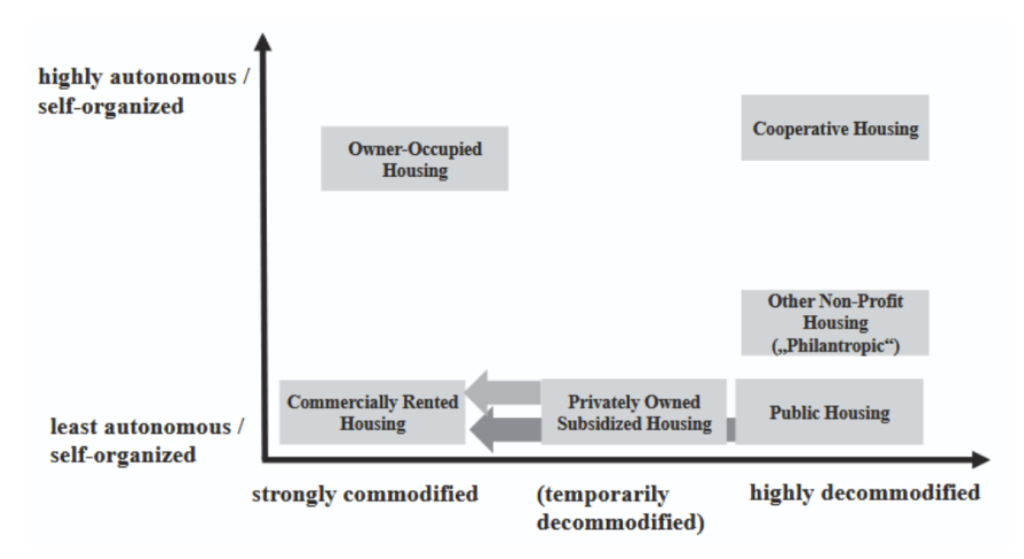
[00:35:13] David: Right, and I actually, I believe in public housing. I think we need it. I think it needs to be part of the solution, and it’s really important for me to say that. The problem is, as our democracy operates right now, we can pretty confidently expect if we build public housing tomorrow, then in four years or in eight years, someone who doesn’t like us is going to come into power and be in charge of that housing’s budget, and they’re gonna destroy it, and then we’re gonna have to sell it at a loss. And this is what happened in Germany, which is a really good example of why co-ops are really viewed as the necessary solution to this market failure. Like, Berlin was full of public housing and a lot of cheap housing in the 90s, and with the fall of the wall, there was this massive, just parceling out of all of these public resources. So through the 90s and through the 2000s, the city of Berlin sold thousands of units of housing, and that’s where the enteignen movement, the people working to decommodify housing in Berlin sort of are coming from. They’re saying, we need to get that housing back on the public market because these massive corporate entities have no interest in following the laws or respecting us or letting us live well, and really don’t mind if they keep a bunch of houses off the market to raise the prices. So that’s why Tobias Bernet has this great chart that I think you’re gonna put in the show notes here where sort of talks about, this was back in 2014, and I’d like to add a little to the chart, but looks at where, it was Tobias Bernet and Eva Balmer published this article, and we can link that too. And it looks at sort of the spectrum of commodified to decommodified and autonomous and independent to non-autonomous, not so democratic. And so we have on there, you can see there are things like, public housing is decommodified, but not necessarily that democratic. Social, non-profit owned social housing tends to be the same, and larger scale co-ops are also on that less democratic side. Now the big difference we have is public housing and non-profit owned housing very often have to be sold, put back on the market just to keep the public housing or non-profit entities’ budgets flowing and keep them liquid. And that’s what even Berlin’s public housing entities right now sell units every year because they’re expected to turn a profit like a corporation. And that’s obviously not.
[00:37:45] Ian: That’s a weird way to run a public thing.
[00:37:48] David: Yeah, and that’s neoliberalism. And I guess we shouldn’t take the time to explain neoliberalism right now, but that’s how our system works too. It’s like this belief that the markets are the best way to do everything, so F you, kind of. And that’s what, thank God, I think there’s a huge backlash against it around the world. I hope that backlash succeeds before our planet is destroyed, but we’re working on it, right?
[00:38:15] Ian: So this chart, it gets me thinking, can we have the best of all worlds? When you think about what are the benefits of private home ownership, then you think, okay, well, wealth building for that particular individual is a good, that would be a reason to get into the housing market. Whereas if I wanted to be able to you know, pack up and move whenever I want to without having to worry about like, I need to sell this particular good, then you know, I would rather be a renter. You know, so yeah, are there ways to like get all of the benefits of all of the various different kind of models for ownership and not have, ideally not have any of the downfalls, but like, you know, maybe just having as few of those as possible. And you know, so that’s getting into kind of the specifics of every individual co-op, right? Like they’ll all have some things in common, such as collective ownership by all the tenants.
[00:39:27] David: Collective ownership, cost rent. Yep. Yeah, those, so.
[00:39:30] Ian: But then there’s various different ways to structure the like, okay, who has voting rights, you know, within this structure. There’s different ways of structuring like, okay, when you join the co-op, do you have to have an upfront cost of, you know, buying a share in the company? Or is it mainly just rent? Or is it a combination of the two? Like, yeah, so what are kind of the benefits and drawbacks of each of those individual components?
[00:39:59] David: I think this is kind of, this is kind of two questions. I’m gonna answer those two questions. Because the first one, like, thinking about like the benefits of home ownership and, you know, what we really, what we love as Americans, you know, we love having a nice garden, a nice yard. We love a little land to enjoy, you know, and we love autonomy to say, do what we want with our place. If we wanna be able to put in, you know, say a hot tub, we should be able to do that, right? And the models of housing that have the best autonomy and communal resources, like really nice, I really love the shared economy, the library economy that I saw at a lot of the co-ops I toured. Those tend to be smaller because you, if you want a lot of say in how your housing looks and how it’s shaped and you want diverse housing styles, you can’t really have these massive scale projects. Now, I think there needs to be a spectrum. We need to have the massive scale projects too because our crisis is much larger than some small projects can fix. And also most people don’t really want this high degree of democracy and participation in their housing. And I do think like, honestly, some of that is gonna need to change.
[00:41:11] Ian: I have to vote every November for city, county, state, and national level things. Why would I want to also have to vote on, you know, every individual little decision that my building is making. And pay attention to what the board is doing. All of that.
[00:41:24] David: And that’s, you know, I think to some degree that needs to change. I think people do need to understand and engage with like, we are responsible for our local environment and we have to talk to our neighbors. We can’t like, like so much of our culture is about just like blocking people out. I think that’s really, that’s not something that I want to have in our future world. Though I think, you know, some people are always gonna be loners. We’re not gonna get rid of all single family housing. Right? My favorite examples of really creative spatial design tend to be smaller projects that really are closer to co-housing in the U.S. And so there are some really cool ones. You know, Spreefeld and the SoWo Solidarity Housing Co-op in Leipzig are two examples I really love talking about for spatial-
[00:42:07] Ian: You sure do.
[00:42:09] David: I do. I talk a lot about them. But, you know, then, and then OurHaus is a really cool one by Dix Tannhäuser Architects, also in Leipzig that I got to tour. And you can look at some of that in a recent presentation I did that hopefully we’ll be able to link. But on the other side, so I think like having that autonomy and a lot of those experiences of like ownership, I think that’s something that’s really feasible. And also then you can have these, you can have giant social housing co-ops. Like, interestingly, you know, people point to Vienna’s model for a Western country where housing is largely decommodified. And now interestingly, Vienna actually has shifted a lot of their, most of their public housing, maybe not most, maybe half, into these giant cooperative ownership structures, literally to protect their public housing from the national government. The national government tends to be more conservative than Vienna’s consistently socialist government. And this is a way to use the supremacy of property to protect your investment in decommodified housing. It works really well there. Now, if you have 60,000 units of housing in your cooperative, democracy doesn’t really make sense. You do have ownership of your unit.
[00:43:19] Ian: That’s just city scale democracy.
[00:43:21] David: I mean, you know, yeah, it’s not direct. It’s gotta be representative and you also need a, you need a really professional skill set to manage these huge assets. And that’s really a risk for co-ops to lose track of their co-op values when they’re bringing in people from the industry and there isn’t a cooperative industry to bring people in from. So they’re bringing people in from the normal, you know, commercial industry who then use those principles.
[00:43:44] Ian: It’s like how REI is a co-op. Kind of.
[00:43:47] David: Totally. Yeah. Or, you know, some of our big agricultural companies are like that too here. Oh, okay. And there’s a really interesting, I wanna name drop another academic, Michel Lafleur up in Quebec. He’s done some really cool research on co-ops losing track of their co-op principles and sort of how these big co-ops corporatize over time.
[00:44:11] Ian: I feel like-
[00:44:11] David: You had a second-
[00:44:12] Ian: Yeah, go for it.
[00:44:13] David: -part of the question. Oh, I was gonna say the moving in and out. That’s something that a limited equity co-op can really have a share price of any amount. You know, usually you don’t wanna go above like half the nominal value of the unit. But then that share can either be not appreciated, it can stay really low, which makes it really easy to move in and out. You know, you can have your share be just the amount of a deposit, a security deposit. Or you can have your share increase at like one and a half to two and a half percent every year, annually. The thing that’s really important, you really don’t want those shares to increase at 3% or higher because you don’t want the line of, you know, your equity in the co-op to surpass the value of the building itself. And you really want a big gap between those things to keep affordability with the co-op.
[00:45:02] Ian: Do any of them like index it to like to inflation?
[00:45:06] David: So that really, there’s an interesting question. I don’t think that would make sense because the point of your shares should be growing slower than inflation, really. Like…
[00:45:17] Ian: Well, right, I mean, you know, you could have it be like 50% of inflation or something like, you know, whatever.
[00:45:22] David: Yeah, yeah, that could work. Though it adds a little complexity for figuring out what the shares continue being, and you know, so a co-op could do that. A co-op could do that if they wanted to. I do wanna say for the moving in and out easily, there actually is a co-op model that works for that that is not limited equity co-ops, which is what I talk a lot about limited equity co-ops because they’re closer to ownership.
[00:45:43] Ian: What does limited equity mean?
[00:45:46] David: Limited equity means you do, you buy in, you have a certain amount of the equity in your building that you hold and is transferred on a sale. So, you know, typically that might mean it’s like a $10,000 share. You have to put 10 down when you buy the co-op and then someone else brings 10 and you take that back out when you move.
[00:46:06] Ian: Yes, okay.
[00:46:07] David: You know, so, and that, and it doesn’t have to be 10, it could be 40 or whatever. The smaller, the better for long-term affordability, of course. But there’s also this model called the leasehold co-op, which we have a number of examples in town. Now, leasehold co-ops can operate with a normal landlord owning the land or they can operate with, you know, a nonprofit owner that keeps it decommodified.
[00:46:32] Ian: Okay.
[00:46:32] David: That’s actually where I’m working now, Riverton Community Housing is built off the leasehold co-op model and it was built out of the Chateau Student Housing co-op. So this is really interesting. The Chateau Student Housing co-op, it’s this tower in Dinkytown. They actually created Riverton in 1991 to be their landlord for them, to do the management and keep running it and keep it affordable in perpetuity.
[00:46:55] Ian: Which I think important to note the difference between a landlord and a management company, right?
[00:47:02] David: Yeah, and this is, Riverton does own the housing.
[00:47:04] Ian: Oh, interesting.
[00:47:04] David: So it does have the responsibility over the housing and that means it really is a landlord. There are fights with the co-op board sometimes about what they can do and how, you know, Riverton has to protect the assets is like its purpose, its mission is keep that housing in long-term and that means sometimes making hard decisions in the short run. But it does mean like that’s really a much more rental style, but it’s still decommodified, it still stays affordable long-term. I will say because insurance especially has gone crazy lately, the Riverton buildings are not that much below market. They’re a bit below market right now, but that’s still, it’s cost rent, you know? And that’s pretty cool. I did wanna make a quick pitch. The Oliver & Wendell co-op is Riverton’s newest co-op and it would be a pretty amazing place for a urbanist to move in. It’s right up the street from the Stone Arch Bridge. They have one unit available right now, but we really need to get some people who care about urbanism and care about co-ops in to really get this new building’s co-op board up and running and get the co-op moving. I think the potential is really incredible for that building and it’s right on a heavily used transit line. It’s very walkable. It’s right across from Alma Cafe, but it really needs to be fully brought into the co-op world and it’s really separate from Riverton.
[00:48:28] Ian: What’s preventing it from being in the co-op world right now?
[00:48:31] David: Well, you have this thing, which is a problem with a lot of co-ops. It’s the percentage of, most people who live in co-ops, I think, really like that they live in a co-op. They like that their prices stay low. They like that they could have a voice. They don’t necessarily want to use their voice. They, and so right now, it’s a lot of residents who like that it’s a co-op, but maybe they don’t totally know what that could mean and they’re not super interested in putting time into changing it. They just feel like their lives are full and that direct governance is not something they wanna take on.
[00:49:02] Ian: It’s like how I like being in a union and one of the reasons I like being in a union is because there are other people who are gonna do the work.
[00:49:09] David: Yeah, yeah. No, totally. And it’s like, that’s fine. And also Oliver & Wendell was just converted to co-op. So there isn’t this long history.
[00:49:17] Ian: Okay.
[00:49:19] David: And it’s like you can get a, you get a stipend, you get a rent credit for hours you put in on the board. And so the board members will be able to decorate the halls. They’ll be able to put furniture in common spaces. There’s a lot of, there’s also a 33 unit lot.
[00:49:34] Ian: How did it get converted?
[00:49:36] David: Yeah, it’s an interesting, so.
[00:49:38] Ian: ‘Cause I feel like that’s kind of the next concept and this might, we might get into this more in a future episode is like how do we go about making more co-ops in the Twin Cities in Minnesota? So how’d this happen?
[00:49:52] David: I mean, it’s kind of a lucky situation. There was a developer who really wanted a lot on the corner in Dinkytown. That lot had an old house on it. Riverton owned that house. It was one of Riverton’s older co-ops, very small by comparison to Oliver & Wendell is a nice 36 unit property, 33 units? I should know that. But so this developer was like, we really want this land. We’ll trade you Riverton for it. And so Riverton was able to get this, piece of housing, this decent sized apartment building, but there was no co-op history with it. And so that was just a year and a half ago. And we officially converted it to co-op with actually a couple of my friends as the new board members of it. But it’s still, you know, it’s been founded. It’s been filed and incorporated as a co-op. You know, I think the culture needs to be built. It’s still, you know, it’s still gonna take a little time to really come into its own and grow into the cooperation world.
[00:50:57] Ian: So does that mean that the other property that was traded is that no longer a co-op?
[00:51:01] David: Yeah, that one is no longer a co-op. Though I will say, I think it’s like, you know, what? Like one or two units compared to like 34 units. I think it’s an okay trade.
[00:51:16] Ian: I wanna leave people with, you know, you, David, what are you personally doing to make more co-ops in the Twin Cities?
[00:51:25] David: Great, yeah, no, I love that. So, I mean, first I need to say I’m really excited about the Eastside Community Investment Co-op. It officially started this last year. We just closed on our first building, which is the old flower shop on Payne Avenue right next to Brunson’s on the Eastside of St. Paul. I really love the Eastside. I kinda wish I had shouted out to it sooner. But that’s really exciting. Working on the Eastside, I started working on the Eastside Community Investment Co-op, I guess five years ago. President of ESCIC is Giovonnia Harris. She’s amazing. She was one of the tenants I worked with in the renter advisory council. And she got on the board and worked with me to help found the Eastside Community Investment Council along with Sid Pisano and Claire Thomas and Paris Dunning and Ben Werner. And this, and oh, I should mention, you know, Benjamin Tsai and Erin Jerabek Heelan as well. And these people all work together. We saw, wow, there’s a lot of displacement that’s already happening and there’s gonna be a lot more. Like gentrification hasn’t come for the Eastside in force yet, but it will. And we need an entity that can start taking some of these buildings and land off the market and holding them that way. And so, and that’s, you know, and that needs to cover, it’s not just about housing, it’s about commercial space too. And so.
[00:52:44] Ian: 2008 would have been a great time to have started.
[00:52:46] David: Yeah, it sure would have been. And you know, Dayton’s Bluff Neighborhood Housing Services bought a bunch of houses then and were able to preserve them affordably that way. So it’s like, it’s not like, you know, there’s been some of that going on. But that’s really exciting. You can become a member. Any Minnesota resident can become a member of the Eastside Community Investment Co-op as an investor member. And any resident of the Eastside for just 10 bucks and a $10 one-time fee can become a member. And the voting shares are, there’s just one vote for every person. So even if you invest thousands of dollars, you never get more votes than someone on the Eastside who put in 20 bucks. And that, I really like that. That’s really important. And we were actually able to stabilize the housing for the residents above this flower shop. It’s a three generation family. And that’s really cool. I’m really proud of that. And then I’m also working on a co-op co-housing project with my friends and loved ones. And we’re, I’d say we’re quite inspired by the one co-housing co-op in town so far, the Twin Cities Family Co-op, which is in Marcy-Holmes. So, I wanna be talking to urbanists and saying, hey, y’all, YIMBYs have 60% right. They understand the spatial side. They need to get behind the housing justice side too, to really be able to make the changes we need to make. And this for me, the transit thing was so huge. I was like, I love rail. I want trams. But we just had the Riverview Corridor in St. Paul shut down. And part of that being shut down is like, all those renters and homeowners along that corridor know that they could be displaced by it. Like, it’s gonna raise their values like crazy. And they already, like a lot of retired homeowners can barely afford just their taxes and insurance now. So, without strong trustable rent control, without really housing as a human right and a right to stay, any transit investment is going to be displacing people. And that’s something I think people need to understand. It’s something we need to address when we’re advocating for transit. And we need to bring those things in line. Yeah, I’ll be working on my own co-op that we don’t really have a name yet. We’ll figure that out. It’ll be 15 to 25 units, hopefully mixed income, mixed ethnicities, you know, not the homogeneity we see in a lot of co-housing and intentional communities. And it’ll be permanently decommodified. And so that’s my dream. That’s what I’m gonna be working on in my free time. And then my day job, I’m gonna try and keep doing the system transformation, try and keep showing that we can and must decommodify our housing so we can all have nice things. And really looking forward to that.
[00:55:23] Ian: So, yeah, for listeners, my plan here is since David’s doing so much ongoing work in this space, to have kind of definitely a follow-up episode where we’ll talk about some like local specific things, you know, like what kinds of policy changes would be helpful for co-op space, you know, financial changes, but also possibly an ongoing series of like following the journey of starting a co-op from scratch could be very fun. Well, David, thanks for coming on the show.
[00:56:00] David: Such a pleasure, Ian. Thank you so much for having me.
[00:56:04] Ian: And thank you for joining us for this episode of the Streets.mn Podcast. The show is released under a creative comments attribution, non-commercial, non-derivative license. So feel free to republish the episode as long as you are not altering it and you are not profiting from it. The music in this episode is by Erik Brandt and the Urban Hillbilly Quartet. This episode was hosted, edited, and transcribed by me, Ian R. Buck, with production assistance from Parker Seaman. We’re always looking to feature new voices on the Streets.mn Podcast. So if you have ideas for future episodes, drop us a line at [[email protected]]. Streets.mn is a community publication and relies on contributions from audience members like you. If you can make a one-time or recurring donation, you can find more information about doing so at [https://streets.mn/donate]. Find other listeners and discuss this episode on your favorite social media platform using the hashtag #StreetsMNPodcast. Until next time, take care.