
Editor’s note: The author of this article requested anonymity because of their participation in the Rethinking I-94 process and their desire not to implicate their employer, a member of the Minnesota Architecture, Engineering, Construction and Planning (AECP) industry.
Rethinking I-94 is a near decade-long “program of projects” the Minnesota Department of Transportation (MnDOT) has been steadily working through since beginning the community engagement process in 2016. The goal of rethinking I-94 was, ostensibly, to analyze the freeway’s history and use, and develop a plan for its future inspired by former Commissioner of Transportation Charlie Zelle’s apology for its construction: “we would never, we could never, build that kind of atrocity today,” he said.
Today, however, it seems MnDOT does not feel that the planning mistakes acknowledged by the department are severe enough to warrant any kind of repair to the I-94 “atrocity.”
MnDOT’s recommendation on Friday, December 20, that the Twin Cities Boulevard and other reduced-capacity project options no longer be considered signals only continued harm for communities affected by the urban freeway. Inclusion of the boulevard and reduced-capacity alternatives was the result of hard work by many transportation-justice advocacy groups, such as Our Streets. And, while inclusion of the boulevard options was exciting, the Twin Cities’ transportation framework for large-scale infrastructure is simply not designed to deliver projects that benefit the people who live in surrounding communities. MnDOT stated that they are “confident in [their] analysis,” however, this analysis was designed to invalidate a livable alternative to I-94.

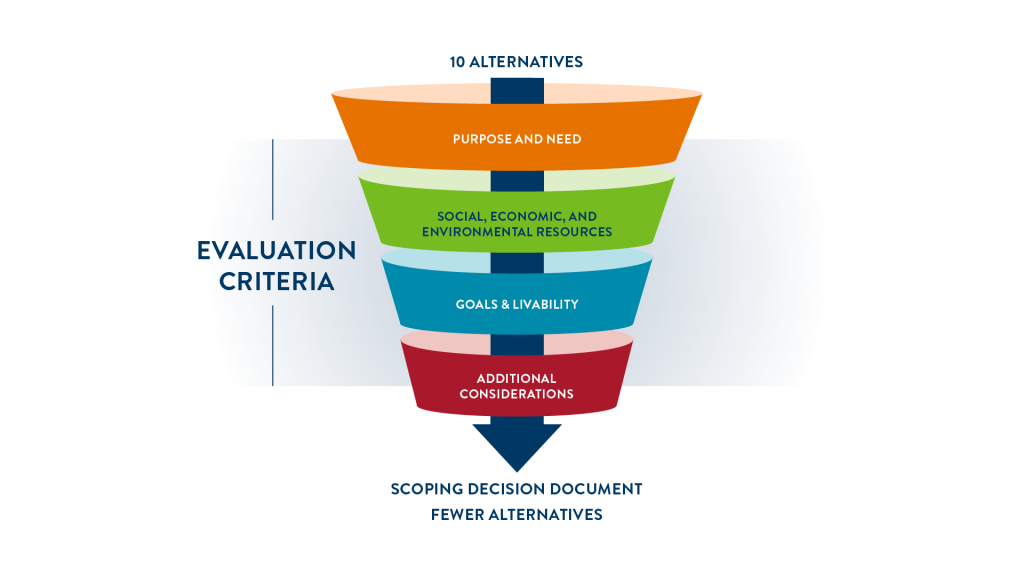
The National Environmental Policy Act (NEPA) is a great law on paper, but in practice, it has serious shortcomings. Some components of the law are good; for example, we should study the environmental — biological and societal — impacts of transportation projects. However, also within the NEPA process is the Purpose and Need Statement, on which the proposal to eliminate the boulevard and reduced-capacity alternatives is based.
The Purpose and Need Statement is the narrowest gate in accessing federal funds for any roadway project. The statement, produced by the project team, establishes the reasoning behind the project; however, the rationale considered acceptable by federal transportation authorities to access funding is functionally limited to a discussion of only transportation. Any other basis for project action — such as the health of nearby residents or remedying past destruction of homes and businesses — must be relegated to Goals and Livability or the legally unaccountable “Additional Considerations.”
On the surface, this may not sound like a huge problem, but this approach takes an incredibly narrow view of community needs, land use, the built environment and the inevitable externalities of any civil infrastructure project.
The Human Cost of Freeways
Transportation projects do not have only transportation impacts on the communities in which they happen. If a freeway is built in your neighborhood, the difference between pre- and post-freeway will not be limited to the fact that people now travel through your neighborhood to get from point A to point B.
Consider the urban freeway construction boom of the 1960s and the far-reaching and long-lasting impacts of those expansions on neighborhoods such as Rondo in St. Paul or portions of South Minneapolis. Freeways were built in primarily Black working-class and poor neighborhoods. In addition to the physical separation of neighborhoods by large roadways and the presence of traveling commuters, these communities also experienced the following:
- A drastic worsening of air quality.
- An increase in respiratory and other diseases.
- A large increase in sound pollution.
- Decline of property values, both residential and commercial.
- Outright displacement of families and businesses.
The construction of freeways in many ways led to the destruction of both the physical community and any civil society that flourished there. These harms are all caused by transportation projects, and it is virtually impossible to remedy these problems or prevent similar damage being done by new projects if we continue to focus solely on transportation outcomes rather than considering the accompanying environmental, societal and economic impacts.

Many other roadways, including state highways, are also subject to the Purpose and Need process. A busy and dangerous road cutting through a dense commercial or residential neighborhood which receives federal funding for construction — think Olson Memorial Highway in Minneapolis or West Seventh Street in St. Paul — cannot simply be changed by consent of the surrounding community. If community desires are anything other than “improvement” within the Federal Highway Administration’s (FHWA) exceedingly narrow definition of transportation, there is no guarantee that the goals of the community will be honored.
As is obvious from the name, the FHWA is car centric. While the agency is under the umbrella of the federal Department of Transportation, their focus, and institutional and cultural definition of transportation tends toward the mobility of cars and trucks.
Now, the FHWA does not come up with Purpose and Need statements, and there is no rule that explicitly states definitions of transportation cannot include modes beyond single occupancy vehicles; however, in the vast majority of states, cities and counties, transportation planning is incredibly parochial. State transportation departments are usually entirely separate from local public transportation authorities and other government entities that may manage and build bike and pedestrian infrastructure. Thus, virtually no state DOT has the resources or authority to readily include new public transportation infrastructure within a project unless they collaborate extensively with local transit authorities, which have their own separate set of regulations to follow.
While collaboration on transit is not impossible or disallowed, it takes time and costs a lot of money, which are deterrents enough for most projects. Because of this structure, transportation improvements for state and federal projects typically hold a very car-centric definition of transportation within their mandated Purpose and Need statement.
Current Practices Prevent Repair of Past Harms
The mass movement of goods and people is an obvious need in an economy, but it was known in the 1960s — as it is known now — that freeways are bad for the communities they slice through. There are negative health impacts to living near a freeway: from air quality to sound pollution, destruction of safe walking paths and speeding cars in your neighborhood, you are simply not set up to be healthy and safe if you are born, live and age near a freeway.
It is far from coincidental that many of the freeways in the United States are in Black neighborhoods. White neighborhoods were not untouched, but many either succeeded in preventing freeway construction or they were never identified for freeway placement at all. Black neighborhoods chosen for freeways remain — even 60 years later —severely disconnected, economically under-resourced, with chronically higher levels of illness and are overall poorer than neighborhoods that were allowed to stay intact. This destruction of Black neighborhoods is the clearly racist outcome of a clearly racist selection process. But the NEPA and Purpose and Need frameworks are not equipped to fix these problems.
Since the murder of George Floyd in Minneapolis in May 2020, transportation planners at the highest level have started to talk about transportation equity. MnDOT has equity goals, and has acknowledged the past harms of some of its transportation projects; but, as long as development is stuck in the Purpose and Need paradigm, promoting equity, repairing neighborhoods and reducing negative health impacts will never be prioritized in an infrastructure project.
“This move, rushed before the holidays, effectively denies the public a chance to explore a transformative alternative that reconnects neighborhoods and addresses decades of harm,“ Our Streets said in a statement. “While this is a setback, we join thousands of Minneapolis and St. Paul residents in calling on MnDOT to restore the boulevard options.”
The Minnesota Star Tribune
Sometimes genuinely good and impactful benefits can come about when a roadway is changed but maintains a similar level of service for motor vehicles. However, everything written above pre-supposes that this can happen despite all of the listed reasons that it usually does not happen. There are plenty of instances where the largest problem, the problem that stands in the way of equity and restorative justice, is simply that a piece of land is seen as a place for only motor vehicles.
Countless neighborhoods in the United States would have better air quality, fewer cases of asthma and chronic obstructive pulmonary disease (COPD), higher property values, more culturally relevant businesses, and fewer motorist, pedestrian, and cyclist injuries and fatalities if travel through the neighborhood was made slower. Roadways should serve their neighborhood so residents can gather, shop, eat and live well, rather than merely providing the fastest route A-to-B. NEPA would never allow this: reducing the level of service for motor vehicles, lowering the number of travelers on a roadway and slowing traffic would be institutionally seen as creating transportation problems rather than solving them. This reality is evident in MnDOT’s insistence that “improvements” to I-94 need to “improve the ability to move goods and people through the corridor.”
And then there are places that should not have large-scale transportation facilities at all. Freeways were built across nature preserves, parks, farm land and neighborhoods, because the concept of speedy transportation for white people commuting from the suburbs was seen as more valuable than the continued existence of healthy, safe and connected places for people to live.
The land beneath Interstate 94 in St. Paul should not be used for high-volume vehicle transportation for people who do not live or have business in the neighborhood. The land should be used for homes, gardens, theaters, libraries, coffee houses, restaurants and other places of community connection. Freeways have hollowed out communities and poisoned land and air, all while enabling the continued segregation of Black and brown and working class residents by the wealthy white class — keeping these neighborhoods poor and sick with the very same freeways used to extract capital benefits from the city.
The racist transportation and planning decisions of the past cannot be remedied within the current framework. We will never heal and repair those who were wronged if we insist on narrow definitions of problems and solutions that are not designed to remedy them in the first place.
In one of the many meetings MnDOT held about rethinking I-94, staff made a point of repeating that the public needed to know that this project “goes beyond concrete and steel,” but no one can seriously come to that conclusion with the alternatives MnDOT wants to move forward. They are underwhelmingly traditional. No serious “rethinking” of existing freeways can be done while we remain within the constraints of narrow definitions of Purpose and Need. Freeway removal is not impossible — it has been done before — but the undertaking of repairing racist planning cannot be done passively.
Repairing the harm of urban freeway expansion requires planners at the federal and state level to take stock of their available tools and commit to legitimately rethinking the way they are used, the systems they perpetuate and the people they serve. Remember: We can never remedy our past if we do not actually “Rethink” our present.