
Editor’s note: Anna Zivarts will be appearing throughout Minnesota from February 11-13, 2025. See a full list of events at the end of this article.
“Probably the hardest thing for people to get their head wrapped around is ‘how can that visually impaired person ride safely?’”
— Tim Tegge, Bowling Green, Ohio
Tim Tegge has been a low-vision cyclist for more than 50 years. He started to lose his vision as a 10 year old from Stargardt disease. As his vision decreased — Stargardt is a degenerative retinal disease that reduces central vision — he kept biking, and biking is his main form of transportation around his hometown of Bowling Green, Ohio, and how he commuted to work for many years.
When we first met, sitting across from each other at an event about transportation access for disabled people in the greater Ohio area, we started to chat about our mutual experience inhabiting the space between seeing normally enough to drive and being totally blind. Tegge serves as executive director for the Sight Center of Northwest Ohio, which helps many blind and low-vision people navigate transportation barriers.
“I actually bike,” Tegge shared, almost in a whisper.
“I bike, too!” I could see he was relieved and perhaps surprised to hear my response. I’m always excited to meet other low-vision people, and especially low-vision cyclists. Because as both Tegge and I have experienced, there’s a certain incredulity that disabled people bike, and that low-vision people do so safely and as a reliable form of transportation access, especially for those of us who can’t see well enough to get a driver’s license.
I wish I had data to share about the prevalence of low-vision cyclists. What I can say is that 3.89 million adults in the U.S. are low vision or blind — meaning that even with corrected lenses, we don’t see well enough to pass the vision test at the DMV.
While not all low-vision people want to or feel comfortable biking independently — many low-vision and blind cyclists enjoy riding with partners, friends and fellow athletes as the “stoker” on tandem bikes — biking is a safe, enjoyable and liberating form of mobility and part of building our mental and physical wellbeing.
Fearful of prying questions about our capacity to bike safely, I think many of us try to keep our low-vision biking status under the radar. But as regulations are being discussed in various states that would require licenses or insurance for e-bikes, I think it’s important to highlight some of our stories. Because in the ways that e-bikes can expand access for fully sighted bikers, they are just as useful for us, if not more, because for those of us who can’t drive, biking becomes a reliable mode of transportation.
E-bikes: Serving the Excluded
Ivy Take has nystagmus, a neurological condition that makes your eyes shake and reduces your visual acuity (it’s the same condition I have). Take raised and transported her children (before e-bikes were largely available) using a golf cart to navigate her suburban neighborhood in Oro Valley, Arizona. Now an e-bike rider, Ivy also appreciates how she’s “not overexerting myself physically because of my hypermobility and chronic pain condition, and also because of the heat.” The e-bike boost is much appreciated going up hills in 100-degree Arizona weather.
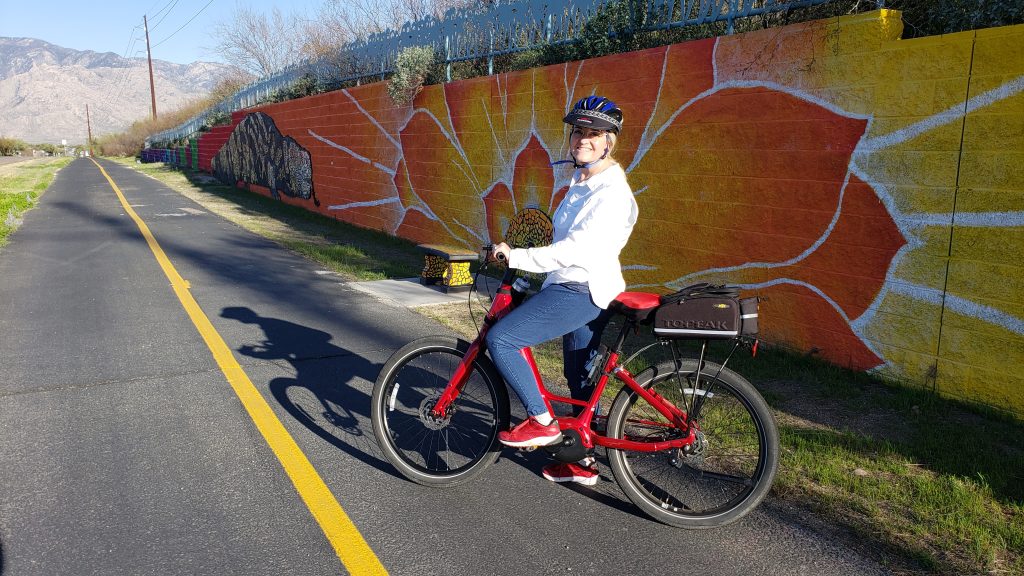
Take can’t see well enough to get a license, but when she first got a golf cart, she tried to get it registered and insured. That wasn’t possible without a license, which is one reason why so many of the pieces of proposed legislation around e-bike regulation and registration requirements concern those of us without licenses who use e-bikes for mobility.
“I think for someone like me who doesn’t have a choice to drive a car, it seems to be unnecessarily restrictive on people who already have limited choices,” she says. “This is my only vehicle to get myself around.”
Alexandra Ramirez, a low-vision cyclist and executive director of Los Angeles Walks, emphasized that e-bikes and cargo/family e-bikes are an incredible tool for increased mobility not just for people with disabilities, but also for working-class people and caregivers. E-bikes “serve the people who are being excluded — the 30 percent of our population who can’t drive, don’t drive, don’t own a car.”
It’s important to recognize that while this article focuses on vision disabilities, there are lots of other kinds of disabilities that prevent driving, and people with these disabilities can and do want to be able to e-bike and e-trike. People with suspended licenses or without documentation also benefit from access to e-bike mobility, and would be excluded.
Ramirez described talking to her friend who uses an e-bike to get places on one of the semi-isolated canal bike paths in Los Angeles. For women, being able to go a little faster in situations or places that can feel unsafe is a part of e-bike access that isn’t often discussed. E-bikes for me are also an issue of safety — because having the e-power boost means I can choose safer routes, even if they’re hillier or longer.
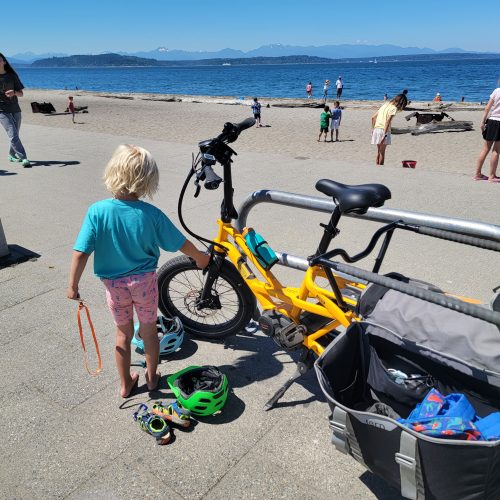
After I got an e-bike to transport my kid to daycare, I noticed a change in my commuting patterns, especially toward the end of the day. As my kid had gotten heavier, I started taking the more direct, and much flatter, larger arterials home. In South Seattle where I live, these arterials don’t have any bike infrastructure, so we’d be dodging Darigold 18-wheelers and home oil delivery tankers. With the e-bike, I could veer out of the valley and take the up-and-down neighborhood street routes that added hundreds of feet of 15-degree blocks (some even steep enough that the concrete was notched to prevent cars from slipping). But with the e-bike assist, it didn’t matter. Without the traffic noise we could talk, we could breathe cleaner air, and it was much, much safer.
Who Benefits From More E-bike Regulation?
The person who convinced me to get an e-bike was my friend Rachael Ludwick, a fellow low-vision mom and cyclist who loaned me her cargo e-bike to try out with my kid. Ludwick’s vision loss came in adulthood. After the onset of seizures and brain surgery, Ludwick was off the bike completely for a while. When she was ready to ride again, the e-bike allowed her to get back rolling, even when she was on medications that made her super tired. Getting fresh air, and getting places independently, without having to overexert herself and set back her recovery was a “mental-health lifesaver,” she said.
When we talked about e-bike safety, Ludwick pointed out that “we let people decide in other areas of society” what is safe. For instance, even though she lost a good amount of her previous vision, nobody directed her to surrender her driver’s license. It was left up to her to decide when it wasn’t safe for her to drive anymore and to surrender it.
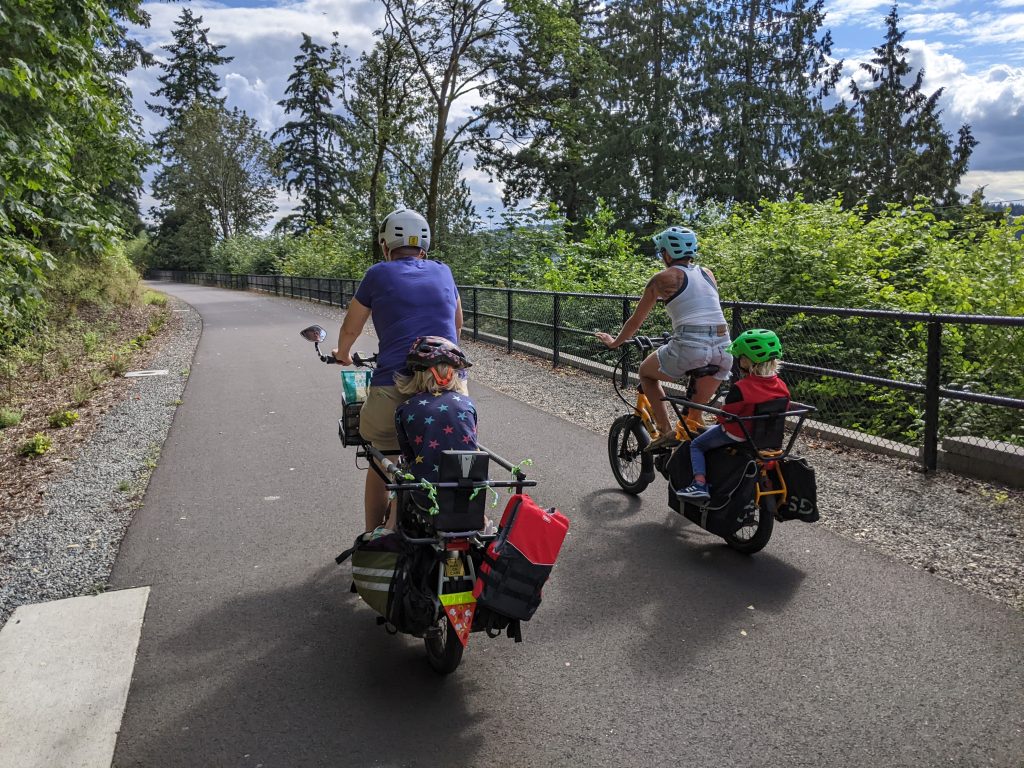
As low-vision cyclists, we are very aware of our visual limitations and the need to limit our speeds. Ludwick described braking way more than her fully-sighted partner on hills, and Take mentioned never reaching the full speed capacity of her e-bike. Tegge was even blunter: “When you get a vision impairment, you self-regulate. You self-regulate or you die.”
From her experience with enforcement more broadly, especially other rules like helmet laws geared to a cyclist’s safety, Ramirez emphasized that increased regulations mean increased policing. “We need to consider whose bodies are going to be policed the strongest. The people who are going to suffer the most are Black, indigenous and people of color, and people with disabilities — invisible or visible,” she warned. More regulations and more enforcement mean that e-bike mobility would become a less safe choice for the people who could benefit from it the most because of a lack of access to car-based mobility.
A Transportation System for All
So what would keep us safe? And where should we draw the line between what kind of vehicle requires license and insurance, and what kind of vehicle is safe enough to exist outside of the regulatory environment built around the inherent dangers of car mobility?
All of the low-vision cyclists I spoke to for this story, only some of whom I’ve had the space to quote here, agreed that limiting the speed at which the e-assist stops assisting seemed like the best path forward for regulation. (Of course many of us would also love to see the same speed governing technology in cars!)
Devin Silvernail is another parent I know with nystagmus who bikes for transportation because he can’t drive. We were neighbors in Seattle, and I was always happy to spot him on his Urban Arrow cargo bike transporting his toddler. Last year he moved to Nantes, France, and brought the family bike with him. I was surprised when he told me that in Europe, his Urban Arrow, where the e-assist taps out at 20 mph, is actually faster than regulations allow for e-bikes in France, where the maximum e-assist speed is 25 kmph (15.5 mph).
“Of course, I never go that fast,” Silvernail told me, so he didn’t worry about getting stopped.
I’m also skeptical of regulations that separate “throttle” e-bikes from those that are pedal assist. From a safety perspective, what matters is the speed and mass of the bike. If speeds are low enough, why should it matter whether the rider is pedaling? It’s not too hard to read between the lines of requirements for pedaling, or proposed laws like this one in Oregon that would allow higher speed “Class 3” e-bikes to use bike infrastructure if they’re “human powered” and see the ableism, diet and fitness culture that persist in the biking world, which insists that pedaling somehow legitimizes e-bike movement.
Along with keeping our speeds slower, the low-vision cyclists I spoke with all appreciated having dedicated places to bike where we weren’t competing with cars or sharing sidewalks with pedestrians; they also liked living in a place where bike mobility was more mainstream. Silvernail noted that in France, as compared with Seattle, traffic moved much slower, so even when he had to share the lane, it didn’t feel as stressful. Ramirez spoke about her experience growing up in a smaller community in Mexico where biking was much more normalized as a form of transportation, and that normalization, as well as the normalization of slower (and more time-consuming) forms of transportation, made it feel more comfortable for her than biking in Los Angeles.
What we don’t want to see are regulations that require licenses or insurance for e-bikes, because both would eliminate biking as a mobility option for us as low-vision non-drivers, and for many other non-drivers as well. As Ramirez noted, e-bikes have incredible potential for non-driver mobility, but only if they are available to those of us excluded already from automobility.
Events Featuring Anna Zivarts
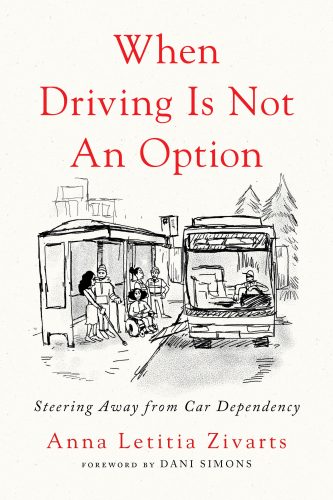
Streets.mn is partnering with the Bicycle Alliance of Minnesota (BikeMN), Our Streets, AARP Minnesota, the Sierra Club North Star Chapter, Destination Medical Center in Rochester, Zeitgeist Arts in Duluth, Age-Friendly Olmsted County, the City of Rochester and Island Press to host Anna Zivarts, author of “When Driving is Not and Option: Steering Away from Car Dependency” for three events over three days in Minneapolis and Greater Minnesota.
Don’t miss these opportunities to connect with Zivarts and advocates from around the state. Island Press is offering a 25% discount for those who purchase Zivarts’ book online. Code: BIKEMN.
- Rochester: On Tuesday, February 11, Zivarts will be at Mayo Clinic (Leighton Auditorium, Siebens Building), 100 Second Ave. S.W., Rochester, from 6:30 to 8 p.m. Her presentation will focus on healthcare access for nondrivers. Registration is free through Eventbrite with a suggested donation of $10; non-alcoholic beverages and snacks will be available for registrants. We Bike Rochester, which “works to normalize biking in Rochester,” is a co-sponsor.
- Minneapolis: Zivarts will be speaking at Minneapolis Central Library, 300 Nicollet Mall, on Wednesday, February 12, 6:30 to 8 p.m. in the Doty Board Room. Registration is free through Eventbrite with a suggested donation of $10; non-alcoholic beverages and snacks will be available for registrants. The location is served by multiple bus lines and both the Green and Blue light-rail lines.
- Duluth: On Thursday, February 13, from 5:30 to 8 p.m., Zivarts will be at the launch party for Vibrant Streets Duluth, one of the newest chapters of BikeMN. She will be doing a meet-and-greet and book signing following a brief presentation about the importance of building an equitable transportation system in America’s most climate-resilient city. The Dovetail Café, 1917 W. Superior St., offers a variety of coffee and non-alcoholic beverages along with an assortment of entrees and baked goods. Registration is free (with a $10 suggested donation) through Eventbrite. For more information, email Vibrant Streets Duluth at [email protected].
In addition, Zivarts will be the keynote speaker at the daylong E-Bike Policy Summit on Wednesday, February 12, which runs from 8 a.m. to 4 p.m. at McNamara Alumni Center (200 Oak St. S.E.) on the University of Minnesota campus, Minneapolis. The event is sponsored by BikeMN in partnership with the U of M’s Center for Transportation Studies; tickets range from $60 for students to $100 for general admission, and the first 100 registrants will get a free copy of Zivarts’ book. Click here to register.