
In 2023 I moved to Duluth for college, to study cell genetics (my major has since switched to civil engineering) at the University of Minnesota–Duluth (UMD). One look at the price of a parking pass, which was necessary to have a car on campus, left me in awe: $500 per semester.
It seemed only logical to leave my car back home in Woodbury for the duration of my studies. Doing so, however, would leave me dependent on Duluth’s multimodal infrastructure and options, including a transit system that only recently has begun to improve.
History and Economy
Perhaps no city in Minnesota exemplifies the Rust Belt more than Duluth. All across the city the remains of industry stand tall, such as the towering Ore Docks of the former “Missabe Road,” a nickname for the main railroad that powered Duluth as an iron ore exporter. While the Twin Cities were partially spared from the devastation of deindustrialization, they did bear the full onslaught of sprawl resulting from the post-World War II “boom.”
Not so for Duluth.
Insulated by geography, the city was largely protected from the effects of suburban sprawl (see this early Streets.mn story), with the steep slopes of the North Shore and soil of the Canadian shield making developers of suburbia turn elsewhere. This is not to say, however, that it was spared the repercussions of U.S. motocentrism at the time.
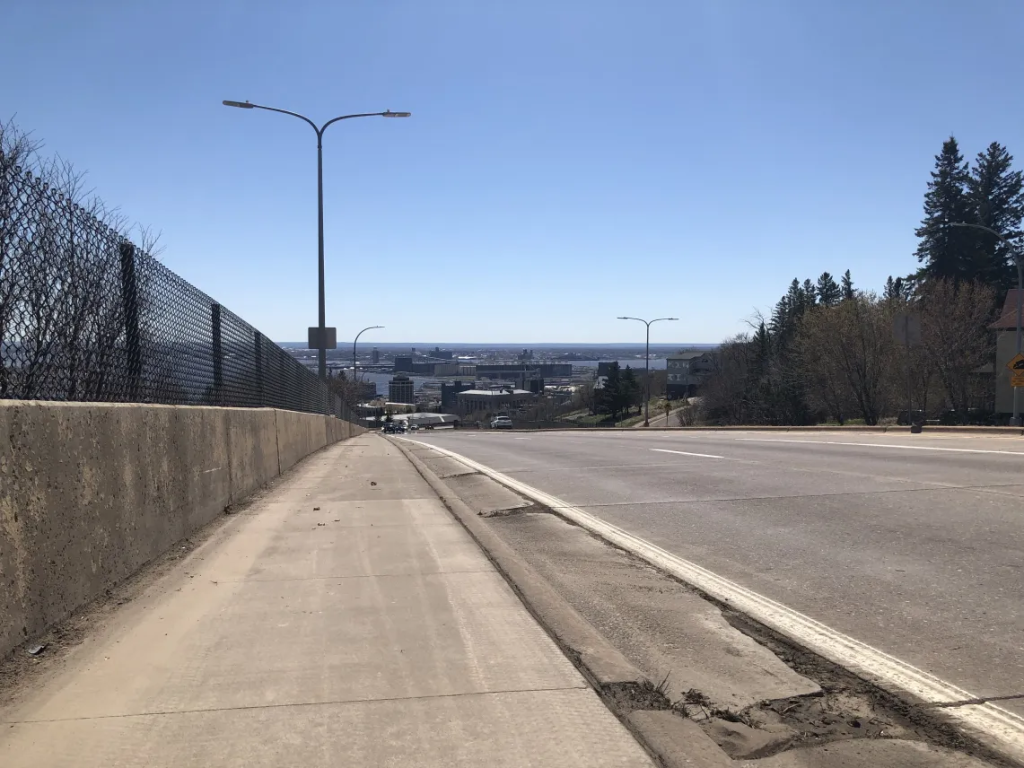
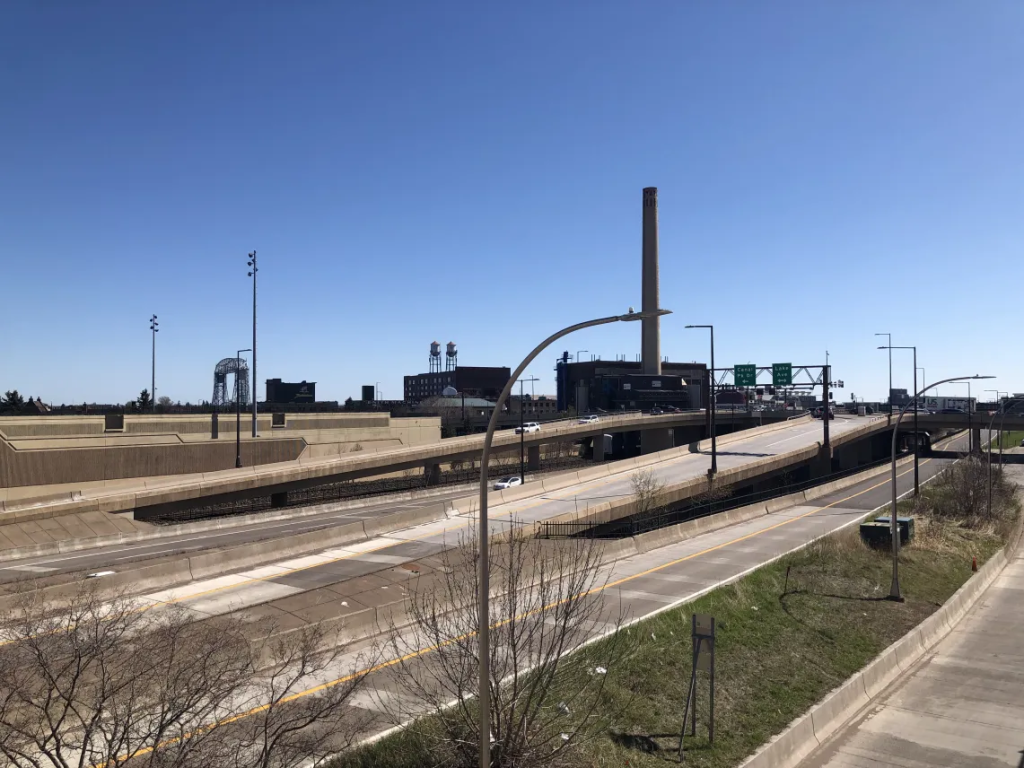
The streetcars were long gone by the end of World War II, having been replaced by buses in the 1930s, and in the post-war explosion of highways, the Minnesota Department of Transportation (MnDOT) planned the Minnesota portion of Interstate 35, the northernmost section of the transcontinental highway that infamously demolished vast areas of West Duluth and the rusted remains of the downtown rail depots. One resident speaking at the launch of Vibrant Streets Duluth this past January noted that when they were growing up in the 1970s, they could find 69 grocery stores, mostly mom-n-pop shops, within city limits. Today that number is nine, all big-box brands.
Today, transit is in a middling state in the city. When I arrived in town in fall 2023, Duluth media were reporting a driver shortage for the Duluth Transit Authority. That likely explains my experience of buses frequently not showing up at all on weekends. Streetcar tracks embedded under layers of asphalt, the scars on the landscape of the “inclines” (cable-hauled streetcars that climbed very steep grades, also known as funiculars), rail trails and a museum are all that remain of Duluth’s car-independent past.
Advocacy Scene
The reconstruction of Superior Street, an arterial road that runs 14 miles from the interchanges of Spirit Valley into the wilderness of the North Shore, had a proposed bike-lane option through downtown that the Duluth City Council ultimately defeated. That was devastating for the advocates who then made up Duluth Bikes, an early chapter of the Bicycle Alliance of Minnesota. Shortly following that blow was COVID-19’s upending of lives and livelihoods. Advocacy fell into disarray as folks, understandably, became occupied with other issues.
“Duluth Bikes fought a strategic, smart battle, but opposition from downtown businesses and city leadership doomed the option for protected bike lanes through downtown,” says longtime advocate Alice Tibbetts, a co-founder of We Walk in Duluth, a predecessor to the recently launched and rebranded Vibrant Streets Duluth.
“Today, downtown is depressed and struggling, and we advocates believe it is in part because the main street is not accessible to all modes,” Tibbetts says. “We know that people riding bikes to support local businesses bring an infectious liveliness and energy. Sales data from across the entire U.S. proves that we are great customers.”
Eventually, and importantly, Duluth multimodal advocates did organize again, creating Vibrant Streets Duluth, whose roots are firmly planted in previous advocacy groups and which has since become a chapter of BikeMN.
An event at the Dovetail Cafe last January represented the debut of the new organization, described by its organizers as a reinvigoration of what I like to call urbanist values, including accessibility, equity, civic engagement, and health and safety. Author and disability rights advocate Anna Zivarts, a low-vision bicyclist, spoke to the new group about her experience and the need for a robust and accessible transportation network — in Duluth and cities nationwide.
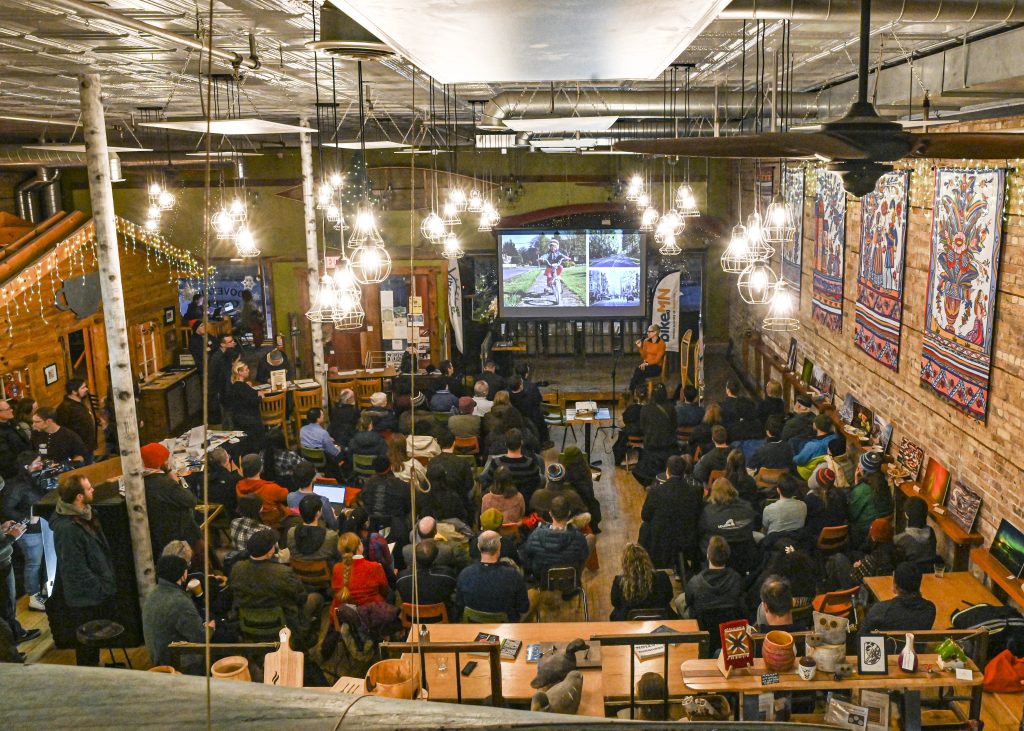
It was Zivarts’ fourth such event of the week, traveling the state at the invitation of the Bicycle Alliance of Minnesota to talk about her experience and book: “When Driving Is Not an Option: Steering Away from Car Dependency” (Island Press, 2024). The audience in Duluth also included City Councilor Mike Mayou, representing District 2 (UMD’s district) since 2021, who has been a consistent ally of multimodal and safety advocates in the city during his tenure, along with council members Azrin Awal, a councilor at large, and Wendy Durrwachter (District 1).
Reorganization, however, is only the first step. Duluthians have several upcoming projects that will help realize their vision — and Zivarts’ — of an accessible and inclusive transportation system.
The largest structural change being pushed is a transportation commission, spearheaded by Councilor Mayou, which would advise both Duluth Mayor Roger Reinert and the City Council on public works projects and matters pertaining to the Duluth Transit Authority (DTA). Such a move would be a major step forward in guaranteeing accessibility in Duluth for the nearly half of residents who do not drive, and making the city safer for all.
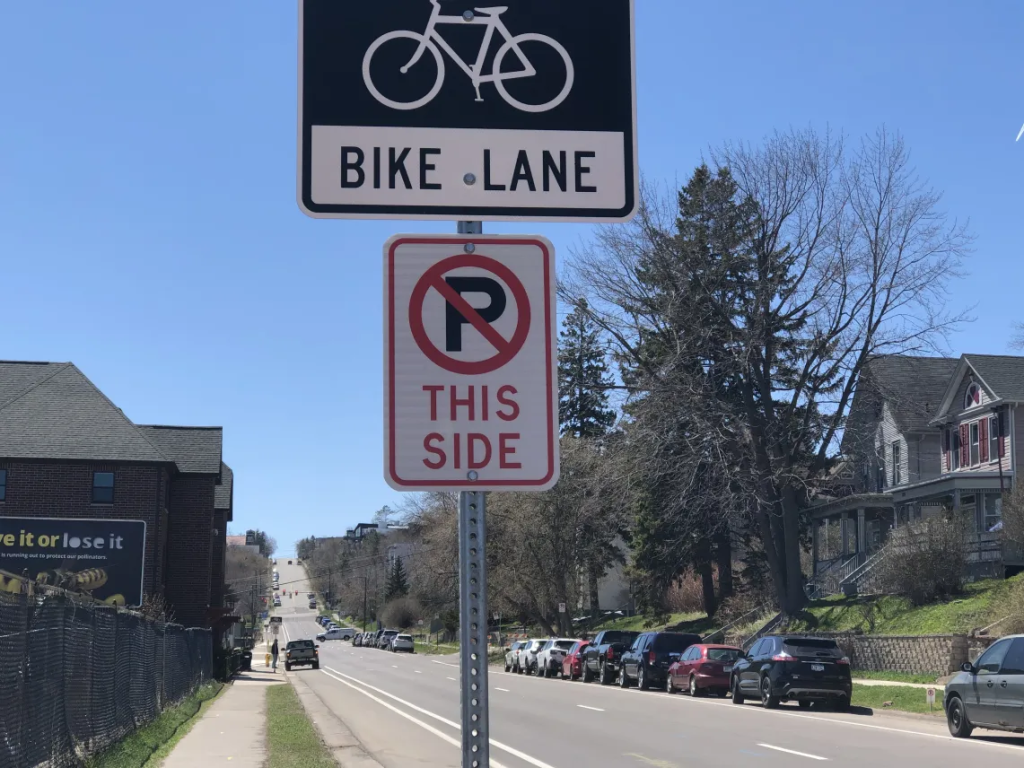
For Tibbetts, the commission couldn’t come soon enough. “We’ve had some draining and time-consuming battles that have burned up time in City Council. These could have been debated and vetted in a commission,” says Tibbetts, who previously lived in the Merriam Park neighborhood of St. Paul, where she helped institute traffic-calming infrastructure such as the city’s first neighborhood roundabout.
“I know from experience with similar commissions in both Minneapolis and St. Paul that this process results in projects that are better designed and safer for everyone,” she says. “Even the staff in those cities say they find lots of benefits from the collaboration.”
But collaboration is more difficult in Duluth. “Many staff and elected officials, including the mayor, think this is a good idea,” Tibbetts says. “But engineering staff are not supportive, and their stubbornness has stalled what should be a straightforward process. If they talked to their peers in other cities, they might change their minds.”
The DTA
My experience as a car-free UMD student has been one I can only describe as “confining.” The decline of local shops is distinctly felt near UMD, where most amenities are separated by dangerous Woodland Avenue or a forested hill. Surely transit, therefore, ought to be robust to counteract this geographic reality. UMD is the second busiest DTA station, behind only the downtown Transit Center, but service has been spotty.
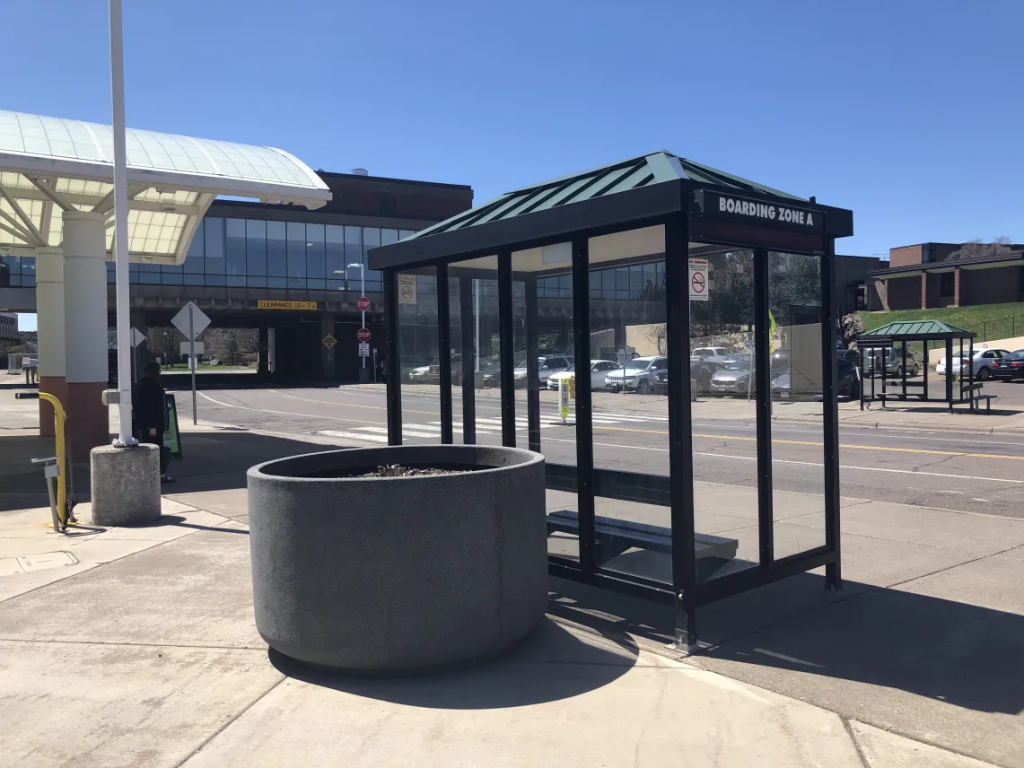
A shortage of drivers has led to buses often not coming at all on the weekends, and winding routes to the sprawling asphalt and winding hills of Miller Hill Mall are nauseating and slow, to the point that it takes a minimum of two hours for me to visit stores, journeys that would be less than 45 minutes at most with a car.
On the upside: The DTA is eyeing the adoption of bus rapid transit (BRT) characteristics into the Blue Line, a limited-stop bus that runs from UMD to Spirit Valley. Battery-electric buses have also become a more common sight in recent months, even during the cold weather this past winter and despite previous issues with reliability.
Vibrant Streets Duluth is putting energy toward promoting the use of mass transit and encouraging improvements to the system’s amenities. “In an effort to destigmatize, we will continue to highlight and normalize the use of Duluth’s bus system through our social media channels, like our recent ‘Meet Val, bus commuter‘ short, as well as related topics like poor sidewalk connectivity and bus stop conditions,” says Forrest Vodden, board chair and media and communications chair of Vibrant Streets Duluth.
He also references recent local media coverage of coming service changes to the Duluth transit system. “The DTA has been making strides recently in hiring drivers and returning service to levels intended by the Better Bus Blueprint, with some significant improvements coming in June,” Vodden explains.
Advocates say they hope the proposed transportation commission will help the Department of Public Works to deliver projects that meet the needs of all transportation users, including the necessary adoption of the National Association of City Transportation Officials’ (NACTO) guide, rather than the more car-centric and established American Association of State Highway and Transportation Officials’ (AASHTO) “Green Book.”
A New Dawn for Duluth
One of the most important fights Vibrant Streets Duluth has ahead is the upcoming reconstruction of Central Entrance (Highway 194). The corridor is notoriously hostile for pedestrians and cyclists: sidewalks completely missing on one side, dangerous driveways creating constant conflict points and few safe crossings, which leaves people exposed in the center turn lane of a four-lane road. Multiple incidents involving pedestrians have occurred, including two documented by the Duluth News Tribune, with one involving a 6-year-old boy.
MnDOT’s priority list for the Central Entrance project includes a number of items that could be interpreted as aligning with safety advocates’ goals, such as prioritizing a “multimodal” corridor; however, it remains to be seen whether MnDOT will actually work toward those goals, especially given its rejection of the boulevard alternatives for Rethinking I-94 in the Twin Cities.
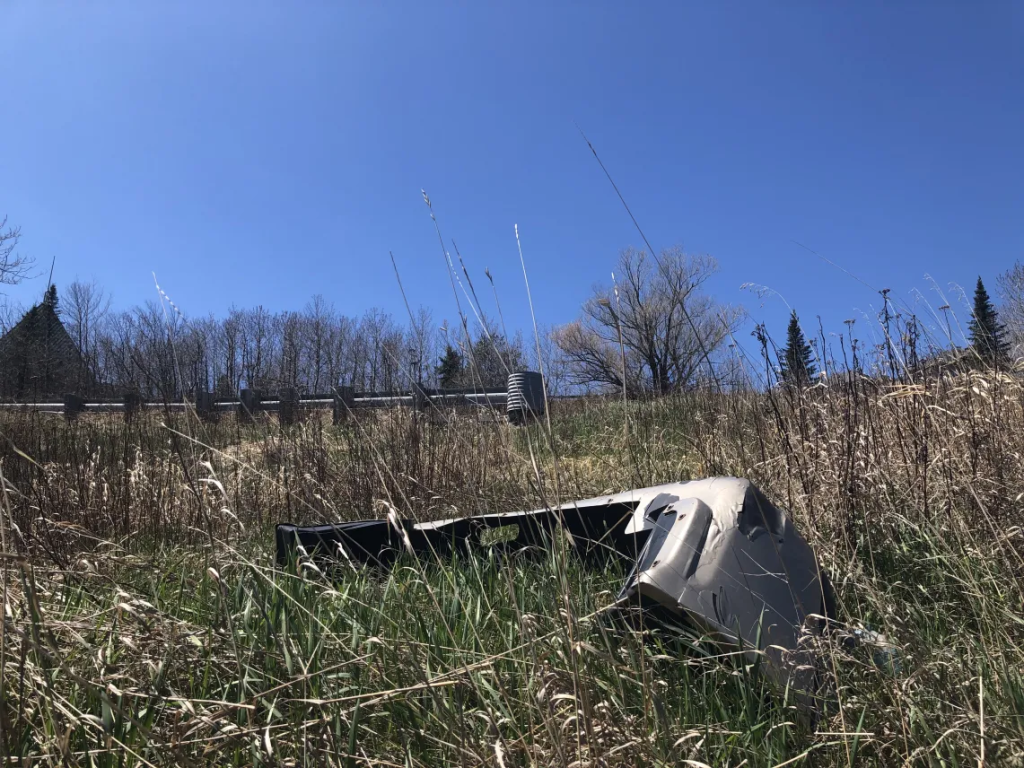
The state faces a looming deficit in coming years and is considering budget cuts, with Greater Minnesota slated to receive $12 million in cuts to transit, according to information current as of May 16. When combined with an anarchic and erratic federal government’s illegal impoundments, it makes for quite the challenge to local and state policymakers, engineers and advocates.
Nonetheless, if Vibrant Streets Duluth and Duluthians overall can bring the institutional change the city needs, those uphill battles for better transportation may become a lot less steep.
All photos are by author Colin Jones.