Editor’s note: This is the first of a three-part series about the need for more small business uses in residential areas of St. Paul. Subsequent articles will be published on Wednesdays for the next two weeks.
The thing I love most about my neighborhood is the abundance of neighborhood-serving businesses within a short walk of my house. If I walk to the intersection of Randolph and Hamline avenues in St. Paul (about a half-mile from my doorstep), I can reach a full-service grocery store, a greasy spoon diner, a burger joint and an ice cream shop. Within a slightly wider radius is a bakery, a coffee shop, a few more restaurants, a liquor store, a pharmacy, an eye clinic, dental offices and more. And in a 10- to 15-minute bike ride or trip on the A Line BRT, I can access dozens of other destinations along Ford Parkway and Snelling Avenue.
This kind of proximity to everyday destinations isn’t just what I love about where I live. For me, it’s the key selling point for city living, the quality that makes it different from (and preferable to) life in the typical suburb or small town. It helps me lead a more active lifestyle — to complete errands on foot instead of by car. It enables me to drive less, reducing my carbon footprint and the amount of money I spend on gas and repairs for our car. It means I bump into my neighbors more often and has helped me feel a greater sense of connection to my neighborhood.
For me, the nearby presence of numerous businesses is a valuable amenity. But for many in St. Paul, it’s a necessity. Thousands of St. Paul residents cannot navigate the city in a car, for all sorts of reasons: their age, ability to obtain a driver’s license, bodily conditions that make it impossible to operate a car, and the steep costs of owning, fueling and maintaining one, to name a few. The availability of everyday businesses within urban neighborhoods is practically essential for many people.
Unfortunately, most people in St. Paul and Minneapolis don’t have as many commercial businesses within walking distance of their homes as I do. I have often wished that every neighborhood in St. Paul had as great an abundance of neighborhood-serving destinations as mine does: little commercial spaces or even little “main streets” where first-time entrepreneurs can start new enterprises, where residents can walk to pick up groceries, where neighbors can meet for conversation over coffee or food. And I have wondered why there aren’t more of them.
It turns out there’s a simple answer: They’re currently illegal almost everywhere in St. Paul.
Isn’t this strange? If you ask any resident of St. Paul to name a few things they love about their neighborhood, the odds are that one of their answers will be a local business. Given how beloved these places are, our city should work to make it easy for new ones to open. Unfortunately, St. Paul’s current zoning laws severely limit the places where a commercial business can open without first navigating city bureaucracy in hopes of getting permission.
Let me show you an example.
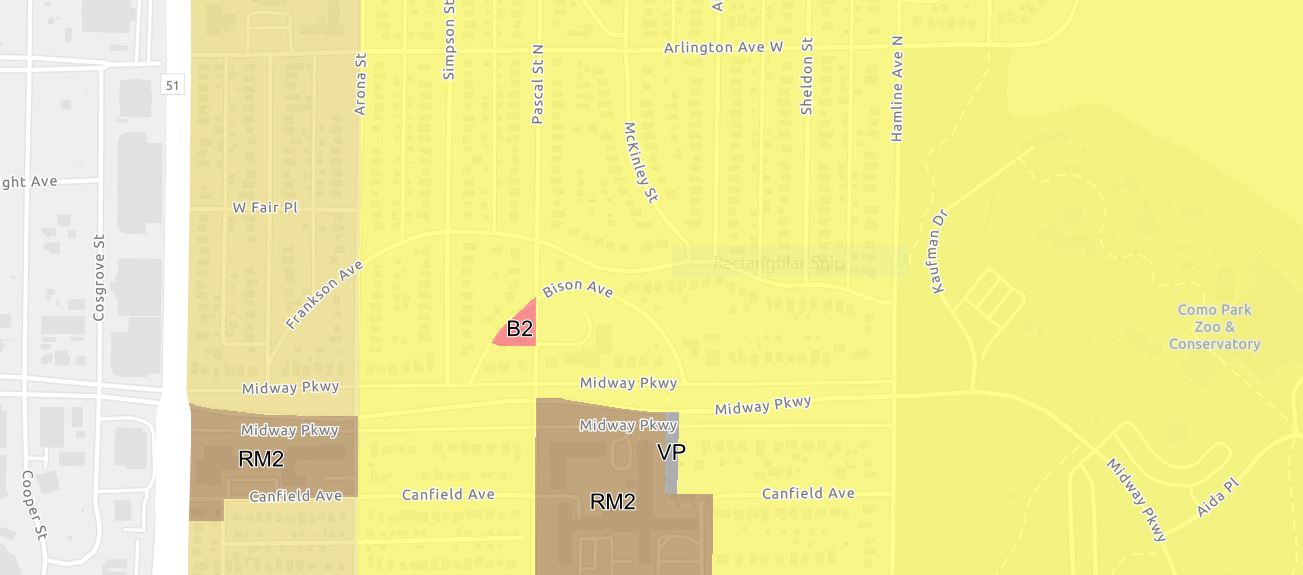
See the little triangle labeled B2? That’s 1341 Pascal St. On that lot is a cute commercial building that houses a fantastic restaurant called Bole Ethiopian Cuisine.
1341 Pascal St. — unlike every other lot in the vicinity — is part of the zoning district called “B2.” The B is short for Business; if a piece of land is part of the B2 zoning district, the owner can operate a commercial business out of a building on that piece of land.
Look at the above zoning map again, and notice the bright yellow area surrounding the B2 lot. All of that area is part of the zoning district called “H1.” If a piece of land is part of one of these residential districts, its owner cannot operate a business out of a building on that land: no coffeeshop, corner store, yoga studio, therapist’s office, etc. The same is true in the H2 district (which includes the orange strip between Snelling Avenue and Arona Street pictured above), as well as the RM1, RM2 and RM3 zoning districts. (The little lot labeled “VP” is zoned for “Vehicular Parking”: The only type of land uses allowed there are parking lots and ramps.)
You may wonder, as I did: If commercial buildings are forbidden on literally every other lot in this relatively large area, why (or how) was it allowed on this funny triangular lot at 1341 Pascal St.? What makes that lot exceptional?
The answer is that the building at 1341 Pascal St., and the buildings at hundreds of other lots in the “Business” zoning districts around St. Paul, pre-date the addition of the “Business” districts to the Saint Paul Zoning Code. This building, and most others located on land that is now zoned “B,” were built in a time when St. Paul allowed landowners to build commercial buildings in those locations (or renovate residential buildings into commercial spaces) without the city’s explicit permission.
A Bit of History
For its first several decades, the City of Saint Paul allowed landowners to build commercial buildings right next to residential buildings anywhere in the city, and to convert residential buildings into commercial ones and vice versa, at their own discretion. Then, in two major phases, the city decided that landowners could not be trusted with this discretion any longer.
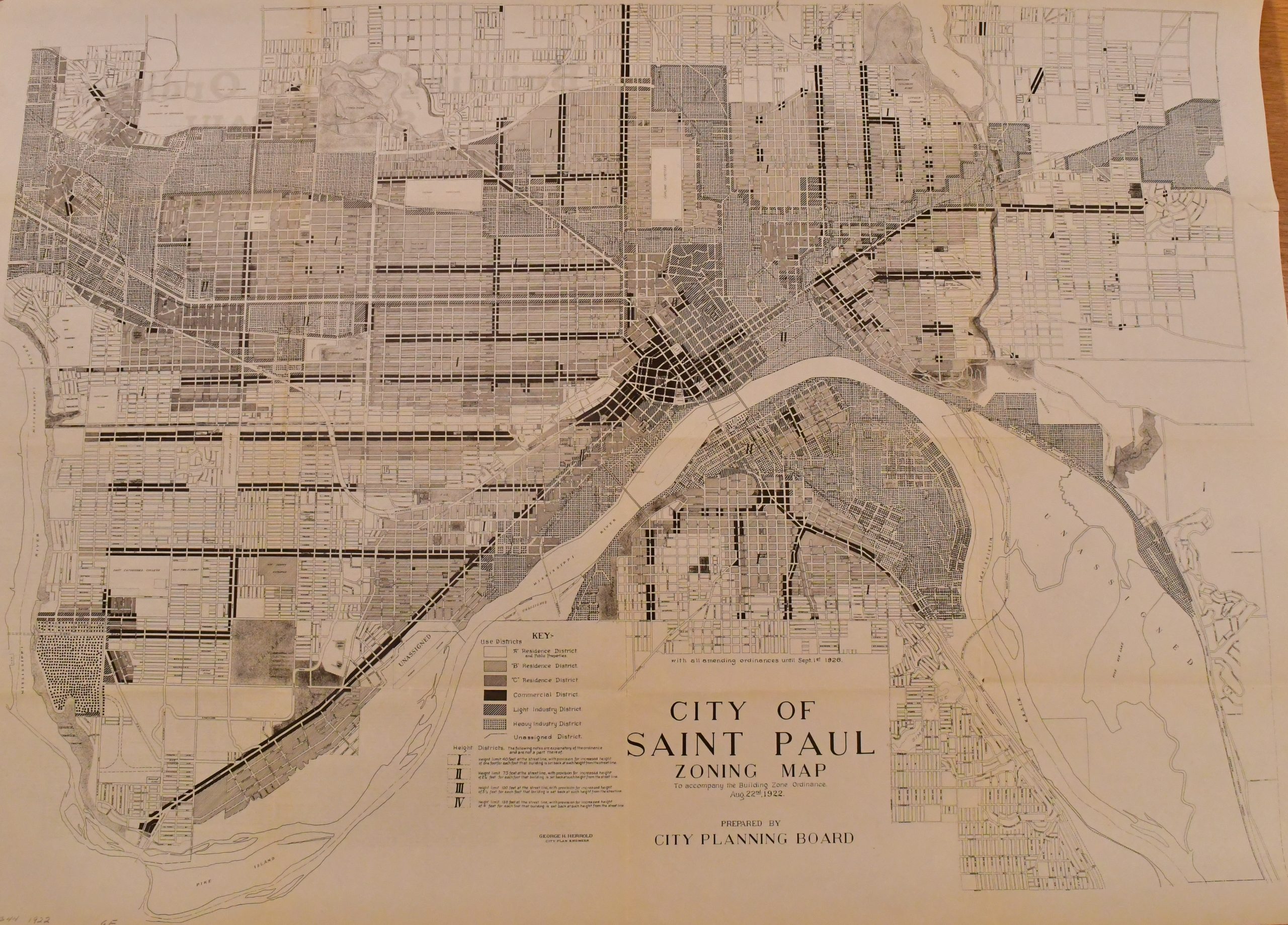
The first major curtailment of the mixed commercial-and-residential permissions in St. Paul came in 1922, when the city created its first zoning map; with that document, the city required that commercial buildings could be located only on busy arterial streets. Although this policy severely curbed landowners’ choices of locations for commercial buildings, it was still fairly reasonable. After all, almost anyone looking to open a retail shop, professional office or restaurant would have wanted to build on a lot along one of these arterial streets, because of the streetcar routes that followed them. Considering the pedestrians, streetcars and other traffic, these streets had the best visibility to potential customers.
As far as I can tell, these rules also allowed both commercial and residential uses within the commercial zoning district along arterial streets. If the owner of a house along a streetcar line wanted to convert the house into a retail shop, for example, they would retain the ability to convert it back into a residence at their discretion.
Five decades later, in 1975, the Saint Paul City Council enacted a major overhaul of the city’s zoning code. Whereas the original 1922 zoning code allowed new commercial buildings along arterial streets, the 1975 zoning code essentially restricted commercial businesses to the places they already existed. It did so by creating the “Business” zoning districts and applied them only to lots that were already occupied by commercial uses. Other lots along arterial streets (which had been zoned “Commercial” in the 1922 zoning code) were rezoned into “Residential Only” zoning districts.

Landowners could no longer create new commercial spaces in residential areas. To this day, if a landowner wants to create a new commercial space in a residential area, they are required to navigate a cumbersome and time-consuming bureaucratic process to “rezone” their property, with no certainty that the city will allow it in the end. (To make things even more rigid, some of the Business zones — B1, OS and BC — disallow several common and desirable commercial uses, including coffee shops, bars and restaurants.)
Importantly, St. Paul designed these zoning rules using a process that was opposite to the typical purpose of such rules. Zoning exists to define the permissible uses of a piece of land in the future (e.g., if and when the owner wants to change from its current use) — not to retroactively describe the current use occupying that land. This incongruity illuminates the intent behind the retroactive process St. Paul followed: to impede anybody who might want to use a piece of land for a different purpose in the future, and thus to keep St. Paul essentially the same as it was when the rules were enacted.
The First Hurdle of Many
Zoning is not the only reason why relatively few neighborhood-oriented businesses exist throughout St. Paul. Without a doubt, many other factors make it difficult to open and sustain a restaurant, retail shop or local service business, some of which may relate specifically to city-level regulations and costs in St. Paul, and some of which are more general in nature.
But I argue that zoning is the first reason why there aren’t more small neighborhood-oriented businesses throughout St. Paul. If we suddenly rezoned vast swaths of the city to re-legalize commercial buildings, we would probably not see a dramatic surge in new businesses springing up in every neighborhood. But we can be certain that small neighborhood-oriented businesses will never open in locations where they’re illegal.
In part 1 of this series, I’ve attempted to demonstrate that the limited number of neighborhood-serving businesses throughout St. Paul is neither random nor natural: It is the result of a policy choice that has mostly been ignored for several decades.
In next week’s article (Part 2 of 3), I’ll outline some of the reasons why it’s past time to relax these zoning rules. Part 3 will present some signs that St. Paul is ready to do so, and suggest some specific ways to get that done.