Editor’s note: This is the third article in a three-part series discussing the City of Saint Paul’s zoning laws that severely limit where businesses can be located.
In the first two articles of this series, I argued that St. Paul’s rigid zoning rules have stunted the evolution of its neighborhoods into more “walkable” places by effectively banning new small-scale, neighborhood-serving commercial buildings from nearly all parcels where they didn’t previously exist. I’ve also shown how this needlessly causes a variety of problems.
In this third and final article, I’ll point to some hopeful signs that St. Paul is ready to relax its rigid prohibitions on new neighborhood commercial buildings, and I will propose a few specific ways it could update its Zoning Code toward that end.
A City Ready for Change
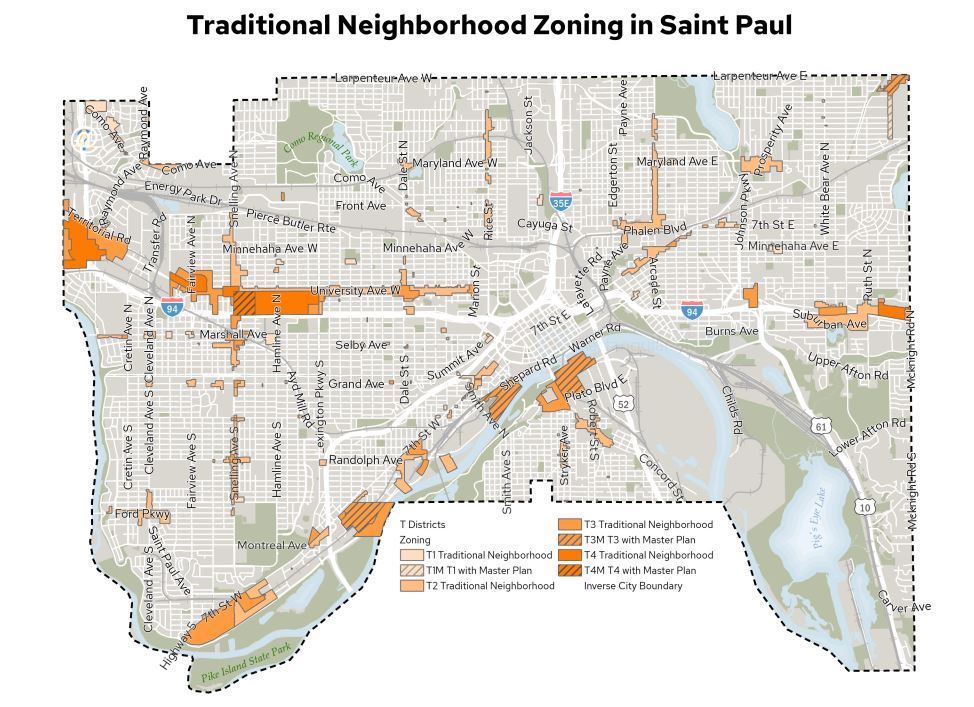
In a sense, the City of Saint Paul has been working to loosen its rigid commercial zoning restrictions for 20 years. Back in 2004, the city codified a new set of “mixed-use” categories into the Zoning Code, called the “Traditional Neighborhood”(‘T’) zoning districts. Whereas “Residential” districts in the code permit only residential uses, and “Business” districts only allow for commercial and office uses, the T Districts allow both by right. This means that a person who owns a house on a parcel of land zoned “T” is able to adapt that house into a commercial space, or vice versa, without having to navigate the lengthy process of requesting to rezone their property. (Importantly, not all commercial uses are allowed by right in T districts. For example: Gas stations and auto repair shops are disallowed in some of the T districts or only allowed if they receive a Conditional Use Permit.)
Let’s notice and appreciate the brilliant choice to name these mixed-use zoning districts “Traditional Neighborhoods.” Mixed-use neighborhoods are, in fact, “traditional” — not some sort of experimental urbanist pet project. If you’ve visited a city or town outside of the United States or Canada, you know this already: For most of human history, and in most places, the typical neighborhood is an eclectic mix of residential, commercial and “mixed-use” buildings. St. Paul’s current zoning rules (and the rigid separation of commercial and residential areas that predominates American cities, suburbs and towns) are, in the historical and global sense, an aberration.
My understanding is that when the T districts were adopted, the city envisioned rezoning broad areas of St. Paul into them. They never did; evidently, elected leaders backed off in response to pushback. Instead of proactively rezoning property into the more-flexible T districts, the city has waited for property owners to take the initiative to request that flexibility. Apart from a few occasions when the city has rezoned a few sections of land along major streets into the T districts — University Avenue when the Green Line was built and along South Snelling Avenue in 2015 and 2017, for example —the usage of the T districts has generally increased one parcel at a time.
Support for “Mixed-use” Areas
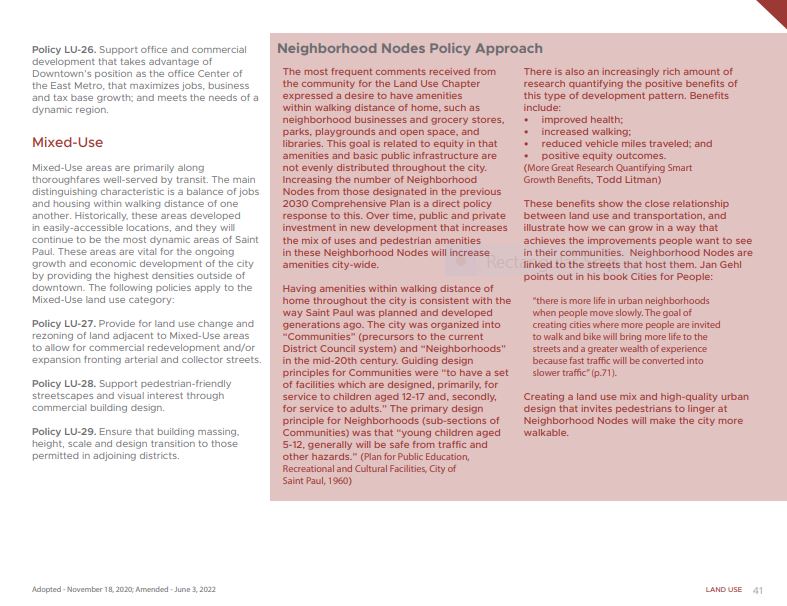
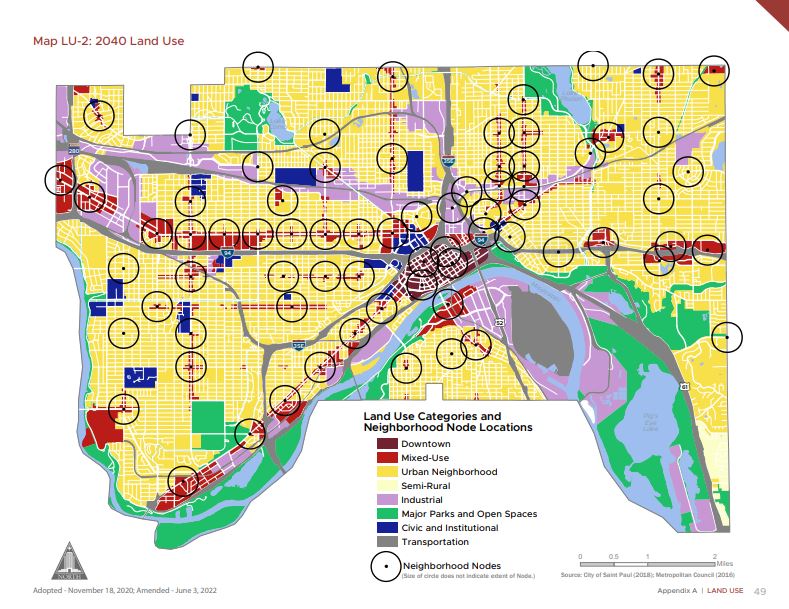
Recently, political will and public support for re-legalizing commercial and “mixed-use” buildings in more places seems to be growing. The City of Saint Paul explicitly identified neighborhood-scale commercial spaces as a priority in the 2040 Comprehensive Plan, published in 2019. That plan identified a series of “Neighborhood Nodes,” intersections around the city that already have neighborhood businesses and are well-suited for more.
Supportive Leadership
Another positive sign is that a majority of our current St. Paul City Council members have publicly and enthusiastically expressed their support for such changes. Councilmembers Hwa Jeong Kim (Ward 5) and Nelsie Yang (Ward 6) did so during candidate forums as they campaigned for office in 2023:
Councilmember Yang responds to mixed-use zoning question at 14:10 in this video.
“Yes, I am very supportive of [mixed-use zoning]. And we really need this in the East Side of St. Paul, where we do know that not all households have the means to get where they need to easily. So, making sure that whether it’s a grocery, a cafe, a place where they need to go for goods and services, that it’s accessible to them, and walkable too. You know, that is really, really important. […] These kinds of changes happening will drastically improve the lives of people who live on the East Side. So I’m really excited to figure out ways that I can continue partnering with organizations to make this happen.” – Councilmember Nelsie Yang
Council Vice President Kim responds to a question about mixed-use zoning at 17:29 in this video.
“Yes, I absolutely support mixed-use zoning. This is a land use tool that allows us to walk and bike, congregate and shop in the very neighborhoods that we live. And this also means a greater level of connectivity and safety. When people other than the folks that live on your block care about your neighborhood, that’s very important to feeling like you belong, but also that you care about the places that you visit. As a former Planning Commissioner and your Zoning Committee member, I also have a history of voting in support of mixed-use development as a way to continue to increase community safety and inclusivity.” – Councilmember Hwa Jeong Kim
At least two of the four candidates to replace former Council President Mitra Jalali as the City Councilmember for Ward 4 (Molly Coleman and Cole Hanson) also appear to support the idea.
And in the past few months, members of the City Council have alluded to their plans to initiate a “Corridor Zoning Study” during council meetings and occasionally in newsletters. Although no details have been made public yet, it seems likely that the council will pass a resolution directing the Planning Department to prepare a set of proposed zoning changes along arterial streets (“corridors”) throughout the city.
Right now, the city is seeking public feedback about some proposed tweaks to the technical details of the Traditional Neighborhood zoning districts (more on this below). Once those updates have been amended in response to public input and adopted by the Planning Commission and City Council, it will be an ideal moment to initiate the Corridor Zoning Study.
Recommendations for Implementation
The City Council is responsible for formally directing the Planning Department to begin zoning studies, and for determining each study’s “scope” — defining the ideas that will and will not be considered in the study.
Here are four broad ideas that they should incorporate into the proposed zoning amendments:
- Sunset the “B” districts and rezone “B” lots to the Traditional Neighborhood zoning districts.
If we want regular folks to build small-scale, neighborhood-serving commercial spaces in St. Paul (and we should), we need to make our Zoning Code simpler and more flexible. One obvious way is to shorten the code. The Traditional Neighborhood districts serve the same function as the Business districts do, but better, because they permit more uses and provide modernized design standards. Rezoning all properties currently zoned “B” into the “T” districts would allow the businesses at those locations to continue unchanged, but give the property owners more flexibility in the future.
- Rezone the land along arterial streets into the Traditional Neighborhood districts, following a clear and predictable pattern.
This change would be reminiscent of the City of Saint Paul’s first zoning map from 1922, where commercial uses are allowed along the arterial streets.
The city should follow a logical process to decide the zoning district into which each lot along an arterial street should be rezoned. I suggest something like this:
- Parcels along arterial streets that are currently zoned for small-scale residential buildings (H1 and H2 districts) or small-scale commercial buildings (OS, B1, BC and B2) should be rezoned into the T1 district at minimum. (If they meet one of the following conditions, it would be rezoned to a “higher-intensity” district: T2 or T3.)
- Parcels along arterial streets that are within a Neighborhood Node designated by the 2040 Comprehensive Plan should be rezoned into the T2 district at minimum.
- Parcels along arterial streets that are currently zoned RM1 should likewise be rezoned to T2. These two districts have similar limits on the height and size of buildings; the major difference is that commercial uses are not allowed in RM1.
- Parcels along arterial streets that are currently zoned RM2 or RM3 should be rezoned to the T3 zoning district. Just as RM1 has similar dimensional standards to T2, so too do RM2 and RM3 have relatively similar limits for building heights and bulk as the T3 district; the key difference is that they forbid commercial uses.
- Parcels along arterial streets that are currently zoned B3 should be rezoned into the T3 district, which allows similarly tall and bulky buildings.
A professional urban planner might find a set of problems with these suggestions, and that’s fine; I don’t claim to be an expert. My point in offering this example is simply that there should be some rhyme or reason to the process by which lots are rezoned into new districts, so that regular folks can understand it with relative ease.
- Legalize Accessory Commercial Units and Corner Stores in Residential zoning districts (e.g., enable small commercial spaces within residential areas between arterial streets).
This would go a step beyond the policies called for in the Comprehensive Plan. But I think it’s an important addition, because locations throughout the city were left out of the list of Neighborhood Nodes where neighborhood-serving businesses are equally needed.
The city, of course, should clearly specify which types of uses should be allowed and disallowed in commercial spaces in Residential districts. For example, it might decide not to allow the sale of alcohol, THC products or nicotine at businesses located within Residential zoning districts. The city should also set clear rules regarding the design of Accessory Commercial Units added to the front of residential buildings and the like.
- Rezone buildings that were formerly commercial buildings into one of the Traditional Neighborhood zoning districts.
Many nondescript one- and two-story buildings throughout St. Paul once housed corner stores and other neighborhood-serving businesses, and have since been converted into residential buildings and rezoned into Residential-only zoning districts (H1, H2, etc.). The owners of these buildings shouldn’t have to endure the cumbersome process of seeking to rezone their properties in order to set up commercial businesses in buildings that were originally designed to house them; it should be allowed by right.
If these properties were rezoned into the T1 and T2 zoning districts, the buildings could continue to be used as residences or converted into commercial spaces.

Take Action
I’m on the board of Sustain Saint Paul, a 501(c)(4) volunteer-driven advocacy group that champions abundant housing, low-carbon transportation and sustainable land use policies in the City of Saint Paul. We’re organizing an advocacy campaign to advance some of the policy ideas I’ve outlined in this article, toward a vision of a city with many more small-scale, locally owned, neighborhood-supporting businesses and more walkable neighborhoods.
There’s a big opportunity to advance these ideas this summer. The City of Saint Paul’s Planning and Economic Development department is currently soliciting public feedback on the Traditional Neighborhood (T) District zoning study they just completed and a series of tweaks they propose to make to the technical details of those “mixed-use” zoning districts. Although the zoning study does not propose to rezone any property into the T Districts, the department’s staff have explicitly indicated that if residents are interested in seeing the city apply the T Districts more broadly throughout St. Paul, they would encourage residents to share that feedback in the public comment period.
In other words: Now is the time to push city leaders to begin studying ways of re-legalizing commercial uses throughout St. Paul.
If you’d like to participate in Sustain Saint Paul’s advocacy efforts, reach out to us using this form. We’d love to work together!