
Editor’s note: We asked Streets.mn correspondents Laura Groenjes Mitchell and Michael Daigh to cover the second annual Cargo Bike Show & Tell event in Minneapolis in June. Laura begins the story, and Michael picks up the narrative midway through.
From Laura: On Sunday, June 1, 100-plus people gathered around 20-plus cargo bikes in a South Minneapolis park. The event was the second annual Cargo Bike Show & Tell organized by Levi Mills and Terri Lindenbaum of Piecycle. This cycling club (featured in a Streets.MN article last year) hosts chill (“pastry pace”), family-friendly group rides around Minneapolis.
The idea for the Show & Tell event came about, Terri said, because they had friends who were “very curious about cargo bikes but felt a little intimidated by bike shops because they aren’t ‘bike people.’ We thought: What might be a low barrier way to expose people to bikes — and cargo bikes specifically? What better way to have people experience bikes? People always want to talk about their bikes.”
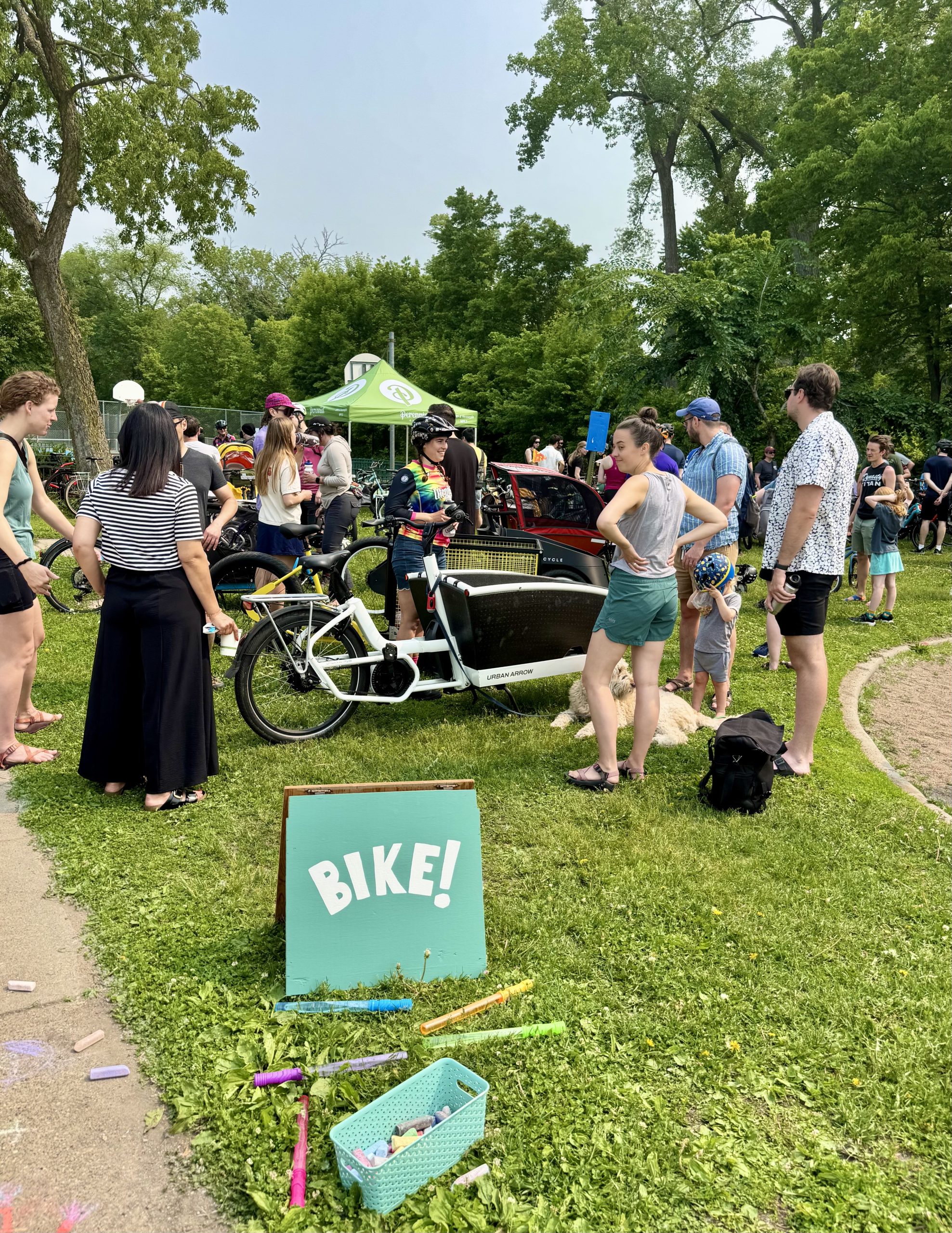
According to Levi, these sorts of conversations were already organically happening at Piecycle rides. “We’d see people congregating and asking each other lots of questions about their bikes on our rides,” he said. “People who buy cargo bikes often do a ton of research, are really passionate and have a purposeful reason for why they have that particular bike. It’s so fun to hear the story of how they landed on it, what customizations they’ve made. It’s cool to see how the bike integrates into their lives and allows them to do the things they want to do.”
Via custom illustrated Instagram posts, Piecycle invited folks to: “Come explore the world of cargo bikes in a fun and casual setting! Whether you’re a longtime rider or just getting curious, the Cargo Bike Show & Tell is the perfect place to meet other cargo bike owners. Bring a bike if you have one — any kind of cargo setup is welcome! If you don’t have one yet, this is a rare chance to see lots of models side by side and talk to the folks who use them daily.”
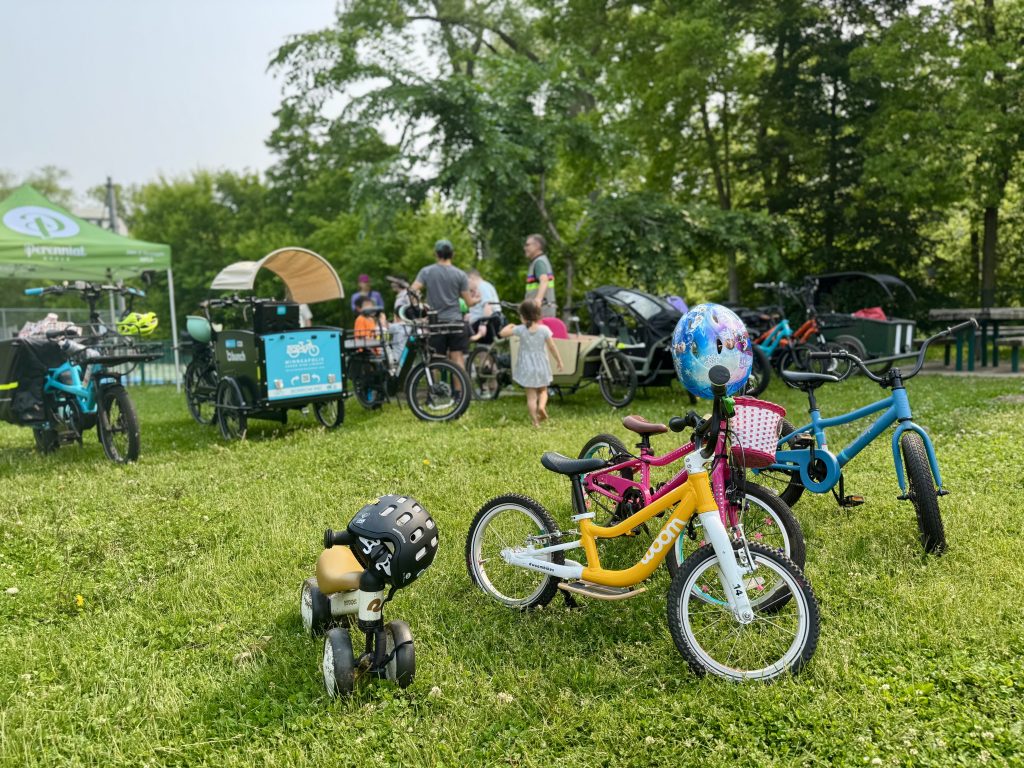
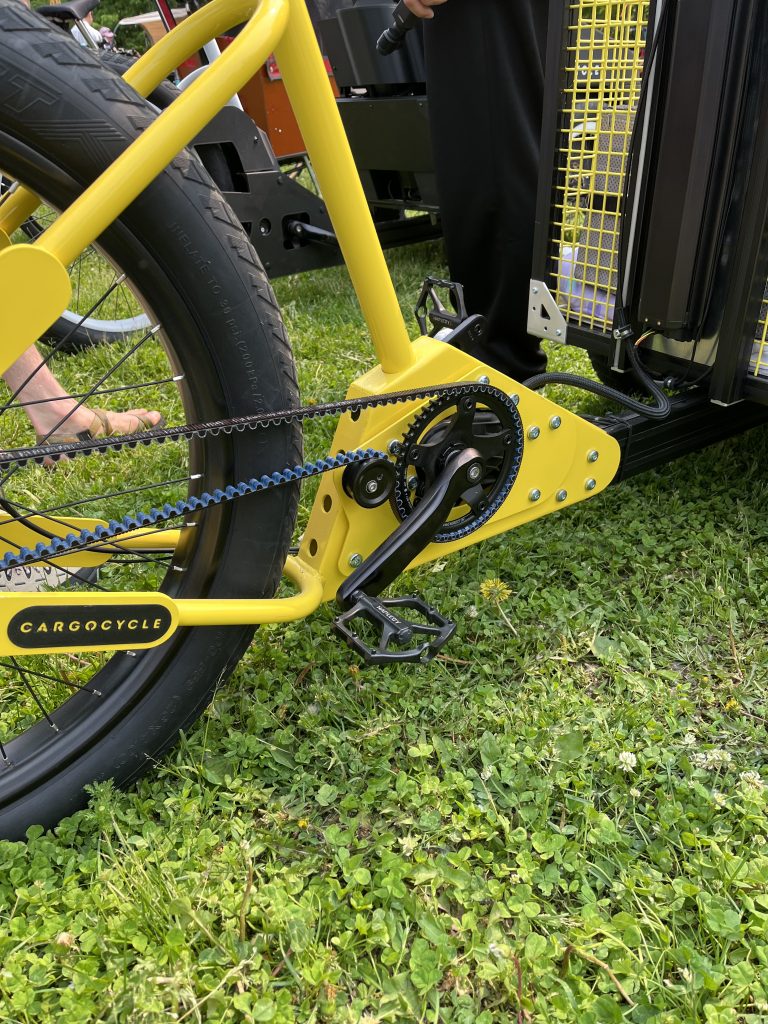
People showed up with cargo bikes of all shapes, sizes, budgets and accessories. Local bike shops Perennial Cycle in Minneapolis and The Cargo Bike Shop in St. Paul brought bikes and advice. The Minneapolis Cargo Bike Library was there with a couple of bikes from their library, and a new local cargo bike company called CargoCycle brought two of their prototype bikes. Bailey (The Cargo Bike Shop) said: “I’m newer to Minneapolis and follow a bunch of people in the bike community on social media, but this allows me to meet them in person. I love these community events.”
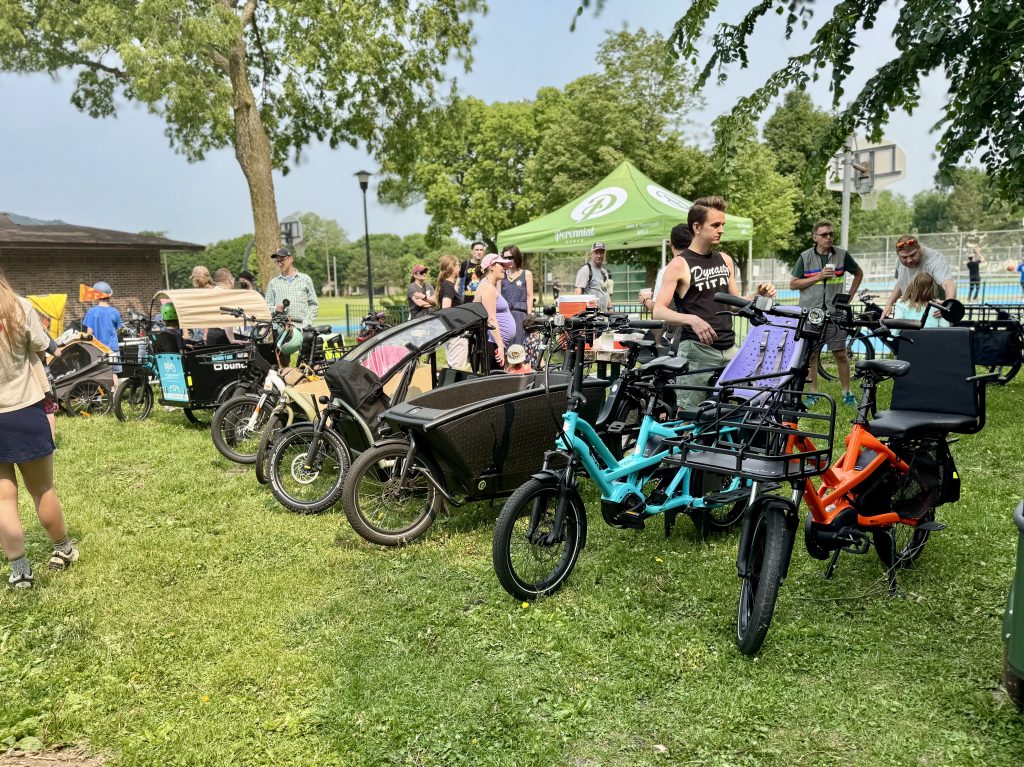
Luke Breen (owner of Perennial) said, “Cargo bikes are incredibly modular. We see lots of families coming into the shop, which is fantastic, but we also have lots of options for carrying gear. At an event like this, you’re seeing everything. All options are on the table here.”
Bailey encourages those who are cargo bike curious to “support your local bike shop!” Buying in person allows customers to ask questions, test ride multiple bikes and have a local shop available to repair or provide regular maintenance on the bike.
For those with a smaller budget or who want to purchase a brand not available locally, many bike brands sell direct to consumers. Electric cargo bikes can be more challenging to repair, so anyone who isn’t confident in doing their own repairs may want to consider the risk/benefit of purchasing a bike that might have proprietary parts (which may be impossible to source locally) and may not be serviceable at some bike shops. With more cargo bikes on the market, the used market is beginning to have more options, too.
Learn More
To learn more and talk with others who are into cargo bikes, check out the variety of online groups dedicated to discussing and sharing about cargo bikes, including the local Twin Cities Cargo Bike Love Facebook Group and many brand-specific groups. Piecycle rides offer ongoing opportunities to see a variety of bikes and chat with others who are knowledgeable about options. Consider following Piecycle on Instagram and subscribing to their newsletter.
A History of Cargo Bikes
From Michael: Finding myself with a free morning and pleasant weather, I decided to take a break from my regularly scheduled itinerary watching the fall of the West and set out for the Cargo Bike Show & Tell, which I learned about from Streets.mn Managing Editor Amy Gage. I hopped on my own cargo bike, notebook and pen haplessly flopping around in its cavernous storage bags, and pedaled off for a distraction. It turned out to be more interesting and pleasant than I had expected.
But first, some history: Cargo bikes are a relatively young established market segment in the United States, not even old enough to drink, depending on how you date it. The early examples here were all “longtails,” first popularized by the Xtracycle Free Radical, which was a bolt-on modification for an existing MTB frame. In 2008, Surly — purveyors of heavy steel bikes — introduced what was effectively a complete frame version of the MTB/Free Radical Frankenbike, called the Big Dummy. Other models followed, like Yuba’s even more tank-like Mundo and Xtracycle’s own complete frame, and the rest was recent history. For more than a decade, if you rode a cargo bike in the U.S., you rode a longtail.
This Cargo Bike Show was a striking demonstration of how much the market has changed, and how recent much of that change has been. Of 21 cargo bikes that I counted early on during the event, 11 were front loading “bakfiets,” or “basket bikes.” Two were prototypes brought by a new, local, family-owned startup named Cargocycle. Erkan, an automotive safety engineer, immigrated to the U.S. with his wife, Asuman, from Germany about three years ago. She brought a bakfiets with her from the Netherlands (where they are ubiquitous) and found that everywhere she went, people were asking what it was and where to buy one. At the time, Asuman didn’t know where to buy one in the United States, but the conversations gave Erkan an idea. He decided to work on developing his own line of bakfiets-style bikes, all manufactured locally, so people could actually buy them here.
The past three years have seen another technological transformation in the cycling world, which has paralleled and perhaps enabled the proliferation of larger and better appointed cargo bikes. Namely, the electric bike, or “e-bike.” All of Cargocycle’s models are electric pedal-assisted by Bosch motors, as were the three models brought by Perennial in Minneapolis. In fact, while unassisted bakfiets are still common in the Netherlands, in the rapidly expanding U.S. market they are commonly assisted, and are trending toward electric motor ubiquity, which just might be the technological convergence that enables them to catch on in this country.
Numerous reasons have been given for why the bakfiets did not cross the Atlantic along with other European styles and disciplines. Part of it is that the U.S. market has long been dominated by sports and recreation; therefore,the earliest effort at a cargo bike in the U.S. was a longtail attachment to a hardtail MTB frame: the Xtracycle Free Radical. It was, in this “ecosystem,” the evolutionary path of least resistance. Additionally, in a way, the longtail was still primarily targeted at the sports and recreation market — “adventurers” and “bikepackers” — and not at families.
There are some other practical reasons why the bakfiets took so long to migrate here. Namely:
- The Netherlands are flat. Very flat.
- They have extensive protected bike infrastructure.
- The environment allows a modestly active human to navigate their velo-battleship without significant elevation gains, frequent start/stop cycles, or proximate and dangerous traffic.
A bakfiets, with its very large frame and extensive (steel) steering linkages, weighs quite a bit more than even a heavy Surly longtail. Also, positioning the weight up front makes it more unwieldy to get up hills than dragging the weight behind, and unlike the Netherlands, terrain in the U.S. is rather more varied. The electric motor effectively flattens all of those uneven challenges and gives a greater safety margin around vehicle traffic.
E-Assist or Pedal Power?
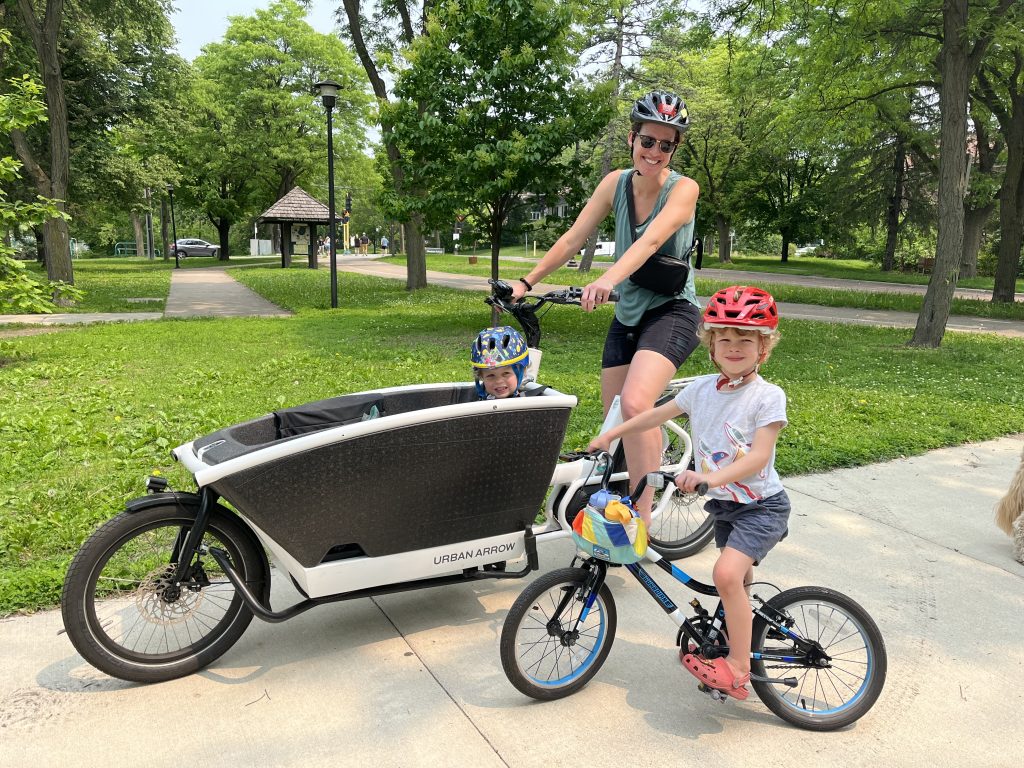
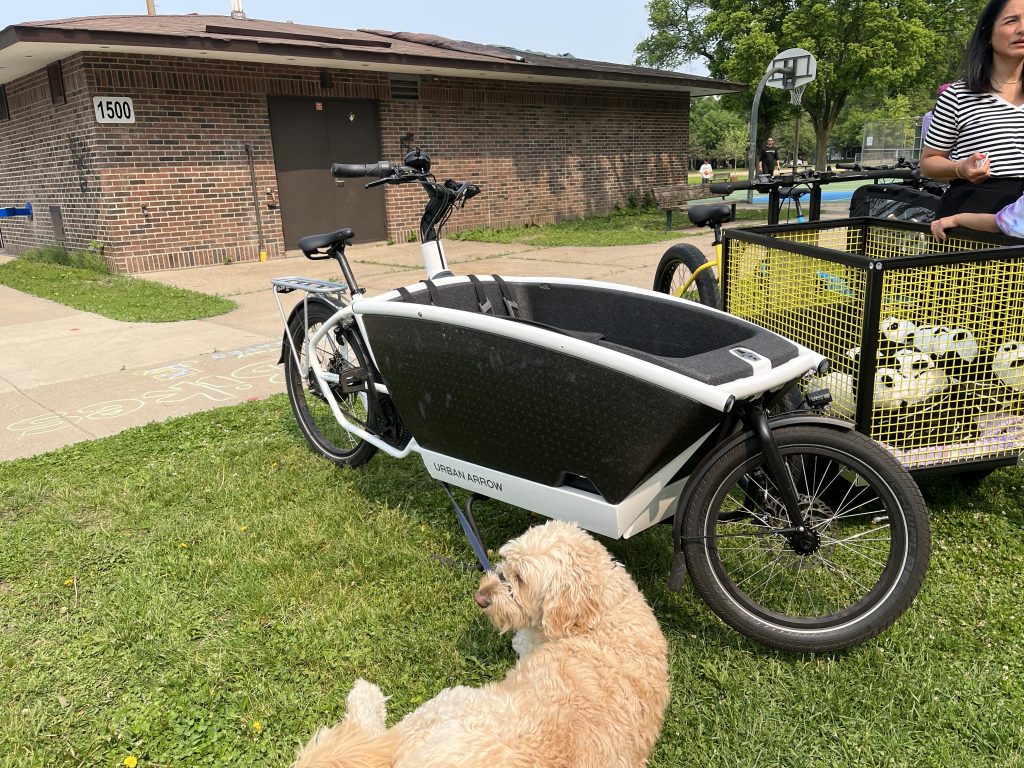
Hannah rode her own Bosch-electric-assisted Urban Arrow bakfiets to the event, which impressively even comes equipped with a Dutch-style rear wheel lock. I asked her if she thought that it would be possible to get around on the Urban Arrow without the electric assist. Her answer was a cautious “I don’t know. Most of my routes are nearby, on flat trails around the creek, so maybe there. But there are other places where maybe not.”
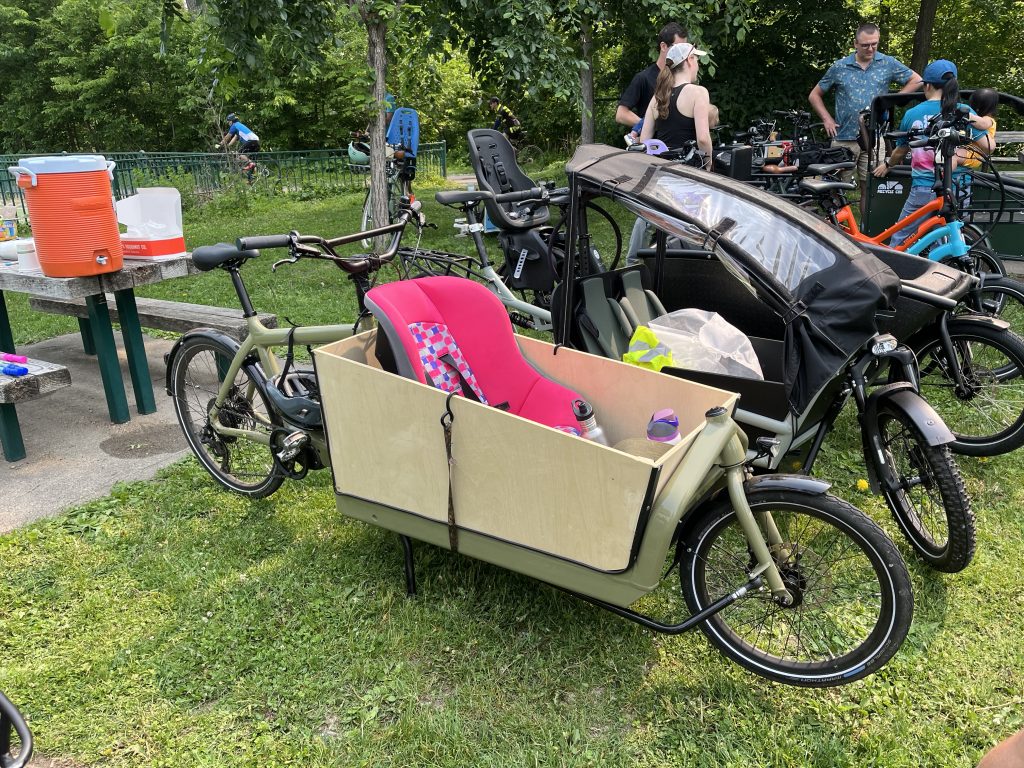
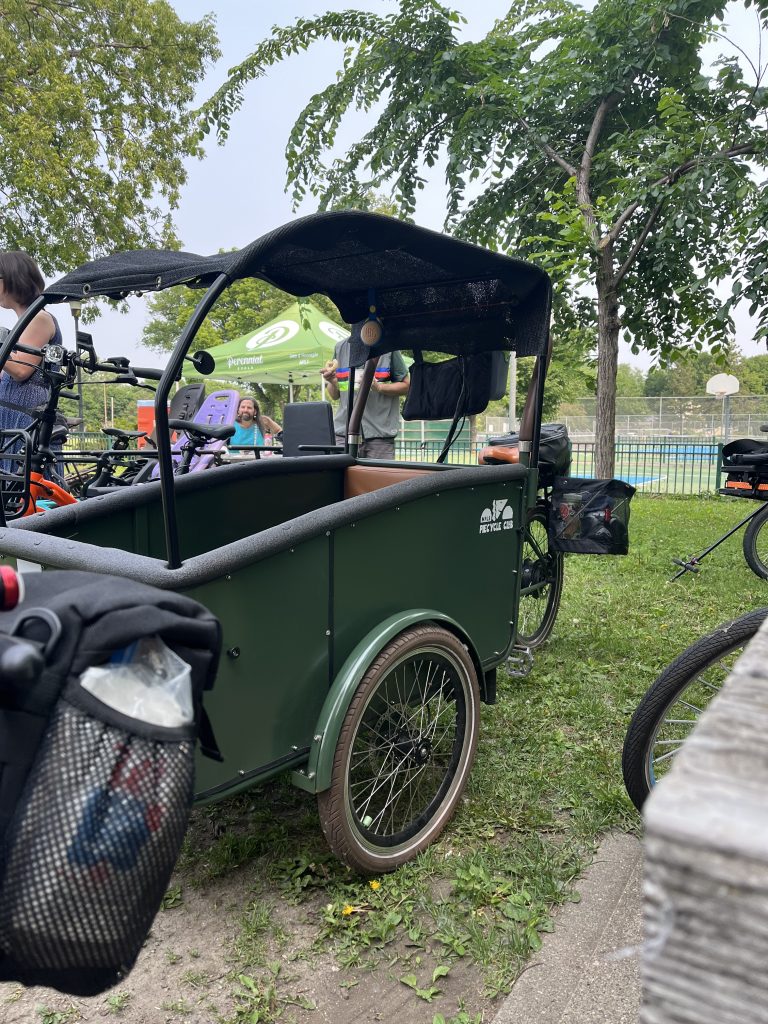
Nearly every attendee I spoke with who was in the market to purchase a cargo bike indicated that they were solely interested in a bakfiets. While some people rode longtails there, it seemed that no one — at least, no one with children — was interested in buying one.
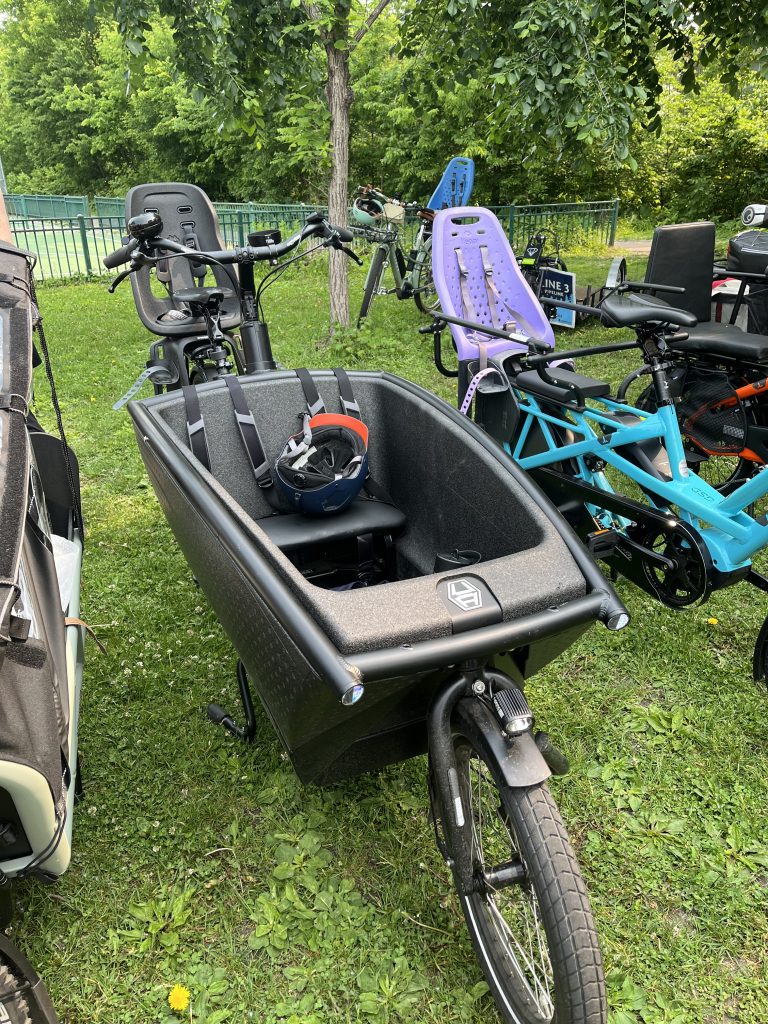
Event co-organizer Levi Mills said that he too wants a “front-loader,” but is struggling with the storage footprint. Indeed, the storage footprint problem would be a recurring theme. And, everyone wanted the electric assist, without question. Becky and Terrence, who recently moved to Minneapolis from Seattle, were looking at some bakfiets with their new baby. They wanted the bin up front for their child rather than a perch on the back. They wanted car-seat attachment compatibility, and room for future expansion and utility when the child (or, one day, children) becomes more independently mobile. They said that without kids, maybe they could make do if only using the bike for light transport like deflated paddle boards, but with a kid, the electric motor was essential.
Becky and Terrence also feel fortunate that they are a single-car family with a two-car garage and a house, and therefore have the space for the daunting footprint of the bakfiets. This might be the central irony of the bakfiets; it almost requires a house with a garage, likely a two-car version, and in the United States most of the bakfiets-friendly garages will be found where the roads and distances are not friendly to cycling.
Unlike many places in Europe, most apartment settings in the U.S. do not have storage for a bike like a bakfiets; an individual can shoulder a traditional bike up the stairs to an apartment, but a large bakfiets is quite another story. Ironically, the obstacles of storage, distance and infrastructure might be why the most expensive segment of the cargo bike market — luxuriously appointed, e-assisted, bakfiets — is having such successful recent growth. The population that can most readily afford to buy and store an expensive bakfiets, and who will need the amenities, are people raising a family in more affluent inner suburbs or suburban-like urban locales. Polling shows that this affluent suburban population is also increasingly concerned with “green” transportation, bikeability and physical activity.
This situation might only be subtly different from the Netherlands. In my own non-scientific, anecdotal observations, I sometimes see bakfiets in central Amsterdam, but far more frequently encounter them on the path network in the outlying areas, where private homes and private storage are more common, but are still connected to the extensive bike network there. In central Amsterdam, I primarily dodge beat-up gaspipe Dutch cruisers being utilized in all manner of creatively acrobatic portages, but not too many bakfiets.
I decided to broach the e-bike subject with Martha of Perennial Cycle. E-bikes have been a polarizing topic within the cycling community, and I told her that I have a possibly persnickety and conceivably controversial definition of bikes with electric motors. That is: If it has a button or a throttle that makes it go, it’s not actually a bicycle, but if it has an assist that pitches in at a particular cyclist power output, then it is. “I don’t think that’s actually controversial,” she replied. “We only sell bikes with pedal assist at Perennial.” That, to me, is far preferable to heavy machines with heavy riders pushing a throttle to make 20-plus mph on a multi-use path, probably while also looking at their phone. (You’ve seen them.)
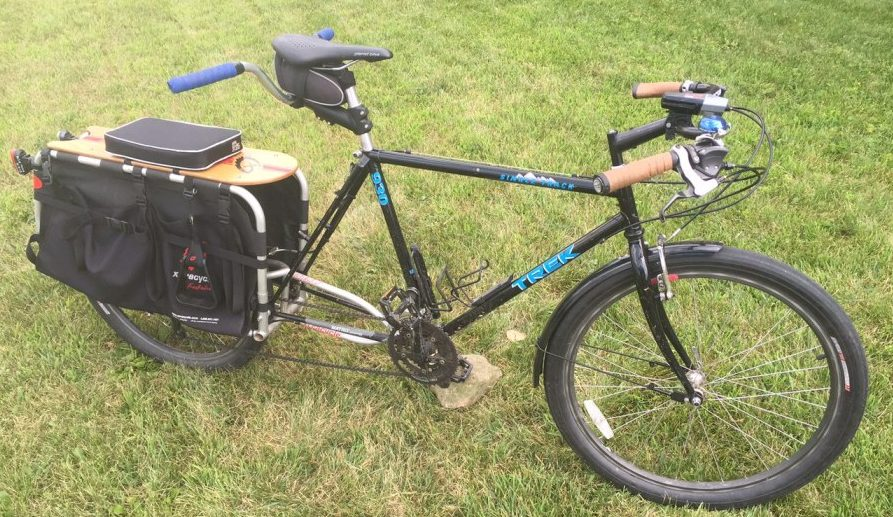
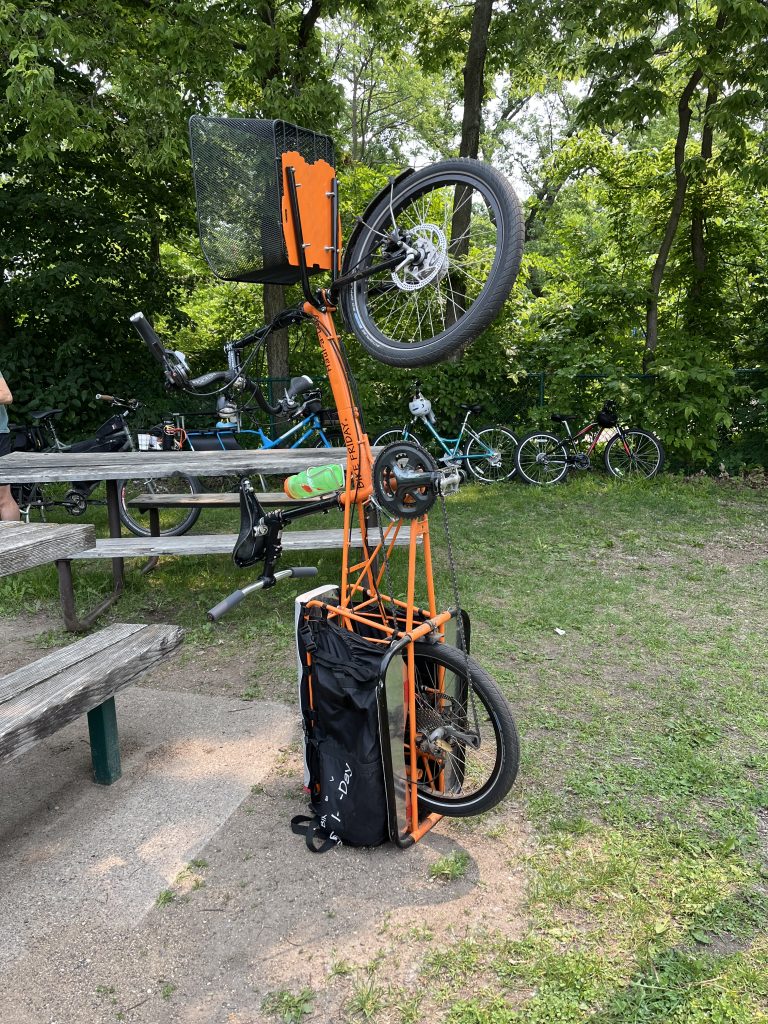
I still love my own old cargo bike, and near the end of the show, I was thrilled to find Illyana of the Cargo Bike Shop in St. Paul and her partner, Quin, admiring my old longtail style bike, which I have been riding for nearly nine years. Purchased back in the days when the options were a few other bulky longtails, the little-known model from Bike Friday called the “Haul-a-Day” is cargo-bike archaeology among all the state-of-the-art bakfiets at the show.
Perhaps the greatest problem with longtail cargo bikes is their ability to carry kids; they carry stuff just fine. A bike like the Big Dummy with its high rear platform and often a safety bar to clear is precarious for mounting and dismounting kids, and can topple over if a strong enough moment arm overcomes the kickstand. Then there is mounting up yourself without roundhouse kicking your kid in the face. When I test-rode one with a kid, after the squirrely loading and near-roundhouse, I found that with the high weight that turns could get spooky, handling was often suboptimal, and the prospect of spills was downright scary.
All the bakfiets at the show solve those problems, but so did my old Haul-a-Day. The diminutive 20-inch wheels put the platform low enough that the kids could climb on by themselves while I simply held the brake and the bike; no kickstand was even required. Additionally, the re-sizable boom frame functioned as a step through to avoid the roundhouse. It is also considerably lighter than its longtail peers, and orders of magnitude lighter than a bakfiets. But it carries as much as all the other longtails, and also solves the storage-footprint problem inherent to cargo bikes; everyone seemed impressed at its best trick of standing vertically on its rear section, a feat made possible by the geometry and the small wheels. The Haul-a-Day squeezes into a corner in the garage. I wouldn’t trade it.
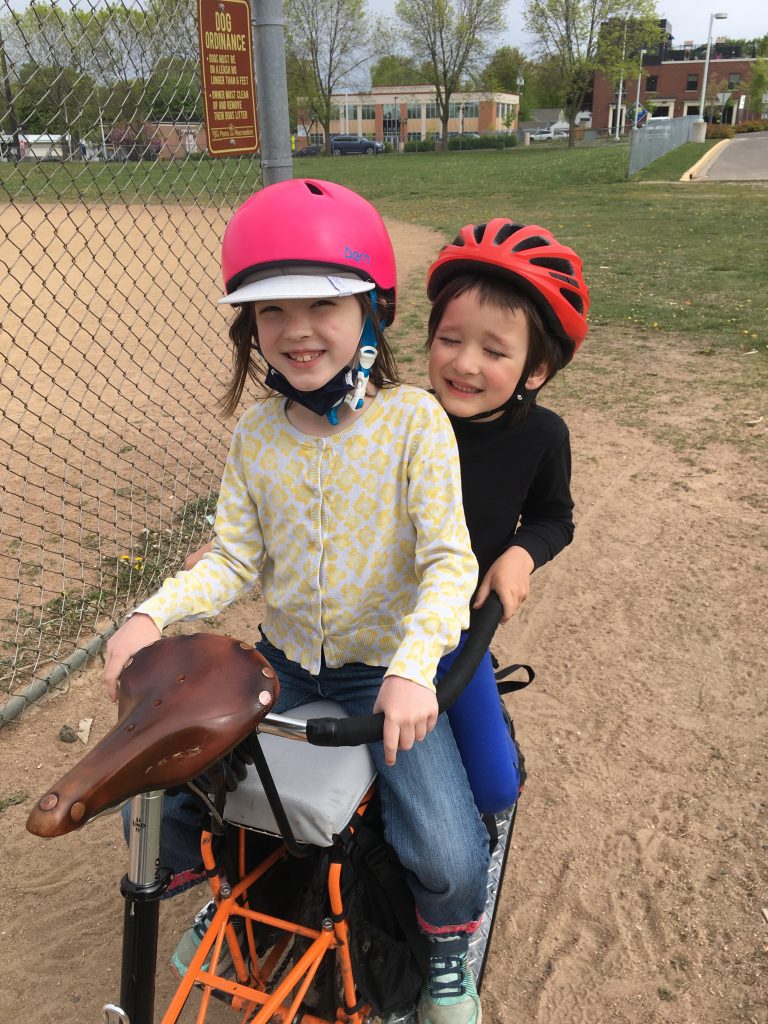
However, if I were new to the market today, with a couple of young children in tow, I would likely also prefer one of the bakfiets at the show. And, with counterfactual retrospective foreknowledge, I think I would also insist on an electric motor. My Haul-a-Day doesn’t have one, though it was an option, but as a fit, former pack-fodder racer and regular long distance cyclist, I didn’t think I would need one. As the years went by and the kids got heavier, I came to regret that decision on occasion.
Did I love my kids a little bit less when they shouted “c’mon, Daddy, pedal harder!” as I strained to grind up a hill? I’m told a parent should never answer questions like that, but I certainly couldn’t have done some of those hills on a loaded bakfiets.
A Happy Ending
For the young families and newer cyclists looking at the cargo bikes on display, the show might not have seemed exceptional, but when you’re peeking in after nearly a decade of ownership, it’s a veritable Rip Van Winkle moment given the rate of change. It was all very encouraging, and seeing people using cargo bikes, particularly with kids, always makes me smile. I smiled a lot at this gathering, which is a welcome change of late.
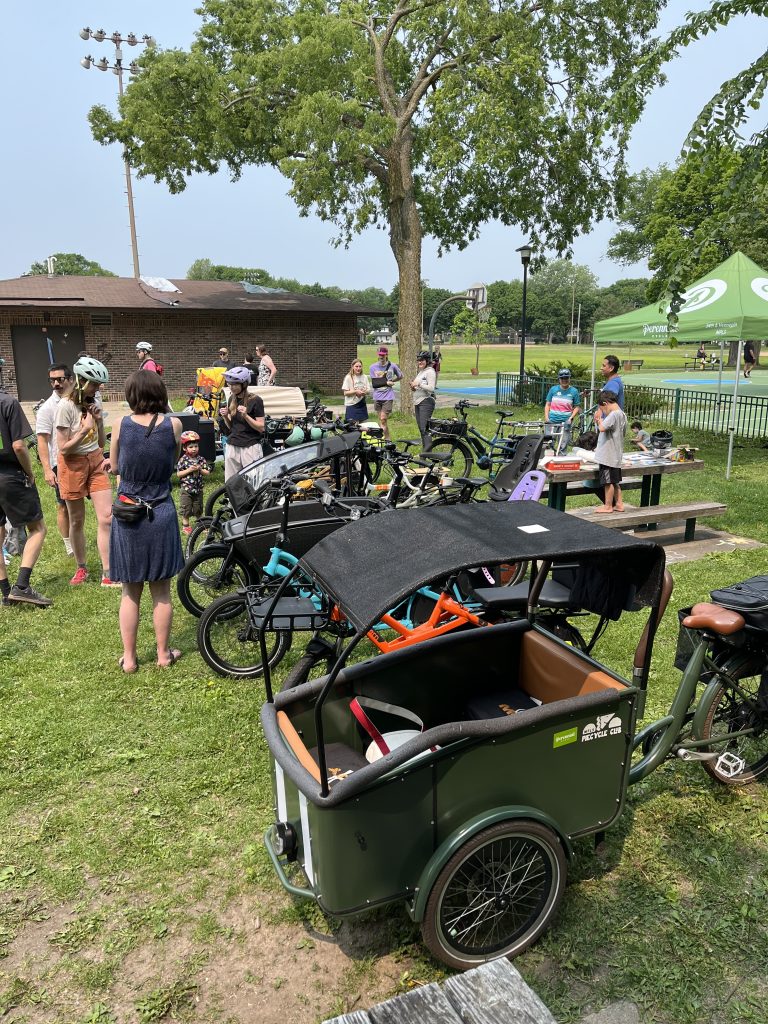
Perhaps the most notable aspect of the Cargo Bike Show & Tell was that its attendees, unlike cargo-bike aficionados of old, avoided preaching about their vehicles’ inherent superiority. Instead, it was a drama-free morning with a lot of people and, most encouragingly, a lot of young families, exploring ways to bike more, and just enjoying looking at all the cool bikes.
A better correspondent would have taken more pictures and much better notes, but, like everyone else, I was too busy chatting with friendly people and looking at the cool bikes. Even an old cargo-bike hand like me could learn quite a few new things at this gathering.