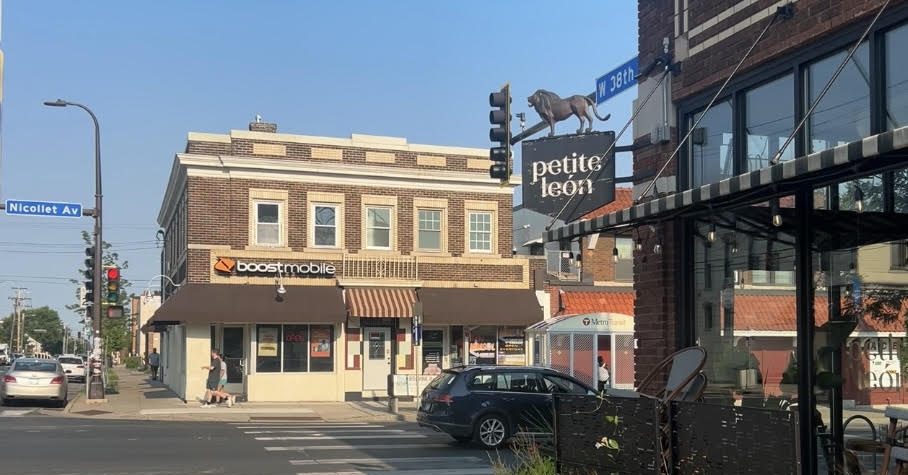
The Minneapolis neighborhood of Kingfield is bounded by 36th Street to the north, Interstate 35W to the east, 46th Street to the south and Lyndale Avenue to the west. It is known for a great farmers’ market, hip restaurants and the landmark Church of the Incarnation. Local restaurant Bucheron recently won a James Beard award for best new restaurant while staples like Boludo, Petite Leon and Sebastian Joe’s are city favorites that keep people coming to Kingfield.
The neighborhood also contains:
- The city’s premier miniature painting and board game store.
- No fewer than five autobody shops.
- Six chiropractors which all appear to be inside homes.
- Two different Mexican grocery stores, selling tacos and burritos within 100 feet of each other.
- A leather repair shop.
- A giant chess board flanked by huge statues of a dog, a cat and a parrot.
- A store that converts VCR tapes to digital files.
- Two dialysis centers.
- A sauna showroom.
- The Cremation Society of Minnesota.
- Three unrelated Spanish immersion daycares.
- Multiple mediation and wellness facilities.
- Minneapolis City & Skyway Tours.
- Three record stores.
- An urban chicken farm based out of a home.
- Five vintage or thrift stores.
- A Boost Mobile store.
Despite having all these essential and beloved businesses, neither Kingfield nor any surrounding neighborhoods contain a beer store.
East Harriet? Beerless.
East Bde Maka Ska? South Uptown? Go jump in the lake.
Lyndale? Central? Not in this neighborhood, buddy.
Bancroft? Bryant? Regina? Forget it.
Tangletown? Lynnhurst? Teetotalers all.
To add insult to injury, Marigold, an NA spirit shop one block outside of Kingfield proper, will sell you six-packs of anything except alcohol. Thirsty Kingfielders are left to choose between an Italian soda or a 10-milligram THC seltzer, making evening plans vary from mowing the lawn to getting scared by a nature documentary.
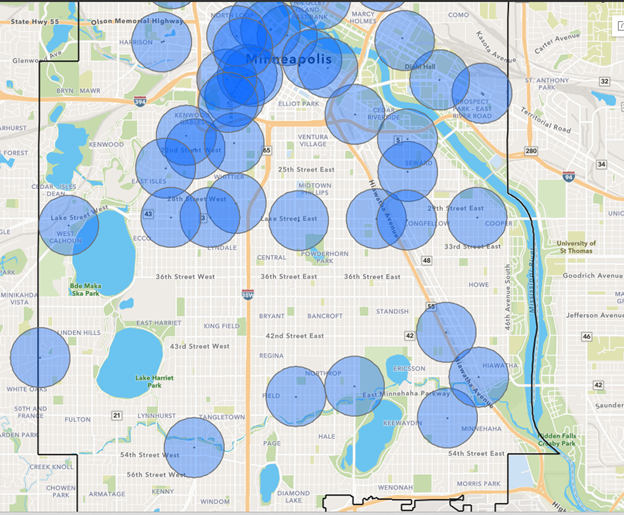
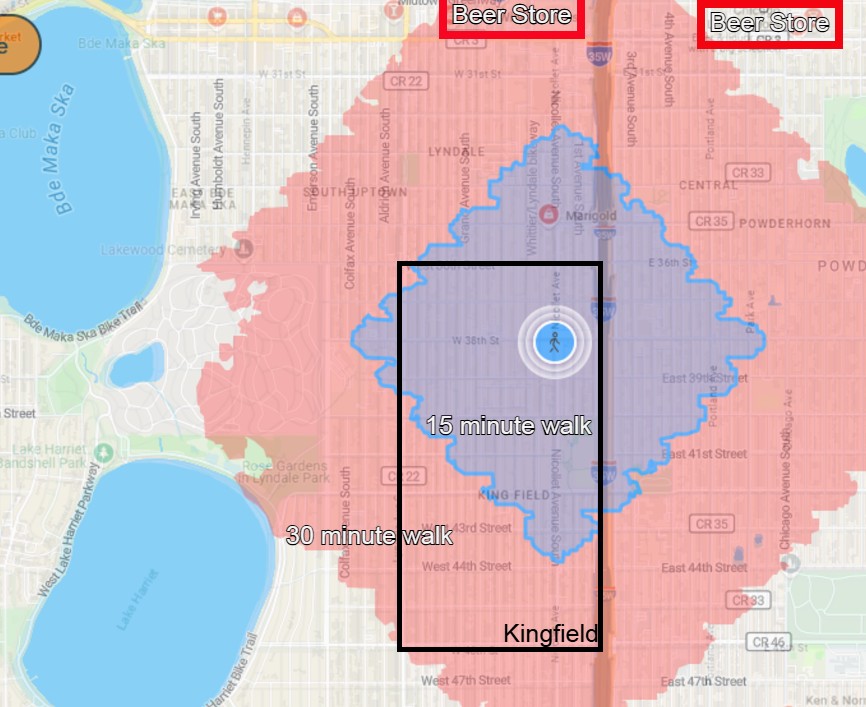
There is not a single beer store south of Lake Street and north of 54th Street between Xerxes and Chicago Avenues. That’s an area of the city three miles wide and three miles tall — nine square miles of moderately dense city living. If you stand at the corner of 38th Street and Nicollet Avenue, the commercial heart of Kingfield, it is a 30-minute walk to the nearest store in Whittier where you can buy a six-pack of beer. The situation is even worse from the geographic center of Kingfield. How did this happen?
Prohibition-Era Farmers
The land south of Lake Street, which would become Lyndale, South Uptown, Kingfield and more, was farmland until the early 20th century, owned by George Bichnell, Hiram Van Nest and William S. King.
When the farmers sold their land to the city in the 1910s, the prohibition movement was gaining momentum, and they attached a clause that no store whose primary business was selling “intoxicating elixirs or potent potables most vile for consumption at home where they corrupt the family and incite base moral turpitude” could ever be opened on their former corn fields. Additionally, bars in the affected areas were required to have enough seats for everyone in the bar to sit down.
Many bars today get around this requirement by having dozens of folding chairs in a supply closet. U.S. Rep. Andrew Volstead (R-Minn.) — whose name may sound familiar to Uptown residents — liked this clause so much that he proposed the Volstead Act. That eventually became the 18th Amendment, banning the sale of alcohol nationwide. Even after prohibition was repealed, there was no appetite to change the city bylaw that prevented opening beer stores south of Lake Street.
It may shock you to learn, but I made up the no-alcohol clause; there is no city bylaw banning beer stores south of Lake Street and no clause attached to the farmers giving up their land. Volstead came up with the 18th Amendment with no input or inspiration from Kingfield. I also made up the chair requirements, just for fun. There is no prohibition on beer or liquor stores in the neighborhood and yet there are no beer or liquor stores to be found for miles. Why?
The Joseph Smith Theory
Utah, the Mormon Church’s seat of power, is famously a heavily anti-alcohol state in keeping with the tenets of the religion. You may be asking, what does this have to do with south Minneapolis?
Kingfield, known to many as the Utah of Minneapolis, is home to the only Mormon Church in the city. One theory is that the Church of Jesus Christ Latter-Day Saints uses the enormous power and influence that comes with being less than 1% of the city’s population to stop the opening of any beer stores within 2 miles of their church to avoid the near occasion of sin. As an avid watcher of “Secret Lives of Mormon Wives,” I have to say that the absence of boutique soda shops, ketamine therapists or laughing gas lounges in Kingfield leaves me unconvinced that the Church of Latter-Day Saints holds enough sway in south Minneapolis to enforce anything like that.
The Lowbrow Neighborhood Association Conspiracy
Another theory, the Lowbrow Neighborhood Association Conspiracy, is that the Kingfield Neighborhood Association board has conspired with local bar Lowbrow to stifle beer stores, so everyone must go to a bar if they want to drink. A quick look at the different board members’ bios shows a disturbing trend in subliminally advertising Lowbrow.




Nearly every board member mentioned that they patronize Lowbrow. Why? Isn’t that suspicious? Would the Kingfield Neighborhood Association really conspire to stop the opening of beer and liquor stores to benefit what Google describes as a “Cheerful spot for comfort-food fare made from locally sourced ingredients, with gluten-free options”? Does the KFNA even have that power? There is no way to know.
Other potential theories include:
- The Bike Mafia runs this town and wants me to use the protected bike lane with new flex posts on Blaisdell to turn a 30-minute walk into a 5-minute ride.
- The Bus Mafia runs this town and wants me to take the number 18 bus down Nicollet to make any purchases I need.
- City Council President Andrea Jenkins personally banned beer stores in Ward 8 so that I would socialize with my neighbors at local eateries and create a welcoming community for all.
The Real Reason
Sadly, it is none of those fun conspiratorial reasons. The real reason is overly restrictive zoning laws. Here are the most basic requirements for a new beer/liquor store in Minneapolis:
| Requirement |
| Located in CM3 or Industrial zone |
| Part of five acres of continuous CM3 or Industrial zoning |
| 2,000 ft from existing liquor store |
| 300 ft from school or church |
The highest level of zoning in Kingfield and any of the surrounding neighborhoods is CM2: Corridor Mixed Use. The CM2 Corridor Mixed-Use District allows small, moderate and large-scale commercial uses. CM2 zoning explicitly bans stores that sell off-site consumed alcohol above 3.2% as seen in this city Uses Allowed Table. CM3 Community Mixed-Use District, the zoning that Lake Street, Hennepin, and Lyndale all have in Uptown and Lyn Lake, allows for denser development and beer/liquor stores. Weirdly, the only real difference between CM2 and CM3 in the Uses Allowed Table is beer/liquor stores, pawnshops and amphitheaters.
Nicollet Avenue, the main commercial strip south of Lake Street, is zoned CM2. Thirty-eight Street and Bryant and Lyndale avenues are also zoned CM2. As a result, residents of Kingfield and the surrounding neighborhoods must leave their neighborhood, often by car, to patronize what we as a city and state considered an essential business in 2020. If the goal of the city is to create complete neighborhoods and limit the number of car miles driven, as the city outlined in our 2040 plan, updating zoning regulations to allow something as commonplace as a beer store to be built south of Lake Street is a no-brainer.
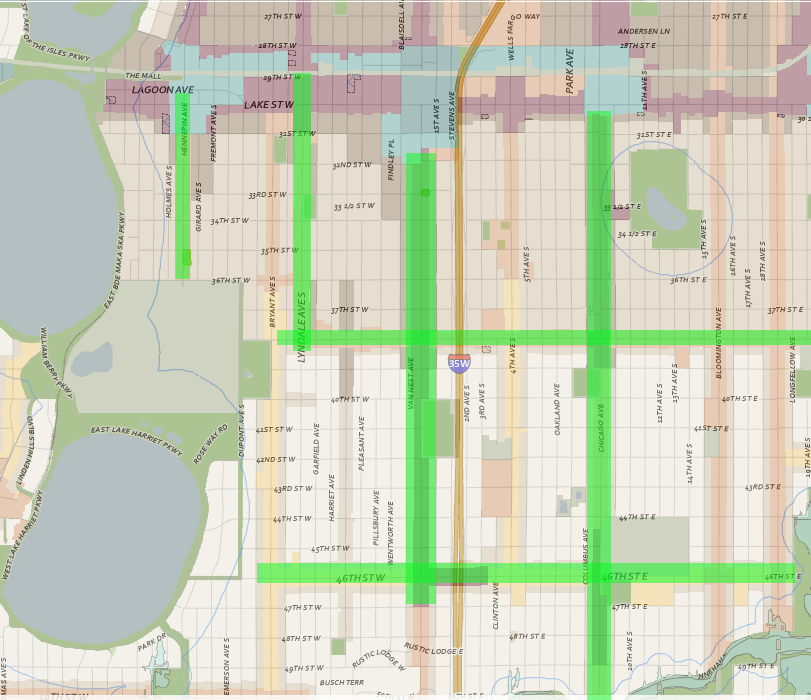
Some will dismiss this, saying, “It’s just a beer store, you don’t need that.” But the map of pharmacies looks nearly identical, again with none in Kingfield and the nearest one being a 30-minute walk from 38th and Nicollet. The current zoning laws are standing in the way of building a walkable city with complete neighborhoods. I have chosen to highlight the dearth of beer stores, but the same could be said for many businesses and services that people use on a weekly basis. I am unaware of any zoning laws that prohibit pharmacies in Kingfield, but more development on the commercial strips would only help encourage those businesses.
Nicollet, Chicago and Lyndale Avenues going north-south and 46th and 38th Streets going east-west should be upzoned to CM3 to allow for denser housing and commercial development and to allow beer stores. This would fill a gap and, with business and community investment, turn the neighborhoods of Kingfield, Regina, East Harriet, Field, Bryant, Central, East Bde Maka Ska, South Uptown and Lyndale into complete neighborhoods.
I am calling for Minneapolis to live up to its ideals of walkable, complete neighborhoods and allow me to finish work on a Friday, walk 10 minutes to my local beer shop, buy a six-pack of the haziest, most Indian pale ale I can find and sit on my couch while deciding what I want for dinner. And the way to do that is to update our zoning laws.