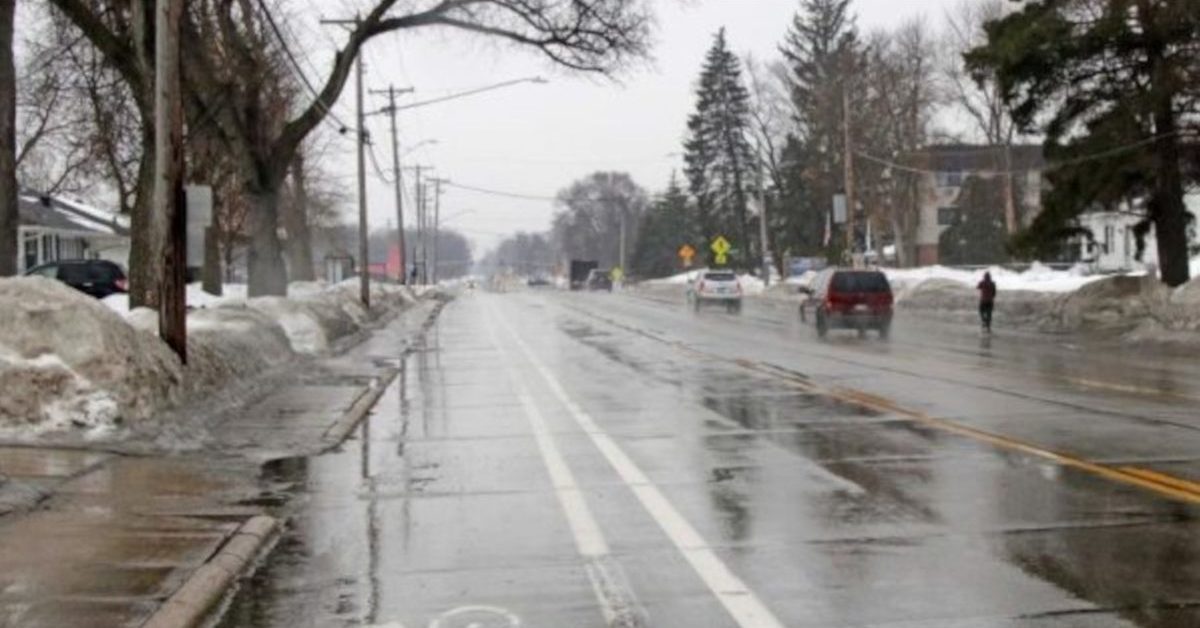
In 2027, Hennepin County will reconstruct Nicollet Avenue in Bloomington between American Boulevard and Old Shakopee Road. This corridor on the east side is a vital connection between three schools, the Valley View Park complex, a clinic and small, local businesses offering everything from boots to candy to music. People of all ages and backgrounds—families, children, lifelong residents, and immigrants—live, work, learn, and play here. That’s why it’s so important that we ensure Nicollet becomes a street that supports all these uses—a street that is not only safe for all road users, but invites people to come and linger.
Context and History
This stretch of Nicollet Avenue was last resurfaced some time between 2017 and 2019, from a four-lane “death road” design to a three-lane with painted, on-street bike lanes. While this was certainly an improvement, the roadway surface and especially the sidewalk (which was not redone with the road) have since deteriorated.
Parked cars and delivery vehicles frequently block the painted bike lanes, which simply disappear at high-volume intersections such as American Boulevard, 90th Street, and Old Shakopee Road. This forces bicyclists into the road with traffic, or into the narrow, curbtight sidewalk with pedestrians. Metro Transit’s Bus 18, which runs along this section Nicollet between 98th Street Station and Downtown Minneapolis. Pedestrian crossings are also lacking, with many being demarcated only by a sign and paint. The pedestrian experience is further marred by the presence of free-flowing right-turn lanes that encourage high vehicle speeds.
The Alternatives
To address these challenges, Hennepin County has presented two design options for the reconstruction project.
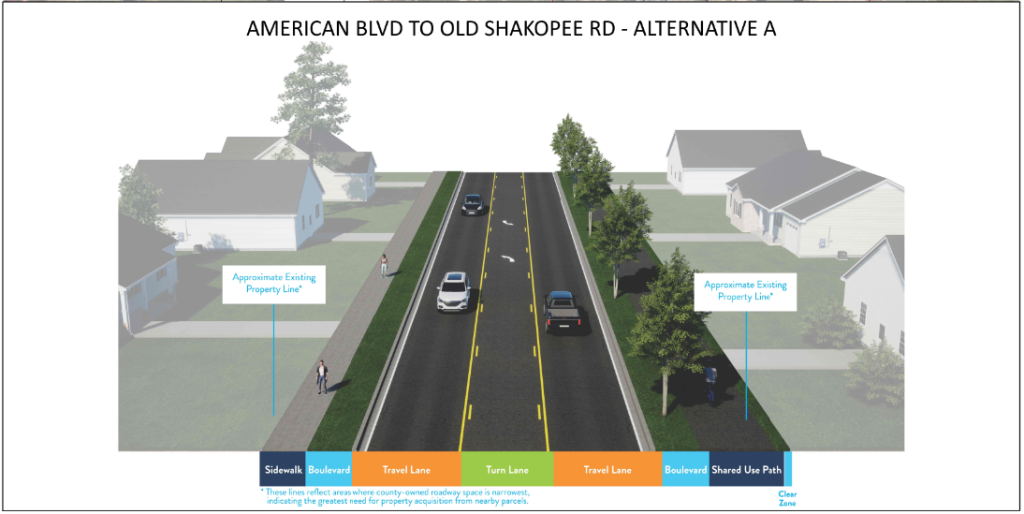
Alternative A maintains the three lane design, but replaces the dedicated bike lanes with a sidewalk on one side and a shared-use path on the other, with boulevard and tree space between these facilities and the roadway.
In addition, it includes traffic calming features such as median closures near Kennedy High School, 84th Street, and north of 81st Street, as well as curb bump-outs and the removal of all slip lanes. Crossings are also improved, though reduced in number, including the addition of refuge islands. The plan calls for some bus stops to be removed, with stops primarily being spaced every two blocks instead of the previous one.
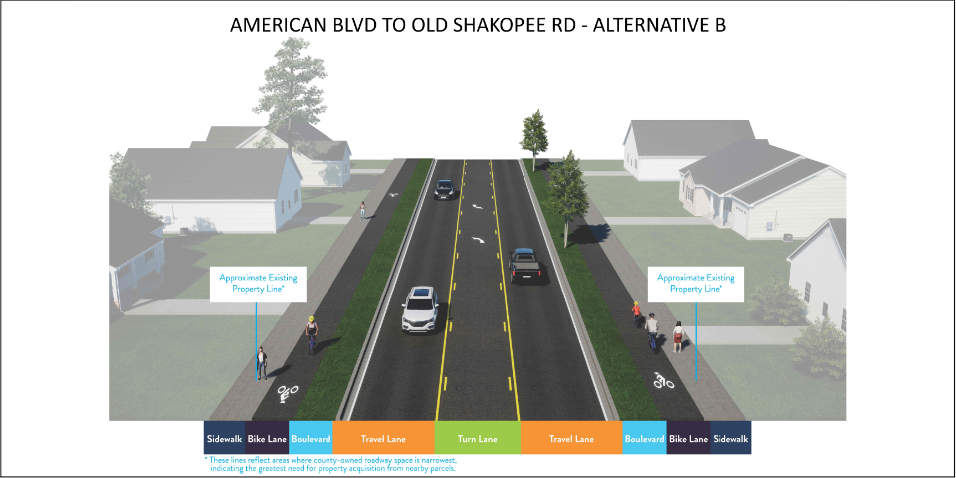
Alternative B is largely the same as Alternative A, with the key substitution of the shared-use path for a sidewalk and curb-level protected bike lane on both sides.
Separated Uses are the Best Option
Alternative B is the safest and most forward-thinking of the two options. Nicollet already has significant pedestrian traffic from kids walking to school and bus riders. Introducing bicycles into the mix, especially given the growing prevalence of e-bikes, is not the best and most thoughtful solution. Improving, rather than removing, dedicated space for both bicyclists and pedestrians, reduces conflicts and makes travel safer. This will encourage more use of these modes.
A shared path handling bike traffic in both directions also brings a factor of inconvenience. Someone making a two-way trip on Nicollet could be forced to cross the street four times in total. Not only is this troublesome, it also increases the risk of crashes and injury.
Additionally, having one-way bike lanes supports consistency and continuity in the broader Nicollet Avenue corridor. South of the project limits, Nicollet has bikeable shoulders on each side. Looking northward, Nicollet is receiving dedicated bike lanes over Interstate 494 as a part of MnDOT’s project on that highway. Continuing north, Nicollet Avenue in Richfield is slated to receive the same protected bike lane treatment as Alternative B. A unified design makes biking for utility more convenient, accessible, and safe.
Take Action!
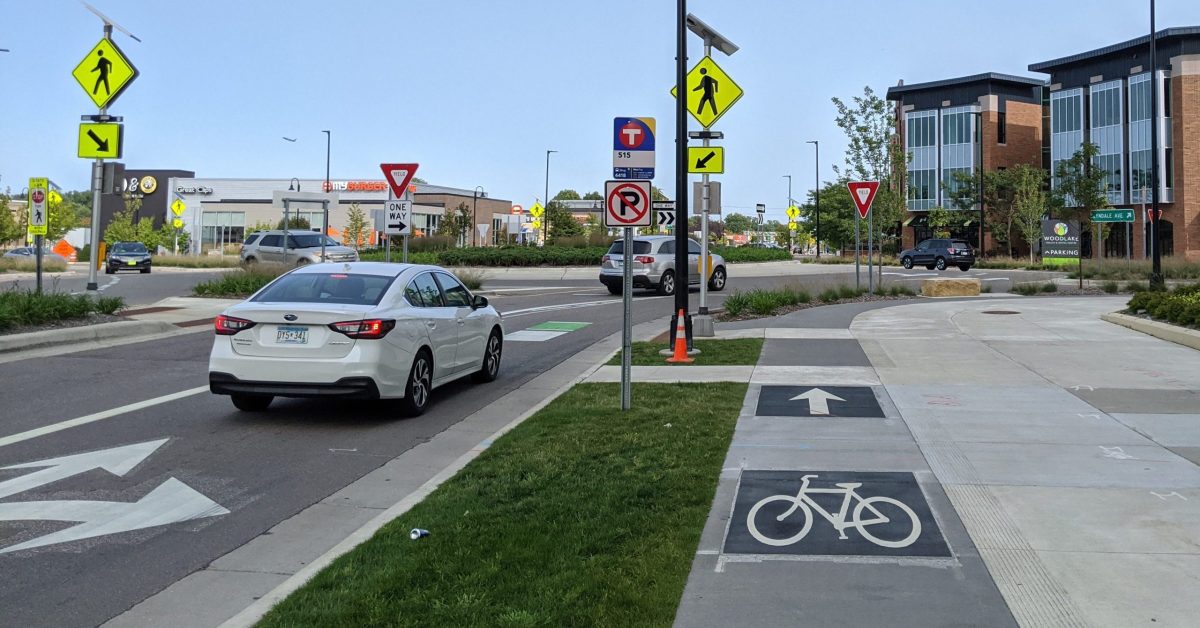
If a city with a smaller tax base like Richfield can build a high-quality network of protected bike infrastructure, and also include pedestrian lighting, raised intersections and four roundabouts, Bloomington should pay close attention. Bloomington leaders should engage in a bit of friendly competition with its neighbor to improve its own network and realize its strategic goal of truly connecting the community. With Hennepin County footing at least half the bill of reconstruction, we should seize this once-in-a-lifetime reconstruction opportunity to better our city in a significant and impactful way that will benefit the city as a whole for decades to come.
If you live, work, or shop in Bloomington, please join me in making sure these transformative changes are implemented. While the design alternatives survey is now closed, there is still time to let project staff and decision makers know your thoughts.
- Bloomington City Council
- You can email your district councilmember, as well as both at-large councilmembers and the mayor.
- Project contact ([email protected])
- Hennepin County Commisioner Debbie Goettel ([email protected])
Learn more about the project and view the design concepts in full at the project page and engagement website.