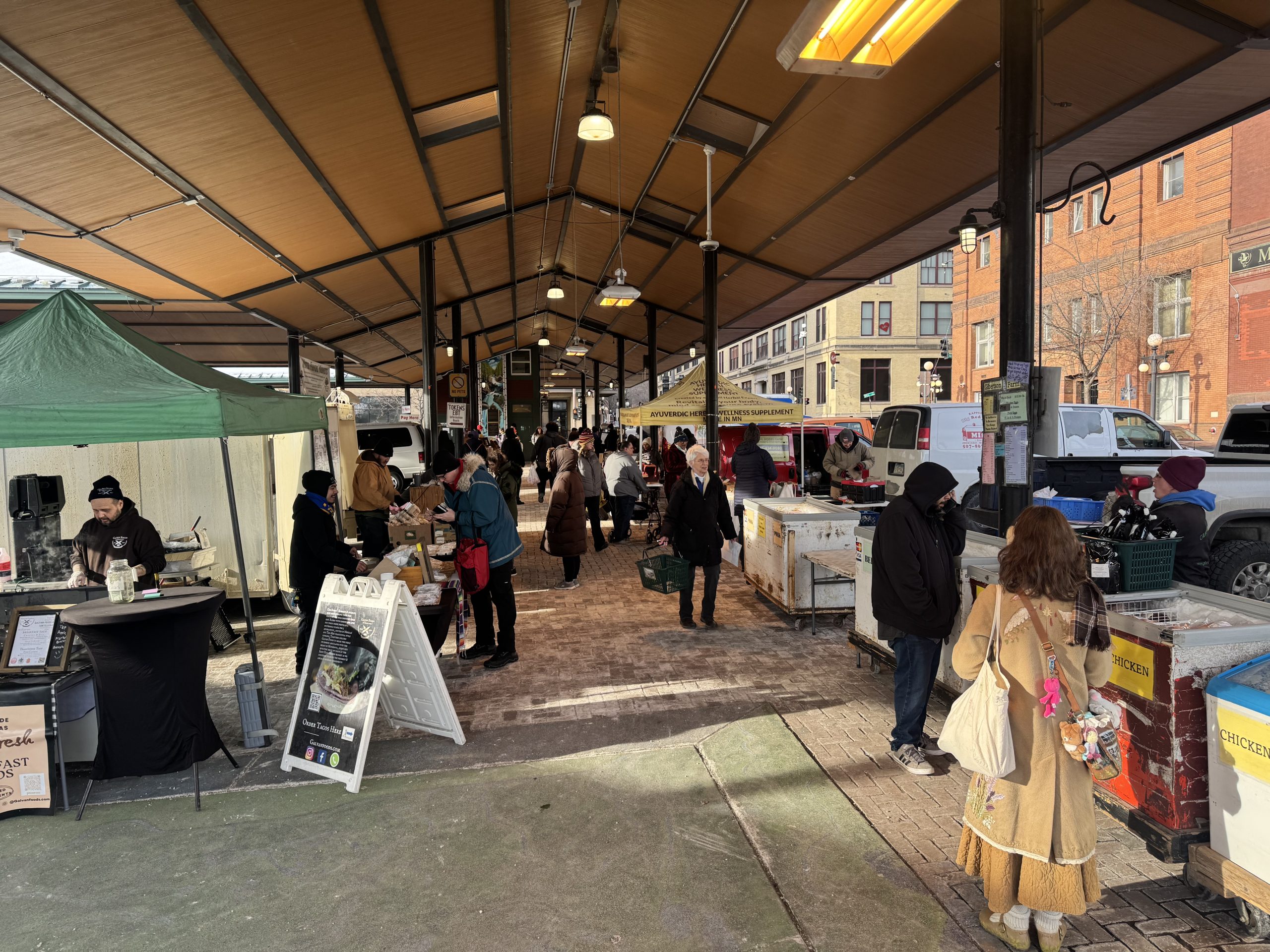
In Nov. 2025, Streets.mn contributor Maryann Wilson wrote that she had come to realize that “land use is also about community and who has access to our streets and who feels safe walking around the neighborhood.” But it’s March 2026 now and I know that so many of us feel less safe than ever. I’ve been thinking a lot about third places recently and I’ve been thinking about community safety and the things that make St. Paul, MN special — and the farmers market comes to mind.
A 2012 article from Michigan State University notes that farmers markets are crucial sites for connection and for community vitality. And a 2025 article from American Farmland Trust notes that farmers markets are true third places — a concept explored in a recent Streets.mn article by Erik Noonan.
In his article, Noonan writes: “Third spaces are where we practice being human together. They are not home. They are not work. They are where community happens. And when one of those spaces is harmed, we feel it in our bones.”
We’re likely all feeling that right now. Our communities are struggling and I know that while there are many folks out and about, there are so many either hiding at home still or hiding in the shadows as they move about in public.
That’s why I think it’s time to head out to our local farmers markets — even now we have weekly markets open. It’s also time to plan for our summer markets: the Minneapolis Farmers Market and the market annex, the indoor and outdoor St. Paul Farmers Markets across the Twin Cities, the Bloomington Farmers Market, the Eagan Farmers Market, and more.

I’ve been lucky enough to go to the farmers market several times this year — our farmers markets are the best of us. Alongside block parties, as Noonan discussed, I think farmers markets are an existing infrastructure we can use to rebuild and deepen bonds of trust and safety across our cities and neighborhoods.
I believe that part of how we make the streets safe for our community is to show up in public in shared spaces. We must reclaim our streets, our farms, our gardens, and all that it takes to be a place where people feel safe leaving their homes.
In Minneapolis alone, Operation Metro Surge had a $200+ million impact on the local economy including millions in lost wages. This, alongside other economic impacts on Minnesota cities and towns, was discussed on February 25th, in the Minnesota Senate Committee on Jobs and Economic Development. St. Paul Mayor Kaohly Her, who started her first term as mayor just three days before the killing of Renee Good, shared that for St. Paul businesses surveyed, business was down 60% to 70%.
“Our mercados, our Vietnamese bakeries, our taquerias, and East African restaurants have been intentionally targeted by federal immigration enforcement operations — from the East Side to the North End, from Rondo to the West Side, and beyond across our entire community,” said Her.
And while the mayor was speaking about restaurants and other neighborhood businesses, many of those same communities are also foundational to our farmers markets. Across the Twin Cities and across Minnesota, immigrant farmers, including Hmong growers, are a vital part of the farmers market ecosystem and economy. The first Hmong farmer at the St. Paul Farmers Market was Xang Vang in 1983, according to an article from Midwesterner. Today, Hmong growers make up ⅓ of the St. Paul Growers Association (SPGA). SPGA is the nonprofit that runs the St. Paul Farmer’s Market.
That’s why farmers markets matter right now. These are not just places that exist as a type of food hub, they’re places where communities get built, local economies are supported, where the story of who we are as a community gets told. And when we show up in these places, we help make these spaces visible and we start rebuilding a sense of community safety. So go to the farmers market — and start taking back our streets and our community.