Metro Transit makes route and schedule changes four times each year. Each quarter, retired transit planner Aaron Isaacs explains them and gives an insider’s perspective on what’s happening.
Route 17: Nicollet — Uptown — St. Louis Park
Sunday afternoon frequency increases from every 30 minutes to every 15 minutes.
Route 22: Lyndale Avenue — Cedar Avenue South — Nokomis
This long line from the Brooklyn Center Transit Center through north Minneapolis and downtown to the VA Medical Center near Fort Snelling will see all weekday service improve from every 20 minutes to every 15 minutes, and from every 30 minutes to 20 minutes on Saturday and Sunday. That brings Route 22 into the High Frequency Network, dramatically increasing the convenience of transfer connections. That’s particularly important in the Hiawatha corridor, where Route 22 connects with the Blue Line LRT in four places.
Route 25: Minneapolis — Silver Lake Road — Northtown and Route 804: St. Anthony — New Brighton
Besides adding service, this quarter’s change undoes a previous arrangement that was confusing. Service connecting Silver Lake Village (Silver Lake Road & 39th Avenue Northeast) to Northtown via Silver Lake Road, and to New Brighton via Old Highway 8 was split between two routes. Route 25 from downtown Minneapolis did the rush hour. During the weekday midday and Saturday passengers had to transfer to Route 804 to reach either destination. Passengers had to consult two different schedules depending on the time of day.
Now Route 25 runs all the service to Northtown, eliminating the off-peak transfer. The peak service north of Silver Lake Village is increased from 60 minutes to 30 minutes. First time hourly Sunday service has been added. Route 804 runs all the service to New Brighton, and still requires a transfer at Silver Lake Village.
Route 94: Downtown Minneapolis — Downtown St. Paul
This fast bus, eventually to be merged end-to-end with the Gold Line, is increasing weekday peak period frequency from every 20 minutes to every 15 minutes.
Route 270: Minneapolis — Maplewood Mall
The peak period frequency is doubling from every 30 minutes to every 15 minutes. For the first time the route will have hourly midday service. This is a Network Now Plan recommendation, to run the biggest commuter expresses all day to accommodate short workdays and open opportunities for faster off-peak trips over longer distances. Besides feeding the Maplewood Mall Transit Center, most Route 270 trips stop at the Rice Street & Hwy. 36 park-ride lot, where it connects with Route 62 Rice Street and Route 68 Jackson Street.
Metro micro Update
Metro micro started as a dial-a-ride in north Minneapolis, an area with some of Metro Transit’s highest ridership. Most of the fixed route bus service runs north-south with crosstowns running east-west. Metro micro is designed to serve the diagonal short trips within the North Side that don’t work well on the fixed routes. Because the service area is compact (two to three square miles) trips are short and per hour productivity is much higher than dial-a-rides with a large roaming area. As the Table 3 shows, North Side Metro micro is averaging about 9,300 riders per month or 306 per day. My back of the envelope calculations show five passengers per bus hour, which is quite good for a dial-a-ride. Ridership appears have stabilized.
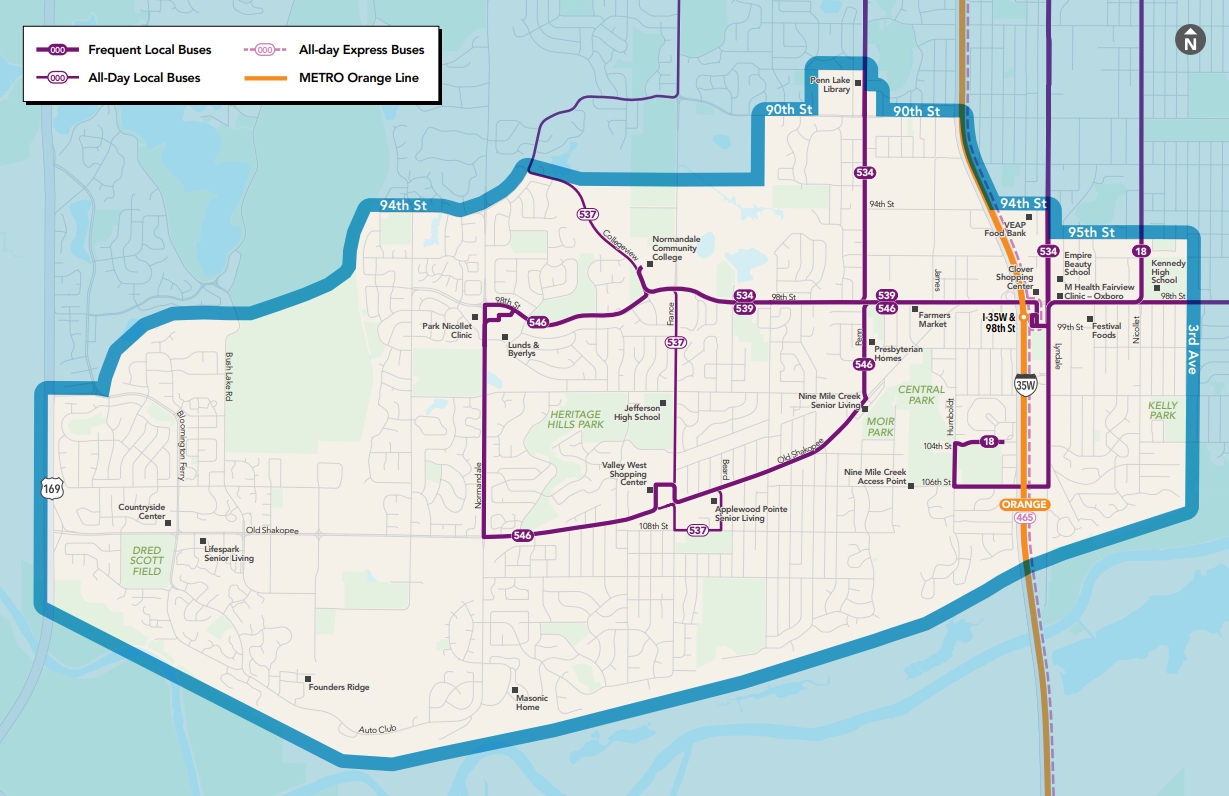
Over the last year Metro Transit has introduced Metro micro to the suburbs. This is a more challenging market. Lower population density and fewer transit riders calls for a different approach. The micro zones are still about two to three square miles, but now they’re anchored to transit centers. There they can feed fixed routes and fill the first mile-last mile gap between the transit center and nearby locations beyond walking distance, or without a connecting fixed route bus. The small size of the zones means a quick turnaround that allows the micro vans to reliably connect with all the buses at the transit center.
Micro zones are currently based at:
| Transit Center | City | Connecting Routes |
| Northtown | Blaine | 6 |
| South Bloomington | Bloomington | 6 |
| Rosedale | Roseville | 9 |
| Woodlane park-ride | Woodbury | 3 |
Future Metro micro zones to be added in 2026-2027
| Transit Center | City | Connecting Routes |
| Starlite | Brooklyn Park | 4 |
| Maplewood Mall | Maplewood | 6 |
| Brooklyn Center | Brooklyn Center | 9 |
| Shady Oak Green Line Station | Hopkins | 2 |
Order a ride by downloading the Metro micro app or by phone at 651-602-1170.
SERVICE HOURS:
Monday-Friday: 5:30 a.m. – 10:30 p.m.
Saturday & Sunday: 7 a.m. – 10:30 p.m.
Up to five vans are assigned to each zone, so rides should always be available on short notice.
There’s an extra charge to use Metro micro. The fare is $2.50/$3.25, depending on time of day. Pay in cash, a Go-To Card or pass or the Metro Transit app. Transfers to buses and trains are free for 2 1/2 hours. The Met Council is considering a proposal to simplify Metro micro fares. Full fares would be $4 and reduced fares would be $1.
So how are the suburban zones doing? We have a year’s experience with Rosedale and Woodbury. Rosedale appears to have stabilized at about 4,300 per month. Woodbury is still growing. I’ll speculate that Rosedale’s zone is better served by the fixed routes radiating in nine directions. Woodbury’s residential neighborhoods have very little service, so it makes sense that micro would fill the void.
The Blaine and Bloomington zones are still pretty new, but their ridership growth trend is close to Rosedale’s and Woodbury’s.
| Month | Blaine | Bloomington | Mpls | Roseville | Woodbury | Total |
| Jan-25 | 9,238 | 557 | 519 | 10,314 | ||
| Feb-25 | 9,087 | 990 | 1,018 | 11,095 | ||
| Mar-25 | 9,181 | 1,551 | 1,376 | 12,108 | ||
| Apr-25 | 9,294 | 1,879 | 1,804 | 12,977 | ||
| May-25 | 9,486 | 2,294 | 2,531 | 14,311 | ||
| Jun-25 | 9,327 | 2,546 | 2,442 | 14,315 | ||
| Jul-25 | 9,855 | 3,196 | 3,105 | 16,156 | ||
| Aug-25 | 217 | 9,635 | 3,460 | 3,453 | 16,765 | |
| Sep-25 | 243 | 1,170 | 8,548 | 3,874 | 3,481 | 17,316 |
| Oct-25 | 862 | 1,646 | 9,328 | 4,398 | 3,632 | 19,866 |
| Nov-25 | 1,190 | 1,846 | 9,196 | 4,158 | 3,708 | 20,098 |
| Dec-25 | 2,236 | 2,377 | 9,346 | 4,294 | 4,689 | 22,942 |
| TOTAL | 4,531 | 7,256 | 111,521 | 33,197 | 31,758 | 188,263 |
I was hoping Metro Transit could tell me what percent of riders are transferring to or from fixed routes, versus those making standalone trips in the zone. Unfortunately that data isn’t available. What I did learn is that the micro vans don’t dwell between trips at the transit centers. They have to be summoned with an app or phone call rather than just walking over to a van and boarding. Supposedly that’s due to lack of room at the centers. With the exception of Rosedale, which is indeed crowded, there’s plenty of room at the other centers. This service needs to be as visible as possible to potential riders.
Eliminating the Opt-outs?
There’s a bill in the Legislature to eliminate the “opt-out” suburban transit providers and fold their services into Metro Transit. What does that mean?
In the late 1970s, when transit was funded by the property tax, a number of suburban communities on the far edges of the transit system protested that they were contributing more tax dollars than they were receiving in bus service. The state legislature allowed them to “opt-out” of Metro Transit service and spend 90 percent of their tax dollars on themselves. Eventually these cities opted out:
- Minnesota Valley Transit Authority (MVTA)
- Burnsville
- Apple Valley
- Eagan
- Rosemount
- Savage
- Prior Lake
- Shakopee by itself, later joining Minnesota Valley
- SouthWest Transit
- Eden Prairie
- Chanhassen
- Chaska
- Maple Grove Transit
- Plymouth Metrolink
Initially, Maple Grove and Plymouth expanded their route networks and hired Metro Transit to run the buses. Maple Grove still does, devoting perhaps half a staff person to it. Metro Transit does everything else. As a result, Maple Grove has always had the lowest subsidy per passenger of the opt-outs.
The others decided to create full administrative staffs. MVTA and South West opened their own bus garages. Although technically subservient to the Metropolitan Council, MVTA and Southwest resisted oversight and a turf cold war developed. Southwest required Metro Transit to add park-ride spaces to Eden Prairie Station as the price of the Green Line LRT terminating there and has always insisted they will run competing express bus service to downtown Minneapolis.
When the Orange Line BRT was extended to Burnsville, MVTA wouldn’t allow it to terminate at the Burnsville Station. Metro Transit had to build its own terminal on the other side of Highway 13. Even Plymouth, which hasn’t been adversarial, built its own park-ride ramp a mile from Metro Transit’s instead of having a joint facility. The property tax is no longer the primary source of transit subsidies, eliminating a major justification for the opt-outs. Beside creating unproductive turf conflicts, having separate transit providers results in higher costs for no good reason.
Administration
In transit, smaller is less efficient. Once a transit system’s administrative structure is in place, the number of buses can be increased dramatically with little increase in admin overhead. You can get rid of most of the opt out admin staffs including managers, finance, route and schedule planning, facility planning, claims, marketing, etc. with almost no increase in Metro Transit staff.
Garages
It takes about 25 staff just to open a bus garage, not including the mechanics. That’s supervisors of drivers and mechanics, facility maintenance, money handling, fare box technicians and stores (bus parts). Post Covid Metro Transit has sufficient garage space to house all the opt out buses with no increase in garage staffing except mechanics. South West and MVTA each have their own bus garages that could be closed. One byproduct would be less spare parts inventory.
On-street supervision
Each of the opt outs has its own radio system for on-street supervision. Metro Transit’s Control Center can handle the opt outs with no increase in staff.
Unnecessary duplicate transit routes
- Minnesota Valley Route 440 Apple Valley — Mall of America was created to duplicate the Red Line when Red Line operation was transferred from MVTA to Metro Transit.
- MVTA Route 465 Burnsville — downtown Minneapolis — U of M duplicates the Orange Line except for the U of M portion.
- SouthWest Route 686L Eden Prairie — MOA — Airport duplicates Metro Route 542 across Bloomington on American Blvd. The two could be easily merged, reducing the cost.
High subsidy services
It’s true that the opt-out bus services generally cost more per passenger. That’s unavoidable given the reality of greater distances and fewer transit riders. But this has gotten worse post-Covid. The downtown commuter express market shrank, and they reduced that service accordingly. The opt-outs have gotten a regular allotment of subsidy dollars from the Met Council. Since the subsidies are “use it or lose it”, more dollars were shifted from the well patronized commuter expresses to suburb-to-suburb fixed routes and dial-a-rides, which cost much more per passenger. Numbers started to appear that were worse than the Northstar Commuter Rail. That got the attention of some legislators and appears to be what prompted the proposed legislation.