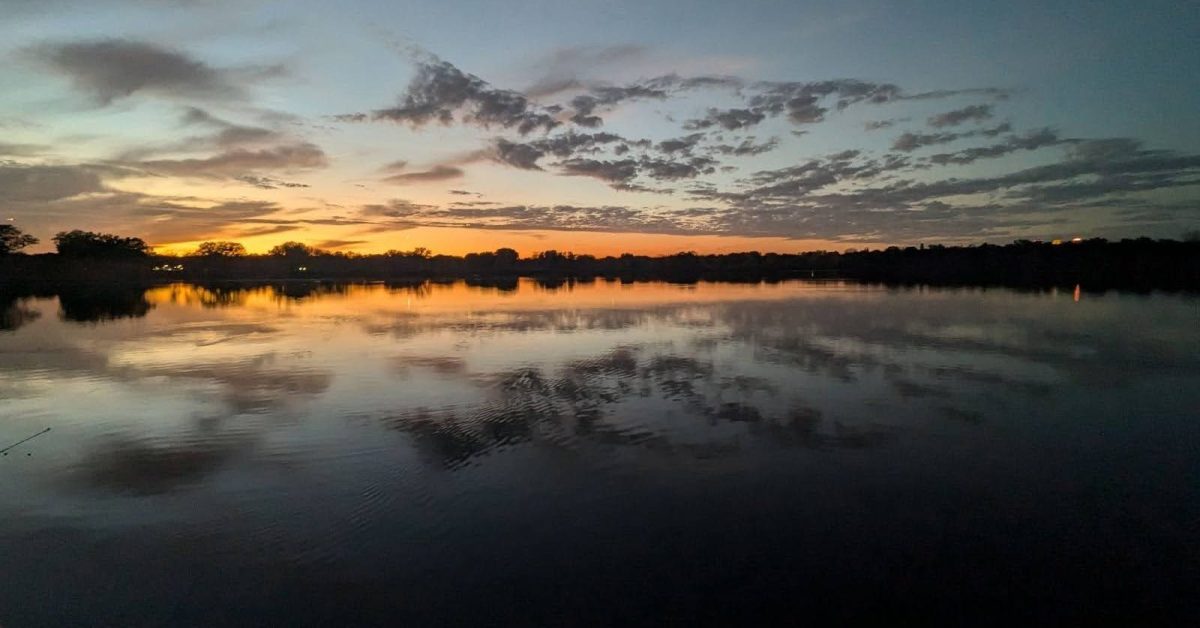
There’s a lake in south Minneapolis that used to be called Rice Lake, or in Dakota: Bde Psin (beh-Day Psheen). Because manoomin — Ojibwe for wild rice — grew there. Because Dakota people had harvested it for generations. Because the water was clean and shallow and productive in the way shallow prairie lakes are productive before someone decides they need improving.
Now it’s called Lake Hiawatha. That name came from Longfellow’s Song of Hiawatha, which was fashionable in the late 19th and early 20th century — the kind of sentimental Americana that let settlers give places Indigenous-sounding names while displacing the people and ecosystems those names gestured toward. Streets.mn contributor Max Hailperin, walking the neighborhood that carries the same name, references Kirsten Delegard when calling it plainly a “‘cult of Hiawatha’ that pervades this part of the city,” a habit of naming places after a fictional Indian in a way that was intended to make settlers feel better about living in the land of actual Native Americans. You rename a thing when you’ve decided the previous version of it is over.
What the settlers who named it probably didn’t dwell on is that in the poem itself, at Hiawatha’s wedding feast, the guests ate “the wild rice of the river.” Manoomin is right there in Longfellow’s text — a food of ceremony, of community, of the people whose names were borrowed to christen a lake from which that same food would soon be erased.
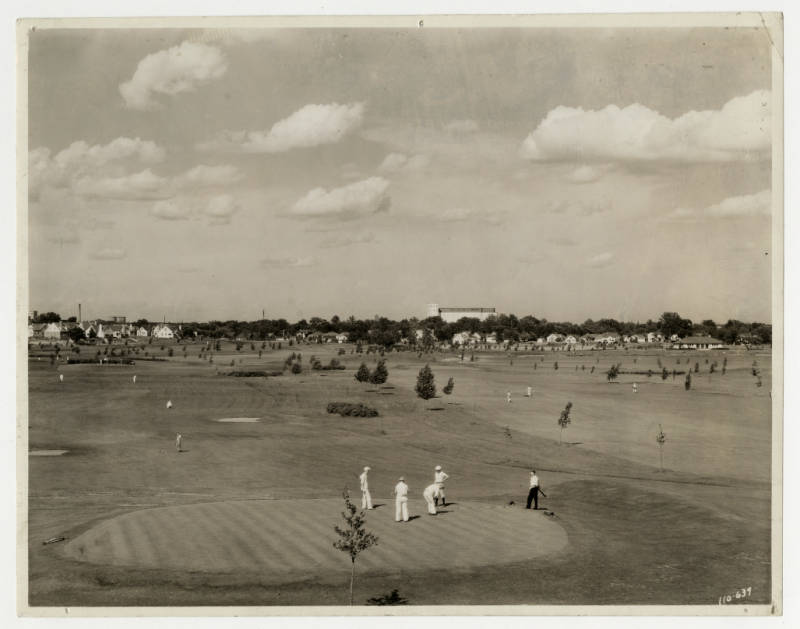
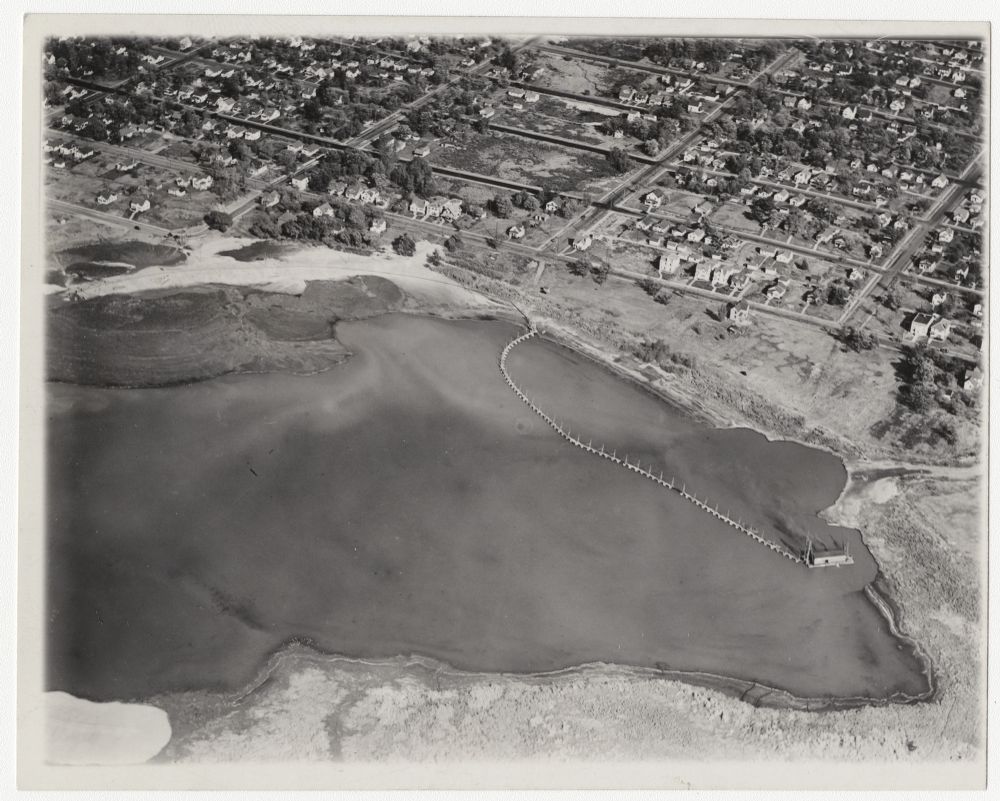
The renaming of Rice Lake followed the lake’s conversion to a park. The Minneapolis Park and Recreation Board (MPRB) purchased the surrounding land in 1922 for $550,000 and officially renamed it Lake Hiawatha on November 4, 1925. Dredging began in 1929. More than 1.2 million cubic yards were pulled from the lake bottom, the shoreline was walled in stone, Minnehaha Creek was straightened, and the dredge spoil was used to build rolling terrain for a golf course. Every tree, plant, and animal was displaced or destroyed. The wild rice was gone. The wetland filtration that had cleaned water moving toward the Mississippi was gone. The food source that had sustained people here for millennia was gone.
What replaced it was golf. Golf was enormously fashionable in the 1920s — the leisure activity of the rising middle class, the justification for turning a living wetland into a recreational amenity for people moving into the new neighborhoods of south Minneapolis. Park Board superintendent Theodore Wirth had called the lake “more attractive as a meadow than a swamp.” The local press dismissed the wild rice as a weedy slough. The logic was aesthetic, cultural, and colonial, dressed in the language of civic improvement. It was the vogue of the moment applied to a place that had been working fine for thousands of years without anyone’s help.
Longfellow’s poem ends with Hiawatha departing and urging his people to welcome the arriving missionaries — “the Black-Robe chief, the Pale-face.” The poem, beloved by the same civic boosters who were draining and renaming the lakes of south Minneapolis, closes with an instruction to yield. The Park Board read it as a landscaping aesthetic. It was always something closer to a blueprint.
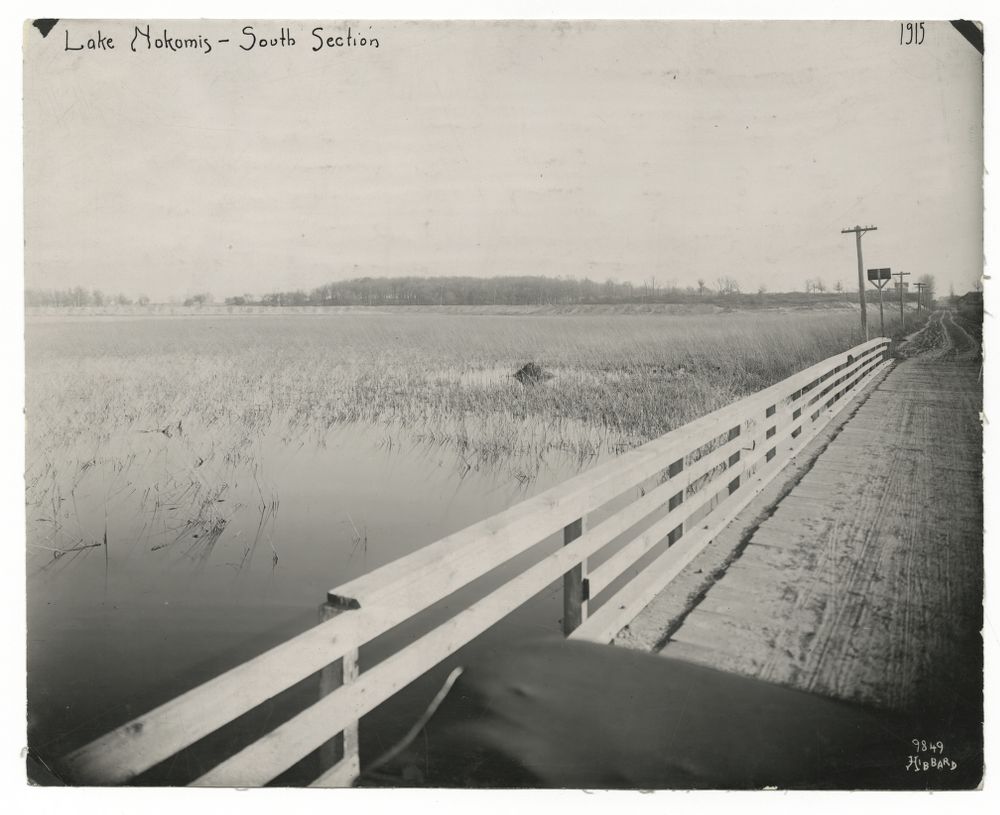
A few miles south, Lake Nokomis tells the same story. A photograph survives of wild rice growing there in 1915 — named, like Hiawatha, for a character in the poem. By the time dredging was completed in 1917, it was gone — the lake converted into a swimming amenity, its shallow productive margins scraped away in favor of something the era considered more suitable. The Park Board’s own superintendent Theodore Wirth, who oversaw both projects, had earlier proposed that Cedar Avenue be rerouted around Lake Nokomis because a bridge over the lake would be “very unsightly.” He had strong aesthetic opinions. Apparently a shallow wetland teeming with wild rice did not meet his standard.
We destroyed the solution to build the problem. Then we named it after a poem.
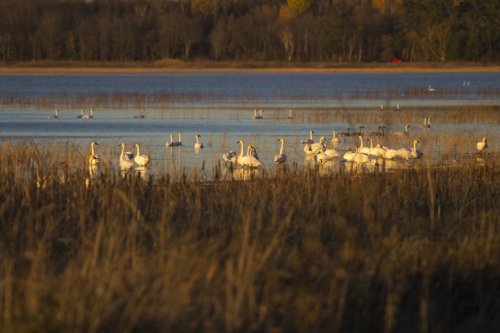
Right now at the Minnesota Legislature, the Wild Rice Act is asking the state to reckon with what that history means going forward. Its central proposal, introduced by Sen. Mary Kunesh (DFL-New Brighton), adds one sentence to the statute recognizing wild rice as Minnesota’s state grain: “It is the policy of this state to recognize the inherent right of uncultivated wild rice to exist and thrive in Minnesota.”
One sentence. A policy statement that makes manoomin the measure. The fight over whether to pass it tells you almost everything you need to know about how we’ve been relating to Minnesota’s water — and what it would mean to do that differently.
That sentence is better understood when we look at the ecological term “indicator species” — organisms whose presence or absence tells you something true about the health of an ecosystem. Manoomin is an indicator species. You can run a hundred water quality tests on a lake and build a detailed picture of its chemistry. Or you can ask whether manoomin is growing in it.
Wild rice is the indicator species of a healthy Minnesota waterway. It needs clean, shallow water. It won’t tolerate excess phosphorus or turbidity. It can’t be established in a lake that’s been dredged and walled and pumped for a century. When it’s present, something is working. When it’s gone, something went wrong — and probably went wrong a long time ago.
Transportation advocates have borrowed the idea. When women and children are biking on a road — not just fast-moving enthusiasts on a weekend, but kids going to school, older women running errands, people who have somewhere to be and didn’t feel like they were risking their life to get there — that’s how you know the street actually works. Not the bike count. Not the lane width. The presence of the most vulnerable, most risk-averse users is the honest measure.
The same underlying truth in both cases: The health of a system is measured by whether it supports the thing that belongs in it. Not the thing that was fashionable to put there, nor the thing that was profitable to build. The thing that thrives when the system is doing what it’s supposed to do.
Neither Lake Hiawatha nor Lake Nokomis has had its indicator species in over a century. What the Wild Rice Act is doing, in one sentence, is making that absence the official starting point for every decision about Minnesota water going forward.
I spent part of the March 15 blizzard making wild rice soup. Every part of making it feels like a familiar ritual — the way the grains split open in the broth, the nutty smell filling the kitchen while the wind throws itself against the windows. It feels like the right response to a late Minnesota winter doing what it does. It connects me to where I live. It has been a part of my winters and Minnesotan winters tracing back as far as anyone can remember.
If our regional story were a food we look to for comfort, it is wild rice soup.
I cherish these small Minnesotanisms. Wild rice on a cold night. Biking to a lake in July. Just as I want to see full trails, I want to see the kids and the dogs and the paddleboarders and the old men fishing from the same shoreline all at once. That’s ours, too. Last summer, the lake time was stolen by blue-green algae and smoke-filled skies. We can’t separate loving our lakes and our waterways from asking what the water is made of, what it used to be, and what we’re willing to do to keep it. As I wrote in an earlier piece on streets as third spaces, the places we share define us — and when one of those spaces is degraded, we feel it in ways we can’t always articulate right away.
Lake Hiawatha is listed by the Minnesota Pollution Control Agency (MPCA) as impaired for excess nutrients like phosphorus. A short trail ride south, the beach at Lake Nokomis — another lake where wild rice once grew, another lake converted into a swimming amenity — closes regularly from algae blooms fed by the same degraded watershed. In the poem, Hiawatha is sent to slay a magician who “breathes fever across the fen-lands.” The fever at Lake Hiawatha is cyanobacteria, and it closes the beach. We built it ourselves. The golf course at Hiawatha, built on peat that was never going to stop sinking, now requires pumping more than 240 million gallons of groundwater into the lake every year to keep the fairways playable — far beyond what the Park Board’s original Minnesota Department of Natural Resources (DNR) permit allowed — contributing an estimated 368 pounds of phosphorus annually to a system that can’t absorb it, according to the Barr Engineering study commissioned by the MPRB. The wetland that was killed to build the course is precisely what would have prevented most of this damage.
The 2022 master plan approved by the Minneapolis Park Board — on a 6-3 vote after years of contentious delay — would reduce the golf course to nine holes, reduce the groundwater pumping, restore some wetland function, and improve stormwater management. It is better than what has been. But it is still the status quo.
Notice how the argument for keeping golf there at all tends to get made: as preservation of green space, of community recreation, of a historic amenity. Golf courses get defended as green space constantly — across Minneapolis, across Minnesota, across the Midwest. And they are green in the narrowest chromatic sense. What a golf course is not is ecologically functional. It’s a monoculture maintained by pesticide application, mechanical management, and in this case a massive groundwater extraction operation that is actively degrading the lake beside it. Calling it green space because it isn’t a building is the same rhetorical move as calling a dredged, walled, pumped urban lake a natural amenity because it contains water.
The nine-hole compromise is where we are. Stopping the bleeding matters. But nobody is promising wild rice at Lake Hiawatha as the outcome of the reduced course plan, and we should be honest about what that means. The master plan is harm reduction. The Wild Rice Act is asking a more fundamental question: What are we actually building toward?
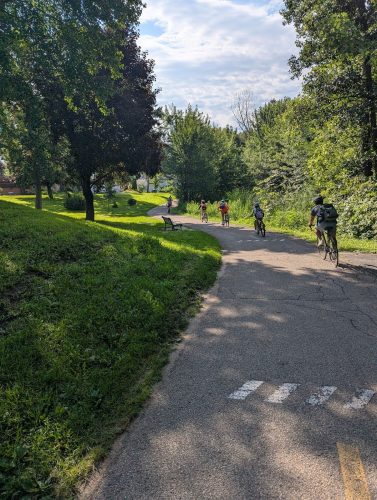
This pattern — the vogue of the present making permanent decisions for the future, wearing the costume of environmental responsibility — is not unique to the 1920s. It’s not unique to Minneapolis. It’s the consistent texture of how natural systems get degraded.
Longfellow’s Hiawatha clears the river for his people — “cleared its bed of root and sand-bar / made its passage safe and certain / made a pathway for the people.” The Park Board applied that same instinct to Minnehaha Creek. They straightened it, dredged it, walled it. They made a pathway for the people, all right. What they unmade was everything the people had been eating.
Across Minnesota and beyond, bikeways and transit lanes get blocked by opponents who’ve learned to position themselves as protectors of mature tree canopy and neighborhood character. The argument sounds ecological. The outcome lands on the side of the car. In St. Paul, opponents of the Summit Avenue bike trail wore green to City Council hearings — “for the trees” — while spreading what Streets.mn documented as misinformation about tree loss, since the trees in question were threatened by the underlying street reconstruction, not the bikeway. The trail was the actual target, or perhaps the types of people who use them. The environmental framing was just the available weapon. This happens in Minneapolis, in Richfield, in St. Paul, and in every city where people have learned that “save the trees” polls better than “save the parking.”
Golf courses continue to be defended as green space when they are expensive, ecologically destructive monocultures occupying land that could function as watersheds and storm sponge.
And right now, knowingly or not, the electrification of the automobile fleet and power grid is being used to justify copper-sulfide mining upstream of the Boundary Waters Canoe Area Wilderness — a water system that still, in places, grows manoomin. The argument sounds like it’s about the clean energy transition. The actual transaction, when you follow it, is a Chilean mining conglomerate proposing to extract from public land and send concentrate to Chinese smelters for processing. The environmental vocabulary doesn’t match the terms of the deal.
Each of these arguments finds the fashionable language of the moment and puts it in service of the same old logic: Natural systems are available for conversion, the indicator species can wait, the future will sort itself out. The people making these arguments are usually not the ones who will live with the consequences.
The Wild Rice Act is a direct refusal of that logic. Not because one sentence in a statute can undo a century of damage, but because it changes which question is being asked.
Right now, the default question about any Minnesota waterway is: What can we do with this? The burden of proof runs toward protection. To stop a project, someone has to demonstrate harm against a threshold that keeps getting calibrated in favor of the proposed use. The water is assumed available until proven otherwise, and “otherwise” is deliberately hard to establish.
The Wild Rice Act shifts that default. If the state has declared that uncultivated wild rice has an inherent right to exist and thrive, the burden moves. The question becomes: Is what you’re proposing compatible with that right? Does this serve the water, or extract from it?
State agencies have pushed back, calling the “inherent right” language too vague, noting that wild rice grows in boom-and-bust cycles and that a right to “thrive” would be hard to operationalize. These are procedural objections dressed in scientific precision. What they protect, in practice, is the status quo — the same asymmetry that can measure car delay to the second but treats a child’s inability to safely bike to school as too diffuse to quantify. The methodology consistently favors the existing use.
Leanna Goose of the Leech Lake Band of Ojibwe addressed this directly in testimony before the Senate committee: “If the Legislature and state agencies consider manoomin first, as should already be happening, then we can avoid that litigation altogether.” She also said “our relationship with the natural world is broken. We’re operating on broken systems of extraction that take and take and give nothing back.”
That sentence describes Bde Psin in 1929. It describes the structure of every similar argument since — the vogue of the present deployed to justify permanently diminishing what the future will need.
Annie Humphrey, also of the Leech Lake Band, testified with rice she’d harvested herself, passing it around to lawmakers who may not have tasted it before. “All we’re asking is that the wild rice beds and the water that surround them are protected,” she said. “We’re only trying to keep what’s left.”
Advocates for the bill testified that Minnesota has lost roughly a third of its wild rice watersheds in the last century, with annual losses continuing at an estimated five to seven percent. That loss is not a data point. It is a severing of a relationship that is thousands of years old, executed incrementally through decisions that each made sense to someone in their moment — dredge the swamp, build the course, call it green space, block the bikeway, mine the copper — and that collectively constitute a choice about whose future we are building for.
Our most precious state resource is clean fresh water. The kind that reflects back the sky. The kind that has always been core to who we are up here — that you bike to in July and jump into, that you watch freeze in November, that you make soup from in a snowstorm.
The Anishinaabe were drawn here by prophecy, following the food that grows on the water to the land of ten thousand lakes. The Dakota called it psíŋ and organized their lives around the shallow places where it grew. The rest of us showed up later, dredged those places, renamed them after fashionable poems, built golf courses on top of what we’d destroyed, drive our single-passenger electric trucks to unload a bundle of clubs, and are now pumping hundreds of millions of gallons of groundwater a year into a lake listed as impaired — trying to keep playable the thing we built on top of what we ruined.
Longfellow put the wild rice of the river at the wedding feast — at the center of the ceremony, the abundance, the life of the place. Then we took his poem’s name and gave it to the lake where that food had grown, after we’d erased the food from the water. We called it a tribute. It was a receipt.
The vogue of the 1920s made permanent decisions about what south Minneapolis lakes would be for the next hundred years. We are living in those decisions right now. The question the Wild Rice Act is asking is whether we’ll let the fashions of this decade do the same thing to what comes next.
When children bike to school without thinking about it, the street is working. When manoomin grows in the water, the water is working. We know what the indicator looks like when the system is healthy. We know what its absence means.
There’s a photograph of wild rice growing in Lake Nokomis in 1915. The lake is shallow and full and alive. Like nobody had named it after a poem yet. The food was just there, doing what it had always done, in the water that had always held it. That’s what we’re building toward. That’s the whole thing.